
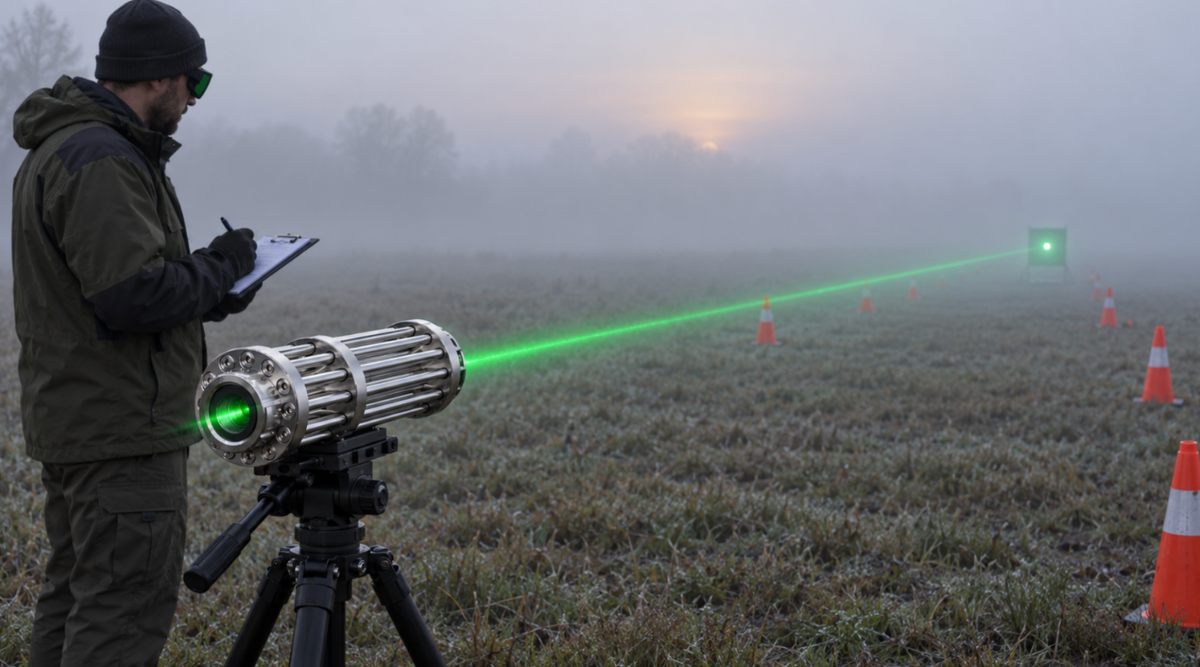
For outdoor use, green laser pointers clearly beat blue ones. The main reason is visibility. Green light at 532nm looks much brighter to your eyes than a blue beam of the same power, so it works better for daytime pointing and long-distance tasks.
When you compare blue vs green laser pointer options, think about several key differences. These include brightness, how well the beam shows in different conditions, safety ratings, battery life, cost, and what you plan to use it for. Green laser pointers do great in most outdoor situations. Blue laser pointers shine in special uses like night photography. Outdoor tactical lasers from trusted brands focus on high visibility and safety. Knowing these factors helps you pick the right handheld tool for your needs.
Key Takeaways
-
At equal measured output, 520nm and 532nm green generally appear brighter than 445nm and 450nm blue.
-
Bright daylight reduces the visibility of both colors; no handheld laser should be described as remaining clearly visible at any distance or in every outdoor condition.
-
Beam divergence, target reflectance, temperature, humidity, aerosols, ambient light, and viewing angle can matter as much as color.
-
A dimmer-looking blue laser is not automatically lower powered or safer than a brighter-looking green laser.
-
Protective eyewear must be selected for the actual wavelength and exposure conditions; no single OD rating suits every product.
-
Outdoor use must account for people, vehicles, aircraft, reflective surfaces, public areas, and local law.
Blue vs Green Laser Pointer Visibility

When you compare blue and green laser pointers for outdoor use, how well you see them is the most important thing. The human eye does not see all colors the same. A green laser at 532nm looks much brighter than a blue laser at 445nm when both have the same power. This difference affects every choice about which tool to take.
Why Green Is Brighter
Green has a substantial perceived-brightness advantage at equal optical output, but there is no single multiplier that applies to every comparison. The result changes depending on whether the products use 520nm or 532nm green, 445nm or 450nm blue, and whether the observer is in daylight, twilight, or darkness.
Product-level comparisons also require measured output, beam divergence, spot size, target surface, ambient light, distance, and viewing geometry. Informal forum observations should not be treated as universal conversion ratios between blue and green power.
Wavelength and Eye Sensitivity
The reason for this difference is in how our eyes work. Your eye has two types of light sensors that work in different light. Photopic vision works in daylight and peaks at about 555nm. Scotopic vision works in darkness and peaks near 507nm. A 532nm green laser is close to both peaks. So it triggers the strongest response from your eyes.
|
Vision condition |
Approximate sensitivity peak |
Practical relevance |
|
Photopic vision |
555nm |
Applies mainly under bright, light-adapted conditions |
|
Mesopic vision |
Between photopic and scotopic response |
Common around dusk and mixed outdoor lighting |
|
Scotopic vision |
507nm |
Applies mainly under dark-adapted conditions |
Both 520nm and 532nm lie closer to the eye’s peak sensitivity regions than 445nm or 450nm. However, a standard sensitivity curve does not by itself predict beam visibility, because divergence, background contrast, air conditions, and output also affect the result.
The Purkinje effect adds to this advantage. As light gets dimmer, your eye's peak sensitivity moves to shorter wavelengths. That actually helps green even more at twilight.
Beyond the sensors, your eye's parts filter light before it hits the retina. Ocular media also influence how much light reaches the retina, particularly toward the shorter-wavelength end of the visible spectrum. However, the amount varies with wavelength, age, and the model used, so simplified transmission percentages should not be treated as universal values.
Both 520nm and 532nm are relatively close to the 555nm photopic peak, but 532nm is numerically closer and generally has higher photopic luminous efficiency.
All these factors together explain why green laser pointers are best for outdoor use. Your eyes evolved to get the most information from green-yellow light. Laser makers use this biological fact. When you think about the differences between these colors, remember that how bright they look matters more than the power number. Green generally appears more visible per milliwatt, but that does not mean it inherently travels farther. The useful visible range of a laser depends on output, beam divergence, atmospheric attenuation, target reflectance, ambient light, and the observer’s position.
Outdoor Beam Visibility

When comparing the blue vs green laser pointer for outdoor use, you need to see how each one works in real life. A green laser keeps a strong visible beam where a blue one disappears. This section looks at how visible these two colors are. Laser pointers serve different needs based on how they perform.
Sunlight vs. Overcast Performance
Direct sunlight greatly reduces the contrast of both green and blue laser spots. Green may remain easier to locate than blue at equal output, but visibility cannot be guaranteed at a specific distance without controlled testing.
Any range claim should state the measured output, divergence, target material, distance, ambient illuminance, weather, and viewing angle.
Under cloudy skies, both lasers work better. But the green beam still has a clear edge. The scattered light from clouds makes the background more even. A green ray cuts through this light with clear visibility. A blue ray stays visible but takes much more focus to follow over distance.
The reason for this difference is in human biology. The eye's sensitivity to blue light at 450 nanometers is much lower than its sensitivity to green light. On the CIE luminosity curve, which shows how the eye sees different wavelengths, blue at 450 nm has a relative sensitivity of only about 0.04.
The human eye's sensitivity to blue light at 450 nanometers is significantly lower than to green light, with a relative sensitivity of only about 0.04 on the CIE luminosity curve. This means a blue laser would appear far dimmer than a green laser of equal power.
Background contrast also matters. A laser spot may be easier or harder to locate depending on the target’s color, brightness, texture, and reflectance. Outdoor visibility should therefore be tested against representative target surfaces rather than predicted from a simple color-wheel relationship.
Distance and Ambient Light Effects
Shorter wavelengths undergo stronger molecular Rayleigh scattering, so 450nm light experiences more molecular scattering than 532nm light under otherwise identical conditions. Real outdoor transmission, however, is also strongly affected by aerosols, haze, fog, humidity, precipitation, and beam divergence.
For that reason, a fixed attenuation percentage per kilometer should not be used without a defined atmospheric model and measurement conditions.
A 450 nm blue beam gets about 1.95 times more molecular Rayleigh scattering than a 532 nm green one. Many people think this higher scattering makes blue beams more visible. But that idea ignores eye sensitivity. Although 450nm light experiences stronger Rayleigh scattering, 532nm generally retains a substantial perceived-visibility advantage because the eye is much more sensitive to green. The exact difference should not be expressed as one universal multiplier.
Ambient light levels also affect performance. In low ambient light at dawn or dusk, the green beam becomes even more noticeable. The eye's scotopic vision peaks near 507 nm, very close to a 532 nm green wavelength. Blue at 445 nm falls far from both photopic and scotopic peaks. This means the blue laser needs much more darkness before it becomes visible.
For practical field work, these differences lead to a clear choice. A green laser offers reliable pointing capability across longer distances and more varied lighting conditions. For controlled outdoor applications, compare the minimum required output, product class, beam divergence, ambient conditions, and ability to maintain a secure beam path.
Laser Safety and Regulations
The choice between a blue and green laser pointer matters less than understanding hazard classes. Any Class 3B or Class 4 device can cause permanent eye damage. Safety must guide every buying decision for these tools.
Eye Hazard and Power Ratings
Government agencies set strict limits for devices sold to consumers. The FDA limits visible-light products to 5 milliwatts maximum (Class IIIa or IEC Class 3R). Class IIIb units cannot be legally sold as demonstration tools. These higher classes need a key switch, remote interlock connector, and warning labels.
|
Requirement |
U.S. FDA context |
|
Visible laser pointer limit |
No more than 5mW from 400–710nm |
|
Permitted pointer class |
Class IIIa or IEC Class 3R equivalent |
|
Class IIIb range |
Generally above 5mW and up to 500mW |
|
Class IIIb promotion |
Cannot legally be promoted as a laser pointer or amusement product |
|
Class IIIb controls |
Requires appropriate warning labels, key control and remote-interlock provisions |
|
Higher-class products |
Require professional applications, stronger controls and accurate documentation |
Nominal Ocular Hazard Distance cannot be determined from output power alone. It also depends on wavelength, beam diameter, divergence, exposure criteria, and the calculation method used.
Do not publish a fixed NOHD for a power category unless it has been calculated from the specifications of the exact product. Statements such as “injury is unlikely beyond a few dozen feet” may create a false sense of safety.
Blue Burning Laser Pointer Risks
The handheld blue laser pointer market, especially high-power blue lasers, sells units marketed as a blue burning laser pointer for special tasks. These devices run at watt-level power in Class 4 territory. They pose serious dangers to eyesight and property. Blue laser light at high power can damage the retina in milliseconds.
Cheap fakes with overstated specs flood online stores. Without proper certification, you cannot trust the power rating or know if safety features exist. When weighing blue vs green laser pointer choices, Green may require less optical output to achieve a similar visual impression, but apparent brightness should not be used to determine hazard. Eye risk depends on wavelength, actual output, beam characteristics, exposure duration, reflections, and laser class.
Battery Life and Efficiency
When you compare blue vs green laser pointer options for outdoor work, battery performance often decides which tool stays useful. Efficiency differences between the two wavelengths affect runtime, heat output, and how long your device lasts in the field. Understanding these trade-offs helps you choose a handheld tool that matches your usage patterns.
Green vs. Blue Efficiency
Green lasers at 532nm use DPSS technology. This design pumps an infrared diode through nonlinear crystals to produce green light. That conversion process wastes energy at every stage. You lose power through heat generation and optical losses inside the crystal assembly. A 532nm green laser typically converts only 10-20 percent of input electrical energy into visible light output.
Blue lasers at 445nm use direct diode technology. The diode emits blue light without wavelength conversion. This simpler path achieves higher electrical-to-optical efficiency, often reaching 20-30 percent. However, that raw efficiency advantage does not translate to practical superiority. Your eye perceives green as several times brighter than blue at equal power. A green laser needs far less optical output to deliver the same visible result.
Modern 520nm direct green diodes change the equation. These diodes emit green light directly without IR conversion crystals. They combine the efficiency of direct diode design with the visibility advantages of green wavelengths. Premium manufacturers like Hgyuskl now use 520nm diodes in their outdoor tactical lasers. Direct-diode 520nm designs may offer advantages in temperature stability and architectural simplicity, but lower current draw or lower operating temperature must be confirmed for the individual model. The wavelength alone does not prove that one product runs cooler or lasts longer.
|
Laser Type |
Technology |
Electrical Efficiency |
Visible Brightness per Watt |
|
532nm Green |
DPSS (IR-pumped crystals) |
10-20% |
Very high |
|
445nm Blue |
Direct diode |
20-30% |
Low |
|
520nm Green |
Direct diode |
20-30% |
High |
Runtime and Heat Management
A higher-output product will generally require more electrical input, but current consumption does not scale directly from perceived brightness. Runtime depends on optical output, diode efficiency, driver losses, battery voltage and capacity, temperature, and operating mode.
Heat presents a second challenge. High current draw generates waste heat inside the laser housing. Blue diodes running at high drive currents produce substantial thermal load. Without proper heat sinking, the diode degrades faster. Output power drops. The laser becomes unreliable over time.
Green DPSS units generate heat differently. The IR pump diode and conversion crystals each produce thermal losses. However, because green needs less total optical power for visible results, the overall heat burden often stays lower than a comparable blue unit. Modern 520nm direct green diodes run cooler still, since they skip the crystal conversion stage entirely.
For outdoor use, consider your typical session length. Astronomy sessions may run several hours. Bird control tasks might involve intermittent use across a full day. A green laser with efficient current draw lets you work longer between battery changes. That reliability matters when you are far from a power source. Always check the duty cycle rating before extended use. Following manufacturer guidelines protects both your laser and your safety.
Cost and Quality
Price often decides which laser you choose. Knowing what you get for your money helps you avoid letdown. How each color is made explains most of the price difference you see in stores.
Price Differences
Blue lasers use direct diode technology. Companies make these diodes in large numbers for many uses, like projectors and tools. That high amount of production lowers the cost per unit. You can get a good blue laser at a reasonable price without losing build quality.
Green lasers at 532nm work in a different way. They use DPSS technology, which pumps an infrared diode through nonlinear crystals to shift the wavelength. The conversion needs careful alignment and good parts. Each laser needs more work and tighter tolerances. These things increase the price you pay.
The link between cost and power changes. An expert comparison by Laser Components says that for outputs above 10 mW, 520nm green diode laser modules already cost less than 532nm DPSS modules. The simpler electronic control needs make the green diode the more cost-effective choice. This change matters when you decide what to buy.
Power Technology, a US company that makes laser modules, says that the 520nm diode laser module is a "cost-effective alternative" to DPSS green lasers at 532nm. This backs up the idea that diode-based modules cost less at similar power levels.
Market Trends and Quality
The market for handheld laser pointers has changed. Older 532nm green models still fill cheap store shelves, but their quality is all over the place. Many sellers claim high output numbers that never match real use. You cannot trust the label alone.
Top manufacturers now use 520nm direct green diodes. These parts combine the visibility benefits of green with the efficiency of direct diode design. They run cooler, use less power, and give steady output for a long time.
Hgyuskl lists 520nm green and 450nm blue models with aluminum housings and model-specific output options. Buyers should check the individual product page for its driver type, body material, duty cycle, measured output tolerance, safety controls, and operating documentation, because specifications may vary by model.
Best Use Cases for Each Color
Your planned use should guide your choice between these two wavelengths. Each color works best in certain settings. Knowing those strengths helps you pick the right handheld tool for your job.
Green for Stargazing and Daytime
Green lasers lead in astronomy for a biological reason. Your eye in the dark responds most strongly to green light near 507nm. Where permitted, a compliant visible green laser rated at no more than 5mW may provide sufficient visibility for identifying objects in the night sky. However, 5mW should not be described as risk-free.
Never direct the beam toward aircraft, people, vehicles, telescopes, binoculars, reflective surfaces, or an uncertain area of the sky. Astronomy venues may also impose rules that are stricter than the general product limit.
-
Recommended specification: Green laser pointers with about 5mW output, the Class 3A ceiling
-
Why green: Green light shows up best to a dark-adapted eye, so it needs very little brightness to be seen
-
Why 5mW: This level cannot burn materials, but eye risk still exists; it also follows most national laws
-
Safety context: Stronger Class 3B units (10–50mW) often get falsely labeled as 5mW and can irritate or harm eyes from the dot alone
That 5mW suggestion protects your night vision. Brighter beams make your pupils shrink, ruining dark adaptation for minutes. A mild green laser keeps your ability to see faint stars between pointing moments.
Daytime use follows the same idea. The strong visibility of green light cuts through bright backgrounds where other colors disappear. Hgyuskl builds its outdoor tactical lasers with 520nm direct green diodes and aviation aluminum bodies. For controlled outdoor work, verify the product’s legal classification, weather resistance, temperature range, duty cycle, access controls, and ability to maintain a secure beam path.
When a Blue Wavelength May Be Relevant
A 445nm or 450nm source can excite fluorescence in some materials, coatings, pigments, and biological samples. The effect is material-specific and should not be generalized to all minerals or biological substances.
Underwater transmission depends on wavelength, water composition, turbidity, suspended particles, beam divergence, and path length. Although blue wavelengths can have relatively low absorption in clear water, increased scattering and real-world water conditions may substantially change performance.
Handheld high-power lasers should not be recommended for casual pool demonstrations, water activities, or uncontrolled photography. Purpose-built, enclosed or professionally controlled lighting equipment is more appropriate for these applications.
The blue vs green laser pointer decision comes down to your primary use case. At equal measured optical output, green generally provides greater perceived outdoor visibility than blue. However, this does not guarantee longer range, better battery life, or lower risk. Those factors depend on the exact wavelength, power, divergence, diode architecture, driver, battery, temperature, duty cycle, and laser class.
Choose a laser by starting with the minimum output and legal classification required for a legitimate application. Then compare visibility, operating conditions, beam control, safety features, and documentation. Do not choose a higher-powered blue laser merely to match the apparent brightness of green.
FAQ
Which laser color works best outdoors?
At equal measured optical output, green generally appears brighter outdoors because human vision is more sensitive to 520nm and 532nm than to 445nm and 450nm. Actual visibility still depends on ambient light, divergence, target surface, weather, distance, and viewing angle.
What safety practices protect you during laser use?
Control the beam path, keep the device away from unauthorized users, avoid people, animals, vehicles, aircraft and reflective surfaces, and follow the product’s laser-class requirements. Protective eyewear is only one part of a complete safety system.
How do you select proper laser eyewear?
Protective eyewear must cover the actual emission wavelength and provide an optical density appropriate for the product’s output and calculated exposure conditions. A generic OD4+ recommendation is not sufficient for every 445nm, 450nm, 520nm, or 532nm laser.
Can laser pointers aid education and physics demonstrations?
Low-power, compliant laser products can support controlled optics demonstrations. Class 3B and Class 4 handheld lasers should not be used as ordinary classroom pointers. Educational settings should follow institutional procedures and applicable laser-safety standards.
Why does each wavelength need different eyewear?
Eyewear must be rated for every wavelength the user may encounter. Some certified lenses cover multiple wavelength bands, while others protect only a narrow range. Check the stated wavelength coverage and optical density rather than assuming that every color requires a completely separate pair.
Share:
450nm Blue Laser Pointer: How Bright Is It?
High-Power Blue Lasers: Why More Power Is Not Always Better