
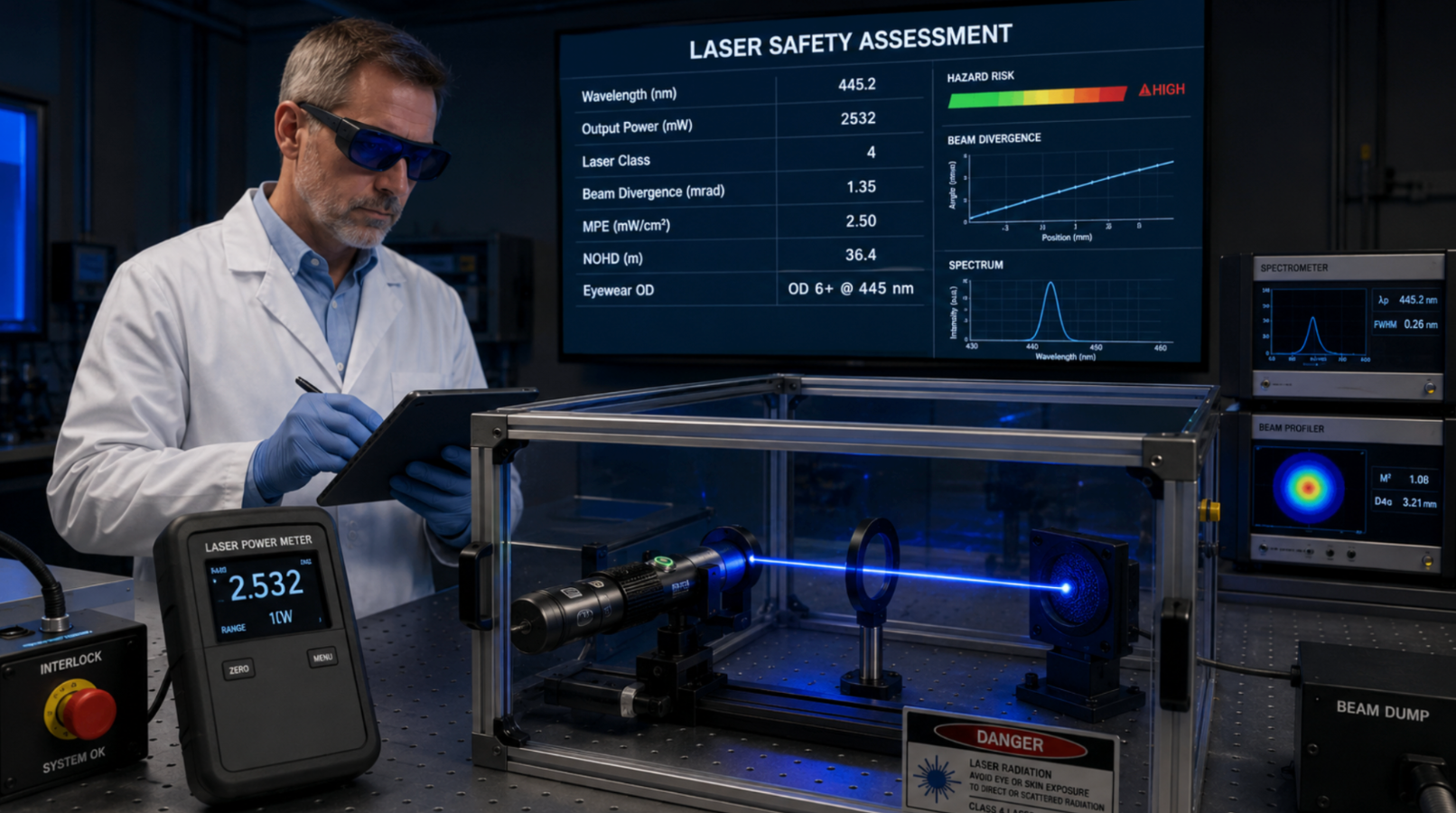
In the United States, visible laser products promoted for pointing or demonstration purposes are limited by FDA regulation to Class IIIa / IEC Class 3R, up to 5mW. Products above 5mW may fall into higher hazard classes and should not be marketed as ordinary laser pointers or demonstration products.
High-output blue laser products in the 1W, 3W, or 5W range are therefore in a completely different hazard category from ordinary presentation pointers.
Blue laser pointers emitting at 445–450 nm present severe hazards. High-power lasers deliver high photon energy that causes instant retinal damage to your eye before your blink reflex reacts. Operating a high power blue laser pointer requires special safety gear. Whether using a portable blue laser pointer or Long-distance high-power lasers, checking real laser power protects you from direct beam hazards.
Key Takeaways
-
In the United States, visible products promoted for pointing or demonstration are limited to Class IIIa / IEC Class 3R, up to 5mW.
-
A 1W blue laser equals 1,000mW, making it hundreds of times more powerful than a 5mW pointer.
-
High-output blue lasers can fall into Class 4 and can present direct-beam, reflection, skin, and fire hazards.
-
Wattage does not tell you everything about visibility or risk; wavelength, divergence, beam diameter, distance, and exposure time also matter.
-
Duty cycle, heat sinking, safety locks, labels, and suitable eyewear should be evaluated model by model.
-
Do not choose a high-output blue laser based on burning, range, or maximum wattage claims alone.
Legal Limits and Laser Safety

FDA Regulations and Classifications
Federal rules separate normal laser tools from high-power devices. The United States Food and Drug Administration sets power limits under 21 CFR 1040. Global rules follow IEC 60825-1 guidelines. A handheld laser pointer must not go over 5 mW. Stronger units belong to Class 3B or Class 4.
|
Class |
Approximate Visible CW Output Context |
What It Means |
|
Class 2 |
up to about 1mW |
Lower-output visible laser; deliberate eye exposure should still be avoided |
|
Class 3R / FDA IIIa |
up to 5mW for visible pointing/demonstration products |
Not risk-free |
|
Class 3B / FDA IIIb |
>5mW to 500mW |
Serious direct-eye hazard; not ordinary pointer use |
|
Class 4 |
Above Class 3B limits |
Direct/reflected eye and skin hazards; fire hazard may exist |
Class 3B laser tools limit steady visible beam power to 0.5 W. Class 4 devices go above Class 3B safety limits. You need to check fda compliance before buying high-power gear.
Under federal rules, makers of dangerous light sources must follow strict safety steps.
-
Single boxed safety tag showing the word DANGER plus full laser class details
-
Permanent exit window tag placed right where the beam shoots out
-
Power info tag showing beam color length and power output rating
-
Clear warning tags attached to protective safety interlock covers
Class 4 tools cause serious safety risks. A direct beam causes permanent eye damage faster than you can blink. These powerful lasers also cause dangerous wall reflections and fire risks. You must follow all legal safety steps while using these tools.
Ocular Hazard Distances and NOHD
Nominal Ocular Hazard Distance (NOHD) is a calculated safety parameter used to estimate the distance at which direct-beam exposure may fall below a specified maximum permissible exposure under defined assumptions.
It should not be interpreted as a distance beyond which it is acceptable to stare into a laser beam. Actual risk depends on the laser, beam geometry, exposure duration, optics, and operating environment.
Making beam power 100 times stronger makes hazard distances 10 times longer. For example, jumping from 5 mW to 500 mW increases danger distance by 10 times. Color does not change this square-root math rule.
Class 4 lasers running over 500 mW create strong light energy. This energy causes fast heat burns on skin and dark cloth. People must follow all safety rules to avoid accidental hits from strong beams.
High Power Blue Laser Pointer Specs
Diode Physics and Photon Energy
Modern high power blue laser pointer devices use direct-diode technology to shoot light across the 445–450 nm wavelength spectrum. A 445–450nm photon has more energy than a longer-wavelength infrared photon, but a watt is still a watt. Laser hazard cannot be inferred from photon energy alone. This packed beam creates amazing visibility during both the day and night. Hgyuskl builds every handheld tool to deliver true power output without using fake wattage claims common in online stores.
Thermal Management and Duty Cycles
High-output blue laser diodes generate significant heat. Duty cycle depends on the specific diode, driver, housing, heat sink, ambient temperature, and output power.
Buyers should follow the manufacturer’s stated run/rest cycle rather than applying one generic rule to every 1W, 3W, or 5W model.
|
Spec |
What to Check |
|
Output |
Rated optical power |
|
Duty cycle |
Manufacturer-specific run/rest guidance |
|
Housing |
Heat-dissipation design |
|
Driver |
APC / constant-current characteristics |
|
Battery |
Required voltage/current/cell type |
|
Safety lock |
Key switch or other lockout |
|
Focus |
Fixed or adjustable |
|
Divergence |
Product-specific |
You must follow exact duty cycles when using a handheld laser pointer that lacks active cooling fans. Pausing the laser diode after short uses keeps the power from dropping down. Built-in safety locks like real key switches stop the unit from turning on accidentally during transport.
Essential Safety Equipment for Blue Laser Pointer Use

Higher-class lasers may require layered safety controls depending on the product and workplace. These may include access control, key switches, beam stops, warning signs, interlocks, written procedures, training, and wavelength-appropriate eyewear.
Requirements depend on the product, jurisdiction, and use environment.
Diffuse Reflections and Fire Prevention
Class 4 lasers can present hazards not only from the direct beam and mirror-like reflections, but in some cases from diffuse reflections as well. The risk depends on output, spot size, surface properties, distance, and exposure duration.
Higher-output Class 4 lasers may present fire hazards around combustible materials. Keep the beam path controlled and away from flammable materials.
Always maintain a clean, non-flammable workspace by keeping combustible materials at least 1 m away from the active optical beam path.
Verifying True Laser Pointer Power Output
Deceptive Wattage Claims vs. Real Output
Advertised wattage does not always match measured optical output. Some online laser products may be mislabeled, overpowered, or missing required safety information.
Buyers should check the stated wavelength, optical output, laser class, warning labels, manufacturer information, and documentation rather than judging a product by the largest wattage claim alone.
|
Red Flag |
Why It Matters |
|
Missing wavelength |
Buyer cannot verify color/spec |
|
Missing output power |
Hazard level unclear |
|
Missing laser class |
Safety classification unclear |
|
Contradictory mW/W claims |
Specification may be unreliable |
|
No manufacturer information |
Harder to verify compliance |
|
“Pointer” marketed at multi-watt output |
Conflicts with U.S. pointer/demonstration limits |
|
No warning labels/manual |
Major safety concern |
Calibrated Power Meter Testing Methods
You need special testing tools to measure true light output strength with complete accuracy. Sellers might mark a blue laser pointer at 3.5 W, 5.6 W, 8 W, or 10 W. Real optical testing often shows lower output levels like 3.3 W, 5.4 W, 7.4 W, or 8 W. A thermal power meter tracks steady beam force over time to check safety rules.
Optical output should be verified using calibrated equipment by qualified personnel. Buyers should not infer wattage from burning ability, brightness, battery drain, or informal home tests.
The dark sensor pad changes bright beam energy straight into heat for quick testing. Special sensor wires turn this warmth shift into a clear voltage reading on your screen. This careful test shows real beam strength to ensure every device follows clear safety standards.
Federal laws set strict safety limits that cap home laser pointers at 5 mW. Still, powerful Class 4 models easily beat these normal limits. Dense 445 nm beams carry 2.5 times more photon energy density than infrared light. Eye protection must be selected for the wavelength and calculated hazard level, and it does not replace engineering controls, safe beam paths, labels, training, or legal compliance.
High-output blue lasers should be evaluated by more than wattage. A 1W, 3W, or 5W rating places the product far above an ordinary presentation pointer in both output and hazard potential.
When comparing Hgyuskl models or any other high-output blue laser product, check wavelength, measured optical output, laser class, duty cycle, beam divergence, battery specification, focus design, safety lock, warning labels, and eyewear requirements. Do not choose by maximum wattage, burning claims, or advertised distance alone.
FAQ
What makes a blue laser pointer more hazardous than a red one?
A blue laser is not automatically more hazardous than a red laser simply because of its color. Hazard depends on output power, wavelength, exposure duration, beam diameter, divergence, and how the beam reaches the eye. Many consumer blue products happen to be sold at much higher output levels, which is why they can present much greater risk.
How does beam visibility differ between blue and green light?
Green light generally appears brighter to human eyes at equal optical output, while blue beams can still become visible in dark conditions depending on output, scattering, divergence, and viewing angle.
Why do high-power handheld devices require strict duty cycles?
High-output diodes generate significant heat. The correct duty cycle depends on the diode, driver, housing, heatsink, output level, and ambient temperature. Follow the specific model instructions rather than applying one generic duty cycle.
Are high-wattage laser products legal to use outdoors?
Laws depend on the product, location, intended use, and jurisdiction. In the United States, products above the FDA pointer/demonstration limit should not be treated as ordinary laser pointers. Outdoor use also creates aviation and public-safety concerns. Never direct any laser toward aircraft, flight paths, vehicles, people, or public areas, and check applicable federal, state, and local rules before use.
Share:
How to Read Laser Pointer Specifications: nm, mW, Class, Battery, and Focus
High Power Green Laser Pointer Buying Guide: What Should You Check First?