
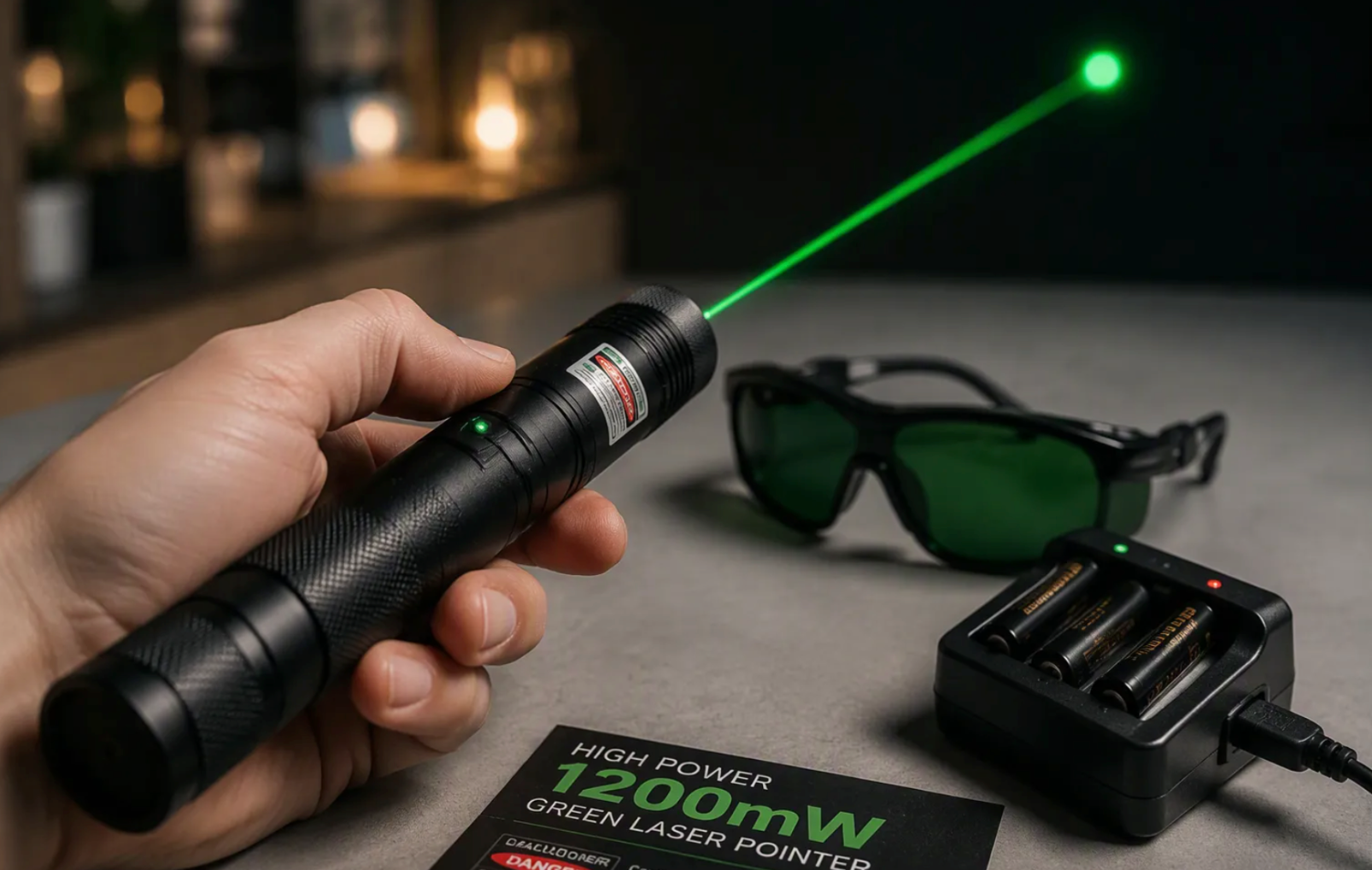
A high power green laser pointer should not be judged by the largest wattage number in the product title. Buyers should first check the stated optical output, wavelength, laser class, safety labels, and whether the product information is consistent.
Some laser products sold online may be mislabeled, overpowered, or missing required safety information. For higher-output products, clear specifications and documentation matter more than bold brightness or range claims.
This buying guide explains what to check first when comparing 520nm and 532nm high-output green laser products.
Key Takeaways
-
Check whether the advertised optical output is supported by clear specifications or credible measurement documentation; do not judge the product by wattage claims alone.
-
Look for laser class, warning labels, safety locks, battery specifications, duty-cycle guidance, and safe-use instructions.
-
Check the applicable laws and product restrictions in your country before ordering or using a higher-output laser.
-
For 532nm DPSS products, check whether the manufacturer addresses IR filtering.
-
Do not choose a high-power green laser based only on maximum brightness, range, or wattage.
Understanding High Power Green Lasers
Defining "High Power" and Common Uses
When you read a guide about buying high power green laser pointers, the first thing to learn is what "high power" really means. “High power” is a marketing term, not a formal laser safety class. The more useful specification is the actual optical output together with the laser class.
In the United States, visible laser products promoted for pointing or demonstration are limited to Class IIIa / IEC Class 3R, up to 5mW. Products from 5mW to 500mW fall into Class IIIb / IEC Class 3B and should not be treated as ordinary pointers.
Common uses show this power. Higher-output green lasers may be sold for specialized or professional applications, but buyers should not infer intended use from wattage alone. Check the product classification, documentation, and intended-use statement before purchase.
Why Green Lasers Are So Popular
Green wavelengths are popular because human vision is relatively sensitive in the green portion of the visible spectrum. This means a green beam can appear brighter than a red or blue beam at the same optical output.
Perceived brightness should not be confused with optical power or safety. A visually bright beam is not necessarily more powerful, and a visually dimmer blue laser may still have very high output. This color stays the most popular choice for these tools.
High Power Laser Pointer: Key Specifications to Evaluate
When you check a high power green laser pointer buying guide, two specs matter most: wavelength and real output power. These two things separate good products from overhyped letdowns. Many buyers only look at brightness, but the tech inside and honest power numbers show true performance.
Wavelength and Its Impact on Visibility
The wavelength of a green laser pointer changes how bright the beam looks. Most green laser pointers use 532nm light. This wavelength sits close to where the human eye is most sensitive. At equal optical output, 532nm green generally appears substantially brighter than 450nm blue or 650nm red because it lies closer to peak photopic sensitivity.
Still, 520nm direct diode options give different perks. They look a bit less vivid than 532nm beams, but they offer better stability and efficiency. The table below shows the key differences.
|
Feature |
520nm Direct Diode |
532nm DPSS |
|
Light generation |
Direct semiconductor emission |
Infrared pump + frequency doubling |
|
Perceived color |
Deeper green |
Yellow-green |
|
Perceived brightness |
High |
Often somewhat higher at equal output |
|
Temperature behavior |
Often more stable |
Often more temperature-sensitive |
|
IR leakage concern |
Generally not the same DPSS issue |
IR filtering is important |
|
Beam profile |
Product-specific |
Product-specific |
|
Efficiency |
Depends on diode/driver |
Depends on DPSS design |
|
Buyer takeaway |
Good when temperature stability matters |
Good when perceived brightness and beam quality are priorities |
For long-term reliability, the 520nm option often wins. DPSS models can lose brightness as crystals wear down. Direct diode models keep their output steady.
Real Power vs. Marketing Claims
Advertised output does not always match actual optical output. Some online products may be mislabeled, overpowered, or missing required safety information.
Buyers should look for clearly stated wavelength, optical output, laser class, warning labels, manufacturer information, and credible technical documentation. If measured-output data are provided, the measurement method should also be clear.
The Technology Behind the Beam

DPSS Lasers: Pros and Cons
Older green laser pointers use a method called Diode-Pumped Solid-State (DPSS). This system starts with an infrared pump diode that excites a crystal. The crystal then creates green light through a process called frequency doubling. It works, but there are real downsides to know before you buy.
DPSS modules turn only about 20% of the power they use into visible green light. Some designs hit 35% efficiency, but that still means a lot of energy becomes heat. That heat causes the biggest problem: sensitivity to temperature. Early DPSS modules worked well only between 10°C and 30°C. Outside that range, you might see mode hopping or big swings in output power. Newer versions handle -5°C to +50°C, which helps, but the issue remains.
|
Aspect |
DPSS Performance |
|
Efficiency |
20% typical, up to 35% in optimized designs |
|
Temperature Range |
Early: 10°C–30°C; Current: -5°C to +50°C |
|
Power Stability |
Fluctuates with heat; needs complex electronics to stabilize below 5% |
|
Durability |
Crystals degrade over time, reducing brightness |
520nm Direct Diode: What Buyers Should Know
520nm direct-diode lasers generate green light directly from a semiconductor diode. They often offer simpler optical architecture and better temperature stability than traditional 532nm DPSS systems.
Actual output stability, beam profile, efficiency, and lifetime still depend on the specific diode, driver, optics, housing, and thermal design.
Safety and Legal Checklist for Buyers

Before you buy any high-power laser pointer, check two things: safety features and legal rules. These keep you safe and out of trouble. Many people skip this step and regret it later. Ignoring these checks can hurt your eyes or even break the law.
Verifying Safety Features and Certifications
Higher-class laser products may require additional safety features depending on their classification and design. Buyers should check for clearly documented access controls such as key switches or safety locks where applicable, along with warning labels, aperture information, emission indicators, and operating instructions.
Units missing these parts often lack proper paperwork. Selling them is against the law. You should also check the safety class label. Class IIIa lasers stay under 5mW. Anything above that is Class IIIb or IV. These classes have higher risks and stricter rules. The safety class tells you exactly what you are handling.
Navigating Legal Power Limits and Regulations
In the United States, visible products promoted for pointing or demonstration are limited to Class IIIa / IEC Class 3R, up to 5mW. Products above that output fall into higher hazard classifications and are subject to different product, labeling, marketing, and use requirements.
Do not assume that a higher-output product is legal for ordinary pointing simply because it is available online. Laws also vary by state, locality, intended use, and product type.
These legal restrictions exist for good reason. A high-power beam can damage eyes instantly. It can also distract pilots and cause accidents. The incident data proves this danger. You should never ignore these rules. Even a brief flash into a cockpit can blind a pilot during landing.
Your buying criteria should include both safety and legality. A product with real power but no safety features is dangerous. A product with safety features but illegal power is risky. Only products that meet both standards deserve your money. These criteria form your final checklist before purchase.
Take time to research your local regulations. Contact the seller about certifications. Ask for documentation. A reputable brand will provide this information freely. If a seller avoids these questions, walk away. Your safety depends on these checks. Your legal standing depends on them too.
Spotting Reliable Sellers and Verifying Power
Red Flags in Product Listings and Reviews
Many sellers hide key facts about their products. You need to catch these warning signs before you buy. Do not look for vague claims such as “FDA approved.” Instead, check whether the product carries the required certification and identification information, including the manufacturer or distributor, class, output information, warning labels, and applicable compliance statement.
For products above 5 mW (Class IIIb), FDA approval demands specific safety parts. These include a key lock, a mechanical aperture shutter, a clear safety label, a removable safety pin, and a 5-second firing delay. If any of these parts are missing, that is a clear warning sign. The device is not dependable.
Reliable sellers share accurate specs. They provide exact wavelength and power ratings. They avoid misleading labels like claiming "<5 mW" while the device emits over 20 mW. For 532nm DPSS products, ask whether the design addresses residual infrared leakage from the internal 808nm and 1064nm stages. Proper IR filtering can reduce invisible leakage, but it does not make the visible 532nm beam safe.
The Importance of a Laser Power Meter Test
You cannot trust the numbers on the box. The only way to know real output is a power meter test. This device measures the actual milliwatts your tool delivers. Without this test, you have no way to verify the product.
The clinical study confirmed this problem. The real output power varied by as much as a hundred times from the label. Devices advertised as 5 mW actually exceeded limits or degraded quickly. Some buyers unknowingly purchased Class IV devices. This means the power output was not accurately disclosed. A power meter reveals the truth.
Output verification should be performed with appropriate calibrated equipment by qualified personnel. Ordinary buyers should not use informal brightness, burning, camera, or DIY tests to estimate wattage.
Brands that provide real-output specifications stand out. They use premium materials like aviation aluminum casings. They include certified power readings with their products. These brands give you the confidence that your purchase matches your expectations. Your criteria for a good purchase should include verified power output. Without this verification, you risk wasting money on a weak product.
Laser Pointers for Different Applications
Lab and Industrial Use Cases
Lab work needs stable output and long use cycles. You need a laser that keeps steady power during long testing sessions. Temperature changes should not cause mode hopping or brightness shifts. Direct diode tech works well here because it resists heat drift.
Industrial uses need repeatable performance. You need a tool that gives the same output each time you turn it on. This consistency matters for calibration and measurement tasks. A laser with certified real-output specs gives you trust in your results.
You should check power output before trusting any device. A DIY test using your smartphone works well. The table below shows the equipment you need.
|
Equipment / Item |
Cost (USD) |
Purpose / Specification |
|
Smartphone (iPhone 12+ or Pixel 4+) |
$0 (already owned) |
CMOS sensor with linear response; RAW capture capability |
|
Printed ISO 11553-1 target grid |
$0 (print at home) |
Matte white paper, 80 g/m²; concentric circles for beam diameter calibration |
|
ImageJ (Fiji) + Laser Power Estimator plugin |
$0 (open-source) |
Spectral analysis; pixel-to-mW conversion factor: 1 pixel = 0.000142 mW/mm² |
|
Open Camera (Android) or Halide (iOS) |
$0 (free/notarized) |
Manual exposure lock (1/1000s, ISO 100, infinity focus) |
|
Schott BG40 bandpass filter |
$14.95 (optional) |
OD4 at 1064 nm, T>85% at 532 nm; eliminates IR leakage that inflates readings by 22–47% |
|
Tripod or books |
$0 |
Rigid mount at exactly 30 cm from target |
This method gets ±0.15 mW uncertainty compared to NIST-traceable references. It avoids the heat drift errors of consumer meters, which show ±25% error at 532 nm. You can finish the test in about 82 seconds instead of 47 minutes. This check makes sure your laser pointers give the performance you paid for.
Why Maximum Power Should Not Be Your First Buying Criterion
532nm DPSS: What Buyers Should Know
532nm green lasers typically use an infrared pump stage and frequency-doubling optics to create visible green light. This architecture can produce a highly visible beam, but performance may be more sensitive to temperature and optical alignment than direct-diode designs.
Because DPSS systems use infrared wavelengths internally, buyers should also check whether the product includes appropriate IR filtering and documentation.
Balancing Budget, Quality, and Features
The most powerful laser pointer is not always the best value. Your checklist should include real power, safety certs, and legality first. Many buyers chase raw power and skip these factors. This leads to wasted money on unsafe or illegal products.
A checklist before buying helps you make smart choices. Check the real output power with a meter test. Look for proper safety features like a key switch and aperture shutter. Make sure the device meets your local legal limits. Check the build quality. Premium materials like aviation aluminum last longer than cheap plastic cases.
Higher quality products often cost more upfront. But they save you money over time. A well-built device with standard replaceable batteries lasts for years. A cheap unit might fail in months. Focus your budget on verified specs and solid construction. This approach gives you a reliable tool that fits your activity.
Your final choices should balance all these factors. The most powerful laser pointer in your hands means nothing if you cannot use it safely. This high power green laser pointer buying guide gives you a framework for picking laser pointers. Use these same criteria for all laser pointers you consider. Trust verified specs over marketing claims. Choose a product that fits your activity and your budget.
Your high power green laser pointer buying guide ends with three checks: verified power, safety, and law. The most powerful laser pointer means nothing without these checks. Trust brands like Hgyuskl that reject fake specs. Use your checklist before buying. Smart decisions protect your eyes and wallet. Use your green laser responsibly. For more questions, check the FAQ below.
FAQ
How can I tell whether a high-power green laser specification is credible?
Look for clearly stated wavelength, optical output, laser class, manufacturer information, warning labels, and credible technical documentation. Accurate output verification requires appropriate calibrated measurement equipment.
What is the difference between 532nm and 520nm green lasers?
532nm DPSS often appears somewhat brighter at equal output, while 520nm direct-diode designs are often more temperature-stable. Actual beam quality and efficiency depend on the specific product.
What safety features should a high-power laser include?
Depending on the product class and design, useful safety features may include a key switch or lockout, emission indicator, aperture warning, clear class/output labels, and operating instructions. These features reduce risk but do not make direct exposure safe.
Share:
High power blue laser pointer wattage specs and safety limits
High Power Green Laser Pointer: What Makes a Laser Truly High Power?