
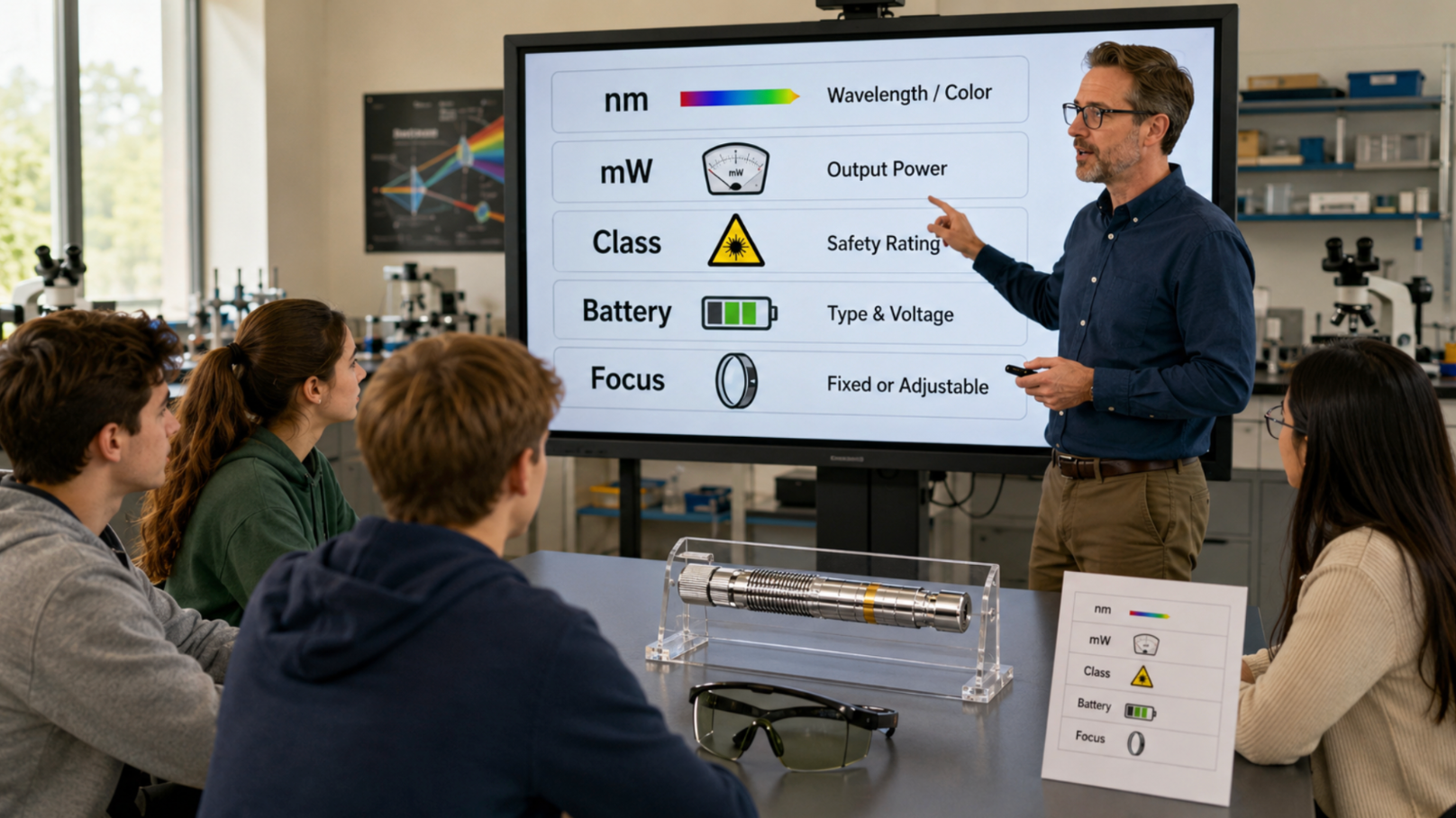
You must check device packaging closely to find real product details. Learning true laser pointer specifications keeps you within the law, protects your eyes, and ensures top performance. Many cheap sellers knowingly boost their actual mW output numbers on basic spec sheets.
|
Spec |
What It Means |
Why Buyers Should Care |
|
nm |
Wavelength |
Determines color and influences perceived visibility |
|
mW / W |
Optical output power |
Major factor in hazard level |
|
Class |
Laser hazard classification |
Helps identify safety requirements |
|
Battery |
Power source |
Affects runtime and compatibility |
|
Focus |
Fixed or adjustable optics |
Changes spot and beam behavior |
|
Divergence |
Beam spread, often in mrad |
Affects spot size over distance |
|
Duty cycle |
Recommended run/rest time |
Important for heat management |
|
Driver |
Current/output control circuit |
Affects output stability |
|
Safety lock |
Physical access control |
Helps reduce accidental activation |
Wavelength tells you the color, but color alone does not determine power, range, or safety. A 450nm blue laser can be lower or higher power, just as a 520nm green or 650nm red laser can fall into different hazard classes.
Always read wavelength together with output power and laser class.
Key Takeaways
-
nm identifies wavelength and therefore the visible color of the laser.
-
mW or W describes optical output power; higher output generally means greater hazard potential.
-
Laser class is a hazard classification, not a quality score. Class 3R is not automatically “safe.”
-
Battery voltage and chemistry must match the product design; physical fit alone does not prove compatibility.
-
Focus and divergence describe beam behavior, not total laser power.
-
APC or constant-current drivers can improve output stability, but they do not remove thermal limits or safety risks.
-
Buyers should check labels, output power, class, wavelength, and manufacturer documentation together.
Understanding Wavelength and Color Spectrum

Wavelength Ratings in Nanometers
Nanometers measure the length of light waves that human eyes can see. This number determines the exact beam color you see when using the device outdoors. Smaller numbers move light toward violet, while larger numbers shift it toward red. You will see these standard nanometer categories listed on laser packaging.
|
Color |
Wavelength(s) |
|
Red |
638 nm, 650 nm, 670 nm |
|
Green |
532 nm, 515/520 nm |
|
Blue |
450 nm, 473 nm, 488 nm |
|
Violet |
405 nm |
Shorter wavelengths generally scatter more strongly in the atmosphere than longer wavelengths. This can influence how visible a beam appears from the side, but it does not by itself determine the laser’s physical range.
Eye Sensitivity to 520nm vs 650nm Beams
Human eyes react differently to colors during normal daylight conditions. The official CIE 1931 efficiency curve gives 515 nm green light a 0.61 rating, but 650 nm red light drops to a weak 0.107 rating.

Green wavelengths such as 520nm and 532nm generally appear much brighter than 650nm red at equal optical power because they lie closer to the peak of human photopic sensitivity.
perceived brightness is not a substitute for mW or class.
Since our eyes spot green easily, 520 nm green diodes look extremely bright in outdoor environments. A 5 mW green pointer appears five to seven times brighter than a 5 mW red laser. Hgyuskl builds 520 nm green diodes with APC current drives inside tough aluminum cases. Driver design and housing quality can affect stability and durability, but buyers should evaluate these features separately from wavelength.
Laser Pointer Specifications for Power Output
Learning about laser pointer specifications helps you pick the correct device for your needs. Output power controls how well you see the light beam, its danger distance, and its safe use. Engineers measure this optical energy using milliwatts, which is shortened to mW. A 5 mW power limit acts as the normal maximum for basic handheld units under safety laws.
Real Output Power versus Inflated Claims
Advertised output does not always match measured output. Some laser products sold online may be mislabeled, overpowered, or missing required safety information.
Buyers should compare the stated wavelength, output power, laser class, certification/identification labels, and manufacturer information rather than trusting a large mW or W number by itself.
|
Testing Metric |
Test Result |
|
Green units failing safety compliance |
90% |
|
Red units failing safety compliance |
44% |
Untrusted factories inflate their highest output claims just to fool shoppers. Hgyuskl refuses to use these misleading sales tricks. We construct tough handheld laser tools with strong aviation aluminum bodies. This solid metal casing moves internal heat away quickly. When comparing Hgyuskl models or other brands, look for clearly stated wavelength, output, class, battery, and operating instructions.
Laser Pointer Safety Classes and Regulations

Understanding Class 2 to Class 3R Ratings
|
FDA / Approx. IEC Class |
General Meaning |
Buyer Takeaway |
|
Class II / 2 |
Low-output visible laser |
Avoid deliberate viewing |
|
Class IIIa / 3R |
Higher visible exposure potential |
Not risk-free; direct viewing should be avoided |
|
Class IIIb / 3B |
5–500mW range under FDA system |
Serious direct-eye hazard; not ordinary pointer use |
|
Class IV / 4 |
Highest hazard class |
Direct/reflected beam, skin and fire hazards possible |
Stronger visible light devices need careful handling in open outdoor areas. Visible light Class 3R lasers allow a top power output of 5 mW. Laser class describes hazard, not suitability for a particular job. A Class 3R label does not mean the product is the best choice for outdoor use, astronomy, farming, or any other activity.Hazards of High-Power Class 3B and Class 4
High-power light tools create serious physical dangers for users. Class 3B systems shoot out up to 500 mW of strong laser light. Direct contact rapidly overcomes natural blink reactions and causes lasting eye damage. Specular reflections can remain hazardous for Class 3B and Class 4 products. Diffuse reflections are generally lower risk than direct or mirror-like reflections, but higher-power Class 4 systems may still require evaluation of diffuse-reflection hazards.
Running high-power gear takes strict attention to laser safety rules. Unprotected views of strong direct beams bring a high risk of severe eye damage. Factory workers must set up real wall guards, safety switches, and wear approved eye glasses in locked work zones. Safety managers must enforce clear entry rules around open beam paths. Buying a properly approved laser pointer guarantees full rule safety and steady job performance.
Power Supply and Battery Specifications
Voltage Stability and Circuit Efficiency
Regular battery power drops lower as you use your device over time. Basic driver circuits cause the light beam to lose its brightness fast. As your battery power fades, the light beam becomes noticeably dimmer. Important jobs like stargazing, science experiments, and pest control need steady energy delivery.
Internal control circuits manage power differently when battery levels begin to change. The chart below shows common circuit types and how they work:
|
Circuit approach |
Effect on laser output |
Battery-voltage behavior |
|
Constant current |
Keeps laser diode current at a safe operating level |
Fixes battery voltage changes, but does not fix heat-related output drops |
|
Optical feedback with unregulated reference |
Uses a sensor to adjust current, but lacks a steady voltage control |
Light brightness changes with battery power and dims as batteries drain |
|
Optical feedback with regulated reference |
Keeps output strength nearly continuous |
Holds steady light output until the batteries are almost empty |
Hgyuskl puts smart constant current APC circuits inside every single laser tool. This internal system shields your laser diode from sudden power drops. Your device keeps a steady light beam even when your internal battery runs low on energy. You can count on your laser pointer to work reliably during important outdoor tasks.
Beam Optics, Divergence, and Focus
Fixed Beams vs Adjustable Focus Lenses
You need to check the optical lens when you look at laser pointer specs for outdoor use. Fixed focus lenses keep the beam width and spot size locked at preset distances. These simple lens designs work well for basic indoor pointing. However, they stop you from adjusting the beam over long distances. A focusable laser pointer uses a movable lens to change the beam’s convergence or spot size at different distances. This is not the same as a beam expander, which increases the diameter of a collimated beam to reduce far-field divergence.
Expanding a light beam shrinks its spread angle: a wider starting beam creates a smaller spread angle over time.
This flexible lens system makes a wider starting beam that stays tight over long distances. Focus adjustment may be useful when users need different spot sizes at different distances, but it does not increase total optical output. Hgyuskl builds these focus controls inside strong aircraft aluminum bodies. This tough shell shields fragile glass parts from rough outdoor weather.
Reading laser pointer specifications correctly means looking at the numbers together, not one at a time. Wavelength tells you the color, mW tells you optical output, class describes hazard, battery specifications tell you what power source the product needs, and focus/divergence describe how the beam behaves.
When comparing Hgyuskl models or any other laser product, do not choose by the largest wattage or longest advertised range. Check wavelength, real output, laser class, battery compatibility, duty cycle, focus type, divergence, safety features, labels, and documentation together.
FAQ
How do you verify true laser pointer specifications before purchasing?
Check the product label, manufacturer information, wavelength, output power, laser class, certification/identification information, and product documentation. Do not rely only on a product title such as “5W” or “high power.” FDA says labels on most laser products should identify the output power and hazard class.
Why does actual mw output drop as battery voltage drains?
Output may change as battery voltage falls because the driver can eventually leave its regulated operating range. Temperature, diode efficiency, driver design, and battery condition can also affect output.
Does a higher laser class mean a better laser?
No. Laser class describes hazard, not product quality or usefulness. A higher class means greater potential hazard and may require stricter controls.
What should I check in a laser pointer battery specification?
Check battery chemistry, nominal voltage, capacity, size, polarity, whether the cell is removable or built in, and whether the manufacturer specifies protected or unprotected cells. Do not substitute batteries based on physical size alone.
Does adjustable focus increase laser power?
No. Adjustable focus changes how the beam is shaped or concentrated at a given distance; it does not increase total optical output power.
Share:
Green Laser Pointer for Outdoor Use: Visibility Factors, Batteries, and Safety
High power blue laser pointer wattage specs and safety limits