
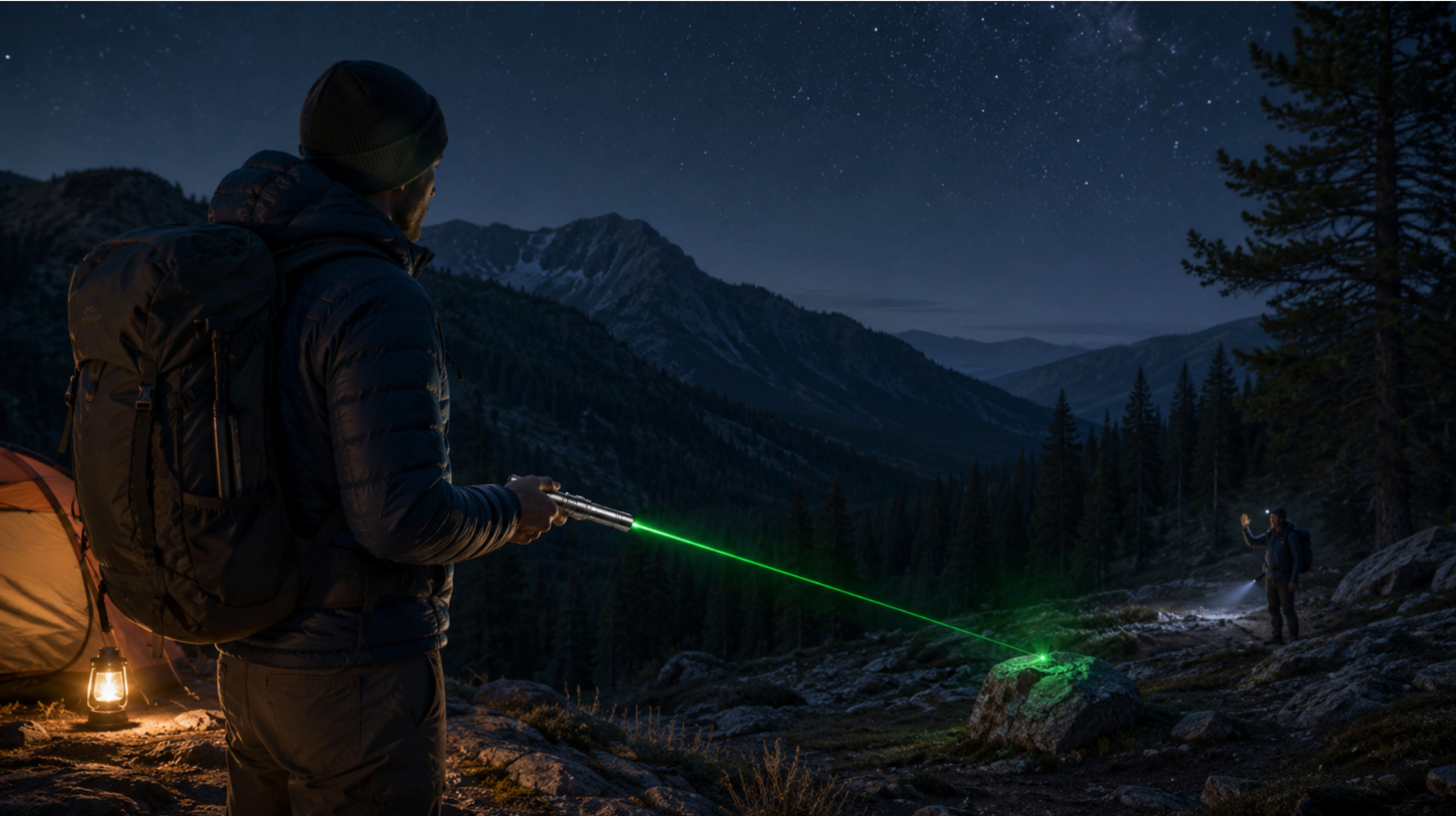
A green laser pointer can appear highly visible outdoors because human eyes are relatively sensitive to green wavelengths, especially around 520nm and 532nm. However, outdoor visibility depends on much more than color alone.

Ambient light, beam divergence, output power, weather, battery condition, and viewing angle all affect how clearly a green dot or beam appears. Outdoor use also brings additional safety concerns around aircraft, roads, reflective surfaces, people, and animals.
This guide explains how 520nm and 532nm green lasers behave outdoors, what battery and runtime factors matter, and what to check before choosing an outdoor green laser pointer.
Key Takeaways
-
Green wavelengths such as 520nm and 532nm often appear more visible than red or blue wavelengths at the same optical output because of human eye sensitivity.
-
520nm direct-diode lasers are often more temperature-stable than traditional 532nm DPSS lasers, but actual performance depends on the specific product.
-
Battery runtime depends on cell type, capacity, output power, driver efficiency, and duty cycle—not battery size alone.
-
IR filtering matters mainly for 532nm DPSS designs because they use infrared stages internally.
-
Outdoor use requires strict beam control. Never direct a laser toward aircraft, vehicles, people, animals, roads, or public areas.
Visibility Optics for Green Laser Pointers Outdoor Use

Air science and human eye sensitivity control beam clarity during night work. You see green light much better than other light colors. Day vision hits top sensitivity at 555 nm. Night vision shifts toward 507 nm because of the Purkinje effect. Colors like 520 nm and 532 nm stay close to both top vision points. Therefore, human eyes see green light up to four times brighter than red light at equal power settings. This visual perk improves green laser pointer outdoor use for field tasks. Outdoor visibility also depends on beam divergence, ambient light, atmospheric conditions, and viewing angle.Wavelength Science and Photopic Sensitivity
You must check part differences when selecting equipment for outdoor use. Old 532 nm diode-pumped solid-state lasers create green beams by doubling infrared light frequency through complicated glass parts. These multi-part setups need warm-up time and lose power in harsh weather. Modern 520 nm direct green diodes in Hgyuskl tools produce green light directly from a semiconductor diode. These direct diodes give instant power and keep steady output in temperatures from -10°C to +50°C.
|
Feature |
520nm Direct Diode |
532nm DPSS |
|
Green-light generation |
Direct semiconductor emission |
Infrared pumping + frequency doubling |
|
Temperature behavior |
Often more stable |
Often more temperature-sensitive |
|
Cold start |
Usually more predictable |
May need warm-up depending on design |
|
IR filtering |
Usually less relevant |
Important because DPSS uses IR stages |
|
Beam quality |
Depends on diode and optics |
Can be very good when properly aligned |
|
Buyer takeaway |
Good when temperature stability matters |
Good when perceived brightness/beam quality matter |
Dust and air particles spread light through Rayleigh scattering. Shorter green light waves scatter faster than longer red light waves. This natural spreading lights up the entire beam path through open air. Spread angle determines how tightly the light beam stays focused over distance. A beam with a full-angle spread of 1.0 mRad grows about 1 meter wider over 1 kilometer. Bright sunlight over 100,000 lux hides normal laser lines completely. In shaded or low-light outdoor conditions, green beams may become easier to see, but there is no universal visibility distance.
Choosing the Best Laser Pointer for Outdoor Use
Picking the best laser pointer for outdoor use means matching gear specs to your work area. Tough aircraft aluminum frames and steady power circuits ensure reliable outdoor operation. Expert workers rely on strong green laser pointers across a few main outdoor tasks:
-
Green lasers are often chosen for supervised astronomy because they are highly visible at low output. However, any sky-directed use requires constant aircraft awareness and compliance with local rules. Never direct a laser toward an aircraft or flight path.
-
Long-range wildlife control: Wildlife deterrence involves separate legal, safety, and site-specific considerations and is covered in dedicated guides.
Outdoor suitability depends on the site, surroundings, and whether the beam path can be controlled safely. Good laser pointers supply the long visual range and clear beam needed for important outdoor tasks.
Power Control for Outdoor Green Lasers
18650 Lithium-Ion Battery vs Standard Alkaline Battery
Outdoor equipment needs steady power to keep its beam bright. Small alkaline coin batteries like the LR44 give 1.5 volts with 150 milliamp-hours of power. NiMH AAA batteries offer 1.2 to 1.5 volts with nearly 1000 milliamp-hours. These common batteries lose voltage quickly when you use them continuously. Top-quality green laser pointers use rechargeable 18650 lithium-ion batteries to supply steady long-term energy for tough outdoor jobs.
|
Battery Factor |
Why It Matters Outdoors |
|
Capacity |
Affects runtime |
|
Voltage |
Must match device design |
|
Protected vs unprotected |
Protection can reduce some electrical risks |
|
Rechargeable vs disposable |
Changes convenience and maintenance |
|
Cold-weather behavior |
Capacity can fall in low temperatures |
|
Cell condition |
Damaged/swollen cells should not be used |
|
Compatibility |
Never substitute cells just because they physically fit |
APC Constant Current Drives and Thermal Limits
APC driver circuitry can help stabilize output, but it does not eliminate thermal limits. Users should still follow the specified duty cycle. Professional laser pointers keep their light output steady without suffering from harmful heat jumps or sudden power loss.
Safety rules call for tough testing before you carry lithium-ion gear outside. The UN38.3 standard tests batteries from T.1 to T.8, checking altitude, heat changes, drops, and short circuits. Shipping a laser pointer with a battery inside requires UN3481 labels. Moving extra loose batteries uses the UN3480 label instead.
For air travel, spare lithium-ion batteries should be carried in carry-on baggage and protected against short circuits. Check the battery’s watt-hour rating and the airline’s current rules before travel. Do not travel with damaged, swollen, recalled, or overheating cells.
Essential Eye Safety and Filter Standards

Infrared Leakage and IR Filter Engineering
Traditional 532nm DPSS lasers use 808nm and 1064nm infrared stages internally, so inadequate IR filtering can create invisible leakage in poorly designed products. A proper IR filter helps reduce this risk.
Direct-diode 520nm lasers do not use the same DPSS infrared conversion path, so this particular IR-leakage concern is generally less relevant. However, the visible green beam itself can still be hazardous.
Strong green light brings big dangers to human vision without correct protective glass. Medical papers recorded serious eye damage from strong laser tools in major health journals. Another medical report tracked lasting eye injuries caused by a medium green laser wand. Published medical reports have documented retinal injuries from laser exposure, including injuries involving handheld green lasers.
Finding the right outdoor laser pointer takes real light science and tough build quality. Direct 520 nm green diodes give great visibility and steady power in hot or cold weather. Pro Hgyuskl tools mix strong aircraft aluminum bodies with APC power circuits to stop heat slowdowns.
High-drain 18650 batteries keep the light beam going for a long time. Properly selected eyewear can reduce exposure risk, but it does not replace safe beam control. Never point strong laser beams at airplanes or open flight paths. Safe users obey local laws and control their beam path during outdoor tasks. Upgrade your gear with Hgyuskl tools for reliable outdoor green laser use.
FAQ
Why choose a direct 520 nm diode for a green laser pointer outdoor use scenario?
520nm direct-diode lasers are often more temperature-stable than traditional 532nm DPSS lasers, especially during cold starts. Actual temperature range depends on the specific diode, driver, and product design.
How do 18650 lithium-ion batteries improve field performance?
18650 cells can provide higher capacity than small button or AAA cells in products designed for them, but runtime depends on output power, driver efficiency, battery capacity, and duty cycle. Use only compatible cells recommended for the device.
Can you use a high-power green laser for laser emergency signaling?
520nm direct-diode lasers are often more temperature-stable, while 532nm DPSS lasers may offer high perceived brightness and good beam quality. The better choice depends on weather, product quality, output class, and intended use.
What features define the best laser pointer for outdoor use?
Look for clearly stated wavelength, output power, laser class, battery type, duty cycle, beam divergence, focus design, safety lock, warning labels, and product documentation. Do not choose by maximum range or power alone.
Share:
Laser Pointer for Presentations: Red vs Green, Indoor Visibility, and Safety
How to Read Laser Pointer Specifications: nm, mW, Class, Battery, and Focus