
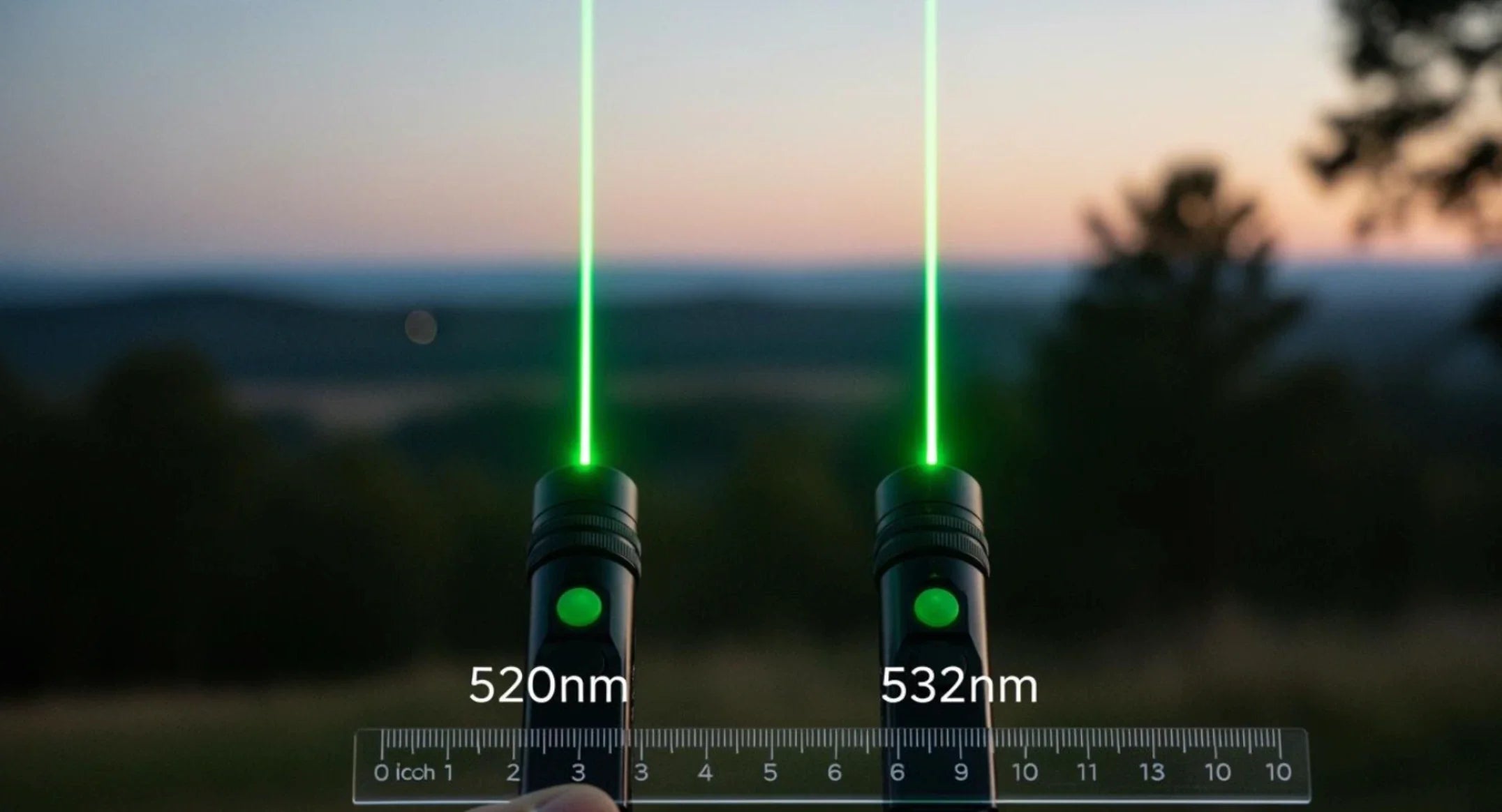
When comparing 520nm vs 532nm green laser options for outdoor use, both types of green laser pointers perform exceptionally well. The 532nm & 520nm green laser pointer models each offer high visibility, but the 532nm green laser pointer typically appears slightly brighter to the human eye. This is because our eyes are naturally more sensitive to green light, making green laser pointers especially effective for outdoor applications. The difference in visibility between a 520nm vs 532nm green laser is minimal, and environmental factors like fog or foliage often have a greater impact on performance than the specific wavelength. These 532nm & 520nm green laser pointer devices are widely used for astronomy, outdoor survival, wildlife control, and laboratory work, as detailed in the table below:
|
Comparison Area |
Comparison Area |
|
Technology |
520nm direct diode vs 532nm DPSS |
|
Visibility |
Which wavelength appears brighter to the human eye |
|
Outdoor Stability |
Temperature response, startup behavior, and output consistency |
|
Beam Quality |
Beam shape, divergence, and pointing clarity |
|
Safety |
Laser class, output power, IR filtering, labels, and local laws |
|
Buyer Fit |
Astronomy-style pointing, demonstrations, or controlled outdoor visibility |
Key Takeaways
-
20nm green lasers usually use direct-diode technology, while 532nm green lasers usually use DPSS technology.
-
532nm often appears slightly brighter to the human eye, but the difference between 520nm and 532nm is usually smaller than the difference between green and red.
-
520nm direct-diode models may offer more stable startup and better temperature tolerance, depending on product design.
-
532nm DPSS models may offer strong beam quality, but buyers should check for effective IR filtering because invisible infrared leakage may be present.
-
For outdoor pointer-style use, do not choose based only on brightness. Check output power, laser class, beam divergence, warning labels, and local laws.
520nm vs 532nm Green Laser Basics
When you look at 520nm and 532nm green lasers, you find some big differences. Hgyuskl is a top brand. Their lasers are strong and made with aviation aluminum. They use APC constant current drives and other good parts. These things help the lasers work well outside, even in tough places.
What Is a 520nm Green Laser
A 520nm green laser uses direct diode technology. This means the green light comes from a semiconductor laser diode. This kind of laser lasts longer and handles heat better. The beam looks grass green and is easy to see in the dark. Hgyuskl’s 520nm lasers save energy and give steady power. They are great for outdoor survival, astronomy, and wildlife control.
-
The 520nm laser comes from a semiconductor laser diode.
-
It saves energy and works well outside.
-
The beam is brighter in the dark.
What Is a 532nm Green Laser
A 532nm green laser uses DPSS technology. The laser starts as infrared and goes through a crystal. This makes the light turn green.
A 532nm green laser usually uses DPSS technology, where infrared light is converted through crystals into visible green output. Many 532nm DPSS lasers can produce a clean, visually bright beam, but buyers should check beam divergence, output stability, IR filtering, and laser class before purchase.
Professional alignment, laboratory, or industrial applications may require purpose-built laser systems rather than ordinary handheld pointers.
Wavelength and Color Differences
The wavelength changes how bright and colorful the laser looks. The 532nm green laser is closer to what our eyes see best, so it looks brighter than the 520nm laser. But the 520nm laser is better in the dark and looks grass green. Each laser is good for different jobs, so pick the one that fits your needs.
|
Property |
520nm Green Laser |
532nm Green Laser |
|
Typical Technology |
Direct diode |
DPSS |
|
Perceived Brightness |
Highly visible green; usually slightly less bright than 532nm |
Often slightly brighter to the human eye |
|
Temperature Behavior |
May offer better startup and stability depending on design |
Can be more temperature-sensitive in some DPSS designs |
|
IR Leakage Concern |
Different design; still check safety labels |
IR filtering is important for many DPSS models |
|
Beam Quality |
Depends on diode and optics |
Often clean and round in well-designed DPSS systems |
|
Buyer Fit |
Outdoor stability and modern direct-diode design |
High perceived brightness and traditional green beam appearance |
You can see that picking between 520nm and 532nm green lasers depends on what you need. If you want a tough and energy-saving laser, go with 520nm. If you want the brightest beam and best quality, choose 532nm.
Visibility and Outdoor Performance

When you look at 520nm and 532nm green lasers outside, seeing the beam is very important. You want a laser that is easy to spot. This matters for controlled outdoor visibility tasks, such as responsible astronomy-style pointing or guided demonstrations where local laws allow.
Eye Sensitivity and Brightness
Our eyes see green light best. Both 520nm and 532nm lasers are green, but our eyes notice light between 550 and 570 nanometers the most. This makes both lasers easy to see, but the 532nm green laser looks a bit brighter outside.
-
Our eyes see green better than other colors.
-
532nm green lasers match what our eyes see best, so they look brighter.
-
520nm green lasers are also easy to see, especially when it is dark.
You can use both lasers for looking at stars, staying safe, and keeping animals away. The difference in brightness is small, but it matters if you need the beam to go far.
Beam Visibility in Day and Night
It is hard to see any laser during the day. The sun makes most beams hard to see, so you need a strong laser. Both 520nm and 532nm green lasers have trouble in bright sunlight, but they still work well in tests.
|
Wavelength |
Visibility in Daylight |
Advantages |
Limitations |
|
520nm |
Not very bright but works well |
Works well and stays steady in many places |
No big problems |
|
532nm |
Not very bright |
Used for many things |
Does not work well in cold, DPSS problems |
-
Most green lasers, like 520nm and 532nm, do not work well for signals during the day. -
Do not judge outdoor performance by distance claims alone. Visible distance depends on output power, beam divergence, wavelength, air clarity, background light, and viewing conditions.
At night, things are different. Both lasers are bright, but the 532nm green laser is very bright and uses good technology. The 520nm laser turns on fast and works well in hot or cold weather. If you want the beam to stay strong in many places, the 520nm laser is more steady.
|
Wavelength |
Pros |
Cons |
|
|
DPSS Green Lasers |
532nm |
Very bright, uses good technology |
Needs to warm up, does not like cold |
|
Direct-Diode Green Lasers |
520nm |
Turns on fast, works in hot and cold |
Not as bright, costs more |
Color Perception Differences
You can see color changes when you use 520nm and 532nm green lasers outside. The 520nm laser looks colder and has a blue-green line. It gives a pure green color, but it is not as bright as the 532nm laser. The 532nm laser makes a strong, bright green beam that is easy to see outside.
|
Wavelength (nm) |
Perception |
Characteristics |
|
520 |
Colder, blue-green line |
Pure green, not as bright |
|
532 |
Strong, bright green |
Brighter, easier to see outside |
-
Green lasers are easier to see than red lasers. -
Your eyes see the 532nm wavelength better, so it stands out more outside.
-
In direct sunlight, both 520nm and 532nm green laser beams can be difficult to see. 532nm may appear slightly brighter to the human eye, but actual visibility depends on output power, beam divergence, distance, background, and air clarity.
Pick the laser that works for you. If you want a pure color and steady beam, choose the 520nm laser. If you want the brightest and easiest to see, pick the 532nm laser for looking at stars, staying safe, or keeping animals away.
Beam Quality and Durability

When you look at 520nm and 532nm green lasers for outside, you need to think about more than just how bright they are. Beam quality and how tough the laser is are also important, especially if you use your laser in rough places. Hgyuskl makes every laser with strong aviation aluminum, APC constant current drives, and a waterproof body. These things help your laser last longer and work better outside.
Beam Shape and Range
The shape of the laser beam changes how far and how clearly you can see it. There are some differences between the two lasers:
|
Laser Type |
Cold-Weather Note |
Cold-Weather Note |
|
520nm Direct Diode |
May provide more stable startup in cold conditions depending on design |
Still requires output power, class, and label checks |
|
532nm DPSS |
Some models may be more temperature-sensitive |
Requires effective IR filtering and proper safety labeling |
Some direct-diode 520nm lasers may have a more elliptical beam profile before optical correction. With suitable optics, this can be managed for pointing or projection tasks. Buyers should compare beam divergence and beam shape rather than assuming one wavelength is always better. The 532nm laser makes a round and even beam. This is great for pointing at stars or lining things up exactly.
Durability in Harsh Conditions
You want your laser to keep working in rain, mud, or if you drop it. Hgyuskl uses aviation aluminum that is strong but not heavy. Outdoor buyers should check the specific product’s housing material, water-resistance rating, operating temperature range, battery type, and safety features. Durable housing can improve reliability, but it does not replace laser safety rules. Here are some reasons why these things are important:
-
Aviation aluminum does not bend or break easily.
-
IP67 waterproofing keeps your laser safe in wet or dirty places.
-
Aircraft-grade housing keeps the laser steady, even if you put it on your gear.
These features mean you can trust your laser in the woods, on a farm, or during a storm.
Maintenance and Longevity
You do not want to fix your laser all the time. The kind of laser you pick changes how much care it needs.
520nm direct-diode lasers last longer and need less fixing than 532nm DPSS lasers. The direct-diode design does not have crystal problems, so your laser works well in hot or cold weather. A 520nm direct-diode design may reduce some of the alignment and conversion issues associated with DPSS systems, but actual lifetime depends on diode quality, heat management, driver design, output power, and operating conditions.
APC constant current drives help too. They keep the power even, which protects the laser and makes it last longer. Both 520nm and 532nm lasers from Hgyuskl last a long time, but the 520nm model is best for working in very hot or cold places.
If you want a laser that works every time and does not need many repairs, the 520nm direct-diode model is the best choice for outdoor trips.
Practical Applications and Use Cases
When you look at the 520nm and 532nm green lasers for outdoor use, each one is good for different jobs. Hgyuskl makes lasers that are strong and can handle tough work. For outdoor buyers, the main decision is not which wavelength can do more tasks. The better question is which wavelength better matches your visibility needs, operating temperature, beam quality expectations, battery requirements, and safety constraints.
Astronomy and Stargazing
You need a laser that is easy to see at night and works in any weather. Both 520nm and 532nm green lasers help you point at stars and planets. The 532nm green laser looks brighter to your eyes. This makes it popular for star tours and big events. If you want to look at stars in cold places, the 520nm laser is better. It keeps working even when it is very cold outside.
|
Laser Type |
Cold Weather Performance |
Operating Temperature |
Safety Considerations |
|
520nm Direct Diode |
Down to -20°C |
Safer in cold places |
|
|
532nm DPSS |
Stops working below -5°C |
Not for very cold |
Watch out for IR leaks |
-
Use a 532nm laser for star events and clear nights. -
Pick a 520nm laser for cold places or mountain stargazing.
Tip: Hgyuskl’s lasers are made with strong aluminum and are waterproof. You can trust them for any night sky trip. For more info on astronomy tools, check our Astronomy Laser Guide.
Outdoor Survival and Emergency Signaling
Outdoor visibility does not mean a 520nm or 532nm green laser pointer should be used as an emergency signal. If you need emergency signaling equipment, use tools specifically designed and approved for that purpose, such as emergency beacons, signal mirrors, whistles, radios, or lights.
Never direct a laser toward aircraft, vehicles, roads, people, animals, public spaces, or reflective surfaces.
Wildlife Control and Lab Use
Wildlife or bird-deterrent use requires separate legal, safety, and humane-use guidance. Do not assume a general 520nm or 532nm green laser pointer is appropriate for animal deterrence. If this is your intended use, check local wildlife rules, protected-species regulations, and equipment suitability before considering any laser-based method.
Some professional optical or laboratory systems use 532nm lasers because well-designed DPSS systems can provide good beam quality. These systems are different from ordinary handheld pointers and may require trained operators, controlled beam paths, protective eyewear, and documented safety procedures. If you need a laser for outdoor pest control all year, the 520nm laser is tough and lasts.
-
Use a 532nm laser for lab work and keeping animals away in nice weather.
-
Pick a 520nm laser for outdoor use all year and rough places.
Hgyuskl’s lasers work well for every job. Learn more about our Wildlife Control Solutions.
Choosing Between 520nm and 532nm Green Lasers
Key Factors for Outdoor Users
When you look at 520nm and 532nm green lasers for outside, you should think about a few important things. You want a laser that works well for what you need and where you use it. Here is a table that shows the most important things to check:
|
Factor |
Description |
|
Laser Brightness |
How bright the beam looks in the day and at night. |
|
Wavelength Selection |
Pick 520nm for bad weather, 532nm for the brightest beam. |
|
Divergence Angle |
A narrow beam goes farther and stays sharp. |
|
Projection Distance |
How far you can see and use the beam. |
|
Laser Stability and Life |
520nm lasers last longer and need less fixing. |
|
Weather Resistance |
Waterproof and strong lasers work in rain, mud, and cold. |
|
Compliance and Labeling |
Check output power, laser class, wavelength, warning labels, manufacturer information, user instructions, IR filtering information for 532nm DPSS models, and local laws. |
You should also think about how easy it is to use your laser and keep it working. 520nm lasers use less power and do not get too hot. DPSS lasers have a better beam but can stop working if it gets too cold or hot.
Safety and Legal Considerations
It is important to be safe when you use green lasers outside. You need to protect your eyes and follow the law. Here are some tips to help you:
-
Never point your laser at people, animals, or planes. This is not safe and is against the law.
-
Products above 5mW may fall into Class 3B or higher hazard classes and should not be treated as casual laser pointers. Higher-class laser products require controlled conditions, appropriate protective eyewear matched to wavelength and power, trained operation, and additional legal review.
-
Only use lasers that follow the rules. Laser pointers for people should be Class 3R and under 5mW.
-
Some states want extra safety parts, like a key or a timer.
Lasers have safety classes. Class 1 and 2 are safe for short looks. Class 3B and 4 can hurt you and need special care.
Final Recommendations
You want a laser that is bright, strong, and safe.
Choose 520nm if you prioritize direct-diode design, stable startup, simpler optical structure, and potentially better performance across changing outdoor temperatures.
Choose 532nm if you prioritize slightly higher perceived brightness and traditional DPSS beam appearance, and if the product provides effective IR filtering and clear safety labeling.
For either wavelength, do not choose based only on brightness or advertised distance. Check output power, laser class, beam divergence, warning labels, battery performance, and local laws before buying.
|
Factor |
520nm Green Laser |
532nm Green Laser |
|
Visibility |
Brighter for night and events |
|
|
Durability |
Strong and reliable |
Depends on who made it |
|
Safety |
Class IIIA is best |
Class IIIA is best |
If you need a green laser pointer for outdoor low-light visibility and stable startup, a 520nm direct-diode model may be a practical choice. If you want slightly higher perceived brightness for controlled astronomy-style pointing, a properly labeled 532nm DPSS model may be suitable where local laws allow. Always follow safety rules and check the laws where you live. Try Hgyuskl’s best lasers for good results every time.
When you compare 520nm vs 532nm green laser options for outdoor use, you see that each has strengths. You should match your choice to your needs:
-
For long-distance visibility, 532nm lasers stand out.
-
If you need steady performance in harsh weather, 520nm lasers work best.
-
Some users find red lasers more effective for pointing out green trees.
Think about your application, visibility needs, and budget. Always choose a laser that fits your scenario and keeps you safe. For reliable outdoor performance, upgrade to Hgyuskl’s professional green lasers.
FAQ
What is the main difference between a 520nm and a 532nm green laser?
You see the main difference in how each laser creates green light. A 520nm green laser uses a direct diode. A 532nm green laser uses DPSS technology. This affects brightness, durability, and performance outdoors.
Which laser is better for astronomy-style pointing?
A 532nm green laser may appear slightly brighter to the human eye, while a 520nm direct-diode laser may offer more stable startup in some outdoor conditions. For astronomy-style pointing, choose a properly labeled lower-power model where local laws allow, and never point it near aircraft, vehicles, people, animals, or reflective surfaces.
Can I use a 520nm green laser in cold weather?
Yes! You can use a 520nm green laser in cold weather. Direct diode technology works well in low temperatures. You get reliable performance for camping, hiking, or emergencies outdoors.
Why does the 532nm green laser look brighter to my eyes?
Your eyes see 532nm green light as the brightest. The human eye is most sensitive to this wavelength. This makes the 532nm green laser beam stand out more, especially at night or during presentations.
Which laser should I choose for astronomy or wildlife control?
For astronomy, you may want the brightest beam, so choose a 532nm green laser. For year-round wildlife control or survival, pick a 520nm green laser. It works better in harsh weather and lasts longer.
Share:
What Does “Avoid Exposure to Beam” Mean on a Laser Pointer?
What Is a 532nm Green Laser Pointer? Wavelength, Brightness, and Use Cases