
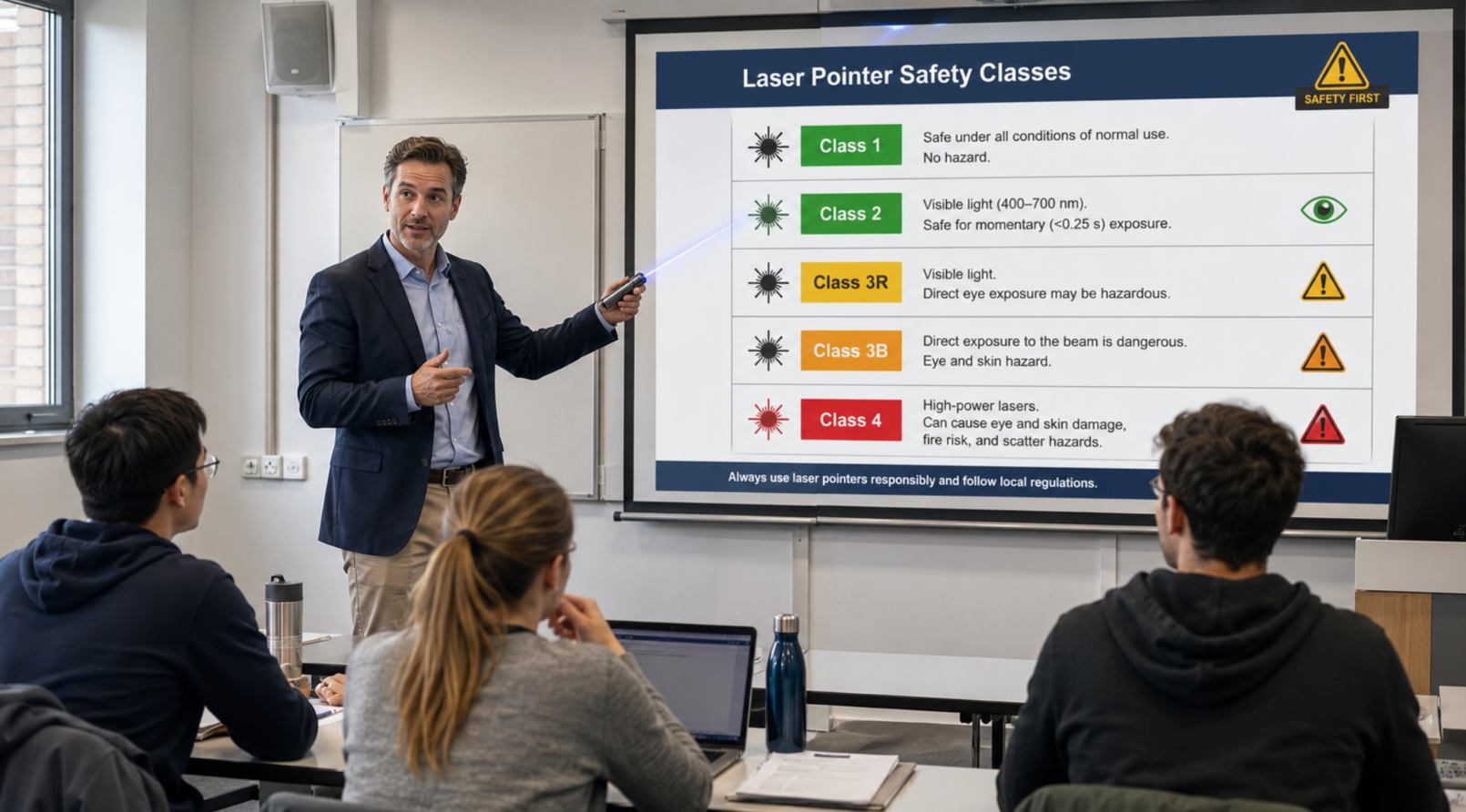
You should know about laser pointer safety classes before using high-power lasers. These classes help keep your eyes safe and protect you and others from harm. If you use high-power laser pointers the wrong way, you can get hurt or feel pain. In Canada, 1.1% of people who saw lasers got hurt, and 26% of laser injuries came from laser pointers. In the U.S., thousands of laser problems with planes happen each year. Many people use heavy-duty farm lasers for looking at stars or for outdoor signals, and some even use them as effective farm tools. Hgyuskl is a top brand that provides true details and prioritizes safety first.
Key Takeaways
-
Laser safety classes help buyers understand the risk level of a laser product, not just its brightness or advertised range.
-
Class 2 lasers are lower-risk visible lasers up to 1mW, but intentional staring should still be avoided.
-
Class 3R lasers can reach up to 5mW in the visible range and require careful handling.
-
Class 3B and Class 4 laser products create much higher eye, skin, reflection, and fire risks and should not be used as casual laser pointers.
-
Always check the laser class, output power, wavelength, warning labels, manufacturer information, and local laws before buying or using a laser product.
Laser Pointer Safety Classes Overview

What Are Laser Pointer Safety Classes
It is important to know about laser pointer safety classes before using any laser device. These classes tell you how safe or dangerous a laser pointer can be. The system puts laser pointers into groups based on their power and the color of their light. Higher class numbers mean more risk if you use the laser in the wrong way.
Here is a simple table that shows the main differences:
|
Laser Class |
Typical Output Direction |
Buyer Meaning |
|
Class 1 |
Enclosed or inherently low-risk laser products |
Generally low risk when used as designed |
|
Class 2 |
Visible lasers up to 1mW |
Lower-risk for brief accidental exposure, but intentional staring should be avoided |
|
Class 3R / IIIa |
Visible lasers up to 5mW |
Higher than Class 2; requires careful handling and proper labeling |
|
Class 3B / IIIb |
5mW–500mW |
Higher-risk class; not appropriate for casual pointer use |
|
Class 4 / IV |
Above 500mW |
Highest-risk class; can create serious eye, skin, reflection, and fire hazards |
Laser pointer safety classes are based on two things:
-
The power of the laser beam (measured in milliwatts, or mW)
-
The wavelength, or color, of the light (measured in nanometers, or nm)
When the power is higher, the risk is higher too. For example, lasers over 5 mW can hurt your eyes very fast. The FDA makes rules to keep laser pointers safe for everyone. If you want to use a laser pointer for astronomy, outdoor survival, or lab work, you need to know the class first.
Why Classification Matters
Laser pointer safety classes are important because they help protect your eyes and skin. Using the wrong class of laser pointer can hurt you. Some people buy lasers that do not have the right label. These lasers might be much stronger than you think and can cause bad injuries.
Here are some reasons why classification is important:
-
You can avoid eye injuries by picking the right class.
-
You follow the law and stay safe when you use a laser pointer.
-
You make sure you do not buy fake or wrongly labeled products.
Tip: Always check the label and real details before buying a laser pointer. Brands like Hgyuskl care about true high power, real output, and professional quality. This helps you get what you pay for and keeps you safe.
Manufacturers must give you the right class and safety details. If they do not, you could get a dangerous laser pointer. You should look for brands that care about safety and quality. When comparing Hgyuskl models or any other laser brand, check the specific product’s laser class, labeled output power, wavelength, warning labels, safety features, and available documentation. Safety depends on choosing the right class and using the product responsibly.
If you want to use a laser pointer for astronomy, outdoor survival, or lab research, you must know the class and follow all safety rules. Laser pointer safety classes help you make smart choices and keep everyone safe.
Class 2 Laser Pointers
Class 2 Definition
You will find that Class 2 laser pointers belong to the group of visible-light lasers with a power limit of 1 milliwatt (mW). These lasers use light in the 400–700 nanometer (nm) range, which means you can see the beam with your eyes. The main safety feature of this class is the blink reflex. If a Class 2 laser beam enters your eye, you will blink or turn away in less than 0.25 seconds. This quick reaction helps protect your eyes from harm.
|
Characteristic |
Description |
|
Blink Reflex |
Limits exposure to no more than 0.25 seconds, making it safer for the eyes. |
|
Wavelength Range |
Visible-light lasers (400–700 nm). |
|
Power Limitation |
Up to 1 mW continuous wave. |
|
Eye Injury Risk |
Suppressing the blink reflex can lead to injury. |
|
Common Applications |
Many pointers and measuring tools. |
Typical Uses
You will often see Class 2 laser pointers in classrooms and offices. Teachers use them to point at the board or highlight important information. Here are some common uses:
-
You can use them to help students focus during lessons.
-
They work well as tools for answering multiple-choice questions in class.
-
Science teachers use them to point out molecules or show how gas particles move.
These uses make Class 2 laser pointers popular for education and presentations.
Safety Risks
Class 2 lasers are lower-risk visible lasers, but they are not toys. Their safety depends on brief accidental exposure and the natural blink response. Intentional staring, repeated exposure, or viewing through optical instruments can still create risk.
Class 2 pointers may be suitable for basic presentations or indoor pointing when used responsibly, but they should be kept away from children and never aimed at people, vehicles, aircraft, animals, or reflective surfaces.
If you stare into the beam on purpose, you can hurt your eyes. They can also distract people, especially drivers or pilots, and cause glare or flashblindness. Using them the wrong way can lead to legal trouble. Children should only use these lasers when an adult is watching.
|
Safety Risk |
Description |
|
Eye Exposure |
Harmful if you stare into the beam. |
|
Distraction |
Can cause glare or flashblindness for drivers and pilots. |
|
Legal Risks |
Pointing at vehicles or planes is illegal and dangerous. |
|
Supervision |
Children need adult supervision. |
Precautions
You should always follow safety rules when using Class 2 laser pointers. Never point the beam at anyone’s eyes or at moving vehicles. Keep the laser away from children unless you are there to supervise. Store the pointer in a safe place when you are not using it.
Note: Laws about Class 2 laser pointers are different in each country. In Australia, lasers over 1 mW are often seen as prohibited weapons. In the UK, you must follow Health and Safety rules when using them in public. In the U.S., the FDA does not allow the sale of laser pointers over 5 mW and requires safety features for stronger lasers.
You should always check the rules in your area before buying or using a laser pointer. Understanding laser pointer safety classes helps you stay safe and follow the law.
Class 3R Laser Pointers
Class 3R Definition
It is important to know what makes Class 3R laser pointers different. Class 3R lasers are visible lasers up to 5mW. They are lower-risk than Class 3B, but direct viewing of the beam can still be hazardous. Users should avoid eye exposure, reflected beams, optical instruments, and any use near aircraft, vehicles, people, animals, or public areas.
The blink reflex might not keep your eyes safe with these lasers. Class 3R lasers are not as strong as Class 3B, but you still need to follow strict safety rules.
Here is a table that shows the differences:
|
Laser Class |
Safety Classification |
Power Limit |
|
Class 3R |
Safe if handled carefully, with restricted beam viewing |
Limited to 5 mW for visible lasers |
|
Class 2 |
Safe due to the blink reflex limiting exposure |
Limited to 1 mW continuous wave |
|
Class 3B |
Hazardous if the eye is exposed directly |
Limited to 0.5 W for continuous |
Typical Uses
Class 3R laser pointers are used for many outdoor and astronomy activities. Their bright beams help people point out stars and constellations at night. Hgyuskl’s professional lasers make it easy to guide groups or line up telescopes. Here are some ways people use them:
-
Pointing at stars, planets, and constellations during night tours
-
Helping beginners see the shapes of constellations
-
Teaching small groups about astronomy
-
Lining up telescopes when it is safe and controlled
Class 3R lasers may be used for controlled pointing tasks where local laws allow, such as supervised astronomy pointing or demonstrations. They should not be used as emergency signals or general long-range outdoor pointing tools.
Safety Risks
You must be careful with Class 3R laser pointers. If the beam goes into your eyes, it can hurt them right away. This is even more dangerous if you look through binoculars or telescopes. The blink reflex may not protect you from harm. Class 3R lasers are more risky than Class 2 lasers. Never think these lasers are not powerful.
Warning: Never shine a Class 3R laser at someone’s eyes or face. Even a quick flash can cause serious harm.
Precautions
You can stay safe with Class 3R laser pointers by following these steps:
-
Only use the laser with safety rules in place.
-
Never aim the beam at people or animals.
-
Pick the lowest power that works for you.
-
Stay away from shiny surfaces that can reflect the beam.
-
Turn on the pointer only when you are ready to use it.
-
Keep the laser pointer in a safe place when not in use.
-
Do not let kids or people who are not trained use the device.
If you follow these steps, you help keep everyone safe. Always remember that Class 3R lasers are strong and must be used with care.
Class 3B Laser Pointers
Class 3B Definition
Class 3B laser pointers are much stronger than lower classes. These lasers have power between 5 and 499 milliwatts. They can make both visible and invisible light. The light covers wavelengths from 315 nanometers to far infrared. If you use a continuous Class 3B laser, the power can go up to 0.5 watts. Pulsed lasers in the visible range can reach 30 millijoules of energy. Looking straight into a Class 3B beam can hurt your eyes badly. You should wear protective eyewear when using these lasers.
-
Output power: 5–499 mW
-
Wavelength: 315 nm to far infrared
-
Can cause eye injury with direct exposure
-
Protective eyewear recommended
Class 3B Use Boundaries
Class 3B laser products should not be treated as casual handheld laser pointers. They may be used only in controlled professional, technical, research, or industrial environments where appropriate safety procedures are in place.
Class 3B products require controlled beam paths, trained users, protective eyewear matched to the wavelength and power, warning labels, access control, and strict avoidance of people, animals, vehicles, aircraft, public spaces, and reflective surfaces.
Safety Risks
You must be very careful with Class 3B laser pointers. These lasers can cause eye injuries that never heal if used wrong. Even a quick look at the beam can make you lose your sight. Using these lasers as toys or for fun is very dangerous. They can also cause flash blindness or after-images, which may lead to accidents or trouble with the law, especially outside or in public.
-
Direct eye exposure can cause permanent damage.
-
Playing around or not being careful makes injuries more likely.
-
Temporary vision problems can cause accidents or legal trouble.
Warning: Never point a Class 3B laser at people, animals, or cars. Always follow strict safety rules.
Precautions
You can stay safe by following these steps:
-
Get trained before using a Class 3B laser pointer.
-
Never leave the laser where untrained people can use it.
-
Use warning lights or sounds when the laser is on.
-
Cover as much of the beam path as you can.
-
Stop the beam at the end of where you need it.
-
Use the lowest power that works for your job.
-
Keep people away from dangerous areas.
-
Use the laser in a space where only some people can go.
-
Never aim at cars or planes outside.
-
Put clear danger signs on the laser and in the work area.
-
Mount the laser on something steady to control the beam.
Always follow the rules for laser pointer safety classes. Hgyuskl’s strong, steady products help you work safely in tough places.
Class 4 Laser Pointers
Class 4 Definition
Class 4 laser pointers have the most power in laser pointer safety classes. These lasers start at 500 milliwatts and can go much higher. They can burn your skin and start fires. Even if you do not look right at the beam, you can get hurt. You must be very careful with these tools.
|
Class |
Power Output |
Description |
|
Class 4 |
≥ 500 mW |
Very dangerous for eyes, can burn skin and things, especially up close. |
|
Class 4 |
> 500 mW |
Extreme danger: burns skin, can cause fires, even reflections are risky. |
Typical Uses
Class 4 laser pointers are only used by professionals. You will find them in labs, research, and factories. People use them for cutting, measuring, or special science tests. If a Class 4 laser product is required for a legitimate professional application, buyers should review the product documentation, safety requirements, protective eyewear specifications, and local regulations before purchase or use.
Safety Risks
Class 4 laser pointers are the most dangerous in laser pointer safety classes. Here are some risks:
-
If the beam hits your eyes, you can lose your sight forever.
-
Your skin can get burned, especially if it is dark or thin.
-
These lasers can start fires if they hit something that burns easily.
-
Even light bouncing off a wall can hurt you.
⚠️ Warning: Never use a Class 4 laser unless you have training and safety gear.
Precautions
You need special safety lessons before using a Class 4 laser pointer. You must follow strict rules to stay safe. Here are some important steps:
-
Take a laser safety class before you use it.
-
Get training from someone who knows how to use lasers.
-
Check for dangers and pick the right safety gear.
-
Always wear safety glasses in the laser room.
-
Get your eyes checked if you work with Class 4 lasers.
-
Learn how lasers work, like their colors and power.
-
Know how laser beams can hurt your body.
-
Spot dangers and use safety steps.
Always follow these rules. When you respect Class 4 lasers, you keep yourself and others safe.
General Safety Guidelines
Safe Handling Tips
You should always be careful with any laser pointer. Even lasers with low power can hurt you if you are not careful. Here are some tips to help you stay safe:
-
Never point a laser pointer at people. Only use it to show things or surfaces.
-
Do not aim the beam at mirrors or shiny things. Reflections can hurt you by surprise.
-
Never look straight into the beam or use tools to see it better.
-
Pick the lowest power you need for your job.
-
Keep laser pointers away from kids. Take out the batteries when you are not using it.
-
Put your laser pointer in a safe spot after you finish.
-
Check the rules in your area about laser power before using it.
-
For higher classes, only use the laser in safe places and follow all safety rules.
Durable housing can improve product reliability, but it does not replace laser safety controls. Users still need to follow the laser class, output power, warning labels, protective eyewear requirements, and local rules.
Protective Gear
If you use Class 3B or Class 4 laser pointers, you must wear the right gear. The table below shows what you need for each class:
|
Laser Class |
Recommended Protective Gear |
|
Class 3B |
Laser protective eyewear (OD-rated), flame-resistant clothes if needed |
|
Class 4 |
Laser protective eyewear (OD-rated), flame-resistant clothes, gloves, face shields, respirators |
Protective eyewear must be rated for the specific wavelength and output power of the laser. Do not rely on generic tinted glasses or unverified “laser safety glasses.” For Class 3B and Class 4 products, eyewear selection should be part of a formal safety plan.
Storage & Transport
Storing and moving your laser pointer the right way keeps everyone safe. Follow these steps:
-
Put your laser pointer in a strong case when you are not using it.
-
Keep it away from kids and people who do not know how to use it.
-
Take out the batteries if you will not use it for a long time or if you travel.
-
Label your laser pointer with its class and power.
-
Carry your device in a way that stops it from turning on by accident.
If you follow these rules, you help keep everyone safe when using any laser pointer.
Legal & Regulatory Aspects
Laws By Class
You must know the laws for laser pointer safety classes before buying or using any device. Every country has its own rules about laser pointer power and how you can use them. These rules help keep people safe from eye injuries and make public places safer.
Legal rules vary by country, state, and local area. In the United States, laser products promoted for pointing or demonstration purposes are generally limited to Class IIIa / IEC Class 3R, which means 5mW or below in the visible wavelength range. Class IIIb lasers between 5mW and 500mW cannot legally be promoted as laser pointers or demonstration laser products.
In Europe and other regions, consumer laser product rules may differ by country, product type, import status, and intended use. Always check local laws before buying, importing, carrying, or using a laser product.
Compliance & Penalties
If you break the rules for laser pointer safety classes, you can get in big trouble. You might have to pay fines, go to jail, or lose your device. The table below shows what can happen if you do not follow the law:
|
Penalty Type |
Description |
|
Recall/Repair/Refund |
Makers may have to fix, replace, or give your money back for unsafe products. |
|
Detention/Seizure |
Customs can stop or take away illegal laser pointers at the border. |
|
Compliance Requirement |
You may have to return or fix your device if it does not meet safety rules. |
Check for required labeling and documentation, including laser class, output power, wavelength, warning labels, manufacturer identification, and safety instructions. Be cautious if the product lacks a clear class label or if the label conflicts with the user manual.
Brands like Hgyuskl focus on true high power and real details. You can learn more about safe and legal laser use in our Laser Pointer Safety Guide. Always pick products that meet strict rules to keep yourself and others safe.
You know how laser pointer safety classes are not the same. Class 2 lasers are safe for everyday things. Class 3R lasers must be used with care. Class 3B and Class 4 lasers need strict safety steps and special gear. Always pick the right class for what you need. Follow all the rules every time.
A safe laser purchase starts with understanding the class, output power, wavelength, warning labels, and legal requirements. When comparing Hgyuskl models or any other brand, choose based on verified specifications, appropriate safety features, and responsible-use requirements rather than advertised power alone.
FAQ
What is the safest laser pointer class for everyday use?
You should choose Class 2 laser pointers for daily tasks. These devices use low power and visible light. They help you avoid eye injuries. Always check the label for true specifications before buying.
Can you use Class 3B or Class 4 laser pointers at home?
You should not use Class 3B or Class 4 laser pointers at home. These devices pose extreme risks. Only trained professionals should handle them in controlled environments. Always wear protective gear.
How do you check if your laser pointer meets legal standards?
You can check the label for power output and class rating. Look for FDA compliance statements. Buy from trusted brands like Hgyuskl that provide real specifications and safety certifications.
What should you do if a laser pointer beam hits your eye?
You must look away immediately. Do not rub your eye. Seek medical help if you feel pain or see changes in vision. Quick action helps prevent lasting damage.
Why do some laser pointers have inaccurate power ratings?
Some sellers exaggerate mW ratings or omit safety information to attract buyers. Avoid products with unclear class labels, missing wavelength information, exaggerated distance claims, or unsafe marketing language. Choose products with clear output power, wavelength, laser class, warning labels, and manufacturer information.
Share:
Are Green Laser Pointers Legal in the US and Europe? Buyer Safety Checklist
Green vs Red vs Blue Laser Pointers: Which Color Is Best for Your Use Case?