
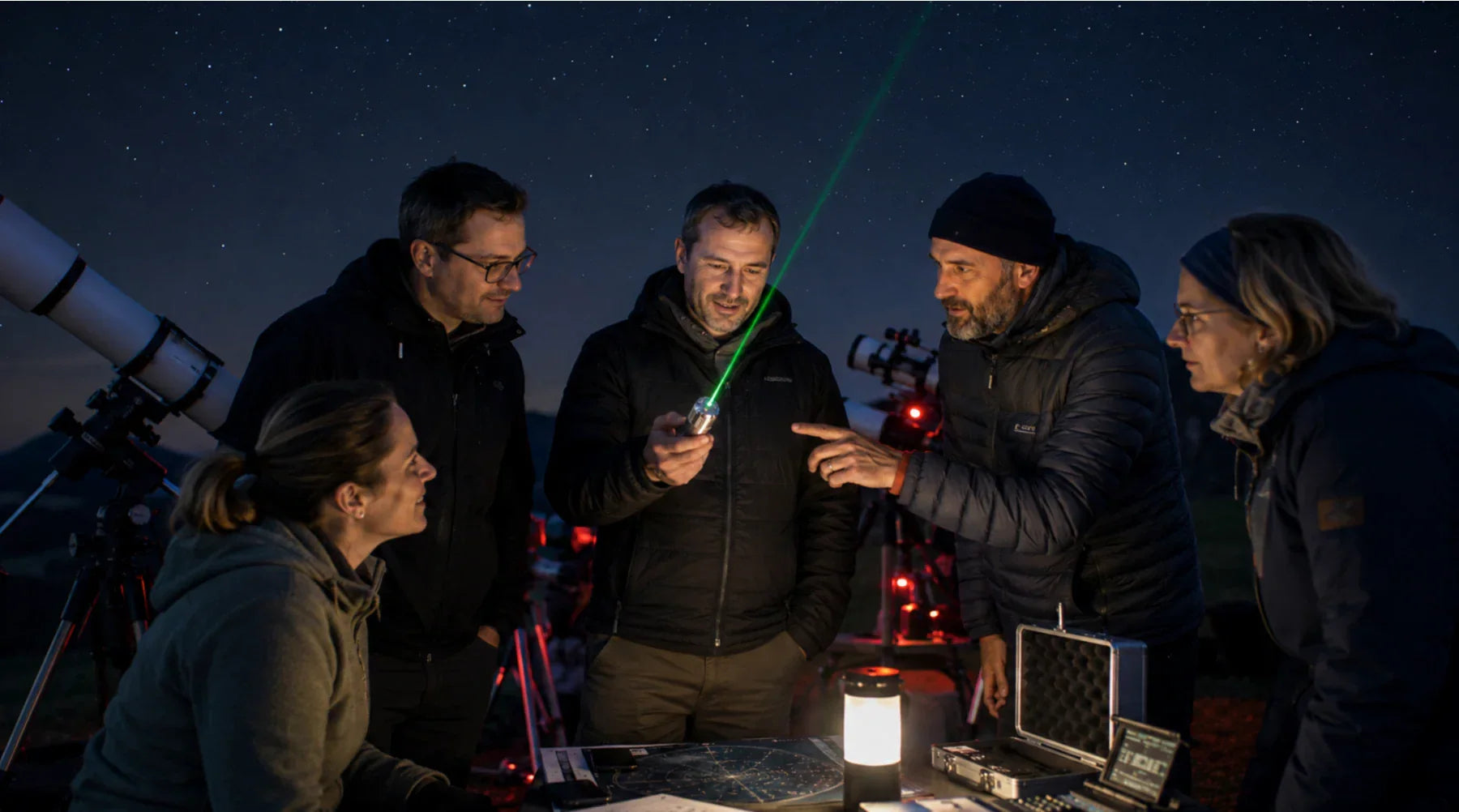
High visibility green stands as the standard in astronomy because your eyes see it best in the dark. Scientists have found that the human eye detects yellow-green shades more easily than any other color at night.
-
The cones in your eyes work less in low light, making green much easier to spot than red or blue.
Green laser pointers shine brighter and clearer, which makes them the top choice for amateur astronomy green laser needs. You see bright green laser beam streaks across the sky, guiding stargazers and revealing constellations. Because of this unparalleled optical advantage, high-visibility green remains the undisputed gold standard for celestial navigation.
Key Takeaways
-
Green light is easy to see at night. This makes it great for stargazing.
-
Green lasers need less power to be bright. This helps keep them safe and efficient.
-
A green laser pointer helps you show others where to look. It makes stargazing easier for groups.
-
Always use lasers safely. Follow rules to keep everyone safe.
-
Pick good green lasers. They work well and last long in different places.
The Science of Green Visibility

Human Eye Sensitivity
You rely on your eyes to explore the night sky. Your eyes have special cells called rods and cones. During the day, cones help you see colors. At night, rods take over. Rods work best with certain colors, especially in low light. Scientists found that your eyes reach peak sensitivity at a wavelength of 507 nanometers. This range falls in the blue-green part of the spectrum. When you use a green astronomy pointer, you take advantage of this natural biological sensitivity. Your eyes notice green light faster and more clearly than other colors in the dark.
Tip: If you want to spot a laser beam quickly at night, choose green. Your eyes will pick it up almost instantly.
Why Green Stands Out at Night
As the sky gets darker, your eyes lose the ability to see reds and yellows. The red cones in your eyes stop working first. Colors like yellow, orange, and red fade away and look gray or black. However, your eyes keep some sensitivity to blue and green. This shift helps you see green fields and trees even on cloudy days, while reds and yellows seem dull. In low-light conditions, your eyes respond best to blue-green light, around 500 nanometers. This makes green lasers the top choice for visibility during stargazing.
-
Green lasers cut through the darkness, making them easy to spot.
-
You can guide others to stars and constellations with a clear, bright beam.
-
The visibility of green light helps you stay safe and aware during nighttime activities.
When you use a green laser pointer, you get the highest visibility possible. This is why green remains the standard for amateur astronomy and outdoor use.
Amateur Astronomy Green Laser Advantages
Power Efficiency and Brightness
Optimal visibility in the field requires a bright and clear beam. Green laser pointers emit light between 520 and 532 nanometers, perfectly matching the peak sensitivity of the human eye in scotopic (low-light) conditions. Consequently, a green beam appears significantly more intense than red or blue beams of the same wattage. A standard 5 mW green laser can appear as exceptionally bright as a 40–50 mW red laser. This superior power efficiency allows for brilliant visibility while keeping output levels within safer limits.
Hgyuskl engineers professional-grade lasers strictly based on real power specifications and robust materials. The aviation aluminum casing protects the sensitive optical components from drops and extreme weather. Equipped with APC (Automatic Power Control) constant current drives, the beam remains steady, ensuring no loss of brightness during extended night sky tours. By utilizing premium direct green diodes, Hgyuskl delivers a sharp, highly visible beam, guaranteeing reliable performance without the fraudulent specs common in cheaper models.
Note: Lower power green laser pointers are legal in most places and safer for amateur use. You get high visibility without risking safety.
Green Laser Pointers vs. Other Colors
You might wonder how green laser pointers compare to red or blue. Green lasers stand out because your eyes see them best. You can spot the beam quickly, even in daylight or from far away. Red lasers need a lot more power to be as bright as green. Blue lasers look cool but are not as bright in the night sky.
Here is a simple table that shows the differences:
|
Laser Color |
Wavelength (nm) |
Visibility Characteristics |
Use Cases |
|
Green |
~520–550 |
Very bright; easy to see in daylight or far away; 30x brighter than red lasers |
Astronomy, outdoor use, education, professional pointing |
|
Red |
~630–670 |
Good for indoor and outdoor use at night; reliable and affordable |
Presentations, pet toys, casual pointing |
|
Blue |
~445–470 |
Medium to high visibility; easy to see in dim light but not as bright as green |
Experimentation, burning (with high power), cool factor |
You pick green laser pointers for astronomy because they are the easiest to see. You can guide groups, point out stars, and keep everyone safe. Professional-grade green lasers from Hgyuskl have dust and water resistance, anti-reflection glass, and stable output circuits. You get good performance in any weather or temperature.
-
You see the beam clearly, even from far away.
-
You use less power, so the battery lasts longer.
-
You can trust the real specs for safety and accuracy.
If you want the best tool for stargazing, you should pick an amateur astronomy green laser. You get great brightness, efficiency, and strength. You make your astronomy sessions easier and safer. You can trust Hgyuskl to give you real performance every time.
Practical Benefits for Stargazing
Usability in the Field
You want your stargazing to be easy and fun. Green laser pointers help you do this. When you use a high-visibility green laser, you see the beam instantly. It shows up well in dark or clear air. The human eye sees green light best, so you spot the beam quickly. This lets you point out stars and constellations easily. Many backyard astronomers say green lasers make night sky viewing simple. You can guide friends or family during group stargazing. At public star parties, everyone follows the beam and knows where to look.
Green laser pointers are small and simple to carry. You do not need a strong device for a bright beam. A lower power green laser looks much brighter than a red one. This means you use less battery and stay safer. You also avoid bothering others with too much light. Always follow safety rules, like using lasers with a 5 mW output and a beam divergence of 1.5 mrad or less.
Tip: Always aim your laser away from people, animals, and planes. Using it safely keeps everyone protected.
Application Scenarios for Green Lasers
You can use green laser pointers in many real-life situations. In astronomy, you mark stars and guide telescopes. Outdoor survival experts use green lasers for emergency signals because the beam goes far and stays visible. Farmers and wildlife managers use green lasers to keep birds away from orchards, vineyards, and fish farms. The beam scares pests without hurting them. In labs and industry, green lasers help with exact alignment and presentations.
|
Scenario |
Benefit of Green Laser |
|
Astronomy |
Marks stars and constellations |
|
Outdoor Survival |
Emergency signaling |
|
Wildlife Control |
Keeps birds and pests away |
|
Lab/Industrial Use |
Precise alignment, presentations |
You get a handy tool that works in many places. Green laser pointers help you enjoy the night sky, protect your crops, and stay safe outdoors.
Safety and Best Practices
Safe Use of Green Lasers
You need to be careful with your amateur astronomy green laser. Safety is important when you use a laser at night. Never point the beam at eyes, people, or animals. Do not aim at airplanes or cars. Only use hand-held laser pointers for their real purpose.
Here is a simple guide for safe laser specs:
|
Specification |
Details |
|
Output Power |
|
|
Wavelength |
532 nm or 520 nm |
|
Beam Divergence |
≤ 1.5 mrad |
|
Switch Type |
Momentary switch |
|
Aperture |
Shutter required |
|
Avoid |
Devices labeled '2000 mW' or 'military grade'; units without IR filters |
Tip: If a laser says "2000 mW" or "military grade," do not use it. These lasers can hurt your eyes forever and break safety rules.
You should look for a momentary switch and a shutter on the aperture. These parts help you control the beam and stop accidents.
Regulatory and Power Guidelines
You need to know the rules for using green lasers. Most countries have a legal power limit for hand-held laser pointers. In the United States, the FDA says you can use up to 5 mW. This rule helps keep everyone safe.
Many people believe things about green lasers that are not true. Here are some common myths:
-
Green lasers are always brighter than red. But brightness depends on wavelength and the light around you.
-
Higher mW means the beam goes farther. But range depends on the beam shape and air, not just power.
-
While older models rely on temperature-sensitive 532nm DPSS (Diode-Pumped Solid State) technology, premium outdoor pointers utilize advanced 520nm direct green diodes for superior cold-weather stability and longevity.
-
All green lasers are 532 nm. Some use 520 nm diodes, and not all match the label.
You should always follow your local laws and use lasers with real specs. Pick products with clear labels and safety features. This keeps your eyes safe and makes stargazing better.
You now know why high visibility green is used most for amateur astronomy green lasers. There are a few main reasons for this:
-
Your eyes see green light best when it is dark. This helps you see things clearly.
-
Green lasers do not need much power to work well. This makes them safer to use.
-
You get good visibility and can use them in many ways. They also do not cost too much.
Pick real-spec, professional-grade tools like Hgyuskl. This will help you stay safe and make stargazing easier.
FAQ
Why do you see green lasers better at night?
Your eyes detect green light more easily in the dark. Green lasers match your eye’s peak sensitivity, so you spot the beam quickly. This makes green the best choice for amateur astronomy green laser use.
Are green lasers safe for stargazing?
You stay safe when you use a green laser under 5 mW and follow safety rules. Never point the beam at eyes, people, or planes. Always use real-spec products for peace of mind.
Can you use green lasers in all countries?
You must check your local laws before using a green laser. Many countries limit laser power for safety. Most allow lasers up to 5 mW for amateur astronomy.
What makes Hgyuskl green lasers different?
You get real output and professional-grade materials with Hgyuskl. The aviation aluminum casing and premium green diodes ensure durability and brightness. You can trust the specs for every stargazing session.
Share:
Best 532nm Green Lasers for Stargazing and Night Sky Tours
How far can a farm green laser reach to scare birds effectively?