
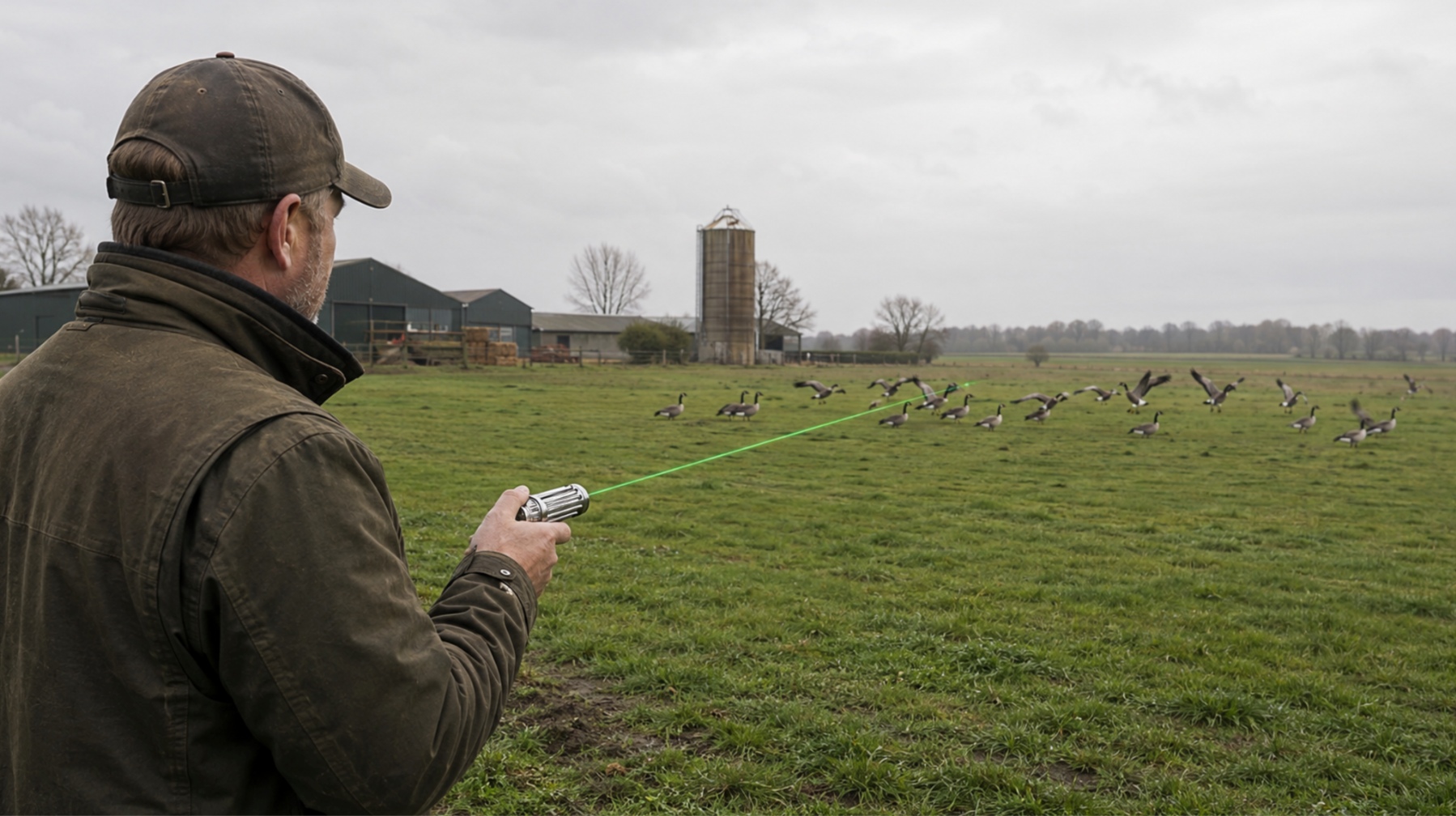
A long range laser for birds, such as a farm goose deterrent laser, can effectively scare birds from distances of up to 600 feet, and in ideal conditions, its bright green laser beam can reach as far as 2,500 meters. High-visibility green lasers are especially effective because birds can easily see the intense beam, making them an excellent choice for protecting crops without causing harm. The laser beam distracts and deters birds, keeping them away from your fields in a humane way. For optimal results, it’s important to use a powerful, high-quality laser with the correct settings, as factors like laser quality, weather, and bird species can influence effectiveness.
-
The bright green laser beam can sweep in a circle around you and move vertically, covering a wide area for maximum deterrence.
-
Raising the laser just one meter higher can extend its effective range by up to 100 meters.
Always use lasers responsibly and in accordance with local laws. Hgyuskl offers premium, high-visibility green lasers designed for accuracy and power, making them the ideal choice for farm goose deterrent lasers and long range bird control.
Key Takeaways
-
Green lasers can scare birds from up to 600 feet away, reaching 2,500 meters in ideal conditions.
-
Birds see green light well, making it effective for humane bird control on farms.
-
Weather and light conditions affect laser effectiveness; use in low light for best results.
-
Move the laser beam often to prevent birds from getting used to it.
-
Always follow safety rules and local laws when using lasers for bird control.
Laser Range for Bird Control

When investing in a long-range laser for avian deterrence, farm owners must understand its maximum effective reach in real-world agricultural settings. Professional-grade equipment, such as the true high-power models engineered by Hgyuskl, delivers verified output capable of humane wildlife control across expansive fields.
Maximum Effective Distance
A farm green laser can scare birds from about 600 feet away. In perfect weather, the beam can go up to 2,500 meters. This big range lets you use it in many ways. Birds see green light better than other colors. Their eyes have special parts that help them notice green. When you shine a green laser, birds see it fast. The beam bothers them and makes them leave your crops or water.
Hgyuskl uses direct 520nm green diodes and strong aviation aluminum cases. This keeps the laser beam bright and clear, even far away. You get a real tool that does what it says. You can trust the range and power, not like some products that say more than they do.
Tip: If you lift the laser just one meter higher, it can reach up to 100 meters farther. This easy trick helps you cover more space with less work.
Real-World vs. Ideal Conditions
How far your laser works depends on a few things. Sunlight, rain, and fog can make the beam hard to see. Birds also act different in each season and time of day. For example, you might see better results in winter, when birds are more active and easier to scare.
-
Sunlight can make the laser beam harder to see.
-
Rain or fog can spread the light, so it does not go as far.
-
Some birds might get used to the laser if you use it too much, but most still react to the moving beam.
Here is a table that shows how different birds act with laser deterrents in different weather:
|
Bird Species |
Response to Laser |
Best Conditions |
Notes |
|
Geese |
Strong |
Overcast, dusk/dawn |
Move beam slowly for best effect |
|
Starlings |
Moderate |
Cloudy, low light |
Use wider beam for groups |
|
Cormorants |
Strong |
Early morning |
Avoid direct eye exposure |
|
Pigeons |
Variable |
Any, but less in sun |
Repeat use may be needed |
Birds react best to green lasers because they think the moving light is like a predator. A wider beam works better, especially for big groups of birds. You can use Hgyuskl lasers for many things, but bird control is one of the top uses because they work well and are trusted.
Factors Affecting Laser Effectiveness
Power and Beam Focus
You need to pay close attention to the power and focus of your laser when you want to keep birds away from your farm. The output power, measured in milliwatts, determines how far the laser can reach and how visible it is to birds. A long range laser for birds with true high power will cover more area and work better in open fields. The focus of the beam also matters. A wide beam can scare groups of birds, while a narrow beam works for targeting single birds.
-
Lasers at 532nm are very effective because birds see this color as a threat.
-
Wide beams are better for large flocks of birds.
-
Professional-grade handheld lasers allow you to manually mimic unpredictable predator movements, which instantly triggers the birds' flight response.
You must use lasers with care. Studies show that too much exposure can hurt the eyes of birds like sparrows and starlings. Always move the laser beam and avoid pointing it at birds for a long time.
Weather and Light
Weather and light conditions change how well your laser works. You will notice that lasers are much more visible at night. During the day, sunlight makes the laser beam hard to see, and the range drops to about 100 meters. At night, the same laser can reach over 1,000 meters. Rain and fog can also spread the light, making it less effective.
-
Lasers work best in low light or cloudy weather.
-
Daytime use limits the range of your laser.
-
Nighttime or early morning gives you the best results.
If you want to get the most out of your laser, use it when the sun is low or the sky is cloudy.
Bird Species Response
Birds do not all react the same way to lasers. Most birds rely on their vision to spot danger. Green lasers match the colors birds see best, and the moving light can confuse them. Birds that have natural predators, like geese and starlings, react strongly to lasers. Predator birds, such as hawks, usually ignore the laser.
Some experts say that the power and color of the laser can affect how birds see it, but there is still much to learn. You should always use safe power levels to avoid hurting birds.
"Habituation does not occur: the movement on the laser never becomes predictable, so birds do not get used to it."
This means you can use lasers for a long time without losing their effectiveness. The efficacy of laser systems stays high because birds keep seeing the moving light as a threat.
Choosing a Long Range Laser for Birds

When you pick a long range laser for birds, you want one that works well on a real farm. It should last through daily use. The right laser helps protect your crops and saves you time and money. Hgyuskl has True High Power lasers with real output. You get the performance you expect. These lasers are not just for bird control. You can also use them for astronomy, outdoor safety, and science labs.
Key Features to Consider
Look for these essential mechanical and optical features when selecting a long-range tactical laser:
-
Aviation Aluminum Casing: A rugged, heavy-duty housing protects the sensitive optical components from accidental drops and harsh agricultural environments.
-
APC Constant Current Drives: This internal circuitry ensures the laser diode maintains a stable, non-fluctuating power output, even during extended use or temperature changes.
-
True Power Output: Many generic brands exaggerate their specifications. A reliable deterrent must offer verified, true high-power output to effectively cut through daylight and span large distances.
-
Direct Green Diodes: Compared to older DPSS technology, 520nm direct diodes offer superior stability in freezing winter conditions.
|
Feature |
Agricultural Benefit |
|
Aviation-Grade Housing |
Survives impacts, dust, and heavy farm usage. |
|
APC Circuitry |
Prevents the beam from dimming during critical hazing sessions. |
|
True High Power |
Ensures the beam reaches target flocks from hundreds of feet away. |
Hgyuskl’s green laser is engineered with aviation aluminum and APC constant current drives. This makes it tough and dependable. It keeps working in rain, wind, or sun. You can trust it to keep birds away without hurting them or nature.
Tip: Always check for real power and strong build. These things matter for how well your laser works over time.
Versatile Application Scenarios
A true high-power laser is a multi-functional tool. While highly effective for securing crops, ponds, and feed storage from invasive birds, its intense visibility makes it equally valuable for other demanding tasks. You can use the intense green beam for nighttime emergency signaling in outdoor survival situations, pointing out constellations during astronomy tours, or executing precise long-range alignments in industrial settings.
-
Bird Control: Use your laser to keep birds away from crops, ponds, and storage. The moving beam scares birds and stops them from eating.
-
Astronomy: Point out stars and constellations with the green laser.
-
Outdoor Survival: Signal for help or mark places in emergencies.
-
Lab and Industrial Use: Get steady beams for science tests and presentations.
Heavy-duty handheld lasers provide an incredibly cost-effective and highly mobile alternative to massive, fixed installations. With a handheld unit, farm owners can actively patrol vast perimeters and instantly target hidden flocks in complex terrain without the need for expensive smartphone apps or complex wiring. The moving patterns of the laser keep birds from getting used to it, so it keeps working.
If you want to know more about using a long range laser for birds with other tools, check out our guide on mixing bird deterrent solutions.
Safe and Legal Use of Lasers
Eye Safety
You should always keep your eyes safe when using a long range laser for birds. High-powered laser deterrents can hurt your eyes badly if you do not follow the rules. Safety groups give some steps to help keep everyone safe:
-
Learn how to use a laser before you start.
-
Use safety tools like the Horizon Safety System to turn off the laser if needed.
-
Never point the laser at planes, cars, or people’s heads.
-
Move the laser in a zig-zag when you aim at birds.
-
Pick a wide beam instead of a tight one for more safety.
-
Use the laser in short bursts, not all the time.
-
Look for things in the way before you move birds.
-
Always watch for planes nearby.
High-powered lasers, like Class 3B or 4, can be dangerous for people and birds. Do not point the laser at any living thing. Keep the beam moving and use sweeping motions to lower the risk.
Legal Restrictions
You must follow all local and national laws when you use laser deterrents. Many places have strict rules about lasers, especially near airports and public areas. Never aim the laser at planes or cars. Some places need you to get a permit to use a laser for wild birds. Always check the rules before you start. If you use automatic systems, you can keep away up to 90% of birds, but you must make sure your tools follow the law.
Note: Following the law keeps you and your farm safe. It also helps your laser deterrents work well and stay safe.
Environmental Impact
Laser deterrents are a kind and earth-friendly way to keep birds away. You do not need to use chemicals or traps. Lasers do not hurt birds or other animals and have little effect on nature. Use the laser at dawn and dusk for the best results. Change how you move the laser so birds do not get used to it. New laser systems help people and wildlife live together by using safe ways to scare birds. Studies show these lasers make birds leave without getting hurt. You help protect nature and keep your farm safe.
|
Method |
Environmental Impact |
Effectiveness |
|
Laser deterrents |
Minimal |
Up to 90% |
|
Chemicals |
High |
Variable |
|
Traps |
Moderate |
Low |
Tip: Use laser deterrents the right way to keep birds and nature safe.
You can use a long range laser for birds to protect your farm. The laser reaches up to 2,500 meters in ideal conditions. The 520nm green laser works well because birds see it quickly. You need to move the laser beam often so birds do not get used to it. Sunlight and weather change how far the laser works. Different birds react in different ways, so you must adjust your laser strategy.
-
The laser is more effective than other wavelengths, especially in daylight.
-
You should install and maintain your laser system for best results.
-
Use unpredictable light patterns to confuse birds.
-
Combine physical barriers with humane laser deterrents.
Choose a reliable, real-output laser for bird control. Hgyuskl offers True High Power lasers that help you keep birds away safely. Always follow safety rules and local laws. Upgrade your gear with Hgyuskl for professional results.
FAQ
How does a laser scare birds away?
You use a laser to create a moving beam of light. Birds see this bright light and feel uncomfortable. The efficacy of laser comes from how birds react to sudden changes in their environment. You can keep birds away without causing harm.
What is the best time to use a laser for bird control?
You get the best efficacy when you use a laser at dawn or dusk. Birds see the beam clearly in low light. You can also use it on cloudy days. Sunlight can reduce the efficacy, so avoid using it at noon.
Can birds get used to a laser over time?
You do not need to worry about birds getting used to a laser. The moving light keeps them alert. The efficacy stays high because the pattern changes. You should move the beam often for the best results.
Is a laser safe for people and animals?
You must use a laser with care. Never point it at eyes. The efficacy depends on safe use. You protect people and animals by following safety rules. Always keep the beam moving and avoid direct exposure.
How do weather conditions affect the efficacy of laser deterrents?
You see the highest efficacy in clear or cloudy weather. Rain or fog can lower the efficacy. You should check the weather before using your laser. Adjust your strategy to keep the efficacy high in all conditions.
Share:
Why High Visibility Green is the Standard for Amateur Astronomy
How Far Can a Laser Pointer Go? Beam Distance, Visibility, and Safety Explained