
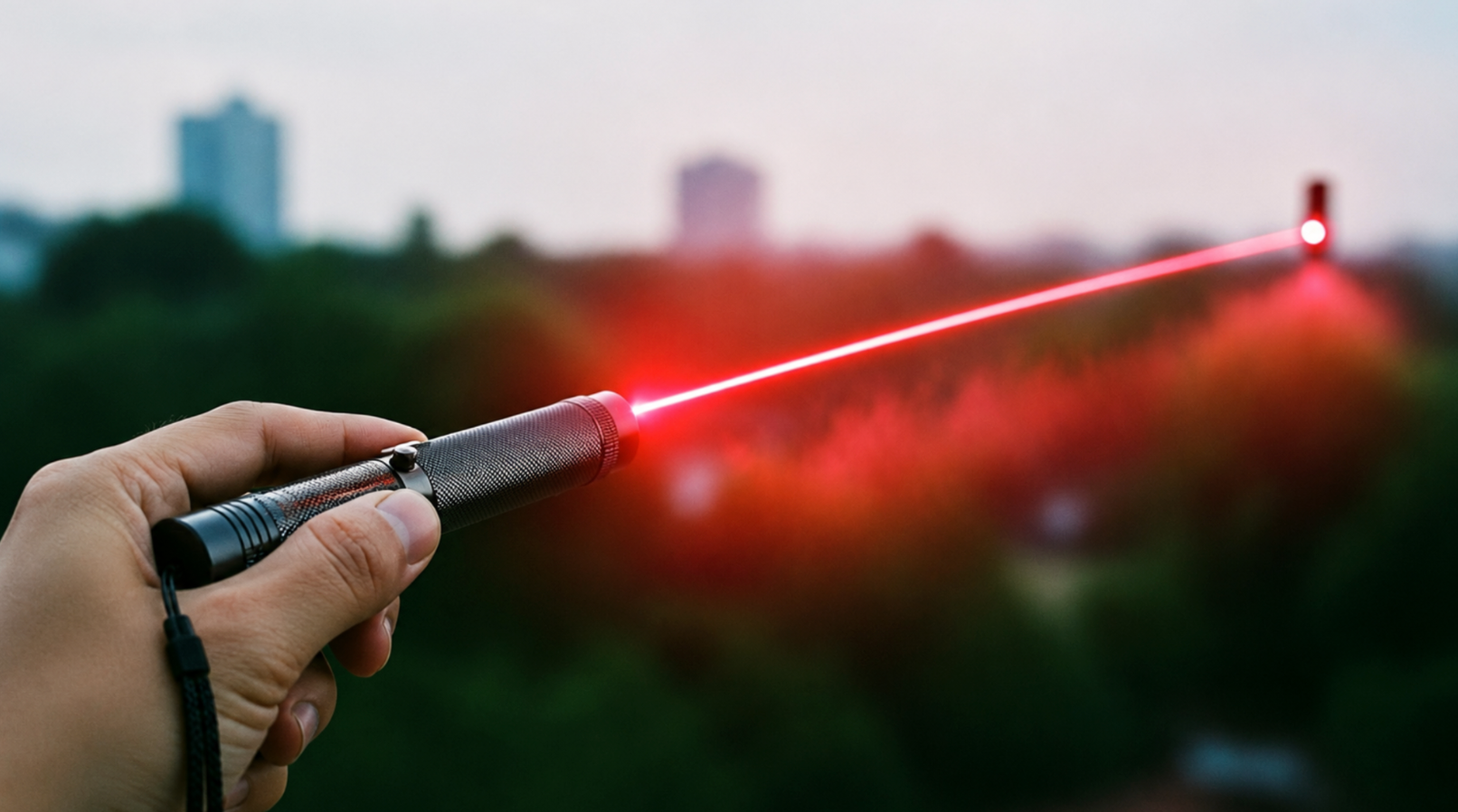
If you’re wondering how far a laser pointer can go, the answer depends on what you mean by “go.” A laser beam may continue traveling far beyond the point where the human eye can clearly see it, but practical visibility depends on power output, wavelength, beam divergence, weather, background light, and safe-use limits.
For most buyers, the more useful question is not only “How far can the beam travel?” but also “How far can I see it clearly and use it responsibly?” See the table below for a quick overview:
|
Laser Power Category |
Maximum Distance Range |
|
Low-Power (1mW–5mW) |
Common for presentations and basic pointing tasks. Visibility is limited in daylight but can be noticeable in darker environments. |
|
Medium-Power (5mW–50mW) |
May appear brighter in low-light outdoor settings, but legal restrictions and eye-safety risks increase significantly. |
|
High-Power (>50mW) |
Can remain visible over long distances under ideal nighttime conditions, but requires strict safety controls and may not be suitable or legal for general pointing use. |
Hgyuskl’s green laser pointers, including both 532nm & 520nm green laser pointer models, are engineered with robust aviation aluminum casings and APC constant current drives for superior performance. These long-range green lasers produce an exceptionally bright green laser beam, making them perfect for astronomy, outdoor survival, bird and wildlife control, and laboratory or industrial use. Even in challenging weather conditions or broad daylight, Hgyuskl’s green laser pointers deliver reliable, high-visibility results.
Key Takeaways
-
Laser pointer range depends on power. Low-power ones can go up to 1 mile. High-power green lasers can go over 10 miles.
-
Green lasers are easier to see than red lasers. This makes them good for astronomy and outdoor use.
-
They are bright and clear. Things like humidity and fog can make lasers harder to see. Pick a model made for tough weather. Always think about safety first. Do not point lasers at people or animals.
-
Use the lowest power you need for your job. Look for safety labels before you buy. Pick trusted brands like Hgyuskl for good quality and correct details.
How Far Can a Laser Pointer Go

You might wonder how far can a laser pointer go before buying one for astronomy, outdoor survival, wildlife control, or lab work. The answer depends on the power level, the color of the beam, and the quality of the parts inside. Hgyuskl laser pointers use strong aviation aluminum casings and APC constant current drives. This means you get real high power and very tough devices. Let’s look at the facts and clear up some common mistakes.
Distance by Power Level
Laser pointers have different power levels. Each level changes how far the beam can go. Some websites say lasers have 10,000mW or even 20,000mW, but these numbers are usually not true. Many people search for these big numbers, but user forums warn that lots of products are labeled wrong and can be unsafe. Hgyuskl gives you the real output, so you know what you are getting.
Here is a table that shows the farthest beam distances in tests:
Power output matters, but it does not create a simple one-to-one distance formula. A higher mW rating may increase brightness and hazard distance, yet practical visibility also depends on beam divergence, wavelength, air clarity, background light, and target reflectivity. This is why two laser pointers with the same power rating can appear very different outdoors.
Most laser pointers for people to buy are between 1mW and 100mW. Low-power models can reach up to 1 mile. Medium-power models can go several miles. True high-power pointers, like Hgyuskl’s green lasers, can send beams over 10 miles if conditions are perfect. Tests show that some brands do not tell the truth about their specs, but Hgyuskl gives you what they promise because they use professional parts.
Tip: If you use a laser pointer for astronomy, you want a beam that you can see across the night sky. For outdoor survival or wildlife control, you need a tough device that works in rain or very hot or cold weather. Hgyuskl’s aviation aluminum casing and waterproof design make these lasers work well in any situation.
Here are some ways people use laser pointers:
-
Astronomy & Stargazing: Point out stars and constellations with a beam that goes across the sky.
-
Outdoor visibility: Some users compare laser pointers for visibility in low-light outdoor environments. However, lasers should never be used as emergency signals toward aircraft, vehicles, people, or reflective surfaces. Dedicated emergency signaling tools are safer and more appropriate.
-
Controlled technical use: In laboratory or industrial environments, laser use should follow formal safety procedures, protective eyewear requirements, and controlled beam paths. Handheld laser pointers are not a substitute for regulated laser systems.
Many people think their laser pointer will go very far, but real tests show that above 5mW, the visible range does not get much better in daylight. The beam goes farther at night, but the risk to eyes gets much higher with more power. Waterproof or rechargeable features protect against rain, but not against shining the beam in someone’s eyes by accident.
|
Misconception |
Reality |
|
More mW = longer visible range |
More power does not guarantee proportionally better visible range. After a certain point, beam quality, wavelength, divergence, and environmental conditions may matter more than simply increasing the mW rating. However, the eye-safety risk increases quickly as output power rises. |
|
Waterproof or rechargeable means safe for unrestricted use |
IP68 rating keeps out rain — but does not protect against shining the beam in eyes or off shiny things. |
Green vs. Red Laser Visibility
You may ask why green laser pointers look brighter and easier to see than red ones. The human eye sees green light best, especially around 532nm. This means a green laser pointer looks much brighter than a red laser with the same power. For example, a 5mW green laser can look as bright as a 40–50mW red laser.
|
Laser Color |
Wavelength (nm) |
Perceived Brightness (%) |
|
Green |
532 |
88 |
|
Red |
633 |
24 |
-
Green lasers are easier to see because our eyes see green light best. -
Green beams are easy to spot even in daylight or from far away.
-
However, brighter does not mean safer. A green laser that is easy to see from far away can also create greater distraction and eye-safety risks if used carelessly.
|
Laser Color |
Wavelength (nm) |
Visual Interference Hazard Distance |
Relative Brightness |
|
Green |
532 |
1.8 NM |
4 times brighter than red |
|
Red |
635 |
0.9 NM |
1 time (baseline) |
If you use a laser pointer for astronomy or wildlife control, you want it to be as visible as possible. Green lasers are the best for these jobs. Hgyuskl uses top-quality 520nm direct green diodes, so the beam stands out even when it is hard to see.
Tests and reviews show that many brands say their lasers are stronger than they really are. Some products are much stronger than the label says, which can be dangerous. Hgyuskl always gives you the real output and uses professional parts, so you get good performance and safer use.
Note: Green lasers are brighter and easier to see in both daylight and at night. Some wavelengths can hurt your eyes more, so always use your laser pointer carefully.
If you still wonder how far can a laser pointer go, remember that the answer depends on power, color, and how well it is made. Hgyuskl gives you real high power and great visibility, so their laser pointers are perfect for astronomy, outdoor survival, wildlife control, and lab work.
Factors Affecting Laser Range
You might ask how far can a laser pointer go in real-world use. The answer depends on more than just power. The range and visibility of your laser pointer change with the quality of its parts, the environment, and even the surface you aim at. Let’s break down what really matters.
Power Output & Beam Quality
Power output plays a big role in how far your laser pointer can reach. When you increase the power, the hazard distance grows, but not as much as you might think. For example, if you jump from 5mW to 500mW, the hazard distance increases by about ten times, not a hundred. Higher power can also make the beam spread out more, which lowers the power density and can actually shorten the effective range.
Beam quality matters just as much as power. A high-quality beam stays focused over long distances. Low divergence means the beam stays tight and clear, so you can point out stars or signal across a field. Here’s a quick look at the main factors:
|
Factor |
Description |
|
Beam Quality |
High-quality beams keep focus over long distances, boosting travel range. |
|
Divergence |
Low divergence keeps the beam tight for longer, making it easier to see. |
|
Beam Waist |
Smaller waists focus better but can increase divergence. |
|
M² Value |
Lower values mean better focus and less spread, so the beam goes farther. |
Hgyuskl uses aviation aluminum housings and APC drive circuits. These features give you better heat control, stable output, and a beam that stays strong and focused. You can learn more about laser pointer technology in our detailed guide.
Environmental Conditions
The air around you changes how far your laser pointer can go. Humidity, fog, rain, and even dust in the air can scatter and absorb the laser beam. This means less power reaches your target. Weather like fog or snow can cut your range by a lot. Even on clear nights, humidity and tiny particles can make the beam wander or fade.
-
Humidity and pollution absorb laser energy, making the beam weaker.
-
Scattering from dust or water droplets spreads the beam out.
-
Temperature changes in the air can make the beam move or blur.
If you use your laser pointer outdoors, you’ll want a model built for tough conditions. Hgyuskl’s aviation aluminum body and cooling system keep your device running steady, even when the weather gets rough.
Target Surface
The surface you aim at also affects visibility. A white wall or a cloud will reflect more light, making the beam spot brighter and easier to see. Dark or shiny surfaces can absorb or scatter the light, making the dot harder to spot. For astronomy, use only an appropriate low-power pointer in a controlled stargazing setting, and stop immediately if any aircraft, vehicles, people, or reflective objects are nearby. Visibility should never be prioritized over safety.
Tip: For the longest visible range, use your laser pointer at night, aim at light-colored surfaces, and choose a model with a tight, high-quality beam.
Visibility vs. Beam Travel

What You See vs. Actual Reach
When you use a laser pointer, you might think the beam stops where you stop seeing it. That’s not true. The actual reach of a laser beam goes much farther than what your eyes can see. In fact, in a vacuum, a laser beam could travel forever! But here on Earth, the air, dust, and weather limit how far you can see the beam.
-
The visible distance you see depends on how clear the air is and how powerful your laser pointer is.
-
Even with a high-power green laser, your eyes usually see the beam for about 4 to 5 kilometers at night.
-
With optical aids like binoculars, you might spot the beam up to 12 kilometers away.
-
The “10km laser pointer” label means the beam can be seen up to 10 kilometers with help, not that you’ll always see a bright dot that far.
Tip: The spot you see on a wall or cloud depends on how reflective the surface is and how much light is around you. Bright backgrounds make the dot harder to see, while dark or cloudy skies help the beam stand out.
Day vs. Night Use
You’ll notice a big difference in how far a laser pointer goes during the day versus at night. Sunlight makes it much harder to see the beam, even if you use a true high-power laser.
-
Green laser pointers shine brightest in daylight. You can see them outside, but you need more power—over 50mW—to cut through the sun’s glare.
-
Blue lasers show up okay in dim light but fade fast in bright sun.
-
Violet lasers are hard to see in daylight and work best for special uses like UV experiments.
-
At night, even a 5mW green laser can look very bright and travel far. You don’t need as much power after dark.
A 115mW green laser pointer stands out in the sun, but at night, it can be blinding. Always use the lowest power you need for the job, and never point your laser at people, animals, or vehicles.
Note: If you want to know how far can a laser pointer go, remember that what you see depends on both the power of your device and the time of day. For the best results, use your laser pointer at night or in low light.
Safety & Legal Guidelines
Risks & Responsible Use
Laser pointers might look fun, but they can be dangerous. If you do not use them safely, people can get hurt. Here are some things you should know to stay safe:
-
Visual Impairments: Shining a laser pointer in someone’s eyes is risky. It can cause flash-blindness, afterimages, or glare. This can distract drivers or pilots and cause accidents.
-
Potential Hazards: Pilots and drivers have said lasers distracted them. Even a short flash can make it hard to see and react.
-
Nominal Hazard Zones (NHZ): The ANSI Z136 Standard tells where laser radiation is unsafe. You should keep people out of these areas.
To use your laser pointer safely, follow these tips:
-
Never point a laser at eyes, animals, or aircraft.
-
Only use laser pointers on things, not people or pets.
-
Do not shine lasers at shiny surfaces.
-
Use the lowest power and widest beam you can.
-
Read the full safety label before use. Do not treat a warning label as a formality. Higher-class laser products require stricter controls, proper protective eyewear, and a controlled environment.
-
Kids should only use laser pointers with an adult.
-
Always check for warning labels on your laser pointer.
Tip: Pick a laser pointer with safety features like interlock systems or beam covers. These help stop accidents from happening.
Laws & Regulations
Laser pointers have rules to keep people safe. Many countries have strict laws about using them. If you use a laser pointer the wrong way, you can get in big trouble.
-
United States: The FDA says all laser pointers need safety labels. Only Class IIIa/IEC Class 3R lasers (up to 5mW) are okay for most people. The FAA can fine you up to $25,000 if you point a laser at an airplane.
-
United Kingdom: Pointing a laser at an airplane can mean a fine up to £2,500 or five years in jail. The Road Traffic Act also gives fines for putting drivers in danger.
-
Australia: You must follow AS/NZS2211.1:1996 rules. There are special rules for healthcare and building work, like training and safety gear.
|
Power Limit (mW) |
Class |
Description |
|
< 1 |
Class 2 |
Safe for most people to use |
|
1 - 5 |
Class 3R or IIIa |
Be careful, do not shine in eyes |
|
5 - 500 |
Class 3B |
Dangerous, use with care |
|
> 500 |
Class 4 |
Not for most people, very risky |
Note: Always check your country’s laws before you buy or use a laser pointer. If you break the rules, you could get a fine, lose your laser, or go to jail. Be smart and use your laser pointer the right way!
You’ve learned how far a laser pointer can go depends on power, beam quality, and safety. Check out this quick guide:
|
Laser Power (mW) |
Max Range (feet) |
Hazard Distance (feet) |
|
5 |
52 |
52 |
|
125 |
164 |
164 |
|
500+ |
Hazardous |
Hazardous |
Choose real-output, professional-grade tools like Hgyuskl for true performance and safety. Here’s how you can use your laser pointer wisely:
-
Match your laser to your main task.
-
Always check for safety labels.
-
Focus on visibility, not just range.
-
Look for safety features.
-
Trust brands with clear specs.
Never point your laser at people, animals, or vehicles. For reliable results, upgrade your gear with Hgyuskl’s trusted tools.
FAQ
How far can a laser pointer go in clear weather?
In clear nighttime conditions, a green laser pointer may appear visible over long distances, but the exact range depends on output power, wavelength, beam divergence, air quality, and surrounding light. Avoid relying on fixed “mile” claims unless the seller provides clear testing conditions.
Is it safe to use a laser pointer for astronomy?
Yes, you can use a laser pointer for astronomy if you follow safety rules. Never point it at people, animals, or aircraft. Always choose the lowest power needed for your stargazing session.
Why do green lasers look brighter than red ones?
Your eyes see green light better than red. A green laser at the same power looks much brighter and travels farther. That’s why green lasers work best for outdoor use and astronomy.
Can I use a laser pointer in the rain?
You can use a waterproof laser pointer, like Hgyuskl models, in the rain. Rain and fog will make the beam less visible, but the device stays safe if it has a strong, sealed casing.
What should I do if my laser pointer stops working?
First, check the batteries and make sure they are charged. If it still does not work, look for dirt on the lens or signs of damage. Contact the manufacturer for help if you cannot fix it.
Share:
How far can a farm green laser reach to scare birds effectively?
Best Green Laser Pointer for Astronomy: Safe Stargazing Buyer’s Guide