
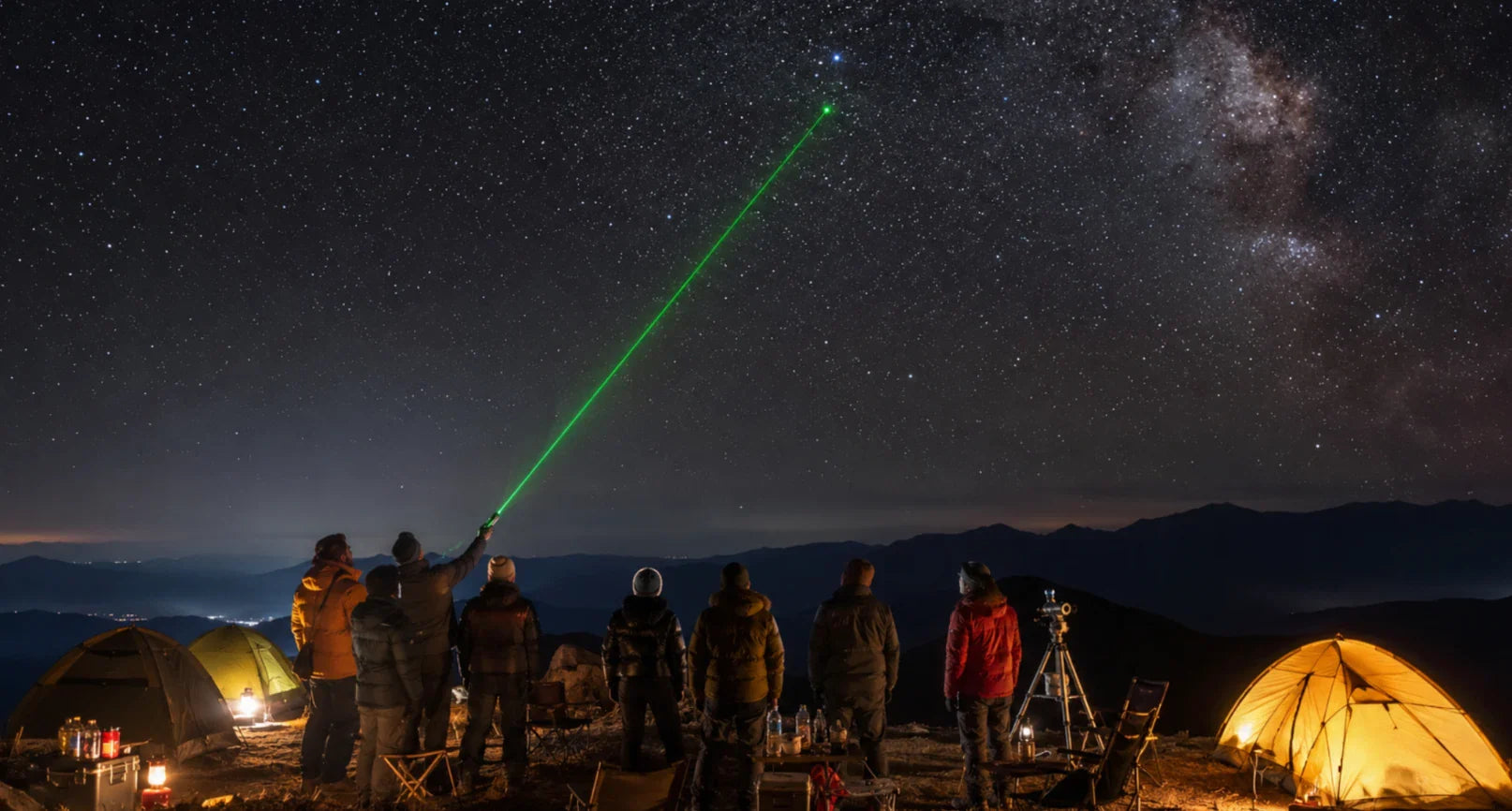
If you are looking for the best green laser pointer for astronomy, focus on three things first: safe output power, clear beam visibility, and reliable product labeling. Green laser pointers stand out because your eyes see their beams much better than red or blue. The 532nm & 520nm green laser pointer creates a bright, clear line that cuts through the night sky. High-visibility green lasers help you point out stars and constellations with ease. For astronomy, the goal is not maximum range, but a visible, controlled beam that can be used responsibly in a dark-sky setting. When you pick a laser, keep these points in mind:
-
Make sure your laser stays below 5mW and includes a solid IR filter for eye safety.
-
Look for products with clear output labeling, laser class information, manufacturer identification, safety warnings, and compliance statements required in your market.
-
Never use unapproved lasers in public spaces.
You can stargaze with confidence when you pick a safe, legal, and reliable laser.
Key Takeaways
Key Takeaways
-
For astronomy and public stargazing, choose a green laser pointer with 5mW or below whenever possible.
-
Green wavelengths around 520nm–532nm are easier for the human eye to see at night than red or blue wavelengths.
-
For 532nm DPSS green lasers, an effective IR filter is important because invisible infrared leakage can create additional safety risks.
-
Buy a strong model with a battery that lasts a long time for long nights of stargazing.
Why Green Laser Pointers Are Preferred for Astronomy

Visibility and Wavelength Benefits
When you step outside for a night of stargazing, you want a tool that makes the sky come alive. Green laser pointer astronomy stands out because your eyes see green light better than any other color. The beam from a green laser pointer appears as a bright, clear line that stretches across the sky. This happens because your eyes are most sensitive to green light, especially around 532 nanometers. Even in low-light conditions, the green beam stays visible and strong.
-
The human eye’s sensitivity to green light peaks at about 555nm, and it remains very high at 532nm.
-
At the same output power, a green laser will usually appear much brighter to the human eye than a red, blue, or violet laser. However, visible brightness does not always reflect the actual hazard level, so buyers should still check the output power, wavelength, and laser class.
-
You only need a modest power green laser to create a visible beam, while blue or red lasers need much more power to achieve the same effect.
Because of this, green laser pointer astronomy tools help you point out stars, planets, and constellations with ease. You can guide a group or teach others about the night sky without losing the beam in darkness.
Green vs. Red and Blue Lasers
You might wonder why astronomers do not use red or blue lasers as often. The answer comes down to visibility and performance. Here’s a quick comparison:
|
Laser Color |
Wavelength (nm) |
Astronomy Visibility |
Buyer Notes |
|
Green |
520nm / 532nm |
Usually the most visible choice for night-sky pointing |
Best balance of visibility and low-power use when kept at 5mW or below |
|
Red |
635nm / 650nm |
Less visible as a sky-pointing beam |
Better for preserving night vision, but harder for groups to follow |
|
Blue |
445nm / 450nm |
Can be visible, but often less efficient for astronomy pointing |
Usually not the first choice for public stargazing |
-
Green lasers have shorter wavelengths, making them stand out in the night sky. -
Red lasers appear dimmer, even at the same power.
-
Blue lasers can be bright, but your eyes do not pick them up as well as green.
Most astronomers choose green laser pointer astronomy tools because the green beam stays visible over long distances. You can see the path of the laser, not just the end dot. This makes it easier to show others exactly where to look and helps everyone learn the constellations faster.
Buyer’s Guide: Choosing a Safe Green Laser Pointer
Choosing the right green laser pointer for astronomy is not just about brightness. A good stargazing pointer should have suitable output power, a visible green wavelength, stable beam quality, clear safety labeling, reliable battery performance, and a durable body for outdoor night use. Their pointers use aviation aluminum cases, APC constant current drives, and direct green diodes. These parts are important. They make the pointer feel solid and shine bright. You get real performance, not fake numbers.
Power Output and Legal Limits
You must check the power output. Laws say how strong your green laser pointer can be. If you want to use your pointer for astronomy, always check your country’s rules.
Laser pointer laws vary by country, state, and local area. In the United States, laser products promoted for pointing or demonstration purposes are limited to Class IIIa / IEC Class 3R levels, which generally means 5mW or below in the visible wavelength range. Buyers outside the U.S. should check their local rules before purchasing or using a green laser pointer for astronomy.
For most green laser pointer astronomy activities, a pointer with 1-5mW power is best. This range gives you a bright beam and stays legal. You can see the safety classes here:
|
Power Level (mW) |
Typical Class |
Description |
|
≤5 |
Class 3R / IIIa |
Commonly used for astronomy pointing when handled responsibly and legally |
|
5 - 30 |
Class 3B / IIIb |
Higher eye-safety risk; not suitable for public stargazing or casual pointing |
|
15 - 100 |
Class 4 / IV |
High-risk laser class requiring strict controls; not appropriate for general astronomy pointer use |
Tip: Pick a green laser pointer with ≤5 mW for public astronomy. This keeps you safe and legal in most places.
When comparing Hgyuskl models or any other astronomy laser pointer, check the labeled output, wavelength, laser class, safety warnings, and compliance information before purchase.
Essential Safety Features
Safety is very important. A good green laser pointer astronomy tool has features to protect you and others. Look for these things:
-
Clear compliance labeling: Look for output power, wavelength, laser class, manufacturer identification, warning labels, and applicable compliance statements.
-
Built-in IR filter: Blocks harmful light you cannot see.
-
Safety key or lock: Stops accidents, especially with kids.
-
Class IIIa/3R rating: Keeps power safe.
For Hgyuskl models, highlight only the safety features that are clearly listed on the product page, such as safety locks, output labeling, wavelength information, and protective design details. Avoid assuming one model meets every international rule unless you can provide documentation. You can use your pointer for astronomy, outdoor survival, wildlife control, and lab work.
Durability and Battery Life
You want a green laser pointer that lasts a long time. Good build quality is important. Hgyuskl uses aviation aluminum for the case. This makes it strong and tough. The lens is polished glass for a clear beam. Inside, good diodes and crystals keep the beam bright.
Battery life is important too. Most good green laser pointers use CR123 lithium batteries. These batteries last for hours and work in cold weather. Your pointer will stay bright, even in the cold. Here is what you can expect:
|
Feature |
Details |
|
Battery Type |
CR123 lithium battery |
|
Battery Life |
Lasts for hours, good for long nights |
|
Cold Weather Impact |
Lithium batteries work well in the cold |
|
Build Quality |
Aviation aluminum case, waterproof, tough design |
|
Performance |
Beam stays bright, even in city lights |
|
Safety Features |
Safety key, IR filter, Class IIIa rating |
|
Best Use Scenarios |
Astronomy, stargazing tours, constellation pointing, night-sky education, small group observing sessions |
Note: Always bring extra batteries, especially in cold weather. Keep them in your pocket to stay warm.
Best Astronomy Use Cases
A green laser pointer for astronomy is best used in controlled, responsible stargazing situations, such as:
- Pointing out stars, planets, and constellations during a guided night-sky session
- Helping beginners understand the shape and position of constellations
- Supporting small-group astronomy education
- Assisting with telescope alignment only when the beam path is controlled and the area is clear
Avoid using an astronomy laser pointer for emergency signaling, animal deterrence, or general outdoor pointing. These uses require different safety considerations and may involve additional legal restrictions.
Top Green Laser Pointer Astronomy Models
Best Picks and Value Comparison
If you want a good green laser pointer astronomy tool, look for models that work well and last long. You should also check which brands experts like. Let’s see how some top models compare.
|
Feature |
What to Look For in an Astronomy Green Laser Pointer |
|
Wavelength |
520nm or 532nm green light for high night-sky visibility |
|
Output Power |
5mW or below for most public astronomy use |
|
Beam Quality |
Stable, visible beam without excessive scatter |
|
Safety Features |
Clear labels, safety warnings, lock mechanism, and IR filtering for 532nm DPSS models |
|
Build Quality |
Durable housing suitable for outdoor night use |
|
Battery Performance |
Reliable output in cool nighttime conditions |
For buyers comparing Hgyuskl models, useful details to check include housing material, wavelength, output labeling, beam stability, battery type, and listed safety features. This makes the pointer strong and bright. Orion and Z Bolt are good for people just starting out. Hgyuskl has better materials and checked specs. If you want to learn more about how laser pointers are made, read our guide on materials and diode technology.
Tip: Always check if the pointer has real output and safety features before buying. The best models use direct green diodes. These diodes make the beam clean and help the pointer last longer.
Pros and Cons of Each Model
It helps to know what is good and bad about each model. Here is a quick list:
|
Model |
Advantages |
Disadvantages |
|
Hgyuskl Pro Series |
Real output, aviation aluminum, direct green diode, strong safety features |
Higher price than entry-level models |
|
Orion SkyLine Deluxe |
Reliable, easy to use, good for beginners |
Basic build, not as durable |
|
Z Bolt Premium |
Verified specs, polished optics, safety lock |
Slightly heavier, mid-tier price |
|
Sanwu |
Consistent power, premium support |
Limited availability |
|
JetLasers |
Durable, balanced power, expert support |
May require special batteries |
Green astronomy laser pointers commonly use either 520nm direct-diode technology or 532nm DPSS technology. Direct-diode 520nm models can offer simpler optical design, while 532nm DPSS models are widely used and may require effective IR filtering. The beam stays clean. You get true specs and a pointer that lasts longer. Good materials are important. Aviation aluminum and copper cases protect your pointer and help keep it cool. If you use your pointer in cold weather, you need a strong case. Cheap models with weak metal can break when you need them most.
-
Direct green diodes help stop IR leakage and make the pointer safer.
-
Strong metal cases keep your pointer safe in tough places.
-
Checked specs make sure you get what you pay for.
If you want a green laser pointer for stargazing, choose a model that prioritizes controlled visibility, clear labeling, safe output power, and reliable nighttime performance.
Safe Usage and Stargazing Tips

When you use green laser pointer astronomy tools, you want to enjoy the night sky and keep everyone safe. Following the right steps helps you avoid accidents and legal trouble. Let’s look at the best ways to use your laser pointer safely and responsibly.
Eye Safety Guidelines
Green laser pointers can be powerful. You need to protect your eyes and the eyes of others. Here are some important do’s and don’ts:
-
Always check the sky for aircraft before you use your laser.
-
Use a stable mount or tripod to keep the beam steady.
-
Announce to your group when you plan to use the laser.
-
Use the laser only in a controlled observing area after checking that the beam path is clear of aircraft, vehicles, people, animals, and reflective surfaces. Keep each use brief and purposeful.
-
Store batteries separately to prevent the laser from turning on by accident.
-
Never point the laser near anyone’s head or eyes.
-
Never view the beam or beam spot through binoculars, telescopes, cameras, or other optical instruments. Optical devices can concentrate light and increase eye-safety risks.
-
Never assume green means safe. Some lasers leak invisible infrared light.
-
Never leave your laser pointer where children can reach it.
High-powered green lasers can cause serious eye injuries. The retina is very sensitive. Even a short flash can lead to permanent vision loss. The bright green beam is easy to see, but that also means it can hurt your eyes faster than other colors. Always treat your laser pointer with care.
Tip: For more on laser safety, visit our Laser Safety Guide.
Beam Visibility and Range
You might wonder how far your green laser pointer can reach. Under clear, dark conditions, a 5mW green laser can appear highly visible for astronomy pointing, especially when the viewer is close to the operator and the beam is used briefly. Exact visibility distance depends on air clarity, beam divergence, background light, and observing conditions. Stronger lasers can reach even farther, but you should always use the lowest power needed.
Many things affect how far you can see the beam:
-
Power output: Higher power means a brighter, longer beam.
-
Wavelength: Green lasers at 532 nm look brighter than red or blue.
-
Beam focus: A tight beam stays bright over long distances.
-
Weather: Fog, clouds, and humidity can make the beam look dim.
-
Darkness: The darker the sky, the easier it is to see the beam.
Note: Always use your laser pointer in safe, open areas. Never point a green laser pointer at aircraft, vehicles, people, animals, or reflective surfaces. Do not use it near airports, flight paths, roads, or crowded public areas.
Legal Regulations and Responsible Use
You must follow the law when using a laser pointer. In the United States, the FDA requires warning labels on all laser pointers. Most legal models for stargazing are Class II (up to 1 mW) or Class IIIA (up to 5 mW). The FAA has rules to protect pilots from glare, especially near airports.
Some states, like Arkansas, ban the sale of laser pointers to minors and require adult supervision. Other states may have similar rules. Always check your local laws before you use your laser pointer.
Here are some best practices for responsible use:
-
Use a laser pointer with 5 mW or less for astronomy.
-
Follow all safety rules and never point at people or vehicles.
-
Make sure your device has the right labels and is registered if needed.
For more on legal compliance and responsible use, see our Laser Laws and Regulations Resource.
If you want a safe green laser pointer for stargazing, choose one that works well and is built strong. Hgyuskl is a good pick because it has real power and good safety parts. Always follow the law and use gear that is approved for safety. Brands like ADM and HoTech also make green laser pointers you can trust. Here is a simple checklist to help you stay safe:
-
Decide what you will use the pointer for.
-
Make sure it meets class rules and has the right power.
-
Look for proof that it was tested by others.
-
Check what kind of battery it uses.
-
See if the company helps customers.
Pick Hgyuskl if you want a pointer that works well every time. Keep learning about the rules and check out our Laser Safety Guide for more help.
FAQ
What makes green laser pointer astronomy better than using other colors?
Green laser pointer astronomy stands out because your eyes see green light best. The beam looks brighter and clearer at night. You can point out stars and constellations easily. This makes green lasers the top choice for stargazing.
Is it legal to use a green laser pointer for astronomy?
You can use a green laser pointer for astronomy if you follow local laws. Most places allow pointers under 5 mW. Always check your country’s rules before you buy or use one.
How do I keep my green laser pointer safe around kids?
-
Store your laser pointer in a locked drawer.
-
Remove the batteries when not in use.
-
Never let children use the laser without an adult.
Safety first! Always supervise kids around lasers.
Can I use my green laser pointer for other activities?
A green laser pointer chosen for astronomy should primarily be used for controlled night-sky pointing and education. Other uses, such as outdoor signaling, wildlife deterrence, or technical work, may involve different safety rules, legal restrictions, and equipment requirements.
Share:
How Far Can a Laser Pointer Go? Beam Distance, Visibility, and Safety Explained
Green Laser Pointer Buying Guide: Power, Visibility, Safety, and Buying Tips