
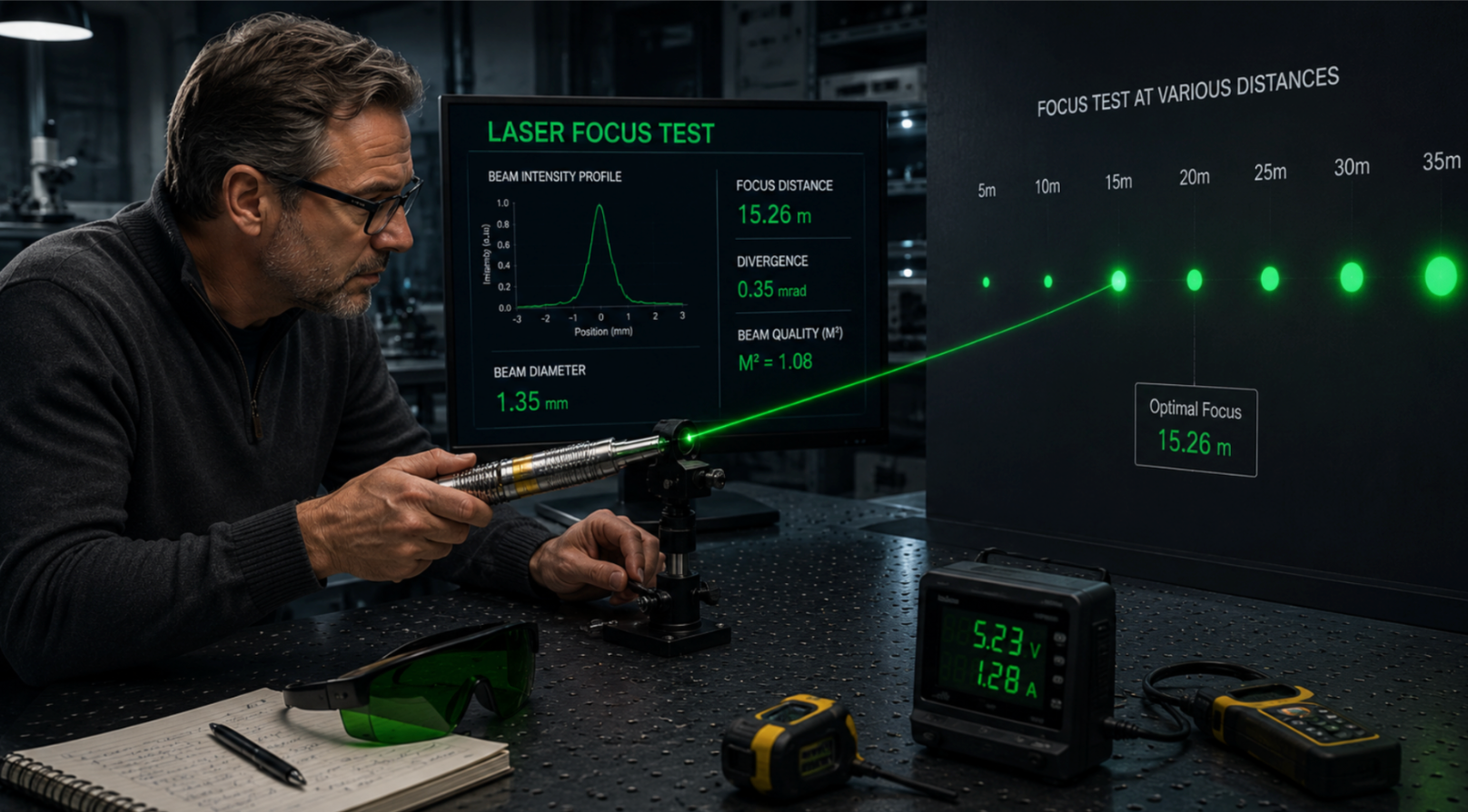
Welcome to our light guide. A fixed focus laser uses a pre-set lens. It gives the best long-range clarity. An adjustable focus system lets you turn the barrel. This gives you flexible focusing options. Pick a focusable laser pointer for changing target distances. Choose fixed beams for easy point-and-shoot stargazing. High-visibility green lasers are great for astronomy. High-power blue lasers give strong energy density. Hgyuskl builds High-power laser pointers with true output power. They also use APC drivers and aviation aluminum bodies.
Key Takeaways
-
A fixed focus laser pointer is simpler and easier to use because the lens position is preset.
-
A focusable laser pointer lets you adjust the spot size or beam appearance for different distances, but it does not increase the laser’s total output power.
-
Adjustable focus adds flexibility, but it may also add moving parts that require more care, cleaning, and alignment.
-
Fixed focus can be a better choice for simple pointing tasks, while adjustable focus can be useful when users need controlled spot-size adjustment.
-
Safety depends on laser class, output power, wavelength, exposure conditions, and beam control—not on focus type alone.
Understanding Fixed Focus vs Adjustable Focus

Laser light tools shape beam paths. They help with outdoor work. Pick optics that fit your task.
Fixed Focus Laser Mechanics
Factory teams set a fixed focus laser. It works best at a set distance. The main internal lens stays in one place. It sits inside the aviation aluminum body. This setup lines up all internal parts.
💡 Key Takeaway: A factory-set focus can provide consistent beam behavior when the optical assembly is well aligned. They stop lens movement and errors.
You get great beam alignment right away. The set lens keeps high optical output. It needs no moving parts. You press the switch now. The diode sends a bright straight line. Because fixed focus designs have fewer external focusing parts, they may be simpler to operate and easier to keep consistent. However, durability still depends on the specific housing, seals, lens assembly, and product rating. Outdoor users like these optics. They work well for stargazing tasks. They also help with long-range pointing.
Adjustable Focus Lens Design
An adjustable focus system gives beam control. You turn a lens ring outside. This changes the space inside. It alters diode and lens gaps. Turning the ring moves the beam point.
An adjustable focus laser pointer uses a movable lens or rotating focus ring to change how the beam is collimated. Depending on the design, the spot may appear wider or narrower at a given distance.
This can help users adapt the visible spot for different viewing distances, but it does not increase the laser’s total output power. A smaller spot may look more concentrated, which also means safety precautions become more important.
This system offers an adjustable focal range. It works at many target distances. You get total control by turning parts. Hgyuskl builds strong threads for this. They last during rough outdoor use. Good laser beam focusing changes your beam. You can adapt in seconds.
Energy Density and Collimation
Learn about beam divergence and focusing. Diodes set the natural beam divergence. Lenses only change where light rays cross.
Smaller spot sizes raise energy density fast. Light power uses this Gaussian beam formula:
Focusing changes how the same optical output is distributed. When the spot becomes smaller, the beam can appear more concentrated at that distance. When the spot becomes wider, the same output is spread over a larger area.
This is why focus adjustment should be treated as a safety issue, not just a convenience feature. Users should avoid direct exposure, reflections, vehicles, aircraft, people, and animals regardless of focus setting.
Proper laser beam focusing packs more light. It puts energy on tiny spots. You get top tool performance. Just match tools to your distance. A good focusable system puts power where needed.
Practical Guide to Focusable Laser Pointer Uses
Pick good light tools. They change field tasks fast. This guide helps you. It solves hard problems anywhere.
💡 Pro Tip: Match your target distance right. This helps your tool last long.
Astronomy and Night Sky Tours
For supervised astronomy or stargazing, a fixed focus, clearly labeled low-output green laser may be convenient because it is simple to use and does not require focus adjustment.
However, any sky-pointing use must be handled carefully. Never direct a laser toward aircraft, flight paths, vehicles, people, or public areas, and follow local observing-site rules.
-
Scattering Intensity Law: Short light waves scatter much faster
-
Wavelength Advantage: Green light can appear more visible than red for many users because human eyes are more sensitive to green wavelengths. Atmospheric scattering can also affect beam visibility, but real-world visibility depends on output power, divergence, humidity, dust, background light, and viewing angle.
-
Practical Visibility: Small green lasers show bright lines. Small red lasers fade fast.
Set optics lock your beam fast. Just aim at big stars. Do not turn rings late.
Humane Wildlife and Bird Control
Wild animals cause big problems. Pests hurt farms and ponds. Use an adjustable beam now. It scares pests away safely.
Spread your beam wide first. Broad light spots scare big pests. Animals run away fast.
A focusable laser pointer changes spot sizes. It works at any distance. Cover big land or far targets easily.
Technical Mechanics of Laser Beam Focusing
Impact of Power Output in Milliwatts
Big power changes light focus steps. High output needs smart tool control. Tight focus makes tiny light spots. Higher output power increases both visibility and hazard potential. Focus adjustment should not be used to encourage burning, cutting, or unsafe exposure. Buyers should treat output power, focus setting, and eye protection as connected safety factors.
An Automatic Power Control circuit preserves stable optical power:
-
Inner sensors check real-time light output.
-
Smart chips change power settings fast.
-
Heat controls stop big power drops.
Role of Diode Wavelengths
Light colors change spot focusing results. Wavelength affects how a beam appears to the human eye, but focus behavior also depends on diode shape, lens design, beam divergence, and output power. A focusable green laser and a focusable blue laser may feel different in use, but buyers should compare actual model specifications rather than assuming one color always focuses better.
Thermal Effects and Beam Concentration
Hot parts shift inner glass lens paths. High heat changes light waves quickly. This heat shift ruins beam focus quality.
Heat can affect output stability and focus consistency, especially in higher-output products. Check the product’s duty cycle, body material, heat-dissipation design, and safe operating instructions. Good cooling keeps light spots steady. Great focus puts energy on small dots. Smart heat control keeps beams steady. Deep planning builds better working tools.
Selecting the Right Focus for Your Needs
Distance and Target Environment
Pick the right tool now. Distance helps you choose best.
This guide helps you choose. It finds your focusable laser pointer.
Set distance tasks like fixed lenses. Hard jobs need proper laser beam focusing. This hits moving targets well.
An adjustable focal range changes beams. It works across far distances.
|
Decision Factor |
Fixed Focus |
Adjustable Focus |
|
Ease of use |
Simpler |
Requires adjustment |
|
Moving parts |
Fewer |
More |
|
Spot-size control |
Limited |
More flexible |
|
Consistency |
Good for repeated pointing |
Depends on setting |
|
Maintenance |
Usually lower |
Lens threads may need more care |
|
Best for |
Simple pointing |
Variable distance / spot-size control |
Durability and Lens Maintenance
Adjustable focus designs may expose lens threads or moving parts to dust, moisture, or wear depending on the construction. Keep the lens clean, avoid forcing the focus ring, and follow the product manual for cleaning and storage.
Final Decision Checklist
|
Question |
Choose Fixed Focus If... |
Choose Adjustable Focus If... |
|
Do you want simple operation? |
Yes |
Not the priority |
|
Do you need spot-size control? |
No |
Yes |
|
Will others use the device? |
Fixed may reduce misuse |
Adjustable needs more instruction |
|
Is dust/moisture a concern? |
Fewer moving parts may help |
Check seals and threads |
|
Is safety training limited? |
Simpler may be safer |
Avoid high-output misuse |
|
Are you comparing products? |
Check divergence and class |
Check focus mechanism and class |
Fixed focus and adjustable focus laser pointers serve different needs. Fixed focus designs are simpler and more consistent, while focusable designs give users more control over spot size at different distances.
When comparing Hgyuskl models or any other laser pointer, do not choose by power or “burning” claims. Check the wavelength, output power, laser class, beam divergence, focus mechanism, duty cycle, safety labels, and documentation before buying.
FAQ
Can you adjust the beam on a fixed focus laser pointer?
No. A fixed focus laser pointer has a preset lens position. It is designed for simple, consistent pointing rather than manual spot-size adjustment.
How do you change the dot size on a focusable laser pointer?
Most focusable laser pointers use a rotating lens barrel or focus ring. Turning it changes the lens position and changes how the spot appears at a given distance. Do not adjust focus while pointing at people, animals, vehicles, aircraft, or reflective surfaces.
Why does laser beam focusing matter for outdoor applications?
Focusing matters because beam shape, spot size, and divergence affect visibility and control. Outdoor use also requires extra caution around roads, aircraft, people, animals, and reflective surfaces.
Share:
520nm vs 532nm Green Laser Pointer: Which Wavelength Should You Choose?
650nm red laser pointer vs green: Visibility and Use Cases