
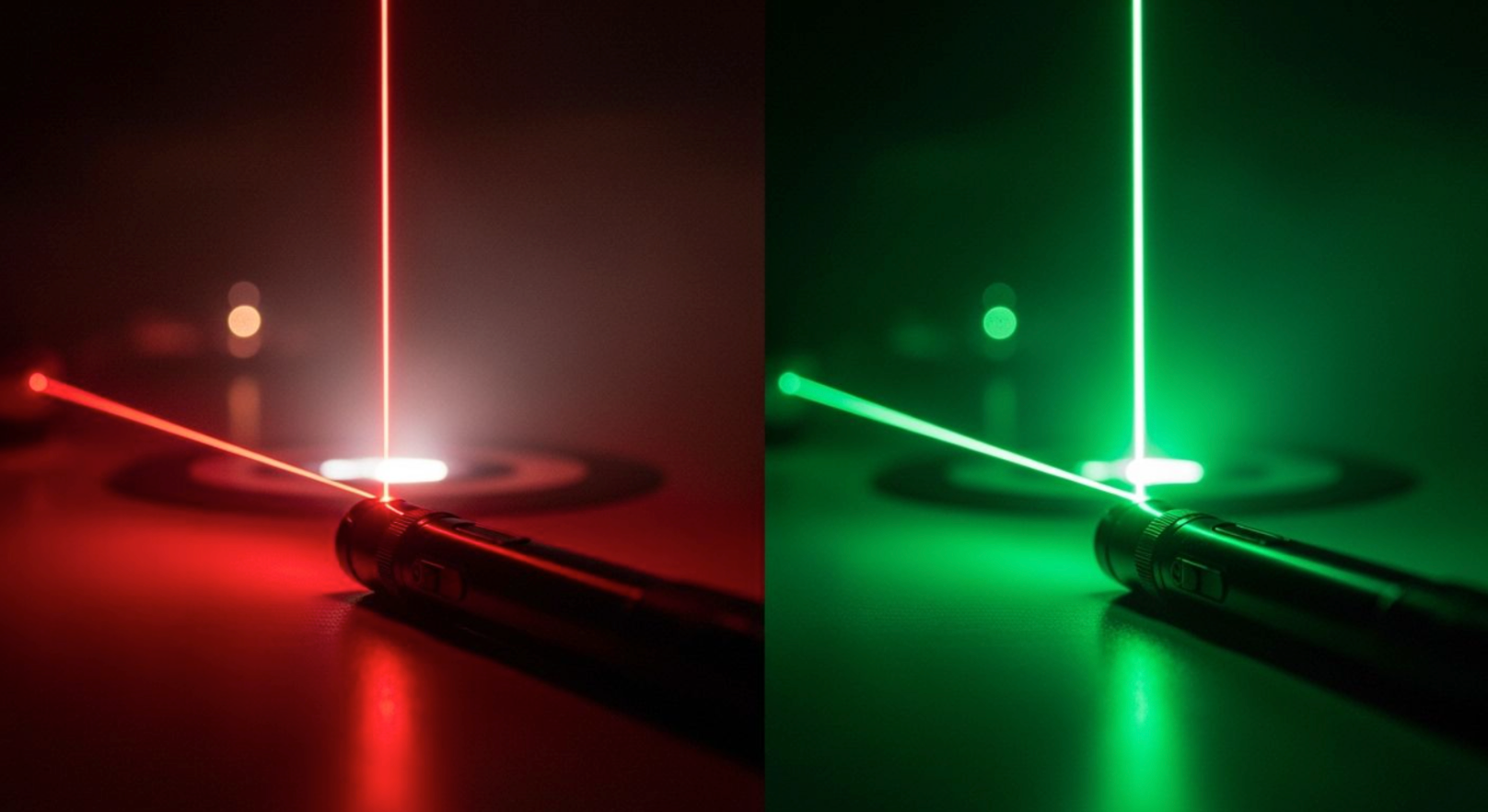
When comparing a 650nm red laser pointer vs green, human eye sensitivity determines the brightness. You can see green light about nine times better than red light. For long distances and a clear beam, choose a 532nm & 520nm green laser pointer. For basic indoor tasks, select a 650nm red laser. Hgyuskl promises real power for all colors.
Key Takeaways
-
Green lasers such as 520nm and 532nm usually appear brighter than 650nm red lasers at the same optical output because human eyes are more sensitive to green wavelengths.
-
650nm red lasers are often practical for indoor presentations, short-distance pointing, and lower-cost everyday use.
-
Green lasers are often easier to see outdoors or in low-light beam-visible situations, but higher visibility does not mean they are automatically safer.
-
Red lasers are not always “weak,” and green lasers are not always “better.” The right choice depends on lighting, distance, laser class, output power, battery needs, and intended use.
-
For astronomy or outdoor use, never direct any laser toward aircraft, vehicles, people, or public areas.
650nm Red Laser Pointer vs Green: Visibility Science

Human Eye Sensitivity and Wavelength Perception
Human eye biology explains the main brightness difference when you compare a 650nm red laser pointer vs green. Your eyes respond differently to each light wavelength. In bright light, daylight vision controls human sight and reaches peak sensitivity at 555 nanometers. This top sensitivity point sits 95 nanometers below 650nm light.
|
Wavelength |
Color |
Visual Meaning |
|
555nm |
Yellow-green |
Peak photopic sensitivity |
|
532nm |
Green |
Very high perceived brightness |
|
520nm |
Green |
High perceived brightness, deeper green tone |
|
650nm |
Red |
Lower perceived brightness at equal output |
The eye sensitivity chart drops quickly away from this top viewing zone. Since 650nm is deep in the red range, red light appears quite dim. At equal power, you perceive green light as much brighter. Daylight vision determines outdoor visibility during the day. Under daylight-adapted vision, the human eye is most sensitive near 555nm. Because 650nm sits deeper in the red range, it usually appears dimmer than green wavelengths at the same optical output power.
Safety classification is a separate issue. In the United States, visible laser products promoted for pointing or demonstration purposes are generally limited to Class IIIa / IEC 3R, up to 5mW. Products above that range may fall into higher hazard classes and should not be treated as ordinary pointers.
Beam Visibility and Rayleigh Scattering
Weather and air conditions affect how well you see a laser beam in mid-air. Tiny floating particles scatter light through a process called Rayleigh scattering. Inside a total vacuum, any light beam stays completely invisible. Air particles bounce photons around in every direction, sending light straight to your eyes. Shorter light waves scatter much more strongly than red light does.
Green beams are often easier to see in the air because green wavelengths are more visible to human eyes and because shorter wavelengths scatter more than deep red light. However, beam visibility is not determined by wavelength alone.
Humidity, dust, smoke, beam divergence, output power, background light, and viewing angle all affect whether you see a beam path or only a dot.

This natural process changes how lasers look in dark outdoor spaces. These scientific facts directly affect real-world viewing conditions. A green laser creates a sharp beam across the night sky, helping you trace its path easily. A red beam usually appears much less visible in mid-air than a green beam at the same output, especially without mist, dust, or other scattering particles. In many indoor settings, users mainly see the red dot rather than a visible beam path.
|
Measurement Category |
Green Wavelength Performance |
Red Wavelength Performance |
|
Dot Visibility Range |
Long distance across daylight |
Moderate distance indoors |
|
Beam Visibility Range |
Visible mid-air line outdoors |
Invisible mid-air path |
Because of low light scattering, deep red beams perform poorly in open outdoor spaces. Green lasers may be easier to see for outdoor pointing or supervised astronomy use, but outdoor use requires strict attention to aircraft, roads, people, animals, and local rules. Understanding these visual facts helps you pick the right laser color for your specific target distance and lighting conditions.
Performance Breakdown: Red Laser vs Green Laser
Power Consumption and Thermal Stability
You get superior battery efficiency when you choose a simple direct-diode 650nm red laser. This electronic design draws minimal energy from your power source while delivering a stable beam. Red-only models emit red light continuously during long operational sessions.
|
Laser Type |
Key Feature |
Battery Life per Charge |
|
Red-only (650 nm) |
Direct-diode; simple circuitry |
120+ minutes (longest) |
Red laser products are often simpler in construction, while green laser products may use either direct-diode or DPSS designs. Durability and runtime should be judged by the specific model, not by color alone.
Check the product’s battery type, duty cycle, body material, driver design, temperature guidance, and warranty information before making a purchase decision.
Manufacturing Cost and Component Durability
Older green models used complex crystal modules that lost power quickly. Hgyuskl builds professional gear using direct green semiconductor diodes. This advanced engineering projects bright green light directly without delicate conversion crystals. A solid brass structure provides high shock resistance for internal components. The direct diode achieves a rated lifespan of 10,000 hours at 25°C.
Hgyuskl maintains strict manufacturing standards across all tools to preserve beam stability. An APC constant current drive regulates energy flow to prevent hazardous power spikes. Heavy-duty aviation aluminum housing protects delicate internal parts against heavy outdoor impact. When comparing Hgyuskl models or any other red or green laser product, check the labeled wavelength, output power, laser class, battery type, driver design, warning labels, and safe-use documentation.
Many of our customers have reported a 20+ year lifespan for their red pointers and 10+ years for green devices.
Best Practical Applications for Each Wavelength
Picking a 650nm red laser pointer vs green relies on your target distance, ambient lighting, and daily needs.
Key Use Cases for 650nm Red Laser Tools
Indoor spaces like school classrooms and office boardrooms work well with simple pointers. While presenting inside a normally lit room, a red dot offers clear contrast against projection screens. Excellent battery savings stay a huge perk for this wavelength. A standard red pointer draws low energy, letting presentation clickers and indoor leveling tools operate dependably over extended sessions.
Red laser pointers are perfectly adequate for indoor presentations in dimly lit rooms, being the traditional, most common, less expensive, and energy-efficient type.
|
650nm Red Laser Use Case |
Why It Can Make Sense |
|
Indoor presentations |
Adequate dot visibility in controlled lighting |
|
Short-distance pointing |
Simple, familiar and low-cost |
|
Training or classroom demonstrations |
Easy to see on nearby screens or objects |
|
Alignment-style visual reference |
Only when using equipment intended for that task |
Red diodes also power tactical firearm sights for close-range target aiming. These specific devices deliver steady performance in indoor tasks while skipping heavy power draw. Still, pet owners must handle these beams with great care. Always stick to low-power red devices under 5mW during pet games to safeguard animal vision.
Optimal Scenarios for High-Visibility Green Laser Gear
Green lasers are often more practical when visibility is the main concern, especially for outdoor pointing in shaded or low-light conditions and for supervised astronomy-style pointing.
However, green does not mean universally better. In bright sunlight, even green dots can become difficult to see. For outdoor or sky use, users must consider aircraft, roads, public areas, local rules, and laser output class.
"A laser pointer can provide the convenient solution you need. By aiming the laser at the target, they’ll immediately be able to spot the star or planet in question."
A green beam stays easy to see in the surrounding air, making a sharp path toward targeted stars. This bright color helps leaders point out constellations without ruining night-adapted eyes.
Farm managers also use a green beam as a gentle animal deterrent. Nuisance birds view the sudden green beam like a physical threat and leave crops right away. Field research proves this tactic gets over 80% avoidance during bird pest control. Feeding damage from wild ducks and geese stopped entirely during real tests. From tactical signaling to farm management, these devices provide incredible reach and outdoor value.
Choosing the Right Laser Pointer for Your Needs
Assessing Working Environment and Lighting
You must look closely at your location when comparing a 650nm red laser pointer vs green. Surrounding room light controls how well any dot shows up on targets. A green laser looks eight to ten times brighter than a red one at identical power levels indoors. This glowing beam easily stays visible up to 10 meters inside bright offices. Red pointers work fine in dark rooms, but light cuts down their target contrast.
Outside environments create special projection problems for every single pointer. Direct sunlight quickly fades out laser dots past short distances. Even so, green tactical tools shine well under cloudy skies or in shady spots. In cloudy weather, green light makes targets 300 to 400 percent easier to spot at 30 meters. Strong sunlight drops total distance, so choosing green guarantees good daytime visibility at work.
Safety Ratings and Quality Engineering Standards
Using lasers means you must pay close attention to radiation safety rules. In the United States, visible laser products promoted for pointing or demonstration purposes are generally limited to Class IIIa / IEC 3R, up to 5mW. Products above this range may fall into higher hazard classes and require stricter controls.
Do not rely on blink reflex as a safety strategy. Avoid direct eye exposure at any power level, and check the product’s class label, output power, wavelength, warning statements, and manufacturer information before use.
Good building practices keep the light steady under changing conditions. Top Hgyuskl designs use special circuits to stop dangerous power jumps. Their tough metal covers protect soft glass parts from drops on rough job sites. Buying a solid red or green laser gives you clear dots, great distance, and safe everyday use.
Comparing a 650nm red laser pointer vs green shows clear advantages for different needs. Choose a 650nm red laser pointer when you need a simple, cost-effective option for indoor pointing or short-distance use. Choose a green laser pointer when perceived visibility matters more, especially in low-light or outdoor pointing conditions.
Before buying Hgyuskl or any other brand, compare wavelength, output power, laser class, battery type, runtime, beam focus, safety labels, and intended use. Color alone should not be the only decision factor.
FAQ
Why does a green beam look brighter than a red beam?
Green wavelengths such as 520nm and 532nm are closer to the peak of human daytime visual sensitivity than 650nm red light, so they usually appear brighter at the same optical output. Actual visibility still depends on power, beam divergence, surface color, and ambient light.
Can you use a red beam for stargazing?
A red laser can create a visible dot, but red beams are usually much less visible in the night sky than green beams at the same output. For astronomy-style pointing, many users prefer low-output green lasers, but any sky use must avoid aircraft, flight paths, vehicles, people, and public areas.
Which option offers longer battery life?
Red laser pointers often use simpler low-output diode designs, so they may offer longer runtime in indoor pointer-style products. However, runtime depends on output power, battery capacity, driver design, duty cycle, and product model.
Share:
Focusable Laser Pointer Guide: Fixed Focus vs Adjustable Beam
Laser Pointer Safety Lock Guide: Key Switches, Tail Caps, and Safe Storage