
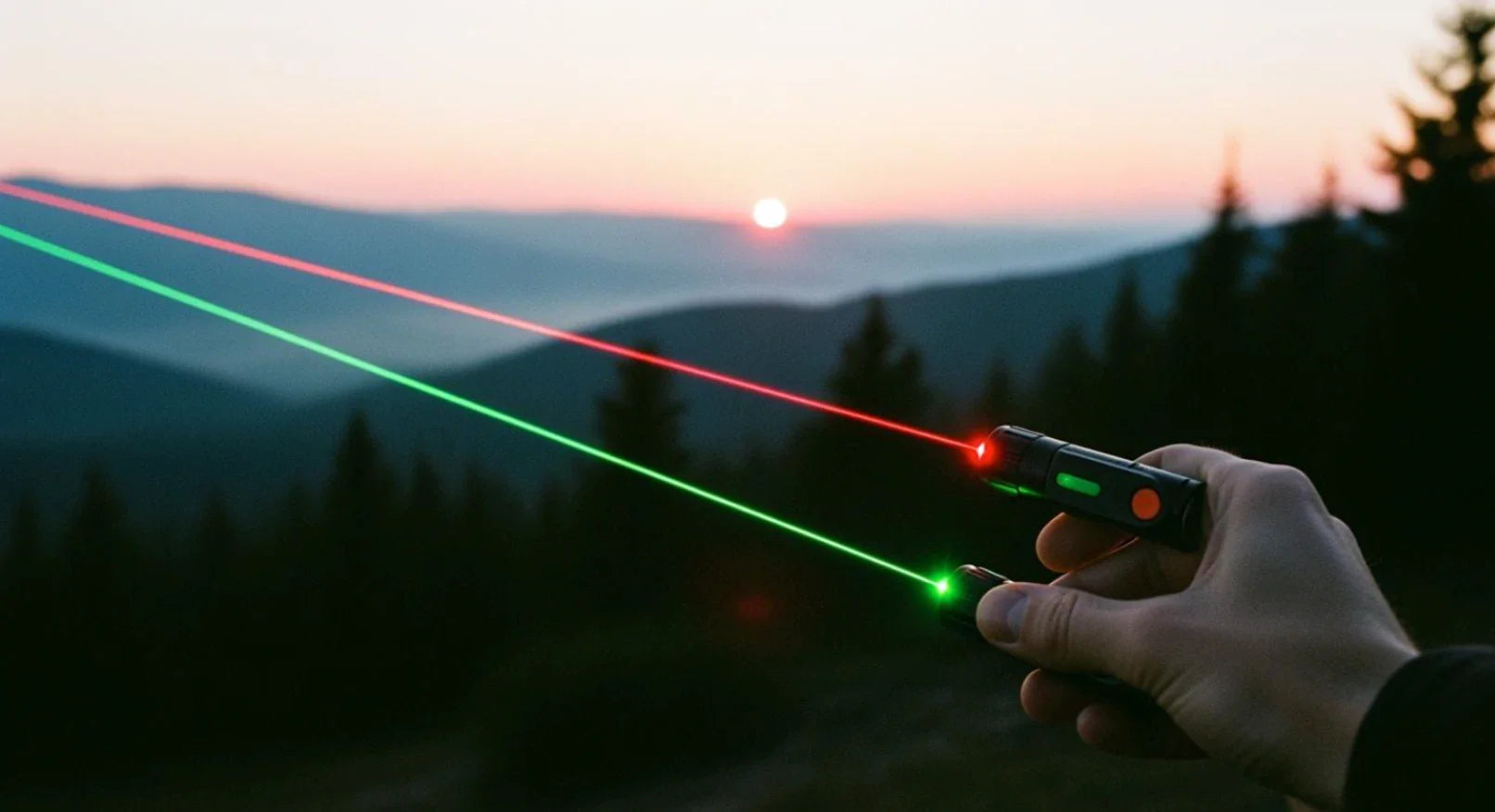
When it comes to outdoor visibility, choosing between green vs red laser pointers is crucial. Green laser pointers are particularly easy to see because our eyes are more sensitive to green light, especially at 532 nanometers. In fact, you can see green lasers up to five times better than red ones during daylight. Long-range green lasers are especially effective, as they are brighter and can reach impressive distances, making them ideal for stargazing or signaling. On the other hand, red laser pointers, such as the 650nm red laser pointer, tend to last longer on a single charge but are not as visible in outdoor settings. Opting for high-quality, professional products like Hgyuskl ensures you achieve optimal performance when you need a powerful laser outdoors.
-
Green lasers are brighter and easier to see outside.
-
Red lasers last longer and are often more affordable.
Key Takeaways
-
Green laser pointers usually appear brighter than red laser pointers at the same output power because the human eye is more sensitive to green wavelengths.
-
Green is usually the better choice for outdoor low-light visibility, astronomy-style pointing, and guided demonstrations.
-
Red laser pointers are often more affordable, more power-efficient, and better suited for indoor presentations or short-range pointing.
-
Bright sunlight, fog, rain, dust, and background surfaces can reduce or change the visibility of both green and red lasers.
-
Do not choose a laser pointer based only on brightness or range. Check the mW output, wavelength, laser class, warning labels, and local laws before buying.
Green vs Red Laser Pointer: Visibility Comparison

Eye Sensitivity to Green vs Red
When you look at a green and a red laser pointer, you can see a clear difference. Your eyes see green light better than red light. The best light for your eyes is around 555 nanometers, which is green-yellow. Most green laser pointers use 532 nanometers, which is very close. Red lasers use light between 630 and 670 nanometers, which is farther from what your eyes see best.
-
A green laser can look 4 to 8 times brighter than a red laser with the same power.
-
Green is much easier to see, especially outside.
-
Many people say their red laser is hard to see outdoors, but green lasers are easy to spot, even near green trees or grass.
For buyers comparing Hgyuskl models or any other laser pointer brand, the useful specifications are wavelength, labeled output power, laser class, beam divergence, safety labeling, battery type, and housing quality. Outdoor visibility should be evaluated together with safety and legal suitability, not only advertised range.
Brightness in Outdoor Light
Sunlight can make it hard to see a laser beam. In many outdoor conditions, green lasers appear brighter than red lasers at the same output power. However, in direct sunlight, even a green laser beam can be difficult to see, especially over distance or against bright backgrounds. Your eyes see green light much better, so a green laser pointer looks brighter than a red one, even if both have the same power.
-
Green lasers are easier to see in sunlight because your eyes pick up green light better.
-
Red lasers fade fast in bright outdoor light.
-
Because green light appears brighter to the human eye, a lower-power green laser may sometimes provide better perceived visibility than a higher-power red laser. However, actual battery life depends on the laser design, battery type, output power, driver efficiency, and runtime settings.
Hgyuskl’s aviation aluminum case and waterproof design keep your laser safe in tough outdoor places. You can trust the real power to shine through daylight, which is great for looking at stars, signaling for help, or leading groups at night.
Day vs Night Performance
The time of day changes how well you see a green or red laser pointer.At the same output power, a 532nm green laser can appear much brighter than a common red laser such as 635nm. Some visibility models estimate that 532nm green appears about four times as bright as 635nm red under equal conditions. This makes green the best choice for outdoor use when the sun is out. At night, both green and red lasers are easier to see, but green is still brighter because your eyes are more sensitive to it.
|
Laser Color |
Outdoor Visibility Fit |
Main Advantage |
Main Limitation |
|
Green |
Better for low-light outdoor visibility and astronomy-style pointing |
Higher perceived brightness |
Requires careful safety and legal checks |
|
Red |
Better for short-range or indoor-style pointing |
Lower cost and longer battery life |
Less visible outdoors, especially in bright light |
-
Use a green laser pointer for looking at stars, outdoor safety, or animal control. -
Pick a red laser pointer for indoor work or when you want the battery to last longer.
If you want the best range for outdoor activities, always choose a green laser pointer. Hgyuskl’s strong materials and real power give you confidence to use your laser anywhere outside, from leading a group under the stars to signaling for help.
Tip: In very bright places or for long distances, you might need a laser detector to see the beam well, even with a green laser.
When you know how your eyes see green and red laser beams, you can pick the right one for you. Hgyuskl makes sure you get the best performance, strength, and brightness for every outdoor trip.
Red vs Green Lasers: Outdoor Factors

When you compare red vs green lasers for outdoor use, you need to think about how each laser performs in real-world conditions. The right choice depends on lighting, distance, and weather. If you want the best visibility, you must understand how green and red lasers react to sunlight, fog, and rain. This knowledge helps you pick the right tool for astronomy, survival, or wildlife control.
Lighting and Ambient Conditions
Outdoor lighting changes fast. You might use your laser in bright sunlight, deep shade, or at dusk. Each setting affects how well you see the beam.
-
Green lasers are much more visible than red lasers in direct sunlight.
-
For pointer-style use, do not assume that higher mW is the right answer. In the United States, products promoted for pointing or demonstration purposes are generally limited to Class IIIa / IEC Class 3R levels, meaning 5mW or below in the visible range. Higher-power products may require stricter controls and may not be legal for general pointer use.
-
Red lasers, especially those with low power, can disappear in bright conditions.
Green lasers are 30 times brighter to the human eye than red ones, even at the same power level.
You will notice that green lasers stand out in almost any light. Red lasers work best in low light or indoors.
Distance and Beam Spread
The distance your laser can reach matters for outdoor activities. You want a beam that stays strong and visible over long ranges.
|
Factor |
How It Affects Outdoor Visibility |
|
Wavelength |
Green wavelengths usually appear brighter than red wavelengths to the human eye |
|
Output Power |
Higher mW can increase visibility but also increases safety and legal risks |
|
Beam Divergence |
Lower divergence helps the beam stay tighter over distance |
|
Background Light |
Bright sunlight reduces visibility for both green and red lasers |
|
Weather |
Fog, rain, dust, and humidity can change beam appearance and reduce clarity |
|
Target Surface |
Light-colored matte surfaces are usually easier to see than dark or reflective surfaces |
-
Your eyes see green light better than red, so green lasers reach farther. -
Green lasers help you point out stars or signal across fields.
-
Red lasers have a shorter range and work best for close-up tasks.
Weather Impact
Weather can change how your laser works. Rain, fog, and humidity all affect visibility.
Fog, rain, humidity, and dust can make a laser beam scatter. This may make the beam path more noticeable at close range, but it can also reduce distance, clarity, and safe control. Green usually remains easier to perceive than red, but weather does not make laser use automatically safe or reliable.
Practical Considerations
Battery Life and Power Use
When you use a green or red laser pointer outside, battery life is important. Green laser pointers are brighter, but they use more power. Red laser pointers last much longer on one charge. You can see the difference in this table:
|
Battery Factor |
Green Laser Pointer |
Red Laser Pointer |
|
Typical efficiency |
May use more power depending on design and output |
Often more power-efficient |
|
Runtime |
Varies by battery, driver, and output power |
Often longer at comparable use levels |
|
Buyer note |
Check real runtime specs, not just color |
Good choice when long runtime matters more than beam visibility |
If you need your laser for a long time, red laser pointers are better. Green laser pointers are easier to see in daylight, but you must recharge them more often. Hgyuskl makes strong, waterproof laser pointers with good power control. You get steady performance even in tough outdoor places.
Tip: Bring extra batteries for your green laser pointer if you will be outside for a long time.
Cost and Availability
Green laser pointers cost more than red laser pointers. Good choice when long runtime matters more than beam visibility, depending on their power and features. You can find them in many places, like Brazil and the United States. Red laser pointers are cheaper and easier to buy, but they are not as easy to see outside as green laser pointers.
-
Green laser pointers: $25–$55, easy to find.
-
Red laser pointers: Cheaper, very easy to buy.
Hgyuskl sells strong green laser pointers with tough aluminum cases and good parts. You pay for strength and real power, which helps in hard outdoor places. For more information, check Hgyuskl’s product page.
Safety and Legal Issues
Safety is important when you use any laser outside. Federal law says laser pointers must be 5 milliwatts or less, called Class 3R. Lasers above this limit cannot be called pointers. Pointing a laser at an airplane is a federal crime, and you can go to prison for up to five years. Some states need extra safety features, like a key switch or a delay.
-
Never point a laser at cars or people.
-
Always check your local laws before using a laser pointer outside.
-
Use lasers carefully at public events.
|
Risk Type |
Description |
|
Distraction |
Laser pointers can distract drivers, pilots, and people using vehicles. |
|
Eye Injury |
Using lasers wrong can hurt someone’s eyes. |
|
Misuse in Events |
Lasers can be used badly at public events and cause safety problems. |
You keep yourself and others safe by following these rules. Hgyuskl’s strong, waterproof design helps you use your laser pointer safely in any place. For best results, clean the lens with a soft cloth and keep your laser pointer in a cool, dry spot.
Note: Green lasers need careful cleaning because their parts are sensitive. Red lasers are stronger and can handle rough use.
Recommendations for Outdoor Use
Astronomy and Stargazing
If you want to point out stars at night, you need a laser that is easy to see. Experts say green laser pointers are best for astronomy. Your eyes see green light better, especially at 532 nanometers. The green beam stands out in the dark sky. This makes it simple to show constellations and planets.
Here are some tips for safe stargazing:
-
For astronomy-style pointing, a properly labeled green laser pointer with 5mW or below is usually the more responsible choice where local laws allow. Lower power does not remove all risk, so avoid aircraft, vehicles, people, animals, reflective surfaces, and optical instruments.
-
Do not point your laser at people, animals, or cars.
-
Make sure your laser has the right labels and is registered.
Hgyuskl lasers have strong aluminum cases and are waterproof. This means you can use them in any weather. The real power makes sure your green laser is visible, even when it is wet or cold. You get a tool you can trust every time you look at the stars.
Outdoor Visibility vs Emergency Signaling
Outdoor visibility does not mean a laser pointer should be used as an emergency signal. If you need emergency signaling equipment, use tools specifically designed and approved for that purpose, such as emergency lights, signal mirrors, whistles, radios, or beacons.
Never direct a laser pointer toward aircraft, vehicles, roads, people, animals, public spaces, or reflective surfaces.
Wildlife Control and Professional Applications
Wildlife or bird-deterrent use requires separate legal, safety, and humane-use guidance. Do not assume a general green or red laser pointer is appropriate for animal deterrence. If this is your intended use, check local wildlife rules, protected-species regulations, and product suitability before considering any laser-based method.
Hgyuskl green lasers use direct green diodes for steady power. The strong aluminum case protects the laser from drops and water. This makes it great for outdoor work. You get a tool that is bright, tough, and meets high standards.
|
Feature |
Details |
|
Power Level (mW) |
Class 3R / IIIa for safety and legality |
|
Battery Type |
CR123 lithium for long-lasting performance |
|
Build Quality |
Aviation aluminum casing, waterproof, rugged design |
Pick a green laser pointer from Hgyuskl for the best results in astronomy, survival, and wildlife control. You get real power, strength, and the confidence to face any outdoor job.
When you look at green and red laser pointers for outside, green lasers are easier to see. Green beams show up better in sunlight and can go farther. Many people and experts pick green lasers for outdoor jobs, looking at stars, and emergencies. The table below explains why green lasers are better:
|
Feature |
Green Laser |
Red Laser |
|
Visibility |
Very high outdoors |
Moderate, indoors |
|
Best Use |
Stargazing, survival |
Presentations |
For outdoor visibility, green is usually the better choice because it appears brighter to the human eye than red at the same output power. Red remains a practical option when battery life, affordability, and indoor use matter more than beam visibility.
When comparing Hgyuskl models or any other brand, check the wavelength, labeled output power, laser class, battery type, warning labels, and local regulations before buying.
FAQ
What makes green vs red laser pointer beams different for outdoor use?
Green laser beams are easier to see outside. Your eyes notice green light more than red. Green lasers look brighter and can go farther. This makes them better for seeing in sunlight or at night.
Can I use a green laser pointer during the day?
Yes, you can use a green laser pointer in the daytime. Green beams stay bright even when the sun is out. Red beams get hard to see very fast. For things like astronomy or signaling, green lasers work best.
Are green laser pointers safe for stargazing?
Green laser pointers are safe for stargazing if they are under 5 mW. Never point them at people, animals, or planes. For stargazing, choose a properly labeled, lower-power green laser pointer that matches your local laws. Use it only in controlled settings and never point it near aircraft, vehicles, people, animals, or reflective surfaces.
How does weather affect green vs red laser pointer performance?
Green lasers work well in fog, rain, or wet air. You can see the green beam even in bad weather. Red lasers get dim quickly when it is foggy or rainy. Green lasers are better for outdoor use.
Why should I choose Hgyuskl for my outdoor laser pointer?
Hgyuskl gives you real power, a strong case, and waterproof safety. These things help your green laser pointer work well outside. Upgrade to Hgyuskl for better visibility and safety.
Share:
What Is a 532nm Green Laser Pointer? Wavelength, Brightness, and Use Cases
Blue Laser Pointer vs Green Laser Pointer: Visibility, Use Cases, and Safety