
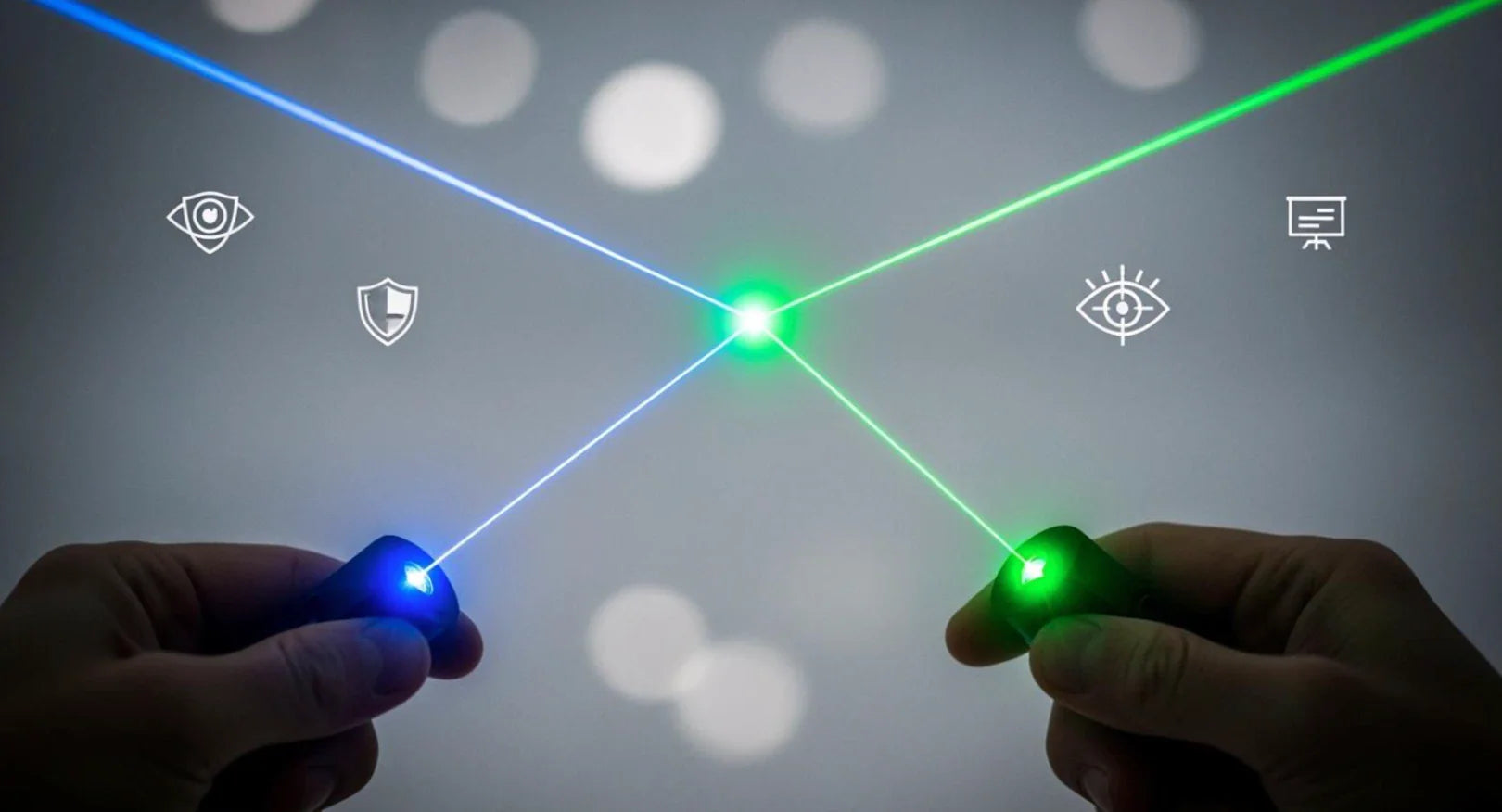
When you look at blue laser pointer vs green, you see a big difference in how well you can see them. Green laser pointers are easier to see because your eyes notice their wavelength more. This makes them much brighter than blue laser pointers with the same power. For example, green lasers make more lumens for each watt and look bright even during the day. If you want a tool that is very strong and dependable, professional brands like Hgyuskl give good performance you can trust. Always pick the one that fits your needs and safety best.
Key Takeaways
-
Green laser pointers usually appear brighter than blue laser pointers at the same output power because the human eye is more sensitive to green wavelengths.
-
Green is usually the better choice for astronomy-style pointing and low-light beam visibility.
-
Blue laser pointers are more specialized and should be evaluated carefully based on wavelength, output power, laser class, and safety requirements.
-
Do not choose a laser based only on color or advertised brightness. Check the mW output, wavelength, laser class, warning labels, and local regulations.
-
Avoid using any laser pointer for emergency signaling, public pointing, animal deterrence, or use near aircraft, roads, vehicles, people, animals, or reflective surfaces.
Blue Laser Pointer vs Green: Visibility

Which Is More Visible?
When you look at blue and green laser pointers, you can see a big difference in how easy they are to see. Green laser pointers are the easiest for most people to notice. Our eyes see green light best, especially at 532 nanometers. This makes green lasers look much brighter than blue ones, even if both have the same power. In real life, A green laser pointer at 532nm looks 8 times brighter than a blue laser pointer at 450nm with the same power. That is why green lasers are the best choice when you need to see the beam clearly, like when pointing at stars or signaling in the dark.
Blue lasers might seem strong, but they do not look as bright as green lasers. Our eyes see green light better, so green beams look brighter. For example, a green laser pointer at 532nm looks 8 times brighter than a blue laser pointer at 450nm with the same power. You will notice this difference when you use lasers outside or in big spaces.
Tip: If your main goal is visible beam pointing in a controlled low-light setting, such as responsible stargazing or guided demonstrations, green is usually the better choice. Brands like Hgyuskl make strong green lasers that work well and have clear beams, even when it is hard to see.
Real-World Scenarios Where Green Outshines Blue
-
Green lasers (532nm) look 10–30× brighter than blue lasers (450nm).
-
Green lasers are best for seeing the beam in the night sky, so they are great for stargazing and pointing out stars.
-
Blue lasers are strong, but they do not look as bright, which can make people think they are not as good for seeing the beam.
Why Visibility Differs
The reason green and blue lasers look different is because of their wavelengths and how our eyes work. Our eyes see green light best, especially at 532nm. Blue lasers work at 445-450nm, which is not where our eyes see best. That means blue lasers look dimmer, even if they have the same power as green lasers.
Here is a simple table to show how bright each laser looks:
|
Laser Color |
Wavelength (nm) |
Perceived Brightness Comparison |
|
Green |
532 |
|
|
Blue |
445-450 |
Less bright than green |
You should always think about how bright the laser looks when you pick one. If you need to see the beam clearly, like for astronomy or outdoor survival, green lasers are the best. Blue lasers can still be good for some things, but they do not look as bright as green lasers in most places.
Green lasers make the beam easier to see, but easier visibility does not mean lower risk. Output power, laser class, exposure time, beam direction, and reflection risks are more important for safety. You can point out things or signal for help more easily. For the best results, choose brands that use good parts and real high power, like Hgyuskl.
Blue vs Green Laser: Science Explained
Wavelengths and Eye Sensitivity
You need to know how your eyes react to different colors when you choose a laser. The color of a laser depends on its wavelength. Here is a simple table to help you see the difference:
|
Laser Color |
Common Pointer Wavelengths |
Buyer Meaning |
|
Green |
520nm / 532nm |
Usually highest perceived beam visibility |
|
Blue |
445nm / 450nm |
Distinct color, but usually less efficient than green for beam visibility |
Your eyes have special cells called cones. These cones help you see color. They work best with green light. The peak sensitivity for your eyes is around 555 nm, which is in the green range. This means you see green lasers much better than blue ones. The main light sensitivity for your eyes sits between 500 nm and 610 nm. Because of this, green lasers stand out more, even if blue lasers have the same power.
-
The human eye is most sensitive to green light.
-
Green lasers show higher perceived brightness than blue lasers.
-
The rods and cones in your retina make green light easier to see.
Brightness in Different Environments
You will notice that the environment changes how you see a laser. Green lasers keep their brightness better in most places. Blue lasers lose brightness faster, especially over long distances. This happens because blue light scatters more in the air.
Blue light generally scatters more than green light in the atmosphere, which can make blue beams appear less efficient for long-distance visual pointing. Actual visibility still depends on output power, beam divergence, air clarity, humidity, background light, and viewing conditions. This means green lasers stay clear and sharp, even in fog, dust, or rain.
-
Green lasers work well for outdoor use, astronomy, and signaling.
-
Blue lasers can look dimmer in the same conditions.
-
You get better perceived brightness with green lasers in almost every environment.
Tip: If you want a laser for outdoor survival, stargazing, or presentations, pick green for the best brightness and visibility. You will see the beam more clearly, and others will notice it too.
Blue Laser Pointer vs Green: Use Cases

Astronomy & Stargazing
You want a laser that is easy to see at night. Astronomers pick green laser pointers because they are the brightest. The green laser shines at 532 nanometers, which matches how your eyes see in the dark. This helps you point out stars and shapes in the sky. When you compare blue laser pointer vs green, green beams look brighter and clearer. Hgyuskl uses strong power and good materials, so the beam is strong and helps your group see during stargazing.
|
Advantages |
Disadvantages |
|
|
Green |
Very bright; easy to see in the dark; great for astronomy |
Costs more than red; uses more battery; needs careful safety |
|
Blue |
Unique color; good for special science or tech jobs |
Hard to keep the beam steady; needs strict safety rules |
Outdoor Survival & Camping
Green lasers are usually easier to see than blue lasers in low-light outdoor environments, but outdoor visibility should not be confused with emergency signaling. Do not use a laser pointer toward aircraft, vehicles, roads, people, animals, public spaces, or reflective surfaces.
If you need an emergency signaling tool, choose equipment specifically designed and approved for that purpose.
|
Laser Color |
Visibility |
Effectiveness in Conditions |
|
Green |
Easier to see with the same power |
Best for most outdoor use |
|
Blue |
Not as easy to see as green |
Works better in dust or haze |
Bird & Wildlife Control
You want a safe way to keep birds and pests away. Green lasers work best because birds see green light well. Studies show green laser pointers work in the evening and make a strong beam that scares birds. Hgyuskl lasers are powerful and tough, so you can protect crops and ponds without hurting animals.
|
Source |
Findings |
|
Wild Goose Chasers |
The Avix Autonomic Mark II uses 532nm green, which birds see as a threat. |
|
Audubon |
Green is the best laser color for evenings, making a strong beam that is easy to see. |
|
Bird Control Group |
Green works best because birds’ eyes see it well, even in different lights. |
A science study found that blue and green lasers do not scare deer. Deer are more curious than afraid. This means lasers may not always work for wildlife control.
Lab & Industrial Applications
You need a laser that is exact and works well for science or work. Blue lasers are good for cutting, looking at tiny things, and saving data. Green lasers are best for lining things up, measuring, and making medical tools. Hgyuskl lasers use top parts for steady beams and high accuracy, so they are great for labs and factories.
|
Laser Color |
Applications in Laboratory and Industrial Settings |
|
Blue |
Cutting, looking at small things, saving data, and robot jobs |
|
Green |
Lining up tools, measuring, machine vision, making medical tools |
Blue laser products may be used in specialized technical systems, research equipment, optical experiments, or controlled visual applications. These are not the same as ordinary handheld laser pointers and may require trained operators, protective eyewear, controlled beam paths, and formal safety procedures.
-
Tools for building and lining things up
-
Pointing far away
-
Lining up machines
-
Making medical devices
When you compare blue vs green laser for each job, green laser pointers are best for seeing the beam in astronomy, signaling, and scaring birds. Blue wavelengths may be useful in certain technical or research applications, but those applications often require purpose-built laser systems rather than ordinary handheld pointers. Pick the right laser for your job and trust brands like Hgyuskl for strong and reliable lasers.
Blue vs Green Laser: Safety
Eye Safety and Risks
You need to understand the safety risks when using a blue laser or green laser. Both types can harm your eyes if you do not use them properly. Green laser pointers, especially those at 532nm, are very visible and can cause instant eye damage if their power goes above safe limits. Blue lasers have different risks. They may not seem as bright, but they can still hurt your eyes, especially at high power.
-
Lower-power laser pointers, such as Class 2 or Class 3R products, are generally lower risk when used as intended. However, intentional staring, reflected exposure, optical instruments, or misuse can still create safety concerns.
-
If you use a laser above 5mW, you risk eye injury. Higher-power green lasers may create serious or permanent eye-injury risks, especially during direct exposure or mirror-like reflections.
-
Blue lasers can also harm your eyes, especially if you use extreme power models. Always wear laser protection glasses when using a high-power blue laser.
Green lasers often use a process that starts with an infrared beam. If the laser pointer does not block this infrared light, it can escape and hurt your eyes. You cannot see this light, so it is very dangerous. Blue lasers do not have this hidden risk, but you still need to use caution.
|
Laser Class |
Typical Output Direction |
Safety Meaning |
|
Class 2 |
Visible lasers up to 1mW |
Lower-risk for brief accidental exposure, but intentional staring should be avoided |
|
Class 3R / IIIa |
Visible lasers up to 5mW |
Requires careful handling; avoid direct eye exposure |
|
Class 3B / IIIb |
5mW–500mW |
Higher-risk class; not appropriate for casual pointer use |
|
Class 4 / IV |
Above 500mW |
Highest-risk class; requires strict controls |
Direct exposure to a green laser for more than 0.25 seconds can damage your retina. Blue vs green laser safety means you must always avoid looking into the beam.
Regulations and Best Practices
You must follow strict standards and laws when using any laser. In the United States, the FDA only allows laser pointers up to 5mW. The European Union and Australia have their own standards. Many countries require warning labels and limit the sale of high-power lasers.
Laser laws vary by country, state, and local area. In the United States, laser products promoted for pointing or demonstration purposes are generally limited to Class IIIa / IEC Class 3R levels, meaning 5mW or below in the visible range. Class IIIb / IEC Class 3B products between 5mW and 500mW cannot legally be promoted as laser pointers or demonstration laser products.
Outside the United States, rules may differ by product type, import status, public use, and local enforcement. Always check local laws before buying or using a blue or green laser pointer.
To keep yourself and others safe, follow these best practices:
-
Never stare into a laser beam.
-
Never aim a blue laser or green laser at anyone’s face.
-
Always point the beam at your target, not at people or animals.
-
Turn off the laser when not in use.
-
Avoid pointing at mirrors or shiny surfaces.
-
Only use laser pointers that meet safety standards and have proper warning labels.
-
Test your laser’s power output to make sure it is below 5mW.
You should always check local laws before buying or using a blue laser pointer vs green. Following these standards and safety tips will help you use your laser safely and protect your vision.
Blue Laser Pointer vs Green: Comparison Table
You want to pick the best laser for your needs. Comparing lasers helps you see their main differences. The table below shows how blue and green lasers are not the same. It lists their specs, how easy they are to see, and what you can use them for.
|
Specification |
Green Laser Pointer |
Blue Laser Pointer |
|
Common Wavelengths |
520nm / 532nm |
445nm / 450nm |
|
Perceived Visibility |
Usually higher |
Usually lower than green at the same power |
|
Best-Fit Uses |
Astronomy-style pointing, guided demonstrations, low-light visibility |
Specialized visual or technical applications |
|
Safety Notes |
Brighter beam can create greater distraction risk |
Lower perceived brightness does not mean lower hazard |
|
Buyer Check |
mW output, class, wavelength, warning labels |
mW output, class, wavelength, warning labels |
Green lasers are much easier to see. You can use them for astronomy, outdoor activities, and teaching. Blue lasers look cool and are good for science or burning things, but they are not as bright.
-
Green Laser Pointers:
-
You can see them in daylight or far away.
-
They are best for pointing at stars, signaling, and keeping birds away.
-
Blue Laser Pointers:
-
They are great for science projects or burning things.
-
Tech fans like their unique color.
Note: Always check the price and warranty before buying. Top brands like Laserglow, Wicked Lasers, and Dragon Lasers sell lasers from $10 to $100+. They offer warranties for 1–2 years.
Think about where and how you will use your laser. If you need to see the beam clearly, green is the best. If you want a laser for experiments or cool effects, blue is a good choice. Always follow safety rules and buy high-power lasers from trusted brands.
You can see big differences when you compare blue laser pointer vs green. Green lasers are usually easier for the human eye to see, making them a better choice for responsible astronomy-style pointing or guided demonstrations. Blue lasers are more specialized and should be chosen only when a blue wavelength is specifically needed. Both types need you to be very careful and safe.
Many people say they have problems with safety glasses and checking the laser’s power. You should always check if the product is good and follows the rules. New studies show green lasers cause more accidents, so safety is very important. Always check your local laws before you buy a laser. Pick brands you trust, like Hgyuskl, for real high power and safe use. Make your tools safer and brighter by choosing the right laser.
Common buyer concerns include mismatched protective eyewear, unclear output power, missing laser class labels, lack of manufacturer information, and exaggerated performance claims.
FAQ
What makes green laser pointers more visible than blue ones?
Your eyes notice green light best at 532 nm. Green laser pointers look much brighter than blue ones, even with the same power. This is why green lasers are great for astronomy, outdoor signals, and giving presentations.
Are blue laser pointers safe for everyday use?
You need to be careful with blue laser pointers. They may look less bright, but strong blue lasers can still hurt your eyes. Always follow safety rules and never aim any laser at people or animals.
Which laser pointer should you choose for astronomy?
Pick a green laser pointer for astronomy. The green beam shows up well in the night sky. It helps you point out stars and shapes easily. Brands like Hgyuskl have strong models with clear beams.
Can you use blue or green laser pointers for bird or wildlife control?
Wildlife or bird-deterrent use requires separate legal, safety, and humane-use review. Do not assume a general blue or green laser pointer is appropriate for animal deterrence. Check local wildlife rules, protected-species regulations, and product suitability before considering any laser-based method.
What safety tips should you follow when using laser pointers?
-
Never look straight into the beam.
-
Do not point at people, animals, or cars.
-
Wear laser safety glasses with strong lasers.
-
Check your local laws before you buy or use a laser pointer.
Share:
Green vs Red Laser Pointer: Which Is Better for Outdoor Visibility?
What Does mW Mean in Laser Pointers? 5mW, 100mW, 1000mW and Beyond