
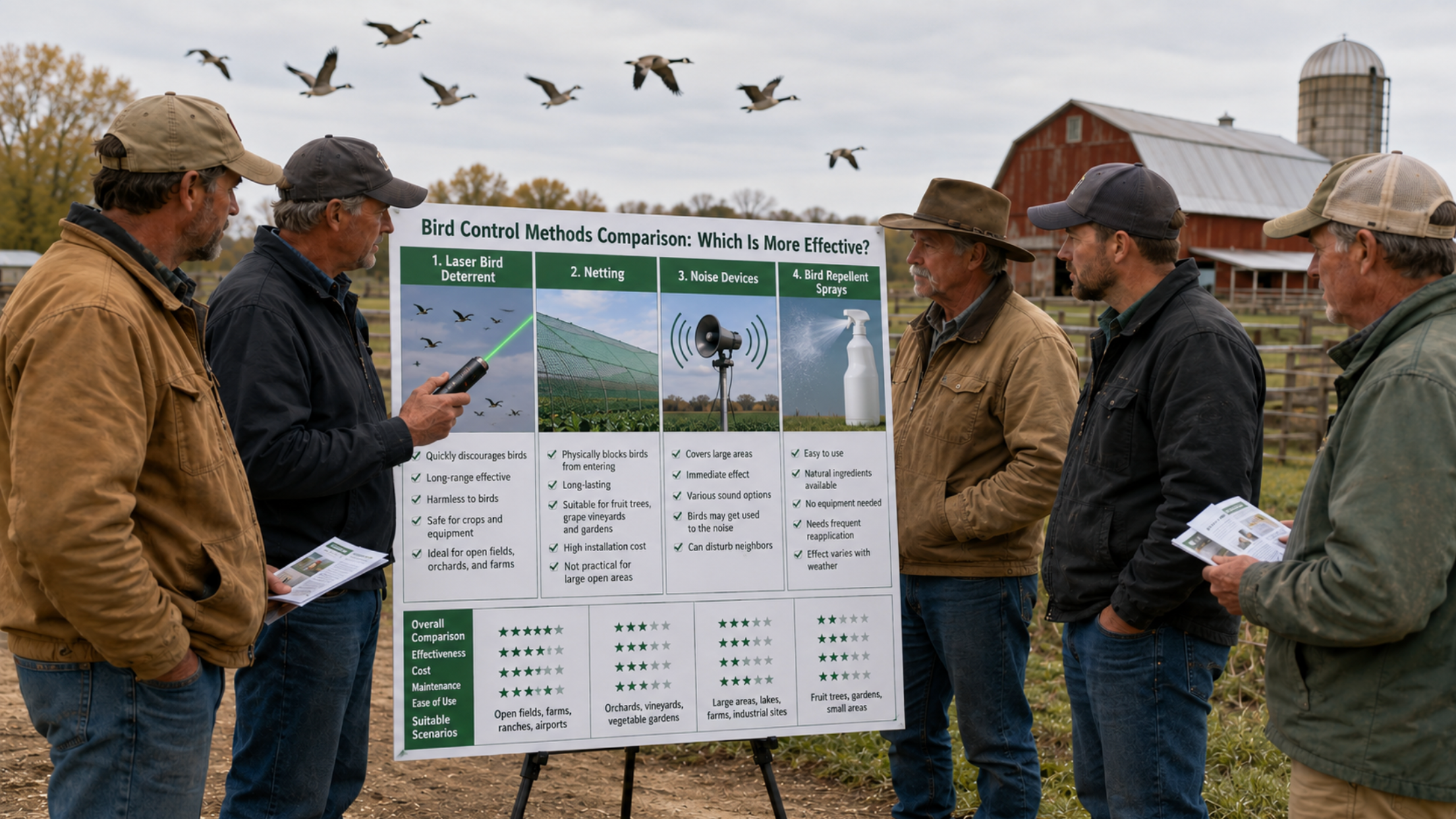
If you want an easy way to stop birds, you should compare laser bird deterrent vs netting. Many experts say Wildlife control lasers and Bird repellent laser pointers work best to keep birds away. Humane wildlife control laser systems provide a safe and effective method to deter birds effortlessly.
Key Takeaways
-
No single bird deterrent method is best for every farm, pond, building, or residential area.
-
Netting can be highly effective where physical exclusion is practical, but it may be expensive or difficult over large areas.
-
Noise devices can create immediate disturbance, but birds may adapt if sounds become predictable.
-
Repellent sprays may help in specific labeled applications, but they often require reapplication and must match the crop, surface, and legal label requirements.
-
Laser deterrents may be useful in some open-area settings, but they require beam control, safety planning, and realistic expectations.
Bird Deterrent Methods Overview
When you look for a bird deterrent, you have a few main options. Each method works in different ways and fits different needs. Here’s a quick guide to help you understand what’s out there.
Laser Bird Deterrent
A laser bird deterrent uses focused beams of light to scare birds away. You can use these tools in places like farms, estates, or even your backyard. Studies show that birds like geese, mallards, and cormorants avoid areas when lasers are active. The best part? Birds may show avoidance responses to moving beams or beam spots, but response varies by species and site.
Repeated or predictable exposure may reduce effectiveness in some situations, so lasers should not be treated as a guaranteed long-term standalone solution. You won’t hear any loud noises or need to spray chemicals. Many professionals now see laser bird deterrent systems as a top choice for humane and effective bird control.
Netting
Netting creates a physical barrier that stops birds from reaching crops, ponds, or buildings. You measure the area, cut the netting, and secure it with cable ties or staples. This bird deterrent works well for small spaces or specific spots. Netting uses strong materials like stainless steel cables and heavy-duty anchors. You need to check for gaps and do regular maintenance to keep it working.
Netting is often one of the most reliable exclusion methods when the area is small enough to cover and the structure can be installed correctly. However, for large ponds, large fields, machinery access, or irregular layouts, netting may become expensive, difficult to maintain, or operationally impractical.
Noise Devices
Noise devices use sounds to scare birds away. Some play predator calls, while others use loud bangs or distress calls. Noise devices may create immediate disturbance, but their practical value depends on the bird species, distance, surrounding neighbors, livestock, legal restrictions, and whether the sound pattern becomes predictable. For best results, you should move the devices around and combine them with other bird deterrent methods.
Sprays
Sprays use ingredients like methyl anthranilate or anthraquinone to make areas unpleasant for birds. You spray these on crops or surfaces where birds land. Sprays can work well, but you need to reapply them often, especially after rain.
Repellent sprays can be useful in some labeled crop, turf, or surface applications. Their practicality depends on the active ingredient, product label, crop compatibility, rain, reapplication schedule, cost, and whether the target birds continue to feed in the area.
Tip: Combining two or more bird deterrent methods often gives you the best results, especially in tough situations.
Laser Bird Deterrent vs Netting: Effectiveness

When you look at laser bird deterrent and netting, you want to know which one works best to keep birds away. Both can help, but they work in different ways. The right choice depends on what you need. Let’s see how each one works in real life.
Immediate Results
If you need birds gone fast, you want something that works right away. Here’s what happens:
-
Lasers may produce a quick response in some birds when the beam is visible and the site conditions are suitable. However, not all bird species respond the same way, and response may be weaker in bright light or when birds are strongly attached to food or roosting sites. You do not need to wait or set up lots of things. A laser may create rapid avoidance in some situations, but it should not be judged by brand, power, or brightness alone. Species response, beam control, operator training, site layout, and safety constraints all matter.
-
Netting also keeps birds out, but you must put it up first. This can take a while, especially for big spaces. Once the netting is up, birds cannot get through. But if you leave a gap, birds might still get in.
Note: Many experts think laser bird deterrent is the best for quick bird control. Laser deterrence is generally considered nonlethal, but nonlethal does not mean risk-free. Beam path, direct exposure, reflections, people, pets, roads, aircraft, and nontarget wildlife must all be considered.
Long-Term Effectiveness
You want something that keeps working for a long time. Here is how laser bird deterrent and netting compare:
-
Laser bird deterrent is great because birds do not get used to the moving light. Studies and people who use them say birds like geese and starlings stay away from lasers. Hgyuskl’s laser pointers use good parts and steady power, so they work well for a long time. You can use them on farms, big yards, or even factories.
-
Netting can last a long time if you take care of it. You need to check for holes or damage from weather. If you fix problems, netting keeps birds out. But if you forget to check, birds might get back in.
Here’s a simple table to help you choose:
|
Factor |
Laser Deterrent |
Netting |
Noise Devices |
Sprays |
|
Best fit |
Open areas with controllable beam path |
Small/high-value areas that can be covered |
Temporary pressure in suitable locations |
Specific labeled crop/surface uses |
|
Immediate response |
Possible for some species |
Works after installation |
Often immediate |
Usually not instant |
|
Long-term reliability |
Variable |
High if maintained |
Often declines with habituation |
Depends on reapplication and feeding pressure |
|
Maintenance |
Monitoring and safety checks |
Repairs, tension, gaps |
Batteries, relocation, sound changes |
Reapplication after rain/growth |
|
Main limitation |
Safety and species variability |
Cost and installation over large areas |
Noise impact and habituation |
Label limits and repeated application |
|
Safety concern |
Eyes, reflections, aircraft, roads |
Entanglement, access, installation |
Stress, neighbors, livestock |
Label compliance and residues |
Tip: If you want something easy, kind to birds, and that works well, laser bird deterrent is a good pick. More people now use lasers for bird control because they work and birds do not get used to them.
When you compare laser bird deterrent and netting, both can help. But laser bird deterrent gives you fast, steady, and long-lasting results, especially if you use a good brand like Hgyuskl. You can feel safe knowing your crops or property are protected from birds.
Ease of Use and Maintenance
Installation
When you look at bird deterrent strategies, you want something you can set up without a headache. Laser deterrents may look simple, but practical use depends on beam control, product classification, site boundaries, people, animals, reflective surfaces, roads, aircraft, and operator training. You don’t need to climb ladders or measure every inch of your property. If you use Hgyuskl’s laser pointers, you get a tool that’s ready to go right out of the box.
Bird spikes and netting, on the other hand, need more work. You have to measure, cut, and secure these barriers. Some products, like Birdwire, can be pretty involved. Here’s a quick look at how different bird control methods compare for installation:
|
Method |
Setup Reality |
|
Handheld laser |
Simple device handling, but high safety responsibility |
|
Automated laser system |
Requires site assessment, programming, mounting and safety controls |
|
Netting |
Physical installation, support structure and boundary sealing |
|
Noise device |
Placement, power, timing and neighbor considerations |
|
Spray |
Product selection, label compliance, application and reapplication |
If you want a fast setup, decoys and laser bird deterrent strategies make life simple. Barriers like netting or spikes take more time, but they work well for some spaces.
Tip: Always check the area before you install any bird deterrent. A clear plan saves you time and effort.
Maintenance
You want your bird deterrent to keep working without constant attention. Laser bird deterrent tools need very little upkeep. Laser maintenance depends on the product type. Handheld devices require secure storage, label checks, battery safety, and responsible use. Automated systems may also require mounting checks, programmed boundary review, lens cleaning, power checks, emergency stop testing, and site hazard inspections.
Bird spikes and netting need more checks. You have to look for damage, gaps, or loose spots. Barriers can wear out in bad weather. Decoys and audio and visual deterrents need to be moved around so birds don’t get used to them.
If you want low-maintenance strategies, laser bird deterrent and decoys are your best bet. For proven bird control methods, always pick what fits your space and how much time you want to spend.
Note: Regular checks help all bird control methods last longer and stay effective.
Cost Comparison
Upfront Cost
When you look for an effective bird deterrent, you want to know how much you will spend at the start. Laser bird deterrent tools like Hgyuskl give you a quick setup. You buy the device, and you are ready to go. Netting, noise devices, and sprays all have different starting costs. Netting can get expensive if you need to cover a big area. Noise devices and sprays cost less at first, but you may need more than one to get good bird control.
Here’s a simple table to help you compare:
|
Method |
Upfront Cost |
|
Laser bird deterrent |
Medium to High |
|
Netting |
Medium to High |
|
Noise devices |
Low to Medium |
|
Sprays |
Low |
Upfront cost depends on the scale and the type of system. A handheld product may have a lower setup cost than an automated system, while netting can become expensive over large areas. However, laser systems may still require site assessment, training, mounting, power supply, monitoring, and safety planning.
Ongoing Cost
You also need to think about what you will spend over time. An effective bird deterrent should not cost you a lot every month. Laser bird deterrent tools need little upkeep. You just clean the lens and store it right. Netting needs checks and repairs. Noise devices need new batteries or sounds. Sprays need to be bought and used again and again.
Lasers may reduce labor or repeated supply costs in some settings, but only if the target species responds and the site can be managed safely. Netting may have higher repair needs but can provide a strong physical barrier. Sprays may require repeated purchase and application. Noise devices may require repositioning, batteries, and pattern changes. You get strong bird control without buying supplies all the time. This makes it a smart choice for anyone who wants to keep birds away and keep costs low.
Tip: Choose the bird control method that fits your budget and gives you the most effective bird deterrent for your space.
Safety and Environmental Impact
Safety for People and Pets
You want a bird deterrent that keeps everyone safe. Laser bird deterrent systems use smart technology to protect people and pets. Some models turn off if they sense someone close. This means you can use them near kids, workers, or pets. No laser deterrent should be treated as risk-free. Safety depends on laser class, output power, wavelength, beam path, exposure time, reflective surfaces, site layout, and whether people, pets, livestock, vehicles, or aircraft could be affected.
Other bird control methods also care about safety:
-
Netting makes a barrier but does not use sharp parts or chemicals.
-
Noise devices, like ultrasonic ones, are safe for cats and dogs.
You can use these tools in your yard or on your farm. Each method helps with birds and keeps your loved ones safe.
Environmental Effects
You want a bird deterrent that does not hurt nature. Laser bird deterrent systems do not use chemicals or make waste. Netting and noise devices also avoid toxic stuff. Sprays use safe ingredients, but you need to spray again after rain.
Scientists use radar to study how bird deterrents affect nature. Radars track birds, help find species, and give real-time data. Here is what these studies show:
|
Method |
Main Environmental Consideration |
|
Laser |
Nonchemical, but beam safety, nontarget wildlife and aircraft risk matter |
|
Netting |
Physical exclusion, but entanglement and plastic waste may matter |
|
Noise |
Nonchemical, but may disturb neighbors, livestock and nontarget wildlife |
|
Sprays |
Chemical or taste deterrent; label, residues, runoff and reapplication matter |
Picking the right bird deterrent protects your crops and birds. You can feel good knowing you made a safe choice for everyone.
Bird Adaptability
Adaptation to Laser Bird Deterrent
You want a bird control method that keeps working for you. Birds are smart and can learn new things. Some birds stay away from laser bird deterrents at first. Crows and starlings do not like moving laser beams. Pigeons sometimes stop caring about lasers after some time. Most other birds still keep away from the light. If you use your laser at different times, it helps a lot. Changing the pattern makes it harder for birds to get used to it.
Here’s a simple table that shows how birds react to each method:
|
Bird Deterrent Method |
Initial Effectiveness |
Adaptation Over Time |
|
Traditional Methods |
High |
Birds adapt quickly, reducing effectiveness |
|
Laser Deterrents |
Varies by species (less effective on pigeons, more on crows) |
Effectiveness diminishes with prolonged exposure |
|
Noise Deterrents |
High |
Birds develop adaptations, reducing repelling effect |
You get better results with a good tool like Hgyuskl. Try moving your laser beam around and change when you use it. This keeps birds guessing and helps protect your space.
Adaptation to Netting, Noise Devices, and Sprays
Netting works well because it blocks birds from getting in. Birds cannot get past a barrier they cannot move through. You just need to check for holes or gaps in the netting. Noise devices and sprays do not work as well over time. Birds learn that loud sounds or bad tastes are not dangerous. They come back if you do not change things up.
If you compare laser bird deterrent and netting, netting gives a strong barrier. Lasers give you more ways to scare birds. You can use both if you have a big bird problem. For the best results, mix your methods and keep birds guessing.
Tip: Change your bird deterrent tools every few weeks. This easy step keeps your property safe and birds away.
Use Cases
Commercial Bird Deterrent Applications
You want to protect your business from bird problems. Farms, estates, and industrial sites face big risks from birds. Laser bird deterrent vs netting is a hot topic for many managers. Hgyuskl laser pointers work well in these places. You can use them on free-range poultry farms, blueberry fields, and even at fish ponds. A study from some automated systems have reported strong results in specific poultry or farm studies, but those findings should not be generalized to all bird species, all farms, or ordinary handheld laser pointers. Lasers use a green beam that birds see as a threat, so they fly off fast. You do not need to worry about harming birds or the environment.
Netting works well for small greenhouses or storage areas. But it takes time to install and needs regular checks. Noise devices can help in open fields, but birds often get used to them. Sprays need frequent reapplication, especially after rain. Lasers may stand out in some open-area scenarios where a controllable beam path is possible, but netting may be more reliable for physical exclusion, and sprays or noise devices may be more practical in certain crop or budget situations. You can read more about laser bird deterrent for farms and industrial bird control for deeper insights.
Residential Bird Deterrent Applications
You want your home, garden, or pool to stay clean and quiet. Laser bird deterrents give you a flexible tool for scenario selection table. Homeowners like that lasers are portable and do not harm birds or pets. You can move the beam to target different spots. Here’s a quick look at the pros and cons:
|
Pros |
Cons |
|
Harmless laser beam disturbs birds |
Not practical for very large properties |
|
Nonchemical, but not risk-free |
Needs manual use, which takes some effort |
|
Portable and flexible for small spaces |
Must handle with care around people/pets |
Netting works for covering fruit trees or small ponds, but it can look messy and block views. Noise devices may bother your neighbors. Sprays wash away in the rain. If you want a clean, quiet, and effective way to keep birds away, try a laser bird deterrent. For more tips, check out our guide on residential bird control.
Tip: Use your Hgyuskl laser pointer for astronomy or outdoor survival when you are not chasing birds. One tool, many uses!
No single bird deterrent method is the most practical choice for every site.
Netting is often the strongest option when physical exclusion is possible and the area can be covered correctly. Noise devices may create short-term pressure, but their usefulness can decline if birds adapt or if neighbors, livestock, or local rules limit sound use. Repellent sprays may fit specific labeled crop or surface applications, but they require correct product selection and repeated application. Laser deterrents may be useful in some open-area settings, but they require beam control, realistic species expectations, and safety planning.
The most practical approach is usually site-specific. Identify the bird species, the type of damage, the size of the area, workers or animals nearby, reflective surfaces, roads, aircraft risks, budget, and maintenance capacity before choosing a method.
FAQ
How does laser bird deterrent vs netting work for large farms?
For large farms, automated laser systems may cover open areas more flexibly than netting, but only if the beam can be controlled safely and the target birds respond. Netting may still be more practical for smaller high-value zones or where full exclusion is required.
Is a laser bird deterrent safe for pets and kids?
Laser deterrents can be used safely only when product class, beam path, exposure risk, people, pets, livestock, roads, aircraft, and reflective surfaces are properly managed. They should never be treated as risk-free.
Can I use a laser bird deterrent in the rain?
Weather resistance depends on the specific product rating. Rain can also affect visibility, equipment operation, ground conditions, and safety controls, so follow the manufacturer’s documentation rather than assuming every laser can be used in rain.
Share:
Green Laser for Crows and Starlings: Safe Bird Deterrent Basics for Farms
Laser Bird Deterrents for Ponds: How to Keep Geese and Water Birds Away Safely