
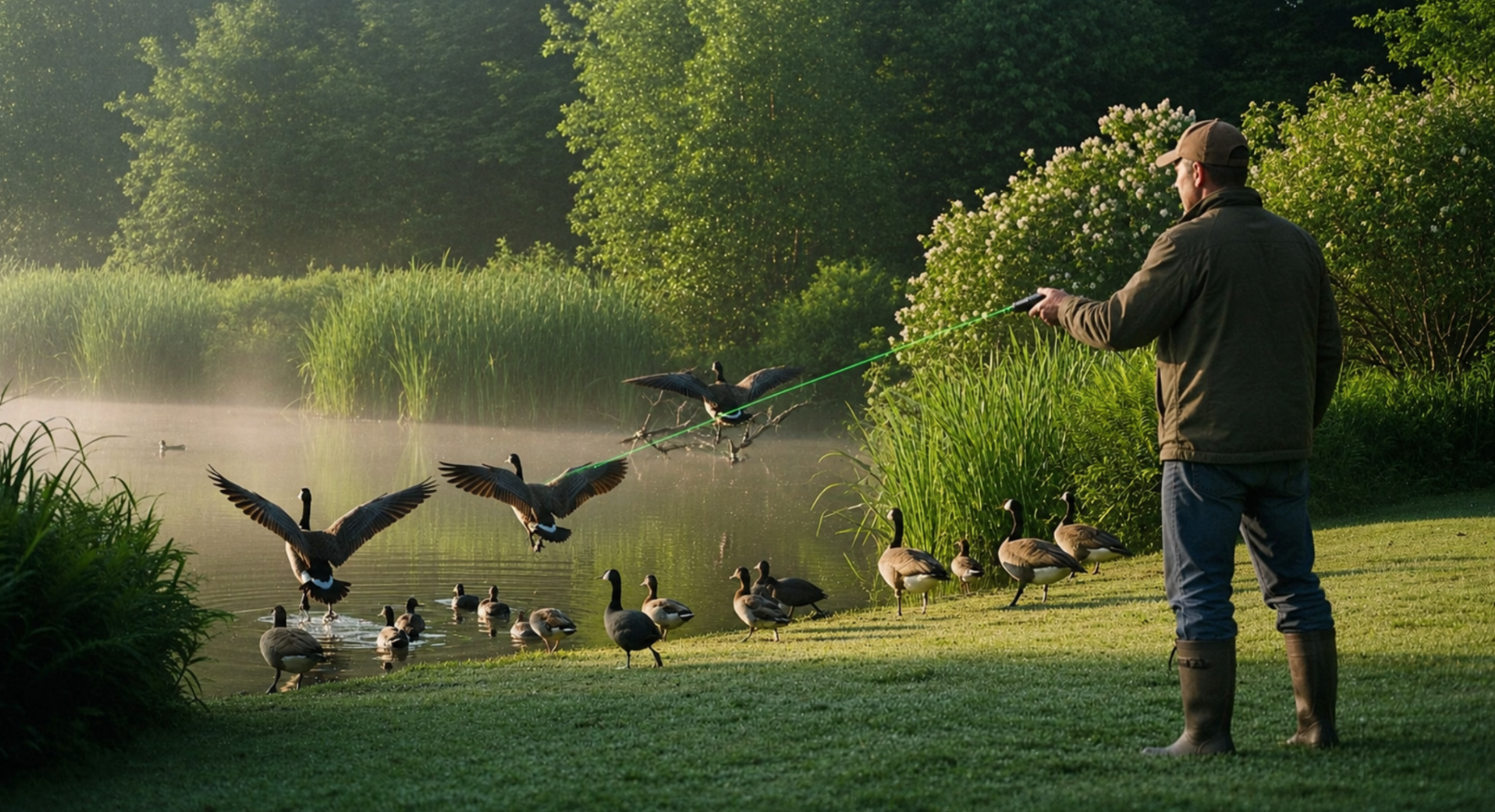
A laser bird deterrent may reduce goose or water-bird activity around some ponds, but pond environments require extra caution.
Water can create reflection and beam-control concerns. Ponds may also be near people, pets, roads, homes, neighboring property, or flight paths. For this reason, farmers and pond owners should not treat a laser deterrent as a simple plug-and-play solution.
This guide explains where laser deterrents may fit, where they may be unsuitable, and what safety checks are needed before considering any pond-based bird control method.
-
Lasers might only scare birds for a little while. The birds could come back later.
-
Bird repellent laser pointers and Farm goose deterrent lasers from good brands like Hgyuskl try to give kind and expert help to pond owners.
Key Takeaways
-
Laser deterrents may cause avoidance responses in some geese and water birds, but results vary by species, lighting, pond layout, food sources, roosting pressure, and equipment type.
-
Pond settings require extra caution because water, nearby roads, homes, people, pets, livestock, and aircraft can affect beam safety.
-
A professional automated bird-deterrent system should not be treated as equivalent to an ordinary handheld laser pointer.
-
Green lasers may be visually prominent in low-light conditions, but color alone does not prove safety or effectiveness.
-
Laser deterrence should be considered one part of an integrated pond-management plan, not a guaranteed standalone solution.
How Laser Bird Deterrents Work

Science and Mechanism
A laser bird deterrent for ponds uses light to scare birds. A laser deterrent uses a visible moving beam or beam spot that may trigger avoidance or startle responses in some birds. In pond settings, the beam path and termination area must be evaluated carefully because water and nearby reflective surfaces can complicate control. Birds see the bright, moving light and get startled. Scientists learned that green lasers can make birds leave. Some birds stay away, but others might come back later. The results depend on the type of bird and the pond. You can find more details in wildlife control guides.
-
Laser systems shine green light that makes birds avoid the area.
-
The moving beam may trigger detection, novelty, startle, or avoidance responses. However, poor beam control, direct exposure, reflections, higher laser classes, or unsuitable site conditions can create risks.
-
How well it works depends on the bird and the pond.
-
You must use lasers safely and follow the rules.
Why Birds Avoid Lasers
Birds notice the laser as something new and strange. Laser deterrence is usually discussed as a nonlethal hazing method, but nonlethal should not be interpreted as risk-free.
Pond bird management is often more durable when the attractants are reduced. Depending on the site, this may include shoreline management, reducing feeding opportunities, exclusion, professional dog hazing, habitat modification, or other nonlethal methods.
-
Laser deterrents are safe and do not kill birds.
-
Traps and poisons are risky and do not work well for birds that come back.
-
You help protect other animals and keep your pond safe.
Tip: Always use lasers the right way and never point them at people or pets. This keeps everyone safe and helps the device work well.
Effectiveness & Safety
Birds Deterred from Ponds
You want something that works well. A laser bird deterrent for ponds changes how geese and water birds act. Studies show lasers make birds leave dangerous places. Birds see the moving green beam and fly away.
Case reports and wildlife-management studies have documented avoidance responses in some waterbirds under specific conditions. However, a response from coots, ducks, or geese in one setting should not be treated as a universal pond result.
Effectiveness depends on the bird species, lighting, food or roosting pressure, previous exposure, and whether birds have another suitable area to move to. You notice fewer geese and problem birds near your water. A laser deterrent may reduce bird activity without using chemicals or lethal control, but it still requires a site-specific safety assessment.
-
Lasers make birds leave the spot.
-
Water birds, like geese, react to the moving light.
-
You see birds act differently after using the deterrent.
If you want more facts about how lasers change bird movement, you can check resources like Bird Control Solutions.
Real-World Results
You see real changes when you use a laser bird deterrent for ponds. Farmers and pond owners notice fewer birds after setting up the device. Lasers help keep geese, cormorants, and other water birds away from crops and water. Birds avoid landing where the laser beam moves. Laser visibility and bird activity often change with time of day, but farmers should base timing on local bird observations rather than assuming one universal schedule.
Note: A site assessment should identify bird-use areas, but also beam boundaries, reflective surfaces, roads, people, pets, livestock, nearby homes, neighboring property, and aircraft risks. Use the device when birds are most active.
You can use lasers with other kind methods for even better results. For example, you might use decoys or sound deterrents with your laser system. This gives you a stronger way to keep problem birds away.
Safety for Birds, People, Pets
Safety is very important. You must use the laser bird deterrent for ponds carefully. Following the manufacturer’s instructions and local rules can reduce risk, but it does not make every laser product or pond site automatically safe.
Safety depends on laser class, output power, wavelength, beam path, exposure duration, reflection risks, people, pets, livestock, vehicles, aircraft, and site boundaries. You avoid traps and poisons, which can harm wildlife and pets. You keep your pond safe and kind.
Pond-Specific Safety Checks
-
Identify reflective surfaces, including water, windows, metal docks, boats, signs, and equipment.
-
Confirm that the beam cannot leave the controlled area or enter neighboring property.
-
Check nearby roads, vehicles, homes, public paths, and aircraft activity.
-
Keep people, pets, livestock, and nontarget wildlife out of the beam area.
-
Do not direct a beam toward the sky, aircraft, vehicles, roads, or public areas.
You also need to follow local and world rules. The table below shows some main standards:
|
Rule Area |
What to Check |
|
Laser product classification |
Class, output power, wavelength, warning labels |
|
Wildlife rules |
Species, nesting status, harassment vs take |
|
Aviation safety |
Aircraft, sky, flight paths, nearby airports |
|
Local/property rules |
Park, HOA, city, farm, neighbor, or public access limits |
|
Product documentation |
Intended use and required safety procedures |
Tip: You protect your pond and wildlife when you use the device the right way. Always follow safety rules and check for new updates in regulations.
If you want more help on safe use, visit Laser Safety Guidelines.
Choosing a Laser Bird Deterrent for Ponds
When you pick a laser bird deterrent for ponds, you want one that works well and is safe. When comparing Hgyuskl models or any other brand, do not judge pond suitability by power, casing material, or advertised range alone.
Check the specific laser class, labeled output power, wavelength, intended use, warning labels, user documentation, and whether the product is a professional wildlife-management system or an ordinary pointer. You avoid fake specs and big claims. You get a device made for real use.
Key Features to Look For
You should check pro models and regular ones. The table below shows the main differences:
|
Feature |
Professional Wildlife System |
Ordinary Consumer Pointer |
|
Intended use |
Site-specific wildlife management |
Pointing or general consumer use |
|
Safety controls |
May include programmed paths, shutoff, access control |
Usually limited controls |
|
Operation |
Requires procedures and trained oversight |
Manual use |
|
Site assessment |
Usually needed |
Often absent |
|
Legal/safety review |
Product and use must be evaluated |
Not automatically suitable for ponds |
Pick devices with strong parts, steady power, and wide coverage. Hgyuskl uses good parts for lasting use and strong performance.
Installation & Usage Tips
Placement, scan area, brightness settings, and operating schedule should be determined by product documentation and site-specific safety assessment. Wider coverage or brighter output is not automatically better.
Pros & Cons
Laser bird deterrents have many good points:
-
They work for a long time with moving beams.
-
Response varies by species. Some birds may leave quickly, some may return, and some may show limited response depending on site pressure and previous exposure.
You may need to care for the device and put it in the best spot.
Alternatives & Complements
You can use laser deterrents with other ways for better protection:
-
Warning sounds using distress calls.
Visual deterrents work best when you change methods and use them at the same time.
Laser bird deterrents may help reduce goose or water-bird activity around some ponds, but they are not a universal or risk-free solution.
Pond sites require special attention to reflections, public areas, roads, aircraft, pets, people, neighboring property, and non-target wildlife.
Before choosing Hgyuskl or any other product, evaluate the specific bird problem, pond layout, laser class, intended use, safety controls, local rules, and whether integrated nonlethal management would be more appropriate.
FAQ
How does a laser bird deterrent for ponds work?
A moving beam or beam spot may trigger avoidance or startle responses in some birds. Results vary by species, lighting, pond layout, food sources, roosting pressure, and equipment type.
Is a laser bird deterrent safe for ducks, geese, and pets?
It should not be treated as automatically safe. Safety depends on laser class, output power, exposure path, reflections, distance, people, pets, aircraft, roads, and product controls. Poorly controlled exposure can create risks.
When should pond owners use a laser deterrent?
Timing should be based on local bird activity, light conditions, safety constraints, and product documentation. Low-light conditions may make the beam more visible, but no single schedule applies to every pond or bird species.
Share:
Laser Bird Deterrent vs Netting, Noise Devices, and Sprays: Which Is More Practical?
How to Keep Geese Away from Crops: Laser Deterrents vs Traditional Methods