
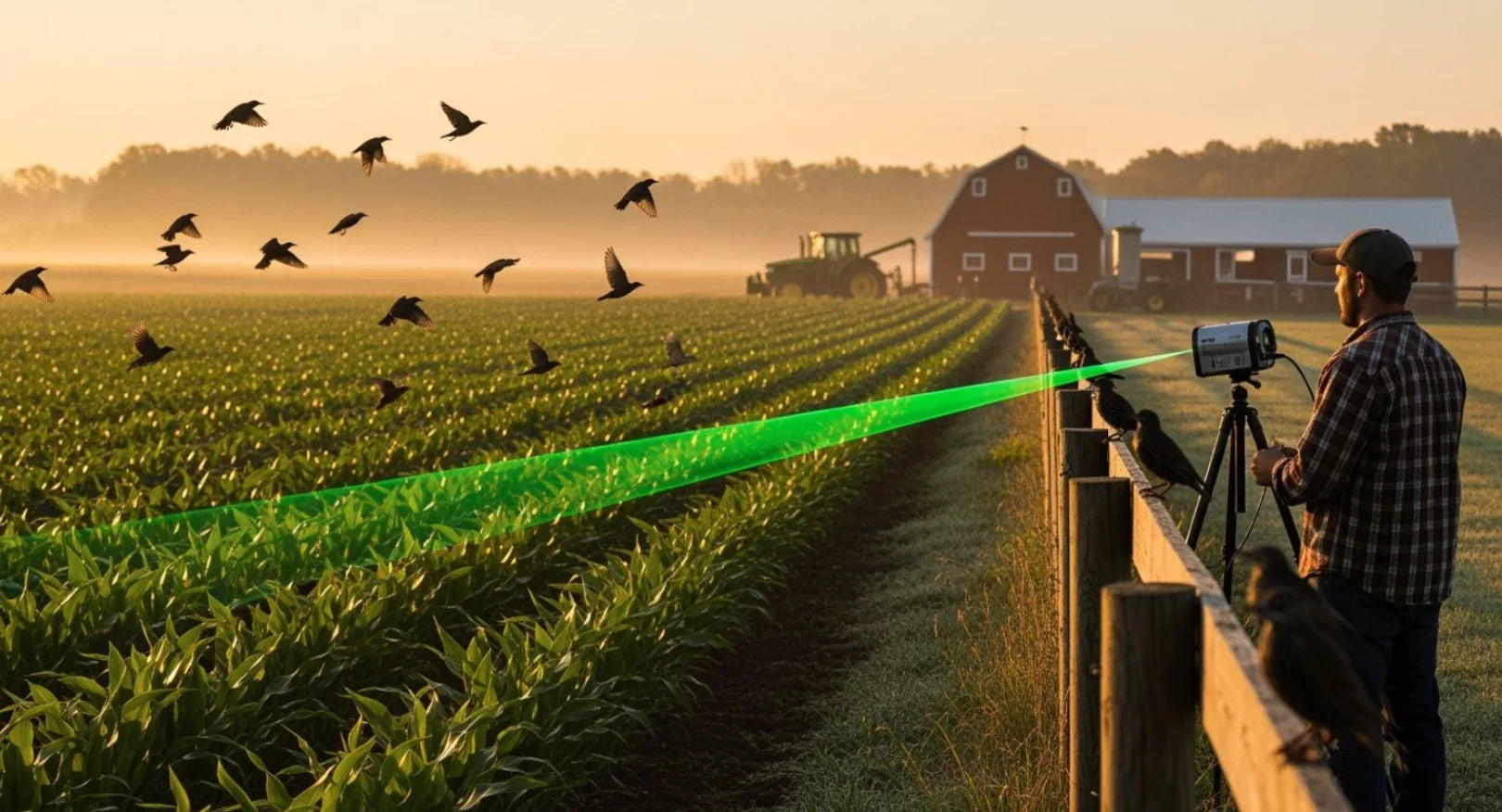
Are lasers safe for birds? There is no universal yes-or-no answer. Laser-based deterrents can cause avoidance responses in some bird species, but safety depends on the laser class, output power, wavelength, exposure conditions, beam path, bird species, and how the system is managed.
Professional wildlife programs may use lasers under formal training and safety controls. Those results should not be treated as proof that every laser pointer or bird-deterrent product is harmless.
Key Takeaways
-
Laser deterrents are not automatically harmless to birds. Risk depends on laser class, power, wavelength, exposure conditions, and beam control.
-
Professional wildlife-management programs use training, safety procedures, controlled equipment, and site checks that ordinary consumers may not have.
-
Class 3B lasers can create serious direct-viewing hazards, while Class 4 products can create even greater eye, skin, reflection, and fire risks.
-
Bird safety involves more than eye exposure. Hazing may also create stress, disorientation, collision risks, or effects on nontarget wildlife.
-
Farmers should treat lasers as one possible part of an integrated bird-management plan, not as a universally safe standalone solution.
Are Lasers Safe for Birds?
You might ask, are lasers safe for birds? This is important for farmers who want to keep crops safe and not hurt wildlife. Experts say that professional-grade lasers can scare birds away safely if you use them the right way. Do not use high-power, unregulated lasers because they can hurt eyes and health. Pick products that follow safety rules, like those from Hgyuskl, to make sure bird control is kind.
What Current Research and Agency Guidance Actually Say
Scientists and wildlife groups have looked at how lasers affect birds. They care about safety, how well lasers work, and being kind to animals. You can see what top groups say in the table below:
|
Evidence Type |
What It Can Tell Us |
Main Limitation |
|
Controlled exposure studies |
Possible eye or behavioral effects |
Specific species and test conditions |
|
Field deterrence studies |
Whether birds leave treated areas |
Does not automatically prove long-term safety |
|
Professional wildlife programs |
How lasers are managed under controls |
Not equivalent to ordinary consumer use |
|
Commercial case studies |
Real-world examples |
May contain marketing bias |
Studies in science journals also help answer, are lasers safe for birds? Scientists tested laser deterrents in real places. Research does not support a simple claim that regulated lasers are harmless to birds. Some studies have reported no visible retinal damage under specific Class 3B exposure conditions, while other studies have observed behavioral changes, and Class 4 exposure has caused eye-tissue damage.
The correct conclusion is that risk depends on the specific laser, exposure conditions, bird species, and safety controls.
Tip: Always look at the details and safety labels before you buy a laser for bird control. This helps you stay safe and use the best tools.
Real-World Use Cases
Farmers and land managers have used bird-repellent lasers in many places. In Otago vineyards, people used Birdzout laser technology to stop birds from hurting crops. They did not need as much netting, spent less money, and lost fewer crops. Bird damage dropped to 10% in places without protection. The lasers were quiet and did not bother the area.
Commercial and farm case studies may show that lasers can reduce bird activity in specific locations. However, individual case studies should not be treated as universal safety or effectiveness guarantees.
Remember, are lasers safe for birds depends on how you use them. If you follow the rules and pick products with safety labels, you keep birds and crops safe. Do not point lasers at birds' eyes. Watch how birds act and change your plan if they seem stressed.
-
Use lasers only when birds are active.
-
Keep lasers away from nests.
-
Pick products with clear safety labels.
Laser deterrence is generally categorized as a nonlethal technique, but nonlethal does not mean risk-free. You can protect crops and not hurt wildlife. Always choose safety and good quality when you buy a laser for your farm.
How Bird-Repellent Lasers Work
Laser Mechanism
You might wonder how lasers help keep birds away from crops. Laser systems shine a green light across fields or ponds. A visible beam may trigger an avoidance or startle response in some birds. However, the same beam can create safety concerns if exposure is poorly controlled, especially with higher-class laser products. The table below shows how some products use this idea:
|
Safety Factor |
Why It Matters |
|
Laser class |
Higher classes generally require stricter controls |
|
Output power |
Influences hazard potential |
|
Wavelength |
Affects biological response and visibility |
|
Exposure time |
Longer exposure may increase risk |
|
Direct beam exposure |
Greater concern than controlled indirect visual deterrence |
|
Reflective surfaces |
Can redirect concentrated light |
|
Site layout |
Affects people, vehicles and nontarget wildlife |
|
Ambient light |
Influences visibility and bird response |
If you use lasers that follow the rules, you do not need to worry about hurting birds. These tools work by making a light that birds want to stay away from.
Interaction with Birds
Birds act differently when they see lasers, which helps protect crops. When birds notice a moving green light, they feel nervous and fly away. This happens because of their natural instincts. Studies show that lasers change how birds look for food and move around.
-
Moving beams or beam spots may trigger detection, novelty, startle, or avoidance responses. The exact mechanism and strength of the response vary among species and situations.
-
Lasers make birds want to leave the area.
Bird eyes can be more sensitive than human eyes. Scientists are still learning how lasers affect bird eyes, especially in birds like European starlings. Always pick bird control tools that meet safety rules to keep risks low.
Note: Watch how birds act and change your plan if they seem stressed. Using lasers the right way keeps your crops and wildlife safe.
Bird-Repellent Lasers: Risks
When you use laser systems for bird control, you need to know about possible dangers. Not every laser is safe for birds. Some lasers can hurt birds if you do not follow safety rules. You should learn how lasers can affect bird eyes and how birds act.
Eye Injury
Birds have very sensitive eyes. Their good vision helps them find food and stay safe. Lasers that are too strong can hurt their eyes. The risk depends on the laser’s power and type. Here is a table that shows the risk for each laser class:
|
Laser Class |
General Safety Meaning |
Farmer Takeaway |
|
Class 2 |
Lower-power visible laser |
Still avoid intentional eye exposure |
|
Class 3R |
Greater caution required |
Not automatically suitable for wildlife control |
|
Class 3B |
Serious direct-viewing hazard |
Professional controls may be required |
|
Class 4 |
Highest-risk category |
Not appropriate for casual farm deterrence |
Class 3B lasers are often used by professionals for bird dispersal. These lasers can still hurt eyes if you do not use them right. Class 4 lasers are much stronger and can cause more eye damage.
Higher output power generally increases concern, but bird-eye risk cannot be determined by mW alone. Laser class, wavelength, exposure duration, distance, beam path, and direct exposure also matter.
Never use unregulated, high-power lasers like 2W models for bird control. These lasers can cause permanent eye damage. They do not meet bird eye safety rules. When comparing Hgyuskl models or any other brand, verify the specific laser class, labeled output power, wavelength, warning labels, intended use, and available safety documentation.
Note: Always keep lasers away from birds’ eyes. Only use regulated products that show their power and safety features.
Stress and Behavior
Lasers can also change how birds act. When you use lasers to scare birds, you might see changes in their actions. Some birds may get stressed or stay away from some places. Other birds may get used to the lasers after a while. Scientists call this getting used to something, or habituation.
Here is a table that shows how using lasers again and again can change bird behavior:
|
Evidence |
Explanation |
|
Habituation |
Birds may get used to the laser and come back when it is off. |
|
Temporary Deterrence |
Lasers can scare birds for a short time but do not remove food or shelter that brings them. |
|
Predictability |
If the laser always moves the same way, birds may learn to ignore it and return faster. |
You can lower stress by using lasers only when birds are active. Repeated and predictable exposure may reduce effectiveness in some situations, while responses vary by bird species and context. Watch for signs of stress, like birds flying in circles or making loud calls. If you see these signs, stop using the laser and try something else.
-
Use lasers carefully to stop extra stress.
-
Watch how birds act and change your plan if needed.
-
Pick products that meet safety rules for bird eye safety.
Scientists are still learning about how lasers affect birds over a long time. Being kind to birds is important. You should always protect crops but also care about wildlife.
Safety Factors for Birds

Laser Type and Power
You must pay attention to the kind and strength of the deterrent. Not every laser system is safe for birds. Rules say lasers in Class 3B or 4, with power over 5 mW, can be dangerous. Pick lasers with low or medium power and long wavelengths. Lasers in the 630-650 nm range are good choices. These lasers work well in dim light and are safe if used right. Always check the label to make sure your deterrent follows safety rules.
Usage Patterns
How you use the deterrent is just as important as which one you pick. Only turn on laser systems when birds are around and active. Do not shine the beam right at birds or their nests. Move the beam slowly and change its direction often. This stops birds from getting used to the deterrent and lowers stress. Watch the area and change your plan if birds seem upset.
-
Use the deterrent early in the morning or late in the day.
-
Change how and when you use it often.
-
Look for changes in how birds act.
Environmental Conditions
Weather and other factors can change how well your deterrent works. Fog, rain, and bright sunlight can make the beam harder for birds to see. Use laser systems in clear, dim conditions for best results. Always think about the weather and your land before using any deterrent. This helps keep your crops and birds safe.
Tip: Always follow local rules and safety advice when using any deterrent outside.
Safe Use Guidelines
Recommended Specifications
Always check the technical details before picking a laser. The right features help keep your farm safe for birds. Look at this table to see what matters:
|
Farmer Check |
What to Verify |
|
Laser class |
Clearly identified |
|
Output power |
Clearly labeled in mW |
|
Wavelength |
Clearly labeled in nm |
|
Intended use |
Wildlife management or ordinary pointing? |
|
Safety controls |
Interlock, key switch, emergency shutoff if applicable |
|
Beam termination |
Can the beam be reliably contained? |
|
Reflective hazards |
Water, windows, metal and signs |
|
Site hazards |
Roads, aircraft, people and buildings |
|
Documentation |
Manufacturer and safety instructions |
Green lasers are best because birds see green well. Pick a model with a moving beam and strong weather resistance. These features help you use the laser safely in different weather.
Minimizing Harm
Any professional system should have a defined beam path and reliable termination point. Do not assume that improvised barriers provide adequate laser control.
If you follow these steps, you protect your crops and wildlife. You also make sure your bird control system works well and stays safe.
Legal and Ethical Considerations
Regulations
You have to follow rules when you use bird-repellent lasers. Many places have laws about using lasers. These laws keep people and animals safe. If you break these rules, you can get in trouble. Here are some things that can happen:
-
If kids use laser pointers the wrong way, they might have to go to Family Court.
-
Police can take away lasers if you use them wrong.
In the United States, intentionally aiming a laser at an aircraft is a federal crime and can result in substantial civil and criminal penalties. Farmers should never direct a laser toward aircraft, the sky, flight paths, roads, vehicles, or public areas.
Tip: Always look up the rules in your area before you use any laser on your farm.
Ethical Use
You should use lasers in a way that is fair to birds and follows the law. Humane bird deterrence means you do not hurt birds. Some professional wildlife-management programs use Class 3B lasers under formal controls. This does not mean Class 3B lasers are harmless to birds or suitable for casual farm use. These lasers scare birds but do not hurt them. Class 4 lasers are much stronger and can be dangerous.
-
Pick systems that are safe and kind, and that follow wildlife rules.
-
Only use lasers when you need to, and never point them at birds’ eyes or nests.
Groups that work with birds have rules for using lasers the right way. The table below shows how these rules work:
|
Standard |
Description |
|
Non-lethal method |
Systems like AVIX Autonomic scare birds but do not hurt them. |
|
Scientific validation |
Effectiveness varies widely by bird species, site conditions, laser system, ambient light, and management approach. Do not use a universal success rate unless the exact study conditions are explained. |
|
Collaboration for safety |
Working with colleges helps make sure lasers are safe for bird eyes. |
When you follow these steps, you keep crops safe and help wildlife too. Always pick safe and kind ways to keep birds away.
When comparing Hgyuskl models or any other product, do not judge bird safety by brand name, color, advertised range, or “professional-grade” language. Review the specific laser class, output power, intended use, safety controls, documentation, and site risks.
FAQ
Can lasers hurt birds?
Yes, under some exposure conditions. Bird eyes can be susceptible to laser light, and risk depends on laser class, output power, wavelength, exposure time, beam path, and distance. Laser hazing may also create behavioral or collision risks.
Are professional bird-deterrent lasers the same as consumer pointers?
You use lasers when birds are active. Change the timing and direction often. This helps you get comprehensive bird control services.
What should you do if birds seem stressed?
Unexpected behavior, disorientation, repeated collision risk, or signs of distress should be treated as reasons to stop and reassess the management method. Consider a wildlife-management professional or lower-risk alternative
Share:
What You Need to Know About Laser Pointers and Goose Control Laws
Laser Bird Deterrents for Farms: Crops, Ponds, Pastures, and Livestock Areas