
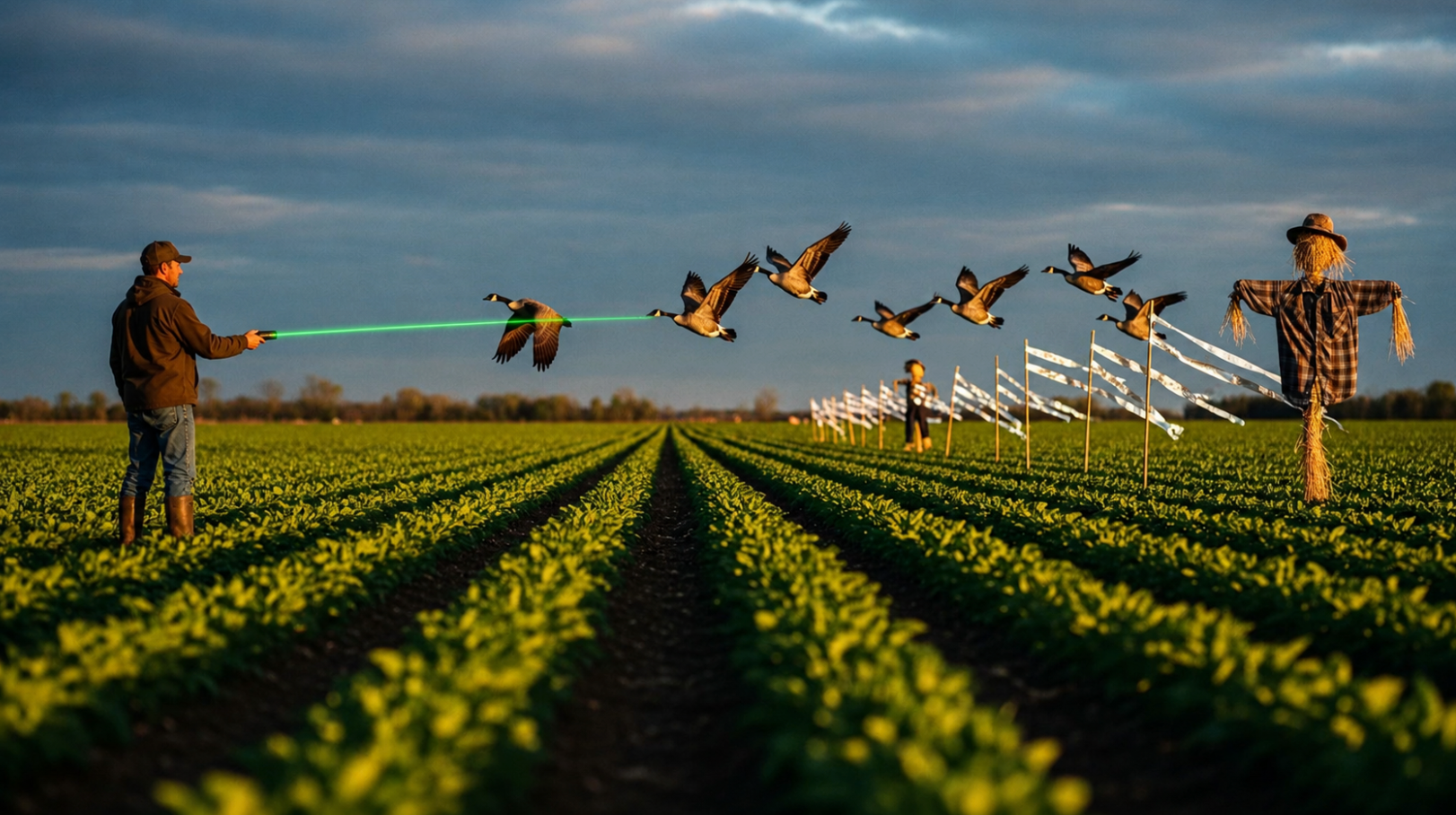
To keep geese away from crops, it's essential to use effective solutions, as these birds can significantly damage crops each season. Bird repellent laser pointers from Hgyuskl offer a humane wildlife control laser option that is both effective and kind. High-visibility green lasers and green laser pointers are particularly effective in open fields, making them a trusted choice among many farmers looking to protect their crops.
Key Takeaways
-
No single goose deterrent is best for every crop field. Field size, crop type, goose pressure, nearby water, labor, budget, and local rules all matter.
-
Laser deterrents may displace geese in some open-field conditions, but effectiveness can vary by light conditions, distance, flock size, and operator effort.
-
Fencing, wire grids, repellents, habitat changes, trained dogs, and other hazing methods may be more practical in some situations.
-
Nonlethal does not mean risk-free. Laser use still requires attention to people, animals, roads, aircraft, reflective surfaces, and product classification.
-
The most practical approach is often integrated goose management, not relying on one method alone.
How to Keep Geese Away from Crops: Laser vs Traditional

Laser Deterrents Overview
Laser deterrents help farmers keep geese away from crops. These tools use green beams to scare geese without hurting them. When comparing Hgyuskl models or any other product, do not judge suitability by casing, brightness, or advertised range alone. Check the laser class, labeled output power, intended use, safety documentation, beam-control requirements, and whether the product is an ordinary pointer or a professional wildlife-management system.
Lasers are best used when it is cloudy or during twilight. Any laser-based hazing plan should control the beam path and background. Distance should not be treated as a simple advantage, because longer-range use can increase safety, boundary, and public-exposure concerns. This makes them good for farms with lots of land.
A 2019 field study found that handheld lasers could displace barnacle geese and dark-bellied brent geese from agricultural grassland. Treated fields had lower goose dropping density and taller vegetation than control fields.
However, the study also found that performance depended on light conditions, time of day, distance, and flock size. The authors’ cost-benefit analysis suggested that the labor required to locate geese and operate the laser could outweigh the potential economic benefit in that setting.
This means lasers may be useful in some local goose conflicts, but they should not be presented as an effortless or universally cost-effective solution.
|
Title |
Authors |
Findings |
|
Effectiveness of lasers to reduce goose grazing on agricultural grassland |
Clausen KK, Marcussen LK, Knudsen N, Balsby TJS, Madsen J (2019) |
You can learn more about humane bird control on our bird & wildlife control page.
Traditional Methods Overview
Traditional methods use barriers, repellents, and scare tactics to keep geese away. Repellents may include active ingredients such as methyl anthranilate or anthraquinone, depending on the registered product and crop use. They should only be discussed with label compliance, crop compatibility, reapplication needs, and local requirements in mind. Loud noises, decoys, and trained dogs scare geese for a short time. Using more than one method works better. The table below shows common traditional ways:
|
Method Type |
Description |
|
Exclusion |
Fences and grids stop geese from getting to crops. Mylar tape helps guide geese away from fields. |
|
Harassment |
Flags, decoys, loud noises, and dogs scare geese for a while. Using many tactics together works best. |
|
Repellents |
Chemicals make plants taste bad to geese. Some chemicals also scare geese by sight. These are safe for crops and help protect farms. |
Learn more in our guide to integrated bird and wildlife control methods.
Pros & Cons: Laser Deterrents
Laser deterrents have many good points for keeping geese away:
-
Safe to use, with trigger guards to stop accidents.
-
Humane, because lasers scare geese but do not hurt them.
-
Easy to use, with light weight and simple controls.
-
Good for big fields and open spaces.
-
Professional quality, with strong cases and good parts.
Lasers work best in certain weather and at certain times. Big groups of geese may take longer to leave. You need to think about the land and how far geese are.
|
Laser Deterrents |
Practical Meaning |
|
Potential benefit |
May displace geese in some open-field conditions |
|
Best fit |
Open areas where the beam path can be controlled |
|
Main limitation |
Effect varies by light, distance, flock size and labor |
|
Safety concern |
People, animals, roads, aircraft and reflections |
|
Cost issue |
Equipment plus operator time or professional setup |
|
Not suitable when |
Beam cannot be safely controlled or birds return quickly |
Pros & Cons: Traditional Methods
Traditional methods give you many choices, but there are problems:
-
Results vary; geese often come back after being scared.
-
You must keep working to keep deterrents in place.
-
Fences and repellents can cost a lot.
-
Geese get used to noises and decoys.
-
Loud sounds can bother other animals and people.
-
Some methods need permits or are not allowed.
-
Repellents work for a short time but can be pricey.
-
Scare tactics need lots of work and permits.
Habitat modification focuses on reducing what attracts geese to a field, such as easy walking access, nearby water, feeding opportunities, or open resting areas. Fencing or wire systems may help in some locations, but they must be designed for the specific crop, field edge, water access, and maintenance capacity.
Note: Always check local rules before using chemicals or scare tactics.
Effectiveness Comparison
You should compare lasers and traditional methods to see what works best. Lasers may be practical where geese are visible in open fields and where operators or automated systems can safely manage the beam. They may be less practical when labor costs are high, when geese are far away, when flock sizes are large, or when roads, people, aircraft, or reflective surfaces make beam control difficult. Studies and real-life tests show lasers lower geese numbers and grazing. Some automated wildlife-management systems may reduce labor compared with manual hazing, but their cost, setup, coverage, safety controls, and suitability should be evaluated separately from handheld products.
Traditional methods are flexible but need more work and may not always work. Geese often get used to noises and decoys and come back. Fences and repellents help, but they cost money and take effort. Weather and land shape affect both types of deterrents. Lasers work best in cloudy weather and big fields. Fences and repellents are better for small areas.
Local rules matter when choosing a method. You need permits to shoot geese or disturb nests. You must be certified to use chemical repellents. Always follow the law to avoid trouble.
|
Legal Area |
What Farmers Should Know |
|
Scaring or harassment |
In the U.S., generally no federal depredation permit is needed to scare birds, except eagles and federally listed threatened/endangered species |
|
Take activities |
Capturing, killing, nest destruction, or other take may require permits or authorization |
|
Chemical repellents |
Use only according to the registered product label and applicable state/local rules |
|
Laser products |
Product class, labeling, intended use and safe-use requirements matter |
|
Aircraft and roads |
Wildlife purpose does not excuse unsafe laser use near aircraft, roads, vehicles or public areas |
If you want a good way to keep geese away, use both lasers and traditional methods. Lasers are good for big fields, and fences and repellents protect small plots. This helps you keep geese away and get more crops.
Actionable Advice: Start with a site assessment: identify the goose species, crop damage pattern, field size, nearby water, roads, aircraft risks, labor availability, and whether physical exclusion or habitat changes could solve the problem. Then choose the lowest-risk combination of methods that fits the site.
Choosing the Best Goose Deterrent
Factors: Crop, Farm Size, Budget
Before picking a goose deterrent, think about a few things. The kind of crop you grow is important. Some crops, like grains and leafy greens, attract geese more. Geese can hurt these crops and cause farmers to lose money. The size of your farm matters too. Big farms need deterrents that work over large spaces. Small farms might do better with barriers or repellents. Your budget is also important. Laser deterrents cost more at first but can save money later. You should also look at how geese move on your land and how much harm they do. Farmers usually pick methods that match how they like to work and what feels right. You have to think about how well each choice works and how much it costs. This helps you find what fits your needs.
|
Factor |
What to Evaluate |
Possible Direction |
|
Crop type |
Is the crop grazed, trampled, fouled or eaten? |
Match method to damage type |
|
Field size |
Can the area be physically excluded? |
Netting/fencing for smaller zones, broader hazing for open areas |
|
Goose pressure |
Occasional visits or daily feeding? |
Higher pressure usually needs integrated methods |
|
Nearby water |
Are geese walking from ponds or wetlands? |
Habitat/fencing may matter more |
|
Labor |
Can staff monitor and adjust methods? |
Manual lasers and scare tactics require labor |
|
Safety |
Roads, people, aircraft, animals nearby? |
May limit laser use |
|
Budget |
Upfront and ongoing costs |
Compare equipment, labor, maintenance and reapplication |
Tip: Draw a map of where geese gather most. This lets you use your deterrent in the best spots.
The best way to keep geese away from crops is usually not one tool alone. Lasers may help in some open-field conditions, while fencing, wire grids, repellents, habitat changes, dogs, and other hazing tools may be more practical in other situations.
Before choosing Hgyuskl or any other product, evaluate the crop, goose pressure, field layout, labor cost, legal requirements, safety risks, and whether a combined nonlethal plan would work better.
FAQ
How do laser deterrents keep geese away from crops?
A moving beam may trigger avoidance or startle responses in some geese. Results vary by species, light conditions, distance, flock size and site pressure. Nonlethal does not mean risk-free.
Are traditional methods safe for crops and animals?
Fences and grids can be safe for crops when installed correctly. Chemical repellents must be used according to the registered product label, crop compatibility, reapplication instructions and local requirements.
What is the best way to protect a large farm from geese?
Large farms often need a site-specific combination of methods. Lasers may help in open areas, while fencing, habitat changes, repellents, dogs or other hazing methods may fit specific field edges or hotspots.
Share:
Laser Bird Deterrents for Ponds: How to Keep Geese and Water Birds Away Safely
Laser Pointer Wavelength Guide: 405nm, 450nm, 520nm, 532nm, and 650nm