
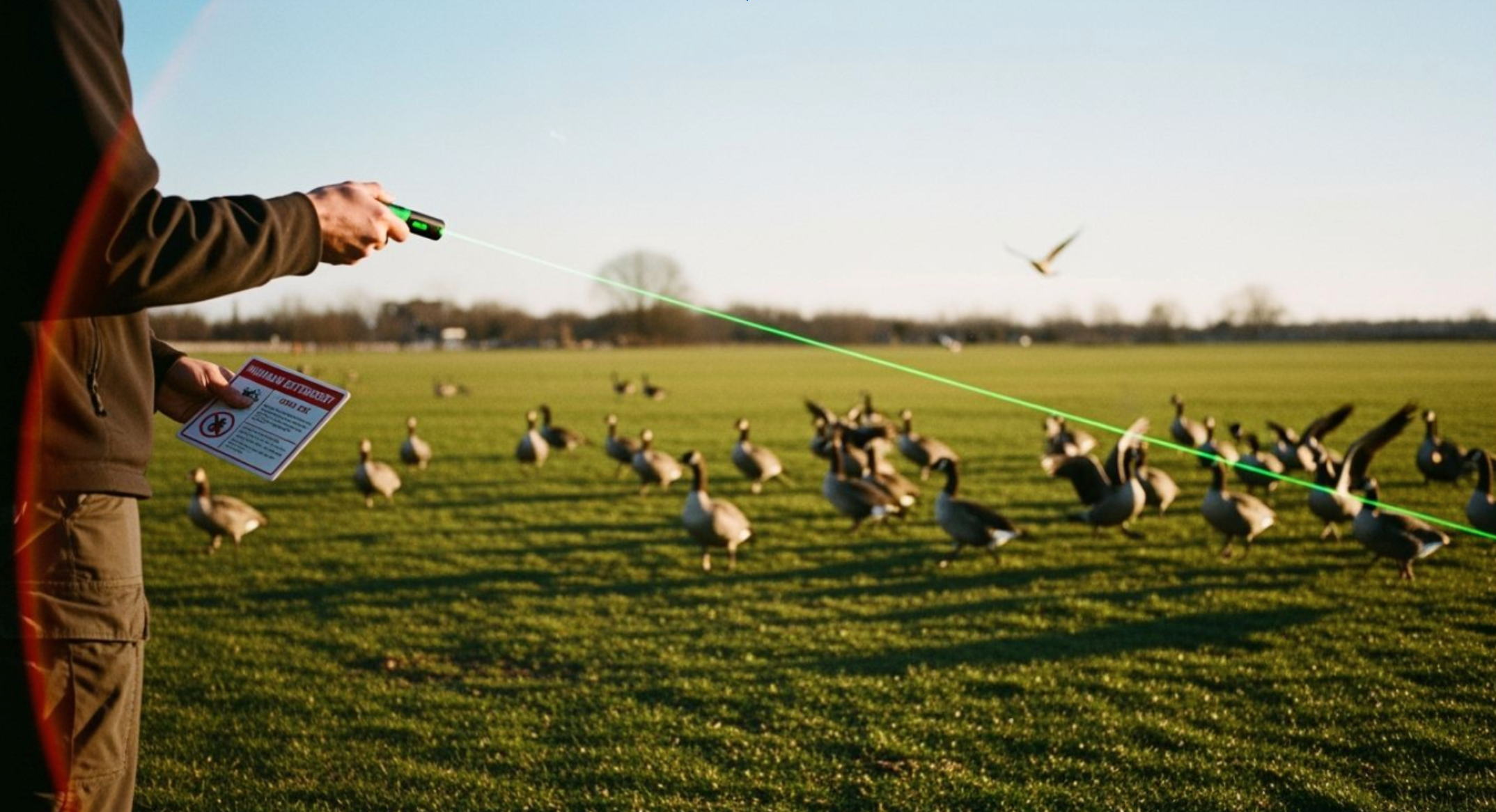
You can use a green laser for geese to move birds away from your property. Always put safety first when using green laser pointers. Many people trust Hgyuskl for reliable tools that work in outdoor conditions.
Key Takeaways
-
Lasers can cause avoidance responses in Canada geese, but effectiveness varies by lighting, site conditions, bird behavior, and equipment type.
-
Low-light conditions generally produce stronger responses than bright daylight.
-
Research results from automated or professional wildlife-management systems should not automatically be applied to ordinary handheld laser pointers.
-
Green is widely used for visibility, but current USDA review did not identify peer-reviewed evidence proving that green is specifically better than red for Canada geese.
-
Laser-based deterrence should be treated as one part of an integrated goose-management plan, not as a guaranteed standalone solution.
Green Laser for Geese: Effectiveness & Mechanism
How Green Lasers Deter Geese
You may wonder why a green laser for geese works so well. The answer lies in how geese see and react to light. Green lasers are commonly used because the beam is visually prominent in low-light conditions, but goose-specific evidence does not establish that green is always more effective than red. When you sweep a green laser across a field or pond.
The moving beam or beam spot may trigger a startle or avoidance response. The exact mechanism is not fully established, and responses vary among species and situations. Laser deterrence is generally described as a nonlethal management technique, but nonlethal does not mean risk-free. Poorly controlled beam exposure may create risks to birds, people, vehicles, aircraft, or nearby property.
In one controlled study of a motion-activated laser system, Canada goose use of the treated area decreased by 83%–92% during the test period. These results came from a specific automated system and should not be treated as a universal success rate for all handheld lasers or field conditions.
The rapid movement of the green laser light makes geese think a predator is near. This reaction is similar to other non-lethal deterrents, but green lasers often work faster and more reliably. U.S. wildlife agencies include lasers among nonlethal hazing options, but effectiveness and appropriate use depend on the specific situation. You do not need to use traps or chemicals. You can keep your property safe and clean without hurting wildlife.
When comparing Hgyuskl models or any other laser product, do not assume that wavelength, brightness, or advertised range alone makes a device suitable for wildlife management.
Check the laser class, labeled output power, wavelength, warning labels, manufacturer documentation, intended use, and local legal requirements. Professional wildlife-management systems should not be treated as equivalent to ordinary consumer laser pointers.
Tip: Always move the green laser beam slowly and never point it at the eyes of any animal or person.
Here is how green laser deterrents compare to other methods:
|
Method |
Potential Benefit |
Main Limitation |
|
Laser-based hazing |
May cause temporary avoidance under suitable conditions |
Results vary by species, lighting and site |
|
Habitat modification |
Reduces how attractive the site is |
Takes time and site planning |
|
Trained dogs |
Can create active pressure over larger areas |
Requires professional handling |
|
Repellents |
May supplement other methods |
Results and legal requirements vary |
When Are Laser Deterrents More Likely to Work?
Laser-based hazing tends to produce stronger responses when the beam contrasts clearly with the surroundings. Low-light conditions may therefore be more favorable than bright daylight.
However, results can also depend on whether geese have another safe area to move to, flock behavior, site layout, and repeated exposure. A laser may be ineffective even in low light if the birds are strongly attached to a feeding or roosting site.
Green Laser Safety & Goose Control Best Practices

Safety Precautions for Geese, Humans, and Pets
You need to keep everyone and all animals safe during geese control. Here are the main dangers and how to stop them:
-
Strong lasers can hurt eyes. This is true for people, pets, and birds.
-
Avoid direct beam exposure to animals. Wildlife-management applications should rely on controlled, site-specific procedures that minimize direct exposure and protect nontarget wildlife.
-
Too much power can cause flash blindness or make accidents happen.
-
Kids should not use laser pointers.
-
Only trained people should use lasers for science or medicine.
-
Always read and follow the safety rules.
-
Turn off the device or take out batteries before putting it away.
|
Buyer Check |
What to Verify |
|
Laser Class |
Clearly stated |
|
Output Power |
Labeled in mW |
|
Wavelength |
Clearly stated in nm |
|
Warning Labels |
Complete and readable |
|
Manufacturer Information |
Identifiable company |
|
Instructions |
Safe-use and storage guidance |
|
Intended Use |
Matches product classification |
Alert: Some professional wildlife-management systems may use Class 3B lasers. These are not ordinary consumer laser pointers and require stricter safety controls, training, documentation, and site management.
Legal Considerations for Canada Goose Deterrence
In the United States, simple harassment or scaring of birds generally does not require a federal depredation permit, although other federal, state, local, property, and safety rules may still apply.
Activities that capture or kill geese, destroy active nests, or otherwise constitute “take” are regulated differently and may require permits or authorization.
Laser use also creates separate aviation and public-safety responsibilities. Never direct a laser toward aircraft, roads, vehicles, people, or public areas.
Common Mistakes in Geese Control
-
Assuming every green laser is suitable for wildlife control.
-
Treating professional Class 3B research as proof that an ordinary consumer pointer will work the same way.
-
Believing green is proven superior to red specifically for Canada geese.
-
Using universal success rates such as 80% or 90% without explaining study conditions.
-
Treating “nonlethal” as meaning completely harmless.
-
Ignoring aircraft, roads, reflective surfaces, bystanders, and nontarget wildlife.
-
Relying on a laser alone instead of using an integrated goose-management plan.
Integrated Alternatives for Goose Management
Effective goose management often combines several approaches. Depending on the site, options may include habitat modification, trained dogs, exclusion methods, repellents, or other professional hazing techniques.
No single method works in every location, and long-term results often depend on reducing the features that attract geese to the site.
Laser-based hazing can cause Canada geese to avoid a treated area under some conditions, particularly when environmental light is low. However, results vary, and research involving professional or automated systems should not be treated as proof that every handheld green laser pointer will work the same way.
Before considering any laser-based deterrent, evaluate the site, local wildlife rules, aviation and public-safety risks, the actual laser class, and whether professional wildlife-management assistance is more appropriate.
The goal should be responsible, integrated goose management—not maximum laser power.
FAQ
Do green lasers actually scare geese?
They can. Canada geese have shown avoidance responses in controlled and field-management settings, especially under lower ambient light. Results vary by site, bird behavior, equipment, and environmental conditions.
Is green proven to work better than red for geese?
Not conclusively. Green lasers are often more visually prominent in low-light conditions, but USDA’s current review did not identify peer-reviewed research proving that green is specifically better than red for Canada geese.
Does a 5mW green laser work for goose control?
Research on goose deterrence includes a range of professional and automated systems, so results should not automatically be applied to ordinary 5mW consumer pointers. In the United States, visible products promoted as ordinary laser pointers are generally limited to 5mW or below.
Are laser deterrents harmless to geese?
They are generally described as nonlethal deterrents, but nonlethal does not mean risk-free. Poorly controlled exposure can create risks to birds, people, vehicles, aircraft, or nearby property.
Do I need a permit to scare Canada geese?
In the United States, simple harassment or scaring generally does not require a federal depredation permit. Capture, killing, active-nest destruction, and other forms of “take” are regulated differently. State and local requirements may also apply.
Share:
Can a Laser Pointer Damage Eyes or Cameras? Safety Facts for Buyers
What You Need to Know About Laser Pointers and Goose Control Laws