
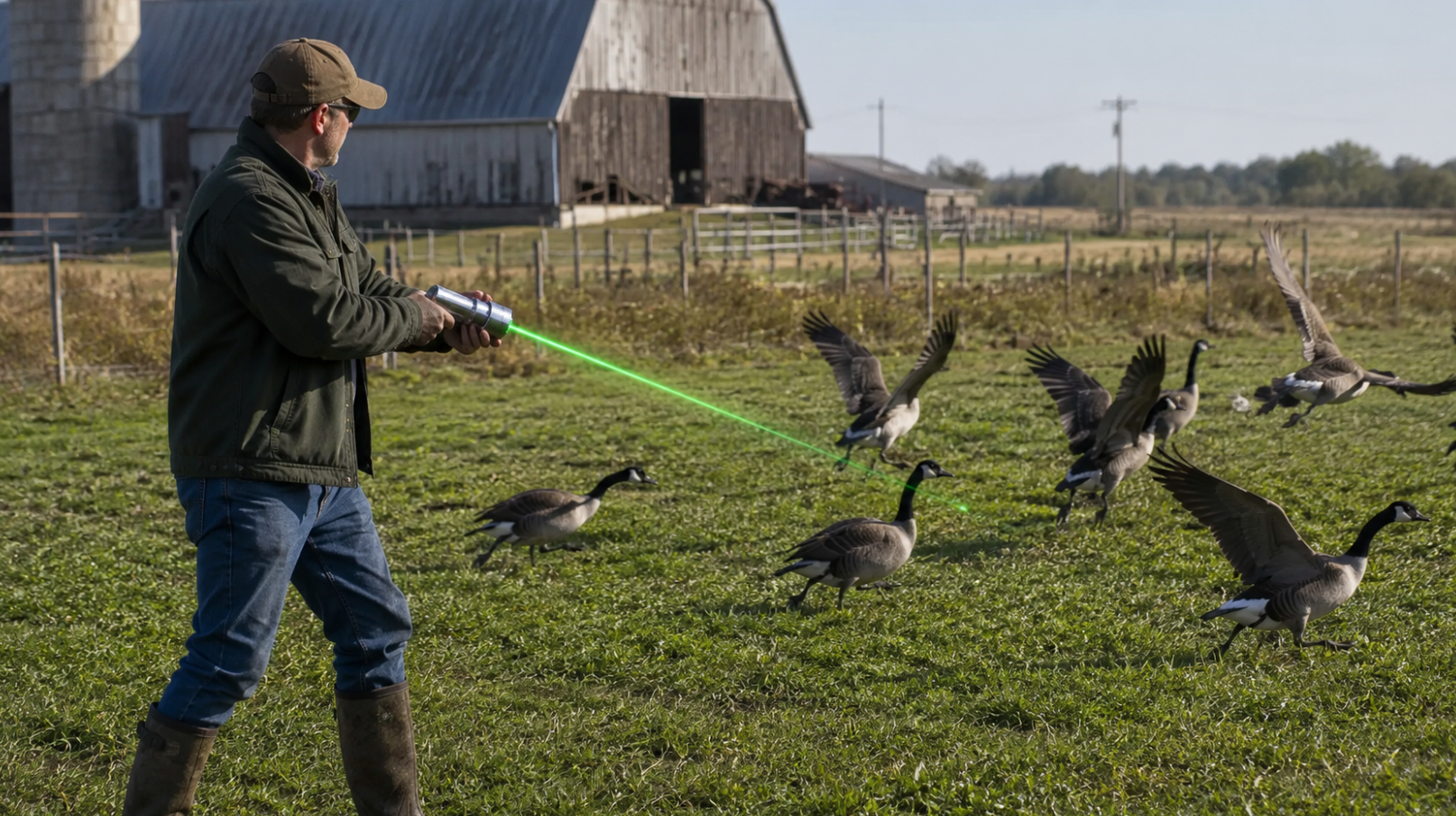
You face a real challenge when crows and starlings target your crops. These birds cause serious losses each year. Many farms lose up to 20% of their blueberry crops, with some like Meduri Farms losing $100,000 from bird damage. Wildlife control lasers offer a humane way to keep flocks away.
This guide focuses specifically on crows and starlings, how they may respond to laser-based deterrents, and what farmers should check before using any bird-repellent laser system.
Key Takeaways
-
Crows and starlings may respond to laser-based deterrents, but results vary by species, flock behavior, lighting, food source, roosting pressure, and equipment type.
-
Evidence from airports, vineyards, waterfowl, or automated systems should not be treated as proof that every farm laser or handheld pointer will work the same way.
-
Green lasers are commonly used because they can be visually prominent in low-light conditions, but color alone does not determine safety or effectiveness.
-
Professional bird-deterrent systems and ordinary consumer laser pointers should not be treated as equivalent.
-
Laser deterrence should be evaluated as one part of integrated bird management, especially for adaptable species such as crows and starlings.
Laser to Scare Crows and Starlings

How Bird Deterrent Lasers Work
You want a good way to keep birds away from crops. A laser to scare crows is a new tool that uses how birds see. Green light may be visually prominent in some low-light farm conditions, which is one reason green lasers are commonly discussed for bird deterrence. However, farmers should not choose a system by color alone.
Moving beams or beam spots may trigger detection, novelty, startle, or avoidance responses in some birds. The response can differ between crows, starlings, waterfowl, gulls, and other species, and it may change with lighting conditions and repeated exposure. This makes them fly away fast, so they leave your farm.
-
Wavelength may affect visibility and bird response, but it does not guarantee effectiveness or prevent habituation. Species, ambient light, previous exposure, food availability, and site pressure all matter.
-
Some professional automated systems may include cameras, programmed movement, or software controls. These systems should not be treated as equivalent to ordinary handheld laser pointers.
-
Laser-based deterrence may interrupt feeding, roosting, or site-use patterns under some conditions, but birds may return if the food source or roosting site remains attractive.
Bird deterrent lasers work well for groups of birds. When you use a laser to scare crows, you mess up their eating and sleeping habits. This method helps farms lose less crops. Farms see fewer birds during the day when lasers are on. Pastures grow better because geese and ducks stay away. If birds return after the laser is turned off, this suggests that the laser may be creating temporary avoidance rather than solving the underlying attractant problem.
|
Evidence Context |
What It Suggests |
Why It Must Be Limited |
|
American crow field observations |
Some avoidance responses have been reported |
Context and species matter |
|
European starling experiments |
Some laser-response testing exists |
Test conditions may not match farms |
|
Waterfowl studies |
Lasers can reduce use of treated areas in some cases |
Not direct proof for crows or starlings |
|
Farm case studies |
May show reduced crop damage at specific sites |
Commercial cases are not universal predictions |
You can trust bird deterrent lasers to keep your crops safe. Hgyuskl lasers use real power and good parts. The strong metal case and green diodes make these tools last on the farm. You get a bird deterrent that works in tough weather.
Safety for Birds, Humans, and Crops
You want to be safe when using tools on your farm. Laser deterrence is generally categorized as nonlethal, but nonlethal does not mean risk-free. Poorly controlled exposure may create risks to birds, workers, livestock, drivers, aircraft, or nearby property.
The green beam does not touch the birds. It only looks scary, so they fly away. Studies and professional wildlife programs show that laser deterrence can be used under controlled conditions, but safety depends on the device, exposure conditions, site controls, training, and species involved.
You should always check the safety features of your laser to scare crows. Look for labels that show the laser class, power, and color. Make sure the laser is made for wildlife control. Use safety tools like key switches or emergency shutoff if you can. Always point the beam away from people, roads, and shiny things. Follow local rules about using lasers.
Never direct a laser toward aircraft, the sky, flight paths, vehicles, roads, or public areas. In the United States, intentionally aiming a laser at an aircraft is a federal crime and can lead to serious civil and criminal penalties.Follow local rules about using lasers.
-
Never point a laser at a plane.
-
Use lasers only when needed and do not shine them in birds’ eyes or nests.
-
Read and follow all safety instructions from the maker.
Hgyuskl lasers are made to move birds away kindly. You get a tool that keeps birds away and keeps your farm safe. By picking a good laser and using it right, you protect your crops and care for wildlife.
Choosing Bird Deterrent Lasers for Farms

Types of Bird Dispersal Devices
When you want a laser to scare crows, you have choices. There are different bird dispersal devices for farms. Each one helps you control pest birds in its own way. Handheld products should not be selected simply because a farm is small. Suitability depends on the target species, product class, site hazards, local rules, and whether trained operation is feasible. You can use them right away when you see birds. Automated systems, like the AVIX Autonomic, work by themselves and cover big areas. These systems use special technology to find and scare birds without you being there. Hgyuskl sells strong handheld and outdoor models. They have tough metal cases and safe power drives for better bird control.
|
System Type |
What It Means |
Main Limitation |
|
Ordinary handheld laser pointer |
Manual device intended for pointing-style use |
Not equivalent to professional wildlife system |
|
Manual professional hazing tool |
Used by trained personnel in controlled settings |
Requires safety procedures |
|
Fixed automated bird-deterrent system |
Programmed or sensor-based system for defined areas |
Requires site assessment and system controls |
|
Integrated bird-management plan |
Combines laser with habitat, exclusion or other methods |
More planning but usually more realistic |
Handheld lasers let you control where you point the beam. Automated systems keep working all the time on big farms. Both types may have roles in bird deterrence, but they require different safety assumptions and should not be compared as interchangeable tools.
Features for Effective Bird Control
You need features that make bird control work well and stay safe. Green may be visible in some low-light conditions, but current evidence does not justify choosing a system by wavelength alone. Hgyuskl lasers use real high power and good parts. They can reach up to 2,500 meters, so they work for big fields and many birds. Waterproofing and strong metal cases protect your laser from rain and dirt. Random movement patterns stop birds from getting used to the laser. Safety features like warning labels and rules help keep everyone safe and make sure the laser only scares birds.
Tip: Always check for laser safety certifications and clear warning signs before using any device.
Best Practices to Keep Birds Away
You can do a few things to make bird dispersal work better. Installation height, coverage, and beam path should be determined by a site-specific assessment. Wider coverage is not automatically safer or more effective. Never point lasers at people, cars, or planes to keep everyone safe. Use lasers with other bird control tools for the best results. Always watch your system and follow the maker’s rules for safe and kind bird dispersal.
For more details on safe and precise bird dispersal, visit our bird control solutions page.
Using a laser to scare crows gives you safe, effective, and humane bird control.
-
You get rapid response and long-range coverage.
-
Farms report up to 90% fewer birds and big crop savings.
Choose Hgyuskl for reliable results.
Learn more about bird-safe solutions on our bird control page.
FAQ
Can you use a laser to scare crows safely?
It may be possible under controlled conditions, but no laser deterrent should be treated as automatically safe. Safety depends on laser class, exposure path, site conditions, operator training, workers, livestock, roads, aircraft, and local rules.
What makes green lasers effective for bird control?
Green beams may be visually prominent under some conditions, especially lower ambient light, but response varies by species, site pressure, food availability, and prior exposure.
How do you choose the right bird deterrent laser?
Choose based on laser class, output labeling, wavelength, intended use, safety controls, documentation, and whether the product is designed for professional wildlife management.
Share:
Laser Bird Deterrents for Farms: Crops, Ponds, Pastures, and Livestock Areas
Laser Bird Deterrent vs Netting, Noise Devices, and Sprays: Which Is More Practical?