
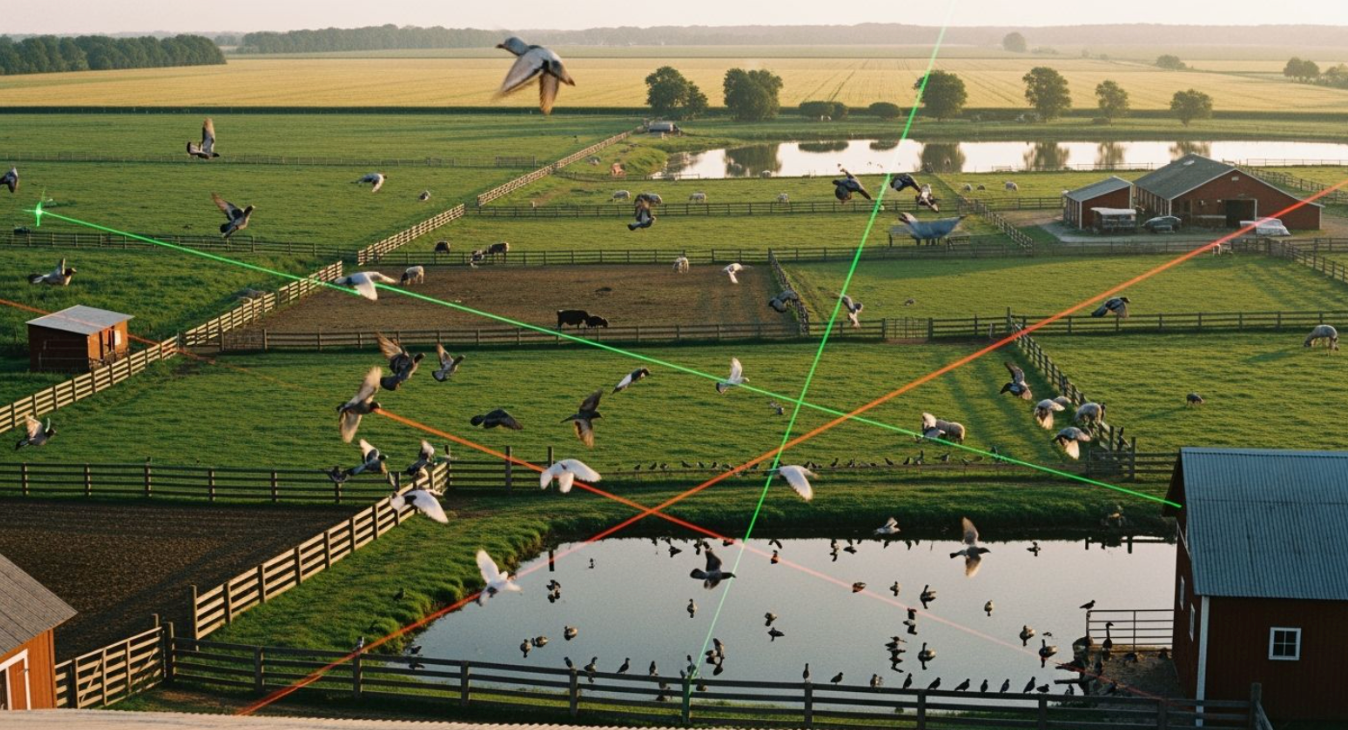
Laser bird deterrents may reduce bird activity in some agricultural settings, but results vary by bird species, farm layout, ambient light, attractants, equipment type, and management approach.
A crop field, pond, pasture, and livestock area do not present the same bird-control problem. Each site has different target species, safety hazards, reflective surfaces, people, animals, and operational constraints.
This guide explains where laser-based deterrence may fit on a farm, where its limitations become important, and what farmers should evaluate before considering any system.
Key Takeaways
-
Laser deterrents may reduce bird activity in some farm settings, but there is no universal effectiveness rate for all species, crops, ponds, or livestock areas.
-
Crop fields, ponds, pastures, and livestock facilities have different safety and management requirements.
-
Professional automated systems should not be treated as equivalent to ordinary handheld laser pointers.
-
Water, glass, metal, roads, aircraft, workers, livestock, and nontarget wildlife can all affect whether a site is appropriate.
-
Laser deterrence is generally more useful as one part of an integrated bird-management plan than as a guaranteed standalone solution.
Laser Bird Deterrents for Farms: How They Work

Visual Deterrence Technology
You can use laser bird deterrents for farms to keep birds away from your land. These systems shine moving laser lights over fields, ponds, and pastures. Moving beams or beam spots may trigger detection, novelty, startle, or avoidance responses in some bird species. The exact response varies by species, lighting, site conditions, and previous exposure.
Variable movement may reduce predictability, but it does not guarantee that birds will never habituate. Long-term response varies by species and site conditions. Laser visibility and bird response often change with ambient light. Site-specific bird activity should be assessed rather than assuming that one time window works for every species or farm.
Tip: Laser bird deterrents for farms do not need much care. Automated does not mean unattended in every situation. Outdoor conditions, equipment position, vegetation, reflective surfaces, people, animals, and site access can change over time and should be included in a documented inspection and maintenance plan.
|
Farm Factor |
Why It Matters |
|
Target bird species |
Species respond differently |
|
Site size and layout |
Affects coverage and beam control |
|
Ambient light |
Changes visibility and response |
|
Reflective surfaces |
May redirect the beam |
|
Workers and livestock |
Create additional exposure concerns |
|
Roads and aircraft |
May make the site unsuitable |
|
Alternative food or roosts |
Can affect long-term response |
Bird Response to Green Lasers
Birds react a lot to green laser light. When you use laser bird deterrents for farms, birds like geese, starlings, and ducks see the moving light as a real danger. Studies and wildlife-management reports have documented avoidance responses in some species, but response rates should not be generalized across all birds or farm environments.
Night birds, like mallards, also fly away when they see the light. Laser deterrence is generally categorized as nonlethal, but nonlethal does not mean risk-free. Bird-eye exposure, behavioral effects, disorientation, and collision risks should be evaluated separately. It just makes them want to go somewhere else.
You can trust this safe and kind way to stop bird problems on your farm. The system works well for crops, ponds, and places with animals. It helps keep your property safe and gives you peace of mind.
Effectiveness Across Farm Areas

Laser bird deterrents for farms help protect your farm from birds. You can use these systems in fields, ponds, pastures, and livestock areas. Hgyuskl makes products that work well outside. They are good for keeping birds and other animals away from farms. If you use these systems the right way, you can see up to 90% fewer birds. Let’s see how you can use them in different places.
Crop Protection
Field case studies have reported reduced bird activity or crop damage in some vineyards and other agricultural settings. However, results from one farm should not be treated as a universal forecast for another property.
Crop type, bird species, field size, harvest stage, existing attractants, alternative food sources, and the deterrent system all affect outcomes.
Crop suitability is site-specific. Farmers should identify the target species, damage period, field boundaries, nearby roads, workers, buildings, and aircraft risks before considering any laser system.
Ponds and Waterfowl
Ponds may attract geese, ducks, gulls, cormorants, or other waterbirds, but water also creates additional beam-control concerns.
Before considering any system near water, evaluate reflections, nearby people, roads, buildings, aircraft, neighboring property, and nontarget wildlife. Professional site assessment may be more appropriate than treating the pond as a simple scanning area.
Pastures and Grazing Zones
Birds in pastures can spread sickness and eat food meant for animals. Laser bird deterrents for farms help keep birds away from grazing areas. Studies show these systems work well for many bird types.
|
Pasture Question |
What to Evaluate |
|
Target species |
Geese, starlings, vultures, or another species? |
|
Main problem |
Feed loss, contamination, roosting, or livestock conflict? |
|
Livestock presence |
Could animals enter the beam area? |
|
Site size |
Can the system be controlled within boundaries? |
|
Roads and neighbors |
Could the beam leave the property? |
|
Alternative methods |
Habitat, feed management, exclusion, or professional control? |

You can put the laser on a pole or fence post. Aim the light to cover the whole pasture. Hgyuskl’s long-range beam lets you protect big areas with one device.
Livestock Safety
You want your animals to be safe when using laser bird deterrents for farms. New systems have many safety features for animals and workers. Hgyuskl follows strict safety rules and uses smart controls.
You can set the system to run only when animals are not in the area. The controls let you aim the laser just where birds gather. This keeps your animals calm and safe.
By using laser bird deterrents for farms, you can protect crops, ponds, pastures, and animal areas with one smart tool. Hgyuskl’s top products give you safe, kind, and strong bird control for your whole farm.
Installation and Best Practices
Placement and Coverage
Do not choose installation height or coverage based only on maximum range. A site assessment should consider the property boundary, terrain, workers, livestock, reflective surfaces, roads, buildings, neighboring land, and aviation risks.
Steps for optimal placement:
-
Put the laser high up to cover more area.
-
Make sure it is away from people and cars.
-
Change how and when the laser moves.
-
Run the system when birds are most active.
-
Use other bird control tools if you need more help.
Timing and Maintenance
Keep your system working by doing regular checks. Clean the window to get rid of dust and dirt. After storms or strong winds, look at the brackets to make sure they are tight. Always check that the laser covers the right parts of your farm.
|
Maintenance Task |
Description |
|
Cleaning the protective window |
Wipe off dust so the laser works well. |
|
Checking the mounting brackets |
Look after storms to see if they are still tight. |
|
Confirming the programmed scanning area |
Make sure it matches your farm’s layout. |
Integrating with Other Deterrents
You can use lasers with nets or spikes for better bird control. This makes it harder for birds to come back. May be more effective in some situations. Many farms do this to get good results. Laser bird deterrents for farms work well with other tools, so you can protect your whole property.
Safety and Environmental Impact
Animal and Human Safety
When you use laser bird deterrents for farms, you must think about safety. These systems are made to follow strict safety rules.
Some professional farm systems may use higher laser classes under engineered controls. Beam width alone should not be used as proof of eye safety. Laser class, output, wavelength, distance, exposure time, optical design, and site controls must be evaluated together.
-
Always point the laser away from people and animals.
-
Use safety tools like emergency stops and keyed switches.
-
Only let trained people use the system.
Ecological Considerations
Laser bird deterrents for farms are a kind way to keep birds away. You must use them carefully to protect nature. Some birds show avoidance or startle responses to moving beams or beam spots, but the mechanism and response strength vary among species and conditions. This makes lasers work well and stops birds from getting used to them. But even weak lasers can hurt eyes if not used right.
You should:
-
Do not rely on generic duration or area rules. Follow the specific system documentation and a site-specific safety assessment.
-
Do not use lasers near roads or airways to stop accidents.
-
Reflective surfaces—including glass, polished metal, signs, equipment, and some water conditions—should be identified during site assessment because they may redirect the beam.
Good training helps you learn how beam power, distance, and time matter for safety. If you use these tips, your farm stays safe and local wildlife is protected.
Cost and ROI
Upfront and Maintenance Costs
When you buy laser bird deterrents for farms, you pay for the system and setup first. This includes putting in and setting up the laser. Most professional systems, like Hgyuskl, are made with strong parts and smart technology. You do not have to change parts often. Taking care of the system is easy and quick. You just clean the lens and check the brackets after storms. These systems last a long time, so you save money instead of buying new nets or scarecrows every year.
-
The first payment covers the system and setup.
-
You do not spend much on upkeep.
-
Strong design means you do not need many new parts.
Tip: Pick a tough, waterproof system for outside. This helps stop damage and saves money.
Challenges and Solutions
Bird Habituation
You may notice that birds sometimes get used to laser bird deterrents for farms if you use them the same way every day. Birds can learn that the moving light does not harm them. When this happens, the system becomes less effective. You can prevent this by changing how you use the lasers. Move the device to new spots and change the timing. Use random patterns so birds cannot predict the light. Try to approach birds from different angles. This keeps them alert and helps the system work longer.
|
Challenge |
Solution |
|
Birds may habituate to consistent laser use. |
Activate lasers unpredictably to deter birds effectively. |
|
Unchanging or overly consistent use of lasers. |
Use lasers in a randomized manner to prevent predictability. |
|
Birds recognize the light presents no real threat. |
Approach birds from different angles at random moments. |
You can also combine laser bird deterrents for farms with other tools. Use scare-eye balloons or distress calls. Move these devices often. This makes it harder for birds to get comfortable.
Weather Effects
Weather can change how well laser bird deterrents for farms work. Bright sunlight makes the laser beam harder to see. The range drops to about 100 meters during the day. At night, the same laser can reach over 1,000 meters. Rain and fog spread out the light, so it does not reach as far. You get the best results at dawn, dusk, or on cloudy days.
-
Lasers show up better at night than during the day.
-
Sunlight can make the beam less visible and shorten its range.
-
Rain and fog can scatter the light, making it less effective.
You can improve results by using lasers when birds are most active and the weather is clear. Try combining lasers with other deterrents, like sound or visual tools, to keep birds away in all conditions.
FAQ
How do laser bird deterrents for farms work?
Laser bird deterrents use green beams that move around. Birds see these lights and think they are dangerous. This makes birds fly away from your farm. Your crops and animals stay safe because the birds leave.
Are laser bird deterrents safe for livestock and humans?
You can use laser bird deterrents without worry. Good systems have emergency stops and safety labels. They also have smart controls to keep everyone safe. Always read the manual and never point lasers at eyes.
What maintenance do laser bird deterrents for farms require?
You need to clean the lens to remove dirt. Check the brackets after storms to make sure they are tight. Make sure the laser covers the right parts of your farm. Taking care of the system helps it work well.
Share:
Are Lasers Safe for Birds? What Farmers Should Know Before Using Laser Deterrents
Green Laser for Crows and Starlings: Safe Bird Deterrent Basics for Farms