
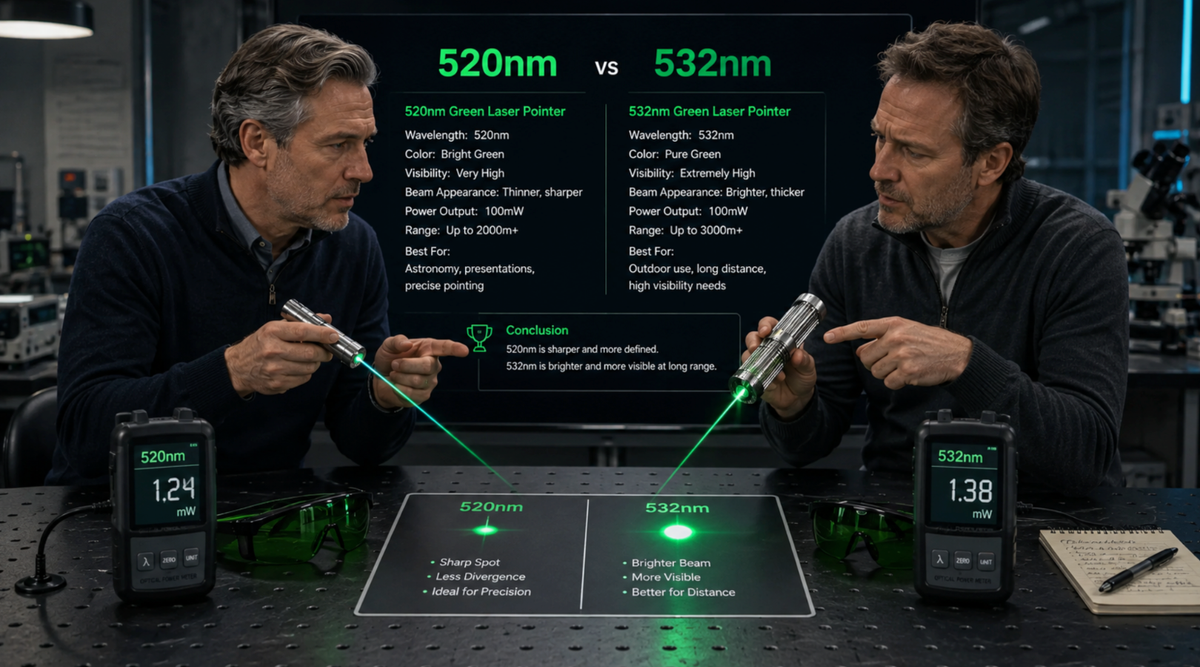
520nm and 532nm are both green laser wavelengths, but they are usually produced with different technologies. A 520nm green laser typically uses a direct diode, while a traditional 532nm green laser usually uses DPSS technology to convert infrared light into visible green.
The best choice depends on what you value most: perceived brightness, color tone, temperature stability, beam quality, IR filtering, product labeling, and safe use. This guide explains the practical differences so you can choose the right green laser pointer without relying only on power or range claims.
Key Takeaways
-
520nm and 532nm are both green, but they often use different laser architectures: direct diode for 520nm and DPSS for 532nm.
-
532nm usually appears slightly more yellow-green and can look very bright because it is close to the peak sensitivity of human daytime vision.
-
520nm usually appears deeper emerald green and is often valued for simpler direct-diode construction and better temperature stability.
-
532nm DPSS lasers may require attention to IR filtering because the conversion process can involve invisible 808nm and 1064nm infrared light.
-
Neither wavelength is automatically safe. Buyers should check laser class, output power, labels, battery, duty cycle, focus design, and intended use.
Beam Color and Visibility Comparison
Wavelength Visibility and Human Eye Perception
Human eyes view light wavelengths in different ways. Daylight vision peaks near 555 nanometers. This peak happens inside the green spectrum. 532nm sits closer to this peak point. A 532nm green laser pointer looks brighter. Equal power levels show this brightness difference clearly.
Under photopic, or daylight-adapted, vision, the human eye is most sensitive near 555nm. Because 532nm is closer to that peak than 520nm, it may appear slightly brighter at the same optical output power.
However, perceived visibility is not determined by wavelength alone. Output power, beam divergence, optics, ambient light, humidity, and viewing angle also matter.
This light difference changes beam visibility indoors. Daylight tasks also show clear visual differences. Night sky beams display clear lines quickly. People trace these bright light lines instantly. For astronomy-style pointing, visibility must be balanced with aviation safety, local rules, and low-output use. Never direct any laser toward aircraft, flight paths, vehicles, people, or public areas.Yellow-Green 532nm vs Deep Green 520nm
Physical color tints separate these green light wavelengths:
-
532nm DPSS Light: Shows bright lime or yellow-green hues. Crystal frequency doubling causes this color effect.
-
520nm Direct Light: A 520nm green laser often appears as a deeper emerald green, while a 532nm green laser often appears slightly more yellow-green or lime. The difference is visible but not the only factor that should guide buying decisions.
A green laser diode module emits 520nm light. It works without using internal crystal parts. This direct green laser diode module builds pure beams. You see deep green hues outdoors easily. Dark outdoor backdrops show sharp visual contrast. Yellow color bleed will not happen here. A 520nm pointer fits continuous field work.
520nm vs 532nm Green Laser Pointer Technical Comparison

The main technical difference is how the green light is produced. A 520nm laser usually produces green light directly from a semiconductor diode. A 532nm DPSS laser uses infrared stages and nonlinear crystals to generate visible green output. Instead, our rugged aluminum cases hold true power. Knowing inner parts helps you choose right.
Direct Diode vs DPSS Laser Architecture
The main design difference sits inside. A 520nm unit uses direct chips. This green laser diode module makes direct light. Current powers it without extra steps. Hgyuskl adds an APC drive circuit to each green laser diode module. This protects parts from big power jumps.
Technical Insight: Direct 520nm chips convert current into light. DPSS 532nm units use crystals to change infrared waves.
A 532nm build uses DPSS tech. First, 808nm light hits a crystal. That creates 1064nm infrared light. Then, a second crystal doubles the frequency. This makes a 532nm green laser module. Drops can bump these crystals out.
Because DPSS systems rely on aligned crystals and coatings, they can be more sensitive to shock, heat, and alignment quality. Direct-diode 520nm designs use fewer conversion optics, so they are often simpler and may be more robust in some portable products. You can pick focusable heads for easy adjustments. This gives control during long-range tasks.
Temperature Stability and All-Weather Operation
Weather tests a 520nm vs 532nm green laser pointer. Direct diodes turn on fast in any weather. The 520nm unit works from -15°C to 45°C. You get instant light without warm-up time.
A DPSS green laser module hates temperature changes. Cold shifts how inner crystals bend light. This causes dimming and fast flickering. The light jumps around during temperature shifts.
The table shows cold impacts on 532nm performance:
|
Factor |
520nm Direct Diode |
532nm DPSS |
|
Cold start |
Often faster and more predictable |
May require warm-up in cold conditions |
|
Temperature sensitivity |
Usually lower |
Usually higher because crystal conversion is temperature-sensitive |
|
Output stability |
Depends on diode and driver |
Depends on alignment, temperature and DPSS quality |
|
Buyer takeaway |
Good choice when temperature stability matters |
Good choice when perceived brightness and beam quality matter |
Physics laws cause these operational problems:
-
Mechanism of Thermal Dimming: DPSS lasers need precise heat to make green light. Cold shifts crystal properties away from 25°C. This drops power efficiency and creates extra waste heat.
-
Mechanism of Optical Mode Hopping: Quick temperature changes expand the cold cavity. This forces light to jump between paths. Users see sudden brightness changes or flickering.
Direct diode tools avoid cold warm-up delays. Hgyuskl adds smart cooling and locks for safety. Users get steady beams in hard weather.
Beam Quality, Efficiency, and Infrared Safety

Beam Divergence and TEM00 Mode Spot Quality
Well-made 532nm DPSS lasers can offer good beam quality and a round-looking spot because of the internal laser cavity and optics. Some 520nm direct-diode products can also achieve good beam control with proper optics, but beam shape and divergence vary by product.
Buyers should check the actual beam-divergence or spot-size information for the specific model rather than assuming all 520nm or 532nm lasers behave the same way.
|
Laser Configuration |
Typical Divergence |
Spot Quality |
|
High-Quality 520nm Direct Diode |
< 1.0 mrad |
Exceptional with glass optics |
|
532nm DPSS (TEM00) |
< 1.0 mrad |
Low spread over long distance |
|
Standard 520nm Module |
< 4.0 mrad |
Standard field performance |
Focusable beam setups let you change spot sizes fast. Adjustable pointers match light beams to field requirements.
Battery Efficiency and IR Filter Hazards
Power usage alters battery runtimes drastically. Each green laser diode module turns power into light. This direct path protects total battery life well.
Critical Operational Hazard: Because 532nm DPSS lasers use infrared stages, lower-quality products may have inadequate IR filtering. Infrared leakage is especially concerning because users cannot see it and cannot judge risk by visible brightness alone.
This is why buyers should check whether a 532nm green laser includes IR filtering and clear output labeling.
Basic DPSS units pump 808nm light through crystals. Budget builds leave out safety filters entirely. Invisible 808nm and 1064nm rays leak out. Your blink reflex ignores invisible light hazards completely. Severe eye damage occurs without clear warning signs.
Hgyuskl fits every green laser module safely. A 520nm direct-diode laser usually avoids the DPSS infrared-conversion path, so IR leakage is less of a concern than it is for 532nm DPSS designs. However, the visible 520nm beam itself can still be hazardous depending on laser class and output power. You skip extra internal crystals for safer use. Each burning laser pointer includes active user protections. Pick certified devices for reliable field safety today.
Compare green light tools based on work locations.
Pick a 520nm unit for tough outdoor conditions.
Direct diodes keep eyes safe from hidden rays.
Pick 532nm units for brighter light inside.
A 532nm DPSS laser may be less suitable when temperature swings, cold starts, or rough handling are major concerns. A 520nm direct-diode laser may be more practical in those conditions, depending on the specific product design.
Choose your Hgyuskl tool by real needs.
|
Feature |
520nm Green Laser |
532nm Green Laser |
|
Technology |
Direct diode |
DPSS frequency-doubled |
|
Color tone |
Deeper emerald green |
Brighter yellow-green/lime |
|
Perceived brightness |
Slightly lower at equal output |
Often higher at equal output |
|
Temperature behavior |
Often more stable |
More temperature-sensitive |
|
IR filter concern |
Usually less relevant |
Important because DPSS uses IR stages |
|
Beam quality |
Depends on diode and optics |
Can be very good when well aligned |
|
Buyer focus |
Stability, simplicity, color tone |
Brightness, beam quality, IR filtering |
Every pointer works well for tough jobs.
FAQ
Which wavelength performs best in freezing temperatures?
520nm direct-diode lasers are often more predictable in cold-start conditions because they do not rely on temperature-sensitive DPSS crystal conversion. Actual performance still depends on the specific product design.
How do you maintain eye safety with high-power beams?
High-output green lasers can create serious eye hazards. Use eyewear matched to the wavelength and optical density required for the specific laser, and never treat any wavelength as automatically safe.
Why choose a 532nm system for indoor work?
532nm may appear brighter than 520nm at the same optical output because it is closer to the peak sensitivity of human daytime vision. It may be a good choice when perceived brightness and beam quality matter, but buyers should still check IR filtering, class, output power, and labeling.
Share:
450nm blue laser pointer visibility, power, and safe use basics
Focusable Laser Pointer Guide: Fixed Focus vs Adjustable Beam