
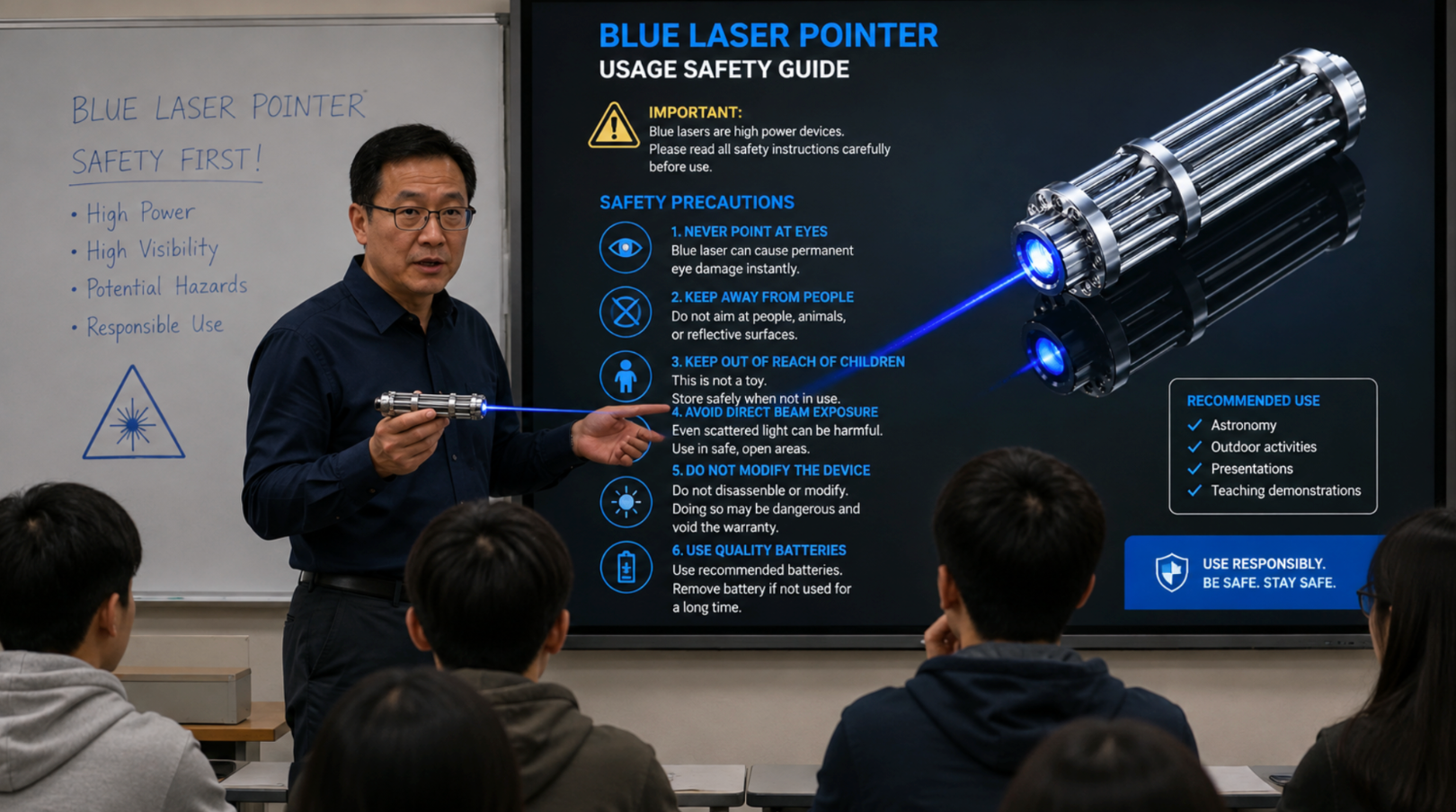
A 450nm blue laser pointer shines exceptionally bright, producing a crisp, vivid beam that stands out in any environment. Because these high-power laser pointers pack intense energy, following strict laser safety rules is essential to eliminate direct light hazards and prevent accidents.
To protect yourself and those around you, proper safety precautions must always be taken against all beam risks. Blue laser pointers from Hgyuskl deliver genuine, lab-verified output backed by professional-grade engineering and APC constant Never direct a 450nm laser toward aircraft, the sky, flight paths, vehicles, roads, or public areas. In the United States, intentionally aiming a laser at an aircraft is a federal crime and can result in serious civil and criminal penalties.current drives, giving you the ultimate combination of heavy-duty reliability and real-output performance. Choose a certified high-power laser pointer today for unmatched precision and peace of mind.
Key Takeaways
-
A 450nm blue laser pointer produces a vivid blue beam, but it may not appear as visually bright as a green laser at the same optical output power.
-
Many 450nm blue lasers are sold in high-output ranges, so buyers must pay close attention to laser class, labeling, duty cycle, heat management, and safe-use requirements.
-
Blue laser safety is not only about direct beams. Reflections from shiny surfaces can also create serious eye hazards.
-
Laser safety eyewear must match the 450nm wavelength and provide an appropriate optical density for the product’s output and use case.
-
Do not choose a blue laser pointer by maximum power or advertised range alone. Check wavelength, mW/W rating, class, labels, battery, focus, and documentation.
450nm Blue Laser Pointer Visibility Characteristics

Photopic Sensitivity and Wavelength Perception
Human eyes are not equally sensitive to all wavelengths. Under photopic vision, green wavelengths near 555nm are perceived most efficiently, while 450nm blue light sits lower on the visual sensitivity curve.
This means a 450nm blue laser may need higher optical output to appear as bright as a green laser to the human eye. However, increasing output also increases safety risk, so visibility should never be separated from laser class and exposure control.
Atmospheric Scattering and Beam Brightness
Dust particles scatter light at night. Short wavelengths scatter very quickly. The table below compares light types:
|
Factor |
What It Means for 450nm Blue Lasers |
|
Human eye sensitivity |
Blue appears less visually efficient than green at equal optical power |
|
Atmospheric scattering |
Shorter wavelengths may scatter more, which can help beam visibility in some dark conditions |
|
Ambient light |
Bright surroundings can reduce perceived beam visibility |
|
Beam divergence |
A tighter beam can appear more concentrated over distance |
|
Output power |
Higher output can increase visibility but also increases hazard |
You see a bright laser beam. It cuts through dark air easily. Every blue pointer emits many photons. This bright laser beam shines far away. Nighttime beam visibility depends on output power, divergence, humidity, dust, light pollution, and viewing angle. It should not be reduced to a simple “stronger is better” rule.
Beam Divergence and Optical Profile
Beam divergence measures how beams spread. Beam divergence describes how quickly a beam spreads over distance. For blue laser pointers, divergence depends on diode design, collimating optics, focus setting, and product quality.
Buyers should check the manufacturer’s stated divergence or spot-size information when available, but they should not assume that every 450nm blue pointer has the same beam profile. Spread control helps your beam stay focused. Every pointer tool stays very clear. You can trust this tool always. Your pointer device keeps tight beams. Sturdy pointers give good spot control. Each pointer unit uses balanced optics. Quality tools offer strong beam control.
Power Output Metrics and Operational Basics
Class IIIa 5mW Limits Versus High-Power Watts
Class IIIa tools cap power under 5 milliwatts. These mild units suit simple indoor slide shows. Power output is one of the most important safety factors. A 5mW visible laser and a 1W blue laser are not in the same risk category. A 1W laser is 1,000mW, or 200 times the output of a 5mW pointer.
For this reason, high-output blue lasers should be discussed as higher-risk laser products, not as ordinary presentation pointers or casual outdoor tools.
Warning: Massive power output turns a standard beam into a real fire hazard. Higher output increases the risk of eye injury, skin exposure, reflected-beam hazards, and fire concerns in unsuitable environments. It should not be treated as a feature for casual use.
Some online laser products may be mislabeled, overpowered, or missing required safety information. Buyers should not rely only on advertised wattage or product photos. Hgyuskl sells every 450nm blue laser pointer accurately. Strong airplane metal shields every light chip. Metal shells keep your unit safe outside.
Thermal Management and Duty Cycles
Laser chips make hot heat inside fast. Hot air ruins fragile inner parts quickly. Rest your tool often to cool parts.
High-output blue laser diodes generate heat quickly. Heat can reduce output stability, shorten diode life, and affect beam performance.
Buyers should check the recommended duty cycle, cooling design, body material, battery compatibility, and whether the product manual explains safe operating intervals. A metal body can help with heat dissipation, but it does not make a high-output laser risk-free.
An APC constant-current or constant-power driver can help stabilize output and reduce unwanted fluctuation. However, driver stability does not make a blue laser safe by itself. Laser class, output power, exposure time, reflections, and eye protection still matter.
Driver Stability and True Output Ratings
Power boards feed energy to inner chips. Cheap handheld units use basic power setups. Simple boards spike power when heat shifts. Great units use Automatic Power Control (APC).
|
Parameter / Feature |
Constant Current (CC) Mode |
Automatic Power Control (APC) Mode |
|
Driving Current Control |
Power stays set at one level. |
Sensor shifts power based on heat. |
|
Temperature Sensitivity |
Heat shifts affect current and light strength. |
Smart parts fix heat drops instantly. |
|
Aging Effects |
Old chips lose brightness over time. |
Brightness stays steady over long use. |
|
Output Power Stability |
Light flickers or changes strength wildly. |
Light stays fixed at target levels. |
APC systems help your tool run well:
-
Constant Current Mode Mechanism: Utilizes driving current as the feedback signal. The adjustable current source output remains unchanged, offering no regulation against optical power variations.
-
Constant Power (APC) Mode Mechanism: Utilizes photodiode current as the feedback signal. The driver actively adjusts the current source output to maintain a constant photodiode current, thereby stabilizing the overall optical output power.
Smart chips hold power at exact levels. Hgyuskl builds tough drive boards for work. Light stays bright without sudden power drops. Choose safe tools built for tough jobs.
Eye Safety Protocols and Hazard Controls

Strong light brings real dangers to your eyes. Learn basic safety steps before using these units.
Instant Eye Injury Risks from Direct Beams
Direct exposure to a high-output blue laser can create serious eye hazards. The risk depends on output power, exposure duration, distance, beam diameter, focusing, and whether exposure is direct or reflected.
Blue light can also raise concern for photochemical retinal injury, while higher-power beams may create thermal injury risks.
Diffuse Reflection Dangers and OD4+ Eyewear
Bounced light keeps high energy levels. Smooth walls and metals reflect bad light. Do not choose laser safety eyewear by color or generic “darkness.” Eyewear must be rated for the laser wavelength, such as 450nm, and must provide an optical density appropriate for the laser’s output power and use case.
Dark sunglasses are not laser safety glasses. Dark sunglasses do not protect eyes. Special lenses filter bad colors clearly.
Reduce risk when properly selected and used. Check safety glasses for scratches first.
Wear approved glasses during test work. Safe glasses block dangerous blue rays. Good glasses block random light bounces. Clean lenses keep clear room views. Safe gear protects eyes during tests. Basic safety steps lower real risks. Trust Hgyuskl for safe blue laser pointer tools.
Class 3B and Class 4 Operating Standards
Many higher-output blue laser products may fall into Class 3B or Class 4 categories. These classes require much stricter safety controls than ordinary low-output pointers.
Class 3B products can create serious direct-viewing hazards. Class 4 products can create direct, reflected, skin, and fire hazards depending on output and conditions.
Higher-class laser use may require controlled areas, access control, warning labels, interlocks, beam stops, eyewear, and trained operation depending on the product and use environment. This trick stops random light exposure.
Pointing light at planes breaks federal laws. Never shine beams at cars or animals. Laws cover any 450nm blue laser pointer. Shining blue light brings big legal trouble. Aviation groups issue major cash fines. Even mistakes bring costly court fines.
Never direct a 450nm laser toward aircraft, the sky, flight paths, vehicles, roads, or public areas. In the United States, intentionally aiming a laser at an aircraft is a federal crime and can result in serious civil and criminal penalties.
Follow safety rules in outdoor areas. Use smart safety steps every time. Respect safety standards to protect everyone. Learn safety steps before starting tools.
Common Uses and Important Limits
Stargazing and Night Tours
Some users compare blue lasers for night visibility, but green lasers are often more visually efficient for astronomy-style pointing. Any outdoor sky use requires strict aircraft awareness and local-rule compliance. The bright beam cuts through dust easily. It shows distant stars during dark night shows. Tour leaders use pointers to guide group tours.
Lab Tests and Machine Setup
Blue lasers may be used in controlled optical demonstrations or alignment contexts, but professional laboratory or industrial work should use equipment designed, labeled, and controlled for that purpose.
A 450nm blue laser pointer is best understood as a vivid blue laser product that often appears less visually efficient than green at the same optical output, but may be sold in much higher power ranges.
For buyers, the most important questions are not only brightness or range. Check the laser class, real output power, wavelength, duty cycle, heat management, driver stability, eye protection requirements, and safe-use documentation.
When comparing Hgyuskl models or any other blue laser product, avoid choosing by maximum power alone. Higher output increases responsibility and risk.
FAQ
How do you protect your eye from a high power laser beam?
Choose laser safety eyewear rated for 450nm and for the required optical density based on the laser output and use case. Do not rely on sunglasses or generic tinted glasses.
What makes a high power laser pointer dangerous to human eye health?
Higher-output blue lasers can create serious eye hazards through direct exposure or specular reflection. Risk depends on output power, exposure time, distance, beam diameter, and focusing.
Where can you find reliable laser safety resources for operating your device?
Reliable safety resources include official laser-product guidance, the product manual, laser class labels, and eyewear specifications. For outdoor use, also check aviation and local rules.
Share:
532nm green laser pointer basics, DPSS technology, visibility, and IR filters
520nm vs 532nm Green Laser Pointer: Which Wavelength Should You Choose?