
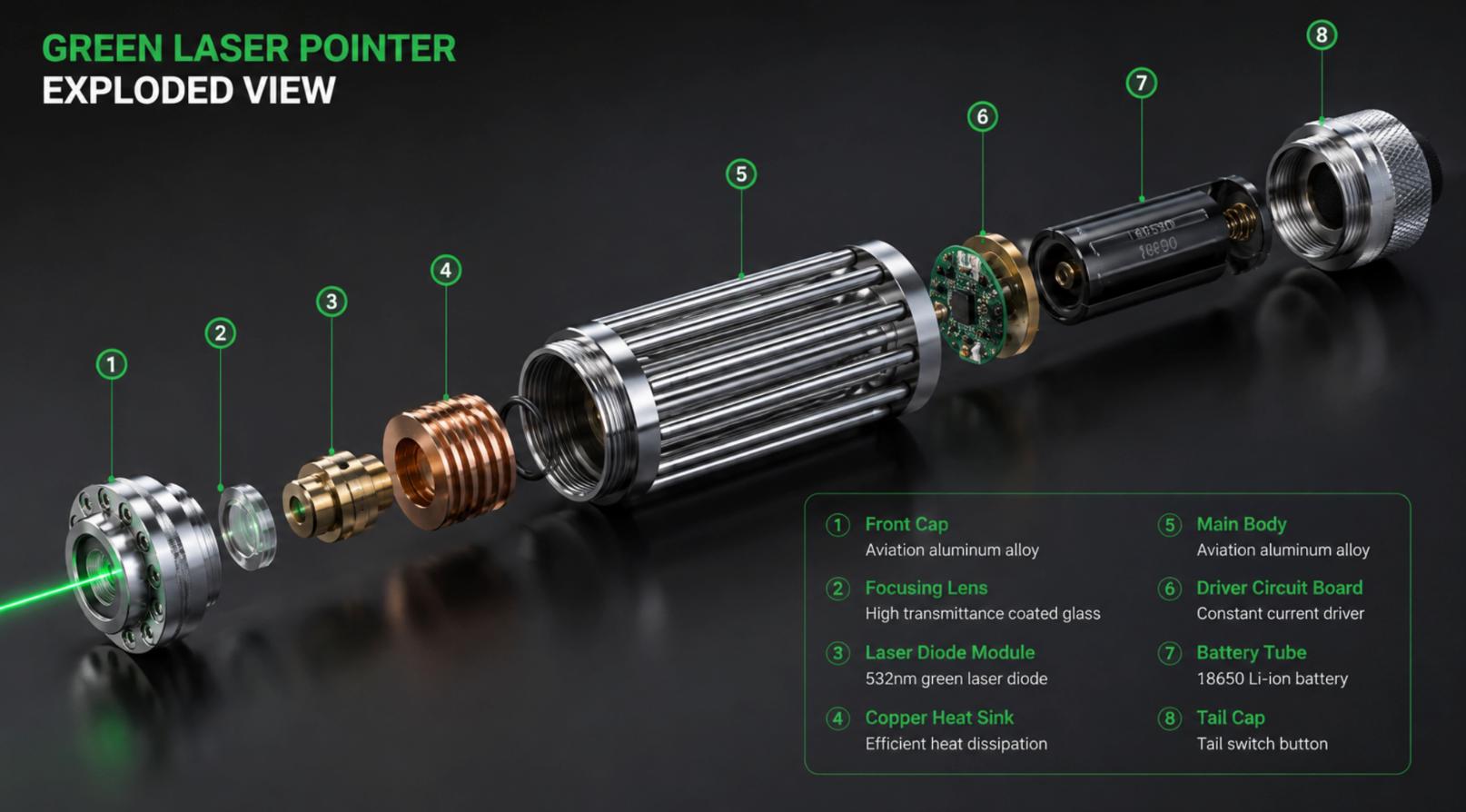
A 532nm green laser pointer appears very bright because its wavelength sits close to the peak sensitivity of human daytime vision. Most traditional 532nm green lasers use DPSS technology, which converts infrared light into visible green light.
Because DPSS systems can involve invisible 808nm and 1064nm infrared light, a proper IR filter is an important safety feature. However, an IR filter does not make a laser pointer risk-free. Buyers should still check the laser class, output power, warning labels, intended use, and local safety rules.
Key Takeaways
-
A 532nm green laser pointer usually uses DPSS technology: an 808nm pump diode helps generate 1064nm infrared light, which is then frequency-doubled into 532nm green light.
-
532nm appears highly visible to human eyes because it is close to the peak of photopic vision.
-
Because DPSS green lasers can involve invisible infrared light, an IR filter is an important safety feature, especially in lower-quality products.
-
A 532nm laser is not automatically safer than other colors. Safety depends on laser class, output power, exposure time, beam control, and labeling.
-
Compared with 520nm direct-diode green lasers, 532nm DPSS lasers may offer different beam characteristics but can be more sensitive to temperature and alignment.
DPSS Technology in a 532nm Green Laser Pointer
How does a 532nm green laser pointer work? One small diode cannot make green light easily. So, experts use Diode-Pumped Solid-State system parts. People call this dpss technology for short. It changes hidden infrared rays into green light. This optical conversion process usually involves three stages.
The 808nm Diode Pump Stage
The process begins inside a special laser diode. It outputs unseen infrared light at 808nm. This invisible beam powers the whole tool.
Note: A power driver runs this pump diode. Good brands use APC constant current drives. These smart parts control electric current well. This stops heat damage inside your device. Cheap items lack this safe part. They get hot fast during dpss use.
Lasing via Nd:YVO4 Crystal
Next, 808nm light hits an Nd:YVO4 crystal. This special material drinks up the energy. It gets excited very fast. Then, it creates a new 1064nm beam.
Nd:YVO4 is commonly used because it absorbs the pump energy efficiently and supports compact DPSS designs.
Laboratory or module-level values vary widely and should not be used to estimate consumer laser pointer output.
This efficient step makes a steady 1064nm beam.
Frequency Doubling with KTP Crystal
The 1064nm infrared beam enters a KTP crystal. This special KTP crystal doubles the light frequency.
-
Material Role: The KTP crystal changes the light waves.
-
Phase Matching Alignment: Workers set the crystal in place carefully.
-
In simple terms, the KTP crystal combines the energy of two 1064nm photons into one 532nm photon.
-
Wavelength Conversion: This trick creates one green light beam at 532nm.
Good dpss setup makes a great tool. DPSS systems depend on precise optical alignment. Shock, heat, poor assembly, or low-quality components can reduce output stability or beam quality.
Human Eye Sensitivity and Green Light Visibility

Our eyes see different light colors differently. Day vision feels green color very clearly. Learning about wavelengths helps you choose good lights.
Photopic Vision and Peak Wavelength Response
Daytime eyes use special functions for light:
-
Under photopic, or daylight-adapted, vision, the human eye is most sensitive near 555nm. Because 532nm sits close to that peak, a 532nm green beam can appear much brighter than a red beam at the same optical power.
-
Equal-flux basis: Peak response shifts left by 10–20 nm.
This $V(\lambda)$ chart shows why green looks bright:
|
Wavelength |
Visual Meaning |
|
555nm |
Peak photopic sensitivity |
|
532nm |
Very high perceived brightness |
|
650nm |
Lower perceived brightness at the same optical power |
A 532nm light gives great bright views. It works well without wasting power.
Rayleigh Scattering and Nighttime Beam Clarity
Dark night skies show green beams best. Air molecules scatter short light waves well. You see a clear bright beam easily.
At night, a green beam may appear more visible because of both eye sensitivity and atmospheric scattering. However, beam visibility is affected by output power, divergence, humidity, dust, background light, and viewing angle. It should not be reduced to a fixed mW comparison.
-
Spectral Sensitivity: Eyes feel strongest near 555nm light waves.
-
Perceived Brightness: Green sits close to peak eye sensitivity. So green beams look far brighter than red.
This science creates a sharp beam over long distances.
Essential Role of IR Filters in Safe Laser Pointers
You love vivid 532nm green laser pointer beams. Hidden hazards lurk inside cheap units. Makers save money by omitting an IR filter. Lower-quality DPSS green lasers may have inadequate infrared filtering. Because infrared leakage is invisible, users may not notice it even when it contributes to total optical output and eye risk.
Hazards of Invisible 808nm and 1064nm IR Leakage
The dpss process uses strong infrared energy. A pump diode fires 808nm light. This makes 1064nm energy inside crystals. Precision setups turn power into green light. Uncalibrated tools leak raw infrared light. Cheap makers skip optical safety tests.
⚠️ Critical Danger: Because infrared is invisible, users cannot rely on brightness perception or aversion response to judge exposure risk.
Invisible infrared leakage harms sight in big ways:
-
Retinal Damage: Strong infrared rays hit retinas without pain.
-
Thermal Accumulation: Focused unseen light burns soft eye tissue.
-
Reflected Rays: Smooth surfaces reflect infrared light around rooms.
How Absorption Filters Block Infrared Radiation
Quality makers add an IR filter inside. This special glass absorbs 808nm rays. It traps extra 1064nm light waves. Visible light passes through the glass easily. An IR filter can reduce unwanted infrared leakage, but it does not remove the need for laser safety practices. The visible 532nm beam itself can still be hazardous depending on class and output power.
|
Component Part |
Function in Assembly |
Impact on Operation |
|
IR Absorbing Glass |
Traps unwanted 808nm and 1064nm waves |
Stops invisible energy leakage |
|
APC Drive Circuit |
Regulates diode current constantly |
Maintains thermal stability and laser safety |
|
Aviation Aluminum Shell |
Cools internal optics quickly |
Protects precise crystalline alignment |
When comparing Hgyuskl models or any other 532nm product, check whether the product documentation clearly states the laser class, output power, wavelength, warning labels, and whether IR filtering is included.
Comparing 532nm DPSS and 520nm Direct-Diode Lasers
Green beams use two main modern tool designs. Classic dpss setups shift infrared light to color. Semiconductor chips in direct diodes make green light.
Beam Quality and Divergence Differences
Many 532nm DPSS modules can produce good beam quality and a round-looking spot when well aligned. Many 520nm direct-diode lasers are simpler and can be more temperature-stable, but beam shape depends on diode and optics design.
|
Feature |
532nm DPSS Green Laser |
520nm Direct-Diode Green Laser |
|
How green is made |
Converts infrared light to green |
Produces green directly from diode |
|
IR filter issue |
Important because IR may be present |
Usually less relevant because no DPSS IR conversion path |
|
Temperature behavior |
Can be more temperature-sensitive |
Often more stable across temperatures |
|
Beam quality |
Can be round and tight when well aligned |
Depends on diode and optics |
|
Buyer focus |
Check IR filtering and alignment quality |
Check diode quality, optics and output class |
Thermal Stability and Operational Durability
Weather shifts touch both light tools in ways. Crystal systems demand very tight heat limits. Harsh cold or heat drops beam power fast. Direct-diode green setups work well in cold. Light turns on fast without waiting to warm. Solid chips take hits better than fragile crystals. Strong Hgyuskl designs guard inside parts using aluminum. Choosing correct wavelengths helps you get proper gear.
Common Uses of 532nm Green Laser Pointers
You can find many real uses for big devices now.
Astronomy Stargazing and Night Sky Tours
A low-output, clearly labeled 532nm green laser may be useful for pointing out constellations during supervised stargazing. Users must never direct any laser toward aircraft, flight paths, vehicles, people, or public areas.
-
Human Eye Sensitivity: Night eyes see green color best with little power.
-
Operational Efficiency: You can show real sky stars fast to groups.
Humane Bird Control and Agricultural Wildlife Management
Some readers also research laser-based wildlife deterrence, but that topic involves separate safety, legal, and site-specific issues.
Laboratory Research and Industrial Alignment
Smart workers use clear light tools for lab tests. Long light lines help big factories build heavy goods:
-
Demonstration, pointing, and controlled alignment tasks may use visible green beams, but professional industrial alignment should use equipment designed and labeled for that purpose.
Safety Classifications, Legal Standards, and Buying Advice
Laser Classes and 5mW: What Buyers Should Know
In the United States, visible laser products promoted for pointing or demonstration purposes are limited by FDA regulation to Class IIIa, commonly associated with output up to 5mW. Products above that range may fall into higher hazard classes and should not be marketed as ordinary pointers.
A lower class does not mean risk-free. Buyers should check the class label, output power, warning statements, wavelength, manufacturer information, and intended use before purchasing or using any 532nm green laser pointer.
Identifying Safe, Fully Filtered Laser Units
Top lasers need special glass parts inside them.
Easy test steps check for trapped hidden rays:
-
Quantitative Verification (With Equipment): IR filtering should be verified by product documentation or appropriate test equipment used by qualified personnel. Ordinary buyers should not attempt unsafe beam tests or infer safety from burning ability, brightness, or price alone. Compare the total emission reading against the filtered reading to calculate precise infrared output.
Pick strong gear made with clear safety glass inside.
Good sellers always make sure tools stay safe.
A 532nm green laser pointer is best understood as a DPSS-based green laser that offers high perceived visibility but requires careful attention to IR filtering, laser class, output power, labeling, and safe use.
When comparing Hgyuskl models or any other 532nm product, do not choose by brightness or advertised range alone. Check wavelength, laser class, real output, power source, focus design, IR filtering, and safety documentation.
FAQ
Why do 532nm green laser pointers look brighter than red lasers?
Because 532nm is close to the peak sensitivity of human photopic vision, it often appears brighter than red light at the same optical output power. Actual visibility also depends on beam divergence, output power, ambient light, scattering, and viewing angle.
Why does your green laser need an internal IR filter?
Traditional 532nm DPSS lasers use infrared stages during conversion. An IR filter helps reduce unwanted 808nm or 1064nm leakage, but it does not make the visible green beam itself harmless.
How do direct 520nm green diodes differ from 532nm DPSS systems?
A 520nm direct-diode laser produces green light directly from a semiconductor diode, while a 532nm DPSS laser converts infrared light into green through crystals. Direct-diode designs may be more temperature-stable, while 532nm DPSS designs can offer strong perceived brightness and good beam quality when well made.
Share:
Red Laser Pointer vs Green Laser Pointer: Indoors, Outdoors, and Presentations
450nm blue laser pointer visibility, power, and safe use basics