
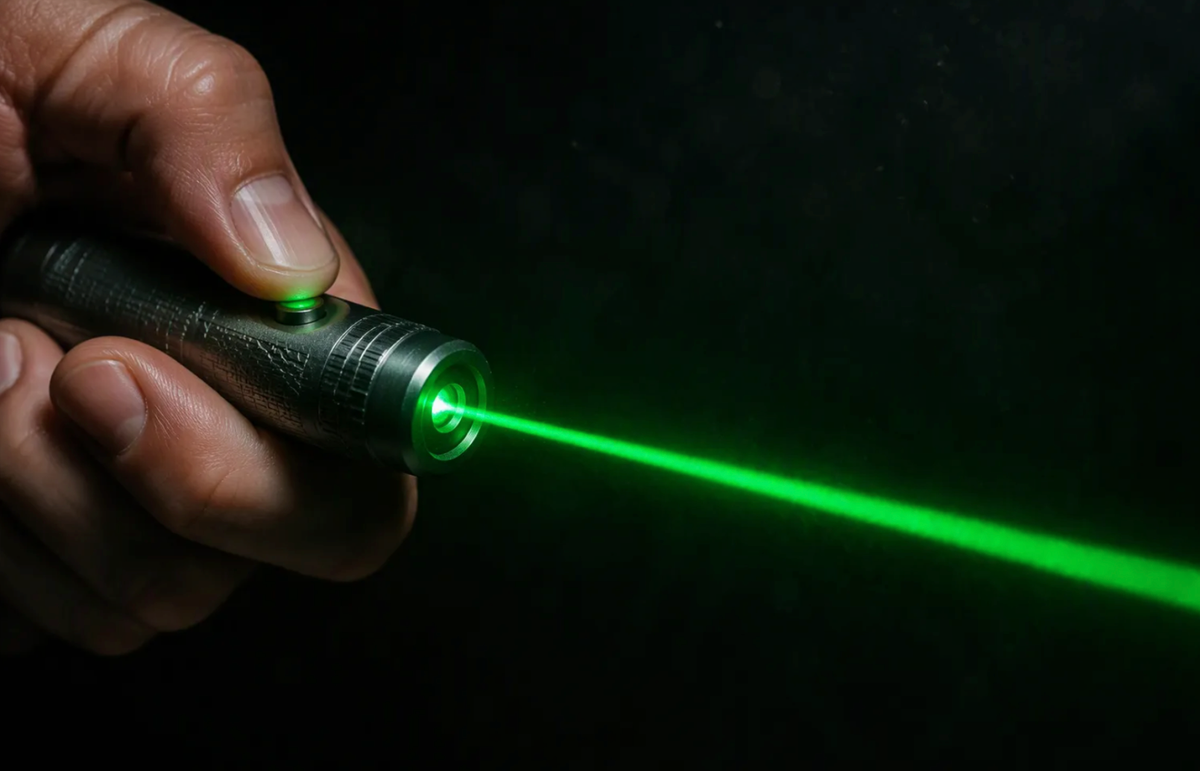
You see a laser advertised as "10 mW" and think it gives off exactly that. Independent NIST lab tests show a different story. A cheap, so-called high power green laser pointer marked at 10 mW actually gave off nearly 20 mW of invisible infrared light—twice its stated rating—while its visible green light looked weak. That gap shows the real difference between a true high-power laser and a marketing label. High-visibility green lasers demand accurate specs, not inflated numbers.
A real high power green laser pointer needs three things: exact milliwatt output, clean beam quality, and solid engineering. You need all three for good real-world use. This article cuts through the hype, showing you how to spot real specs versus inflated claims. Higher-output laser products need especially clear specifications because greater optical output generally means greater hazard potential. You deserve tools that work as promised, safely and reliably.
Key Takeaways
-
“High power” describes output, not overall quality. Optical output should be read together with laser class.
-
Beam quality, driver stability, thermal management, and construction determine how well a higher-output laser performs.
-
Brightness alone does not prove high optical power.
-
A well-built high-output product should include clear class, wavelength, output, and safety information.
Defining a High Power Laser Pointer
When you shop for a high power green laser pointer, you need to understand what "high power" really means. The term is relative to your application. “High power” is a marketing term rather than a formal safety classification. A better way to understand output is to look at milliwatts or watts together with the laser class.
For context:
-
5mW = 0.005W
-
100mW = 0.1W
-
500mW = 0.5W
-
1W = 1,000mW
In the United States, visible laser products promoted for pointing or demonstration are limited to Class IIIa / IEC Class 3R, up to 5mW. Products from 5mW to 500mW fall into Class IIIb / IEC Class 3B and should not be treated as ordinary pointers.
Measuring Optical Output in Milliwatts
Milliwatts (mW) measure the optical power a laser emits from its aperture. This is the standard unit, but you cannot trust the number printed on the label alone. Many sellers list peak or theoretical values, not sustained output. To verify true power, you need independent measurement.
The most reliable method uses a calibrated thermopile sensor. These sensors handle high power levels and have a broad spectral range from UV to far IR. They have low angle and wavelength dependence, making them accurate for various laser types. Their main drawback is a slow response time, ranging from seconds to minutes. This is acceptable for continuous-wave lasers.
Optical output is measured using calibrated laser-power measurement equipment. For higher-output products, accurate verification should be performed with equipment suitable for the wavelength and power range by qualified personnel.
Do not estimate laser power using brightness, burning ability, battery drain, or smartphone-camera tests.
Sustained power measurement is critical. Real-world output often drops significantly after 45 seconds without cooling. A unit that claims 5000 mW may emit only 1200 to 1800 mW in practice. Many units lack independent verification, IR filtering, or thermal cutoffs, leading to ±30% variation and potential invisible 808 nm leakage. You need a true high power laser that maintains its rated output over time.
Why Advertised Wattage Needs Context
Higher-output portable green laser products exist in different architectures and power ranges. Buyers should evaluate each product by its documented optical output and class rather than assuming a universal handheld maximum.
Diode-pumped solid-state (DPSS) lasers at 532 nm have inherent thermal instability. Their power drifts with temperature and may dim or flicker when cold or after extended use. They also require a certified IR filter to block the 808 nm pump light. Many budget models omit this filter, producing dangerous invisible infrared output that exceeds the visible green output.
Direct-diode green lasers are often less temperature-sensitive than traditional DPSS designs, but operating range is product-specific. A 520nm direct-diode design does not use the same 808nm/1064nm DPSS conversion path, so residual IR leakage is generally less of a concern. However, the visible 520nm beam can still present serious hazards at higher output levels.
In the United States, FDA rules limit visible laser products promoted for pointing or demonstration to Class IIIa / IEC Class 3R, up to 5mW. Class IIIb / IEC Class 3B products emit from 5mW to 500mW and cannot legally be promoted as ordinary laser pointers or demonstration products.
A study found that 0 out of 4 green DPSS lasers conformed to the 1 mW safety standard. The measured output reached up to 127.9 mW. The study attributes this non-compliance to the DPSS construction, which can emit excessive IR radiation due to poor workmanship. Handheld lasers used recreationally are often improperly labeled as belonging to a lower class compared to their true power outputs, posing a grave ocular hazard.
Any genuine high power laser must honor these physical limits. Extremely high wattage claims should be treated cautiously unless they are supported by credible optical-output measurements, class information, thermal specifications, and product documentation.
Why Green Can Look Bright Without Being Higher Power

Green wavelengths such as 520nm and 532nm sit closer to the peak sensitivity of human photopic vision than 650nm red or 450nm blue light.
This means green can appear very bright even at comparatively low optical output. Perceived brightness should therefore never be used as a substitute for a measured mW/W rating or laser class.
The Role of Wavelength and Eye Sensitivity
Your eye's photopic vision curve peaks near 555 nanometers, so green wavelengths sit close to maximum luminous efficacy. The cone cells in your retina react most strongly to green light.
|
Wavelength |
Color |
Perceived Visibility at Equal Optical Power |
|
520nm |
Green |
High |
|
532nm |
Green |
Very high |
|
650nm |
Red |
Lower |
|
450nm |
Blue |
Lower |
At the exact same power output, a green laser can look up to 4 to 8 times brighter to your eye than a red laser. This means you can use a lower-power green laser for jobs that would need a much stronger red unit. For stargazing, this efficiency gives you a clearly visible beam without using too much power.
Beam Visibility and Rayleigh Scattering
Atmospheric scattering can make a laser beam visible from the side, especially in dark conditions. Visibility depends on wavelength, output, humidity, dust, divergence, ambient light, and viewing angle.
Beam visibility is not a reliable measurement of optical power.
What Makes a Higher-Output Laser Well Engineered?
A real high power laser needs more than just a bright diode. The inside design decides if you get steady performance or a risky, unreliable tool. Two key parts separate good tools from cheap fakes: the driver circuit and the heat control system.
Driver Efficiency and Power Stability
A laser driver regulates electrical current delivered to the diode. Better-regulated designs can reduce unwanted output fluctuations as battery voltage and temperature change.
APC, or Automatic Power Control, may use optical feedback to help stabilize output. However, APC cannot eliminate heat, battery limits, diode aging, or safety risks.
|
Driver Circuit Type |
Effect on Power Stability |
Effect on Battery Life |
|
Series Resistor |
Poor: beam power falls a lot when battery voltage drops |
Poor: current drops as battery drains |
|
Constant Current |
Good: keeps set current even when battery voltage changes |
Okay: works until battery can't give enough current |
|
Optical Feedback (unregulated reference) |
Okay: brightness changes with battery voltage |
Okay: output drops as batteries drain |
|
Optical Feedback (regulated reference) |
Excellent: keeps nearly constant output until batteries are almost empty |
Excellent: uses battery well until it's empty |
The best systems use an APC constant current drive with a steady reference. This circuit watches the light output and adjusts current in real time. You get stable brightness from start to end. Some poorly made drivers that use resistors can push diodes too far with higher-voltage batteries, risking permanent damage. Others shut off suddenly or fade slowly as batteries die. Neither is good for professional use.
You can check power stability yourself. First, see if your laser needs a warm-up before measuring. Then watch readings over several minutes to tell short-term changes from long-term drift. For random changes, use your meter's averaging feature. For drift, take readings at regular times to see the pattern. Thermopile detectors are a cheap option, but they respond slowly.
Thermal Management and Duty Cycle
Higher-output lasers generate more waste heat and may require more effective thermal management. Performance depends on diode efficiency, driver efficiency, battery capability, housing design, heatsink mass, ambient temperature, and duty cycle.
A metal body can help transfer heat, but weight or material alone does not prove that a product has adequate thermal design.
Your duty cycle depends on this heat design. A laser with good heat sinking can run all the time for lab or industrial work. A compact unit without enough cooling needs rest periods often. Budget lasers often have poor quality control, loose battery compartments, and overheating problems. These signs mean missing heat control and driver regulation.
For a truly reliable tool, look for engineering features like APC constant current drives and aviation aluminum bodies. These parts make sure your high power laser works steadily, whether you're guiding a night sky tour or protecting your farm from animals. Choose a unit built with professional-grade materials, not marketing hype.
Safety for High Power Laser Pointer Users

Direct exposure from higher-output visible lasers can cause retinal injury. Risk increases with output and depends on beam geometry, distance and exposure duration. Laser safety eyewear must be rated for the actual wavelength and selected optical density required by the specific hazard assessment. Do not choose eyewear from a simple “watts = OD” rule.
Essential Safety Features and Classifications
The laser class system tells you the risk level. For visible green lasers (400–700 nm), the Accessible Emission Limit (AEL) sets each class:
|
Class |
General Meaning |
Important Limitation |
|
Class 2 |
Lower-output visible laser |
Do not deliberately stare into the beam |
|
Class 3R / IIIa |
Higher accessible visible output, up to 5mW in U.S. pointer context |
Direct viewing can be hazardous |
|
Class 3B / IIIb |
5–500mW |
Serious direct-beam and specular-reflection hazard |
|
Class 4 |
Above Class 3B limits |
Direct/reflected eye hazards; skin/fire risks may also exist |
Higher-class products may require additional engineering and administrative controls depending on product design and use environment. These can include key control, interlocks, beam attenuators, emission indicators, controlled areas, warning signs, and procedures.
A “high power” green laser should be defined by documented optical output and laser class—not by beam visibility, advertised distance, burning claims, or a heavy metal housing.
A well-engineered higher-output product should also provide clear wavelength and class information, stable driver design, realistic duty-cycle guidance, appropriate thermal management, safety features, and complete operating documentation.
When comparing Hgyuskl models or any other brand, evaluate these specifications together instead of choosing the largest wattage number.
FAQ
Does “high power” have an official definition?
No. “High power” is primarily a marketing description rather than a formal laser class. Optical output in mW/W and the product’s laser class are more meaningful specifications.
How verify true output?
Accurate optical-power verification requires calibrated equipment suitable for the wavelength and power range. Buyers should look for credible measurement documentation rather than relying on brightness, burning ability, or informal home tests.
Why does a green laser appear brighter than a red one?
Human photopic vision is highly sensitive to green wavelengths, especially around the 520–555nm region. As a result, green can appear substantially brighter than red or blue at equal optical output. Brightness is not a reliable substitute for measured power.
What duty cycle should you expect from a high power laser?
Duty cycle depends on the specific diode, output, driver, housing, heatsink, and ambient temperature. Follow the model-specific run/rest guidance; do not assume a handheld high-output laser is continuous-duty.
How do you choose between 532nm and 520nm green lasers?
520nm direct-diode designs are often more temperature-stable and avoid the traditional DPSS infrared-conversion path. 532nm DPSS lasers can offer high perceived brightness and good beam quality but should address residual IR filtering. Neither wavelength is automatically safe at high output.
Share:
High Power Green Laser Pointer Buying Guide: What Should You Check First?
Green Laser Pointer Beam Visibility: Power, Wavelength, and Ambient Light