
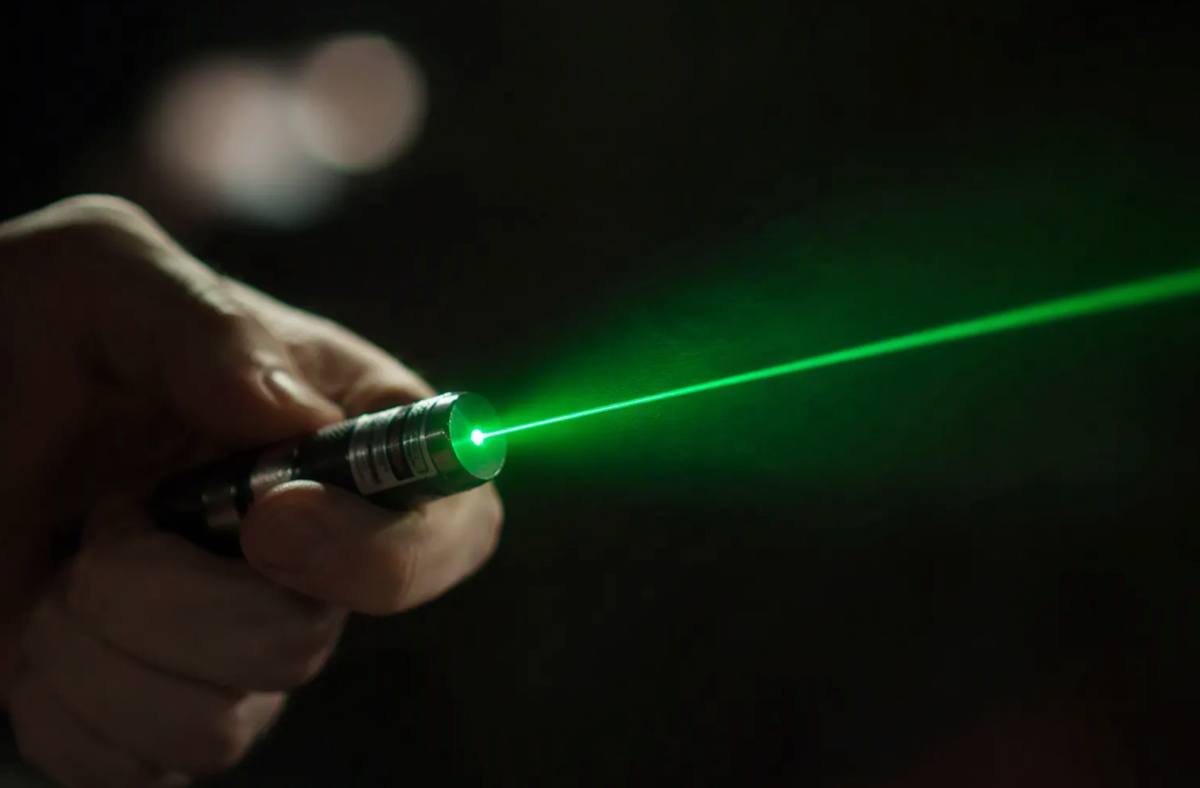
Green laser pointer beam visibility depends on several factors working together: wavelength, optical output power, beam divergence, ambient light, atmospheric conditions, and viewing angle.
Green wavelengths such as 520nm and 532nm often appear highly visible to human eyes because they lie close to the peak sensitivity of daytime vision. However, a brighter-looking beam does not necessarily mean greater optical power or greater physical range.
This guide explains what actually makes a green laser beam visible and why two green lasers with the same power rating can look very different in real-world conditions.
Key Takeaways
-
520nm and 532nm green light usually appears more visible than red or blue light at equal optical output because human eyes are more sensitive to green wavelengths.
-
Higher optical output can increase apparent visibility, but there is no universal “miles of visibility” value for a given mW rating.
-
Beam divergence matters because it changes how quickly the beam spreads and how concentrated the light remains.
-
Dark surroundings generally make a green beam easier to see, while bright daylight can make even a visible green beam difficult to observe.
-
Humidity, dust, haze, and viewing angle affect how much scattered light reaches the observer.
-
Beam visibility should not be confused with safe use distance or legal outdoor use.
Green Laser Pointer Beam Visibility Basics
Eye Sensitivity to Green Light
Your eyes react most strongly to green light. Human daytime vision peaks at 555 nanometers. This wavelength sits in the yellow-green spectrum. A green laser at 532 nm or 520 nm lands very close to this peak. This closeness gives green lasers a big visibility edge. The green laser pointer beam visibility beats other colors at the same power level.
Human daytime vision peaks near 555nm, so both 520nm and 532nm lie in a visually efficient part of the spectrum. At equal optical output, they generally appear substantially brighter than deeper red or blue wavelengths.
Perceived brightness is a visual effect and should not be treated as a measurement of optical power. In very low-light conditions, scotopic vision peaks around 507nm, which also favors blue-green wavelengths over deep red.
Green light also scatters better off airborne particles. A laser beam becomes visible from the side because some light is scattered toward the observer. Molecular scattering contributes in clear air, while larger aerosols, haze, dust, and moisture droplets can increase scattering under real outdoor conditions.
More scattering can make the beam path easier to see, but it can also reduce clarity and does not mean the laser travels “farther.”
Beam Divergence and Brightness
Beam divergence describes how quickly a beam expands as it travels. It is commonly expressed in milliradians (mrad).
Lower divergence generally means the beam spot grows more slowly with distance. However, divergence is product-specific and depends on the diode, collimating optics, focus setting, and beam quality.
Buyers should compare the stated divergence of specific models rather than assuming one universal “good” value.
A lower-divergence beam may look more concentrated at distance, but it does not increase the laser’s total optical output power.
The Role of Power

Increasing optical output generally increases the amount of light available to be scattered toward the observer, so the beam may appear more visible under the same conditions.
This does not create a fixed maximum beam range. A laser beam can continue propagating well beyond the distance at which a person can visually detect it.
Visibility and Power Levels
The power level you pick depends on what you plan to do. For indoor presentations, a small 1 mW laser works fine. The beam stays visible on whiteboards and projection screens without bothering your audience. Go outside at night for astronomy, and you need more power. A 5 mW green laser gives you a beam you can follow across the night sky easily. This same power level works well for showing constellations to small groups.
Daylight is a whole different challenge. Bright daylight reduces beam contrast significantly. Increasing power is not a safe or universally appropriate solution.
|
Factor |
Effect on Beam Visibility |
|
Higher optical output |
Usually increases apparent brightness |
|
Lower ambient light |
Improves contrast |
|
Lower divergence |
Keeps light more concentrated over distance |
|
More haze/aerosols |
Can increase side-scattered beam visibility |
|
Bright sunlight |
Strongly reduces contrast |
|
Viewer close to beam axis |
Changes apparent scattering/visibility |
|
Dark background |
Improves perceived contrast |
|
Clean optics |
Helps maintain expected beam profile |
These numbers assume clear skies and few obstacles. Air clarity, ambient light, and beam divergence all change your actual results. A strong laser in fog does worse than a weaker one on a clear, crisp night.
The Role of Wavelength
Wavelength is the second major factor that controls your green laser pointer beam visibility. The color of the light your laser emits directly affects how bright the beam appears to your eyes. Each wavelength interacts with your vision system differently. Understanding this relationship helps you choose the right tool for your needs. The science behind this is straightforward but powerful.
Why Green Laser Pointers Excel for Visibility
Your eyes have a built-in preference for green light. The human eye's photopic vision peaks at 555 nanometers. This peak sits right in the green part of the spectrum. A green laser at 532 nm or 520 nm lands very close to this peak. This closeness gives green laser pointers a massive visibility advantage over other colors. You see more of the beam with less power.
At equal power, 532 nm green light appears 8.3 times brighter than 650 nm red light. This comes from the standard CIE 1924 photopic luminous efficiency data. Your cone cells respond most strongly to green wavelengths between 520 and 570 nm. Green light triggers these cells much more effectively than red or blue light. The result is a beam that looks far brighter at the same power level. Your beam pops out against the background.
Green light also benefits from Rayleigh scattering. Shorter wavelengths scatter more off airborne particles like dust and humidity. This scattering creates a visible column of light from the emitter to your target. The beam appears to glow in the air. This effect makes a green laser pointer beam visibility excellent even in moderate ambient light. For a clear beam in high ambient light conditions, you need 3 to 5 mW of green output power. That small amount of power delivers a bright, visible beam.
Comparing Green, Red, and Blue
The differences between wavelengths become clear when you compare them directly. A 5 mW green laser at 532 nm produces a somewhat visible beam in darkness. To match that visibility with a red laser at 650 nm, you need 90 mW of power. Even at 250 mW, a red laser is barely visible in darkness. The red beam struggles to stand out. This shows how inefficient red light is for beam visibility. You waste power trying to get the same result.
Blue light at 445 nm performs slightly better than red but still falls far short of green. Under photopic vision conditions, 450 nm blue light appears only about 25 percent as bright as 532 nm green at the same power level. The ratio between 532 nm green and 445 nm blue is 29.7 to 1. This means you need nearly 30 times more blue output power to match the perceived brightness of a green beam. That is a huge difference in efficiency.
For practical use, the numbers tell a clear story. A 5 mW laser pointer gives you a visible beam that rivals a 90 mW red unit. This efficiency saves battery life and reduces the need for extreme power levels. Your beam stays bright and visible across the distance you need. Hgyuskl uses 520 nm direct green diodes in its laser pointers. These diodes deliver superior beam quality without exaggeration. The real wavelength specification ensures you get the performance you expect. You do not have to guess about the output you receive. Your beam performs exactly as the specs promise.
The Role of Ambient Light
Visibility in Darkness
Darkness makes your green laser beam much easier to see. When there is less light around, the beam stands out more against the background. In very dark conditions below 0.001 lux, your eyes become highly sensitive. Even a low-power green laser creates a clear beam over a long distance. Your effective range grows a lot in total darkness. A 5 mW green laser can show a visible beam for several miles. How far you can see depends on how dark it is. For the best visibility, pick a moonless night away from city lights. The distance you can see the beam increases greatly. Your working range expands as ambient light drops. This long-distance visibility makes green lasers great for outdoor use. The effective range of your laser pointer changes with every light condition. The range of use grows a lot at night.
Light Pollution and Indoor Use
Ambient light pollution directly reduces your beam visibility. City lights, street lamps, and indoor lighting all wash out the laser beam. In urban twilight conditions around 10 lux, a 50 mW green laser beam becomes hard to see beyond 500 meters. Compare this to a dark sky where the same laser stays visible for miles. Indoor environments present similar challenges. Typical office lighting reduces your effective range considerably. A 5 mW green laser shows a visible dot on a white wall at 300 meters in low indoor light. But outdoors on asphalt at noon, the same laser dot becomes unlikely beyond 30 meters. The sun produces over 100,000 lux of illumination. No standard laser can overpower direct sunlight. The beam simply disappears. For outdoor survival or astronomy, dark skies remain ideal. Your light conditions determine your real-world visibility. The range you get from your laser depends on ambient light. The distance you can cover shrinks as light increases. The range at which you can spot your beam changes instantly with the light. The visible range you achieve correlates directly with ambient light levels.
Choosing the Right Laser Pointer
Safety and Practical Considerations
Safety must guide every choice you make. Never point any laser at people or aircraft. This hazard applies to every power level, from 1 mW to 1W. The risk of eye damage increases with output power. A high-power handheld laser creates a serious hazard if misused. You must treat every laser as a potential hazard, not a toy.
Hgyuskl builds safety into its design. Aviation aluminum casings protect internal components from drops and impacts. APC constant current drives maintain stable output, preventing power spikes that create unexpected hazards. These features reduce risk during demanding outdoor use. Your handheld laser stays reliable when you need it most.
Practical considerations extend beyond safety precautions. Battery life matters for extended field use. Weather resistance protects your investment during outdoor survival scenarios. The effective range you need determines your power choice. A 5 mW unit offers limited range but minimal hazard. A 200 mW unit extends your laser performance dramatically but demands greater respect for its hazard potential. Your health and the health of others depend on responsible use. Choose the lowest power that meets your needs while maintaining appropriate safety levels. This balanced approach maximizes performance while minimizing risk.
Green laser beam visibility depends on a combination of wavelength, output power, divergence, ambient light, atmospheric scattering, and viewing angle.
Green wavelengths such as 520nm and 532nm are visually efficient, but brightness alone does not tell you the true optical output, hazard class, or safe-use distance.
When comparing Hgyuskl models or other green laser products, check wavelength, output, class, divergence, focus design, duty cycle, and safety documentation rather than choosing by advertised range or maximum power alone.
FAQ
How far can I see a green laser beam at night?
There is no single reliable distance for a given power level. Visibility depends on output, wavelength, divergence, ambient light, atmospheric conditions, viewing angle, and whether you are looking at the airborne beam or the target dot.
Why does my green laser beam disappear in daylight?
Bright daylight greatly reduces contrast between the scattered laser light and the background. This can make the airborne beam difficult or impossible to see even though the laser is still emitting normally.
What power level do I need for outdoor use?
Not always. Higher optical output can increase apparent brightness, but beam divergence, optics, wavelength, ambient light, and viewing angle also matter. Higher output also increases hazard and may place the product in a higher laser class.
Share:
High Power Green Laser Pointer: What Makes a Laser Truly High Power?
520nm vs 532nm Green Lasers for Outdoor Use: Visibility, Stability, and Efficiency