
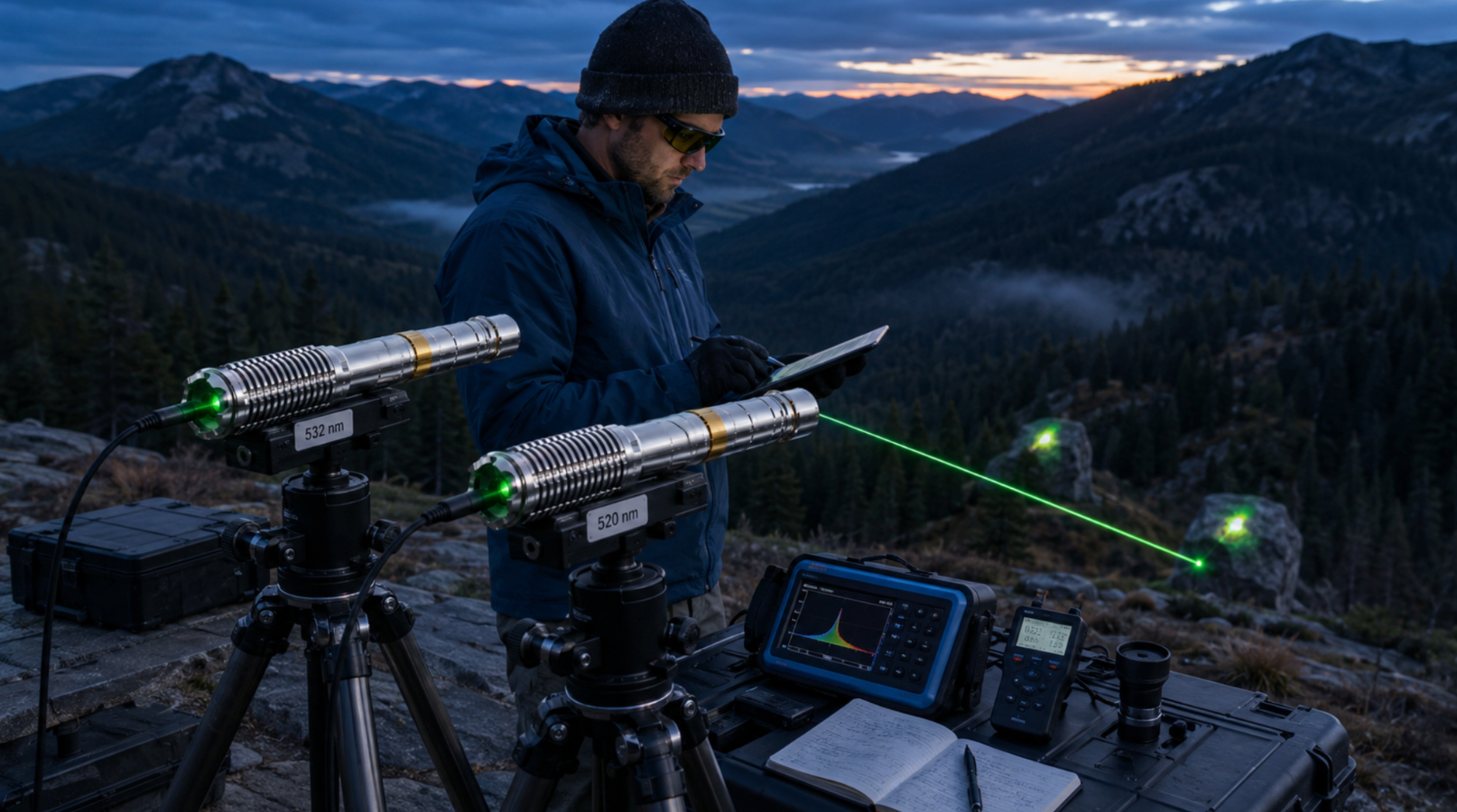
520nm and 532nm green lasers can both be highly visible outdoors, but they usually use different technologies and behave differently in changing temperatures.
A 532nm DPSS laser often appears slightly brighter at the same optical output, while a 520nm direct-diode laser is often more temperature-stable and may offer better electrical efficiency.
For outdoor buyers, the most important differences are perceived brightness, temperature behavior, battery use, beam quality, IR filtering, and model-specific operating limits.
Key Takeaways
-
532nm often appears slightly brighter than 520nm at the same optical output because it lies closer to the peak sensitivity of human daytime vision.
-
520nm direct-diode lasers are often more temperature-stable than traditional 532nm DPSS designs.
-
Battery runtime depends on output power, driver efficiency, battery capacity, and duty cycle; 520nm does not automatically last longer in every product.
-
532nm DPSS lasers require attention to residual infrared filtering because their internal conversion process uses IR wavelengths.
-
Beam quality and divergence are product-specific and should not be assumed from wavelength alone.
-
Outdoor use requires strict beam control around aircraft, vehicles, people, animals, and public areas.
Wavelength and Visibility
Human Eye Sensitivity and the Green Peak
Both 520nm and 532nm fall in a highly visible part of the spectrum. At equal optical output, 532nm generally has a modest perceived-brightness advantage because it is closer to the photopic peak near 555nm.
In practice, output power, beam divergence, optics, and ambient light may matter more than the 12nm wavelength difference alone.
The 12nm Difference: Perceived Brightness
The 12nm gap between these wavelengths creates a small but visible difference. A 532nm laser produces the classic, bright green that most people expect from a good pointer. A 520nm laser moves toward a grass-green look, slightly cooler and less intense to the eye.
For typical working distances, the exact wavelength (520nm vs. 532nm) is not a critical factor; both deliver identical perceived brightness. The choice between them is more often dictated by other factors like power consumption, thermal stability, and cost, rather than a difference in visibility.
These green visibility gains make both wavelengths great picks for outdoor use. Your choice should focus on brightness perception along with practical factors like efficiency and durability. When you need the most perceived brightness from your laser, 532nm has the edge. When you value steady performance across different conditions, 520nm offers benefits that go beyond raw visibility.
520nm vs 532nm Outdoor: Beam Brightness

When you take your laser outside on a sunny day, you can quickly see the difference between 520nm and 532nm. Strong sunlight fades weak beams fast, so you need every bit of help you can get. The 532nm wavelength gives you more perceived brightness per milliwatt because it is closer to the human eye's best sensitivity at 555nm. This means a 532nm laser looks much more vivid than a 520nm laser at the same power.
Laser Brightness in Daylight Conditions
Bright outdoor light reduces contrast for both 520nm and 532nm green lasers. At equal optical output, 532nm may retain a modest visual advantage because of human eye sensitivity, but neither wavelength should be expected to remain highly visible under every daylight condition.
Daylight visibility depends on more than wavelength. Output power, beam divergence, surface reflectivity, background brightness, viewing angle, and optics all affect whether the user can see the dot clearly.
Driver design can also affect output stability. APC or regulated-driver circuitry may help reduce output fluctuation while the battery remains within the driver’s normal operating range, but it does not guarantee constant brightness under all battery and temperature conditions.
Beam Divergence and Long-Distance Visibility
Beam divergence describes how quickly a laser beam expands as it travels and is commonly expressed in milliradians (mrad). Lower divergence generally means the spot grows more slowly with distance, while higher divergence causes faster beam expansion.
Under a simple small-angle approximation, 1.2 mrad corresponds to roughly 1.2mm of additional beam spread per meter. However, there is no universal divergence threshold that makes one outdoor laser “good” and another “bad.”
Divergence depends on diode geometry, collimating optics, focus setting, beam quality, and product design. Well-designed 532nm DPSS lasers can produce good beam profiles, but 520nm direct-diode products can also achieve good beam control with appropriate optics.
Buyers should therefore compare the actual divergence or beam-profile specifications of individual models rather than assuming that 532nm always has lower divergence than 520nm.
Power Efficiency and Battery Life
Diode vs. DPSS Technology
A 520nm green laser typically uses a direct semiconductor diode to produce visible green light. This avoids the additional frequency-conversion stages found in traditional 532nm DPSS designs.
A 532nm DPSS laser typically begins with an infrared pump diode and uses a solid-state laser medium and nonlinear crystal to generate visible 532nm green light. Each conversion stage introduces efficiency and thermal considerations.
Because of the simpler optical architecture, 520nm direct-diode designs can be more electrically efficient than many 532nm DPSS systems. However, actual efficiency depends on the diode, driver, output level, battery system, and thermal design of the specific product.
Impact on Runtime and Portability
Battery life is an important outdoor consideration, but wavelength alone does not determine runtime. A 520nm direct-diode design may use electrical power more efficiently than some 532nm DPSS designs at comparable optical output.
Actual runtime depends on output power, battery voltage, battery capacity, driver efficiency, operating temperature, and duty cycle. Two 520nm products can have very different runtimes if their output levels and battery systems differ.
When comparing outdoor models, check the battery type, rated capacity, driver design, charging requirements, and manufacturer-specified runtime or duty cycle instead of assuming that every 520nm laser will automatically last longer than every 532nm model.
Temperature Stability and Outdoor Reliability
Outdoor conditions change fast. One hour you work in warm sunlight, the next you stand in freezing wind. Your laser must handle both extremes without losing power. This is where the 520nm vs 532nm outdoor debate becomes critical. Temperature stability separates reliable tools from frustrating gadgets.
Cold-Weather Performance: 520nm's Advantage
Direct-diode 520nm lasers are often less temperature-sensitive than traditional 532nm DPSS systems because they do not rely on temperature-sensitive frequency conversion.
532nm DPSS output can change with temperature, especially during cold starts, but the exact operating range and degree of variation depend on the specific module and thermal design.
Heat Management in 532nm DPSS Lasers
Both 520nm and 532nm lasers generate heat, and both require appropriate thermal design at higher output levels.
A 532nm DPSS system has additional conversion stages that can make its optical output more sensitive to internal temperature. A 520nm direct-diode design avoids those DPSS-specific conversion stages, but it can still experience output drift, driver heating, diode heating, or reduced battery performance when operated outside its designed conditions.
Cooling requirements are product-specific. Some products rely on passive heat spreading through a metal housing, while higher-output or professional systems may use more substantial thermal management. A metal body can help transfer heat, but it does not by itself prove that a laser can operate continuously.
Buyers should check the manufacturer-specified operating temperature and duty cycle for the exact model rather than assuming that one wavelength is immune to heat or cold.
Cost and Availability
532nm DPSS technology has been used in green laser products for many years and is available across a wide range of designs. 520nm direct-diode technology is also widely available, with pricing that varies according to optical output, diode type, driver design, housing, and product quality.
Price alone does not tell you which wavelength is better. A lower-cost 532nm product may be appropriate in some conditions, while a 520nm product may offer advantages in temperature stability or electrical efficiency.
Compare actual model specifications, warranty, battery system, safety features, operating-temperature guidance, and documentation rather than assuming that one wavelength always has a lower total cost of ownership.
Practical Applications and Choosing the Right Laser

Outdoor Safety and Aviation Limits
Outdoor visibility does not make a laser suitable for uncontrolled long-distance pointing. Never direct a laser toward aircraft, flight paths, vehicles, people, animals, roads, or public areas.
In the United States, intentionally aiming a laser at an aircraft is a federal crime. The FAA continues to treat laser illumination of aircraft as a serious aviation-safety issue.
U.S. FDA rules also limit visible products promoted for pointing or demonstration purposes to Class IIIa / IEC Class 3R, up to 5mW. Products from 5mW to 500mW fall into Class IIIb / IEC Class 3B and cannot legally be promoted as ordinary laser pointers or demonstration products.
Local rules can also vary, so outdoor use should be evaluated separately from product availability or advertised power.
For outdoor use, 532nm generally offers a modest perceived-brightness advantage, while 520nm direct-diode designs often offer better temperature stability and simpler optical architecture.
Neither wavelength is automatically better in every outdoor environment. Actual performance depends on optical output, beam divergence, ambient light, battery system, driver design, thermal management, operating temperature, and product quality.
When comparing Hgyuskl models or other green lasers, use model-specific specifications and safety documentation rather than choosing by wavelength, maximum power, or advertised range alone.
FAQ
Which wavelength usually performs better in cold weather?
520nm direct-diode lasers are often less temperature-sensitive than traditional 532nm DPSS designs, especially during cold starts. However, the actual operating-temperature range and degree of output change depend on the specific diode, driver, battery, optics, and thermal design.
Is 532nm more visible than 520nm outdoors?
At the same optical output, 532nm generally appears slightly brighter because it lies closer to the peak sensitivity of human daytime vision. However, output power, beam divergence, optics, ambient light, surface reflectivity, and viewing angle can have a larger effect on real-world outdoor visibility.
Which wavelength can offer longer battery life outdoors?
A 520nm direct-diode design can be more electrically efficient than some 532nm DPSS designs, which may help battery runtime in comparable products. However, actual runtime depends on optical output, battery capacity, driver efficiency, operating temperature, and duty cycle. Compare the specifications of the individual models rather than wavelength alone.
Share:
Green Laser Pointer Beam Visibility: Power, Wavelength, and Ambient Light
Best High Power Laser Pointer: Green or Blue?