
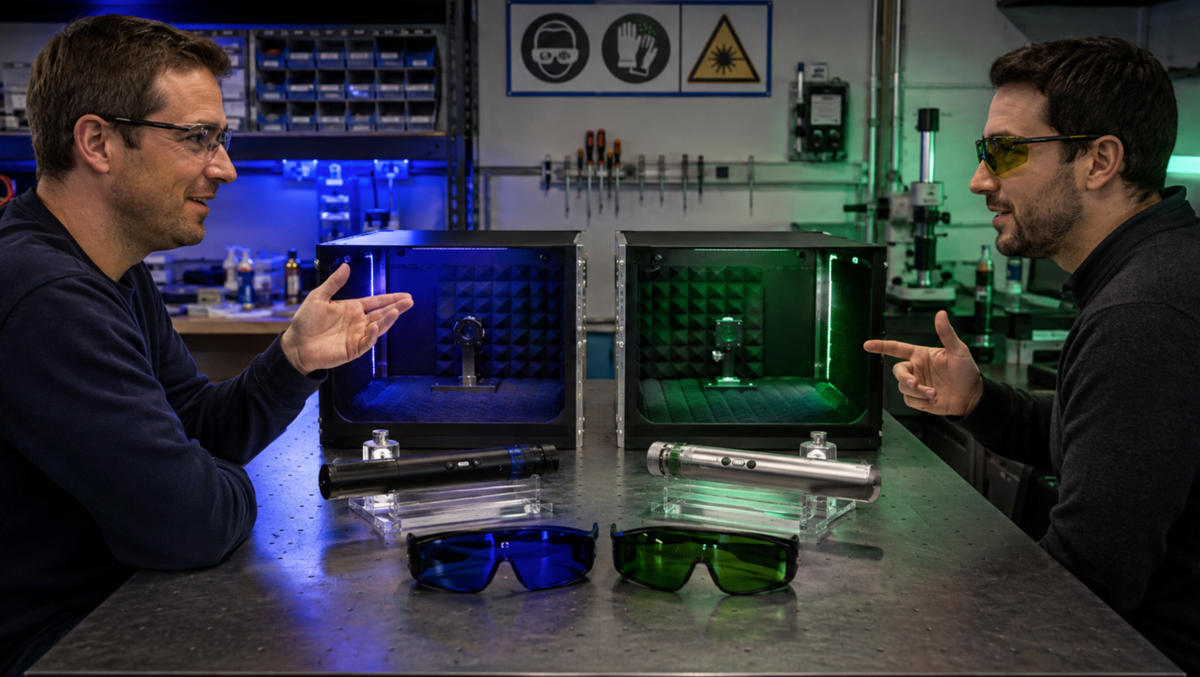
Choosing between a green and blue high-output laser is not simply a question of which color is “more powerful.” Green and blue wavelengths differ in perceived visibility, available diode technology, beam characteristics, battery demands, and safety considerations.
At the same optical output, green wavelengths such as 520nm and 532nm usually appear brighter to human eyes than 445nm or 450nm blue light. Blue lasers, however, are widely available in direct-diode designs across many output levels. That does not make blue inherently more powerful or better.
This guide compares green and blue lasers by visibility, wavelength, output power, battery and thermal performance, beam characteristics, safety, and value so you can understand which specifications matter before buying.
Key Takeaways
-
Green wavelengths such as 520nm and 532nm generally appear brighter than 445nm or 450nm blue light at the same optical output because of human eye sensitivity.
-
Blue is not automatically more powerful than green. Optical output must be compared in milliwatts or watts on the specific products.
-
520nm green and 445/450nm blue products are commonly available as direct-diode designs, while traditional 532nm green lasers usually use DPSS technology.
-
Battery life, heat, beam divergence, and duty cycle depend on the specific diode, driver, output level, battery, and housing—not color alone.
-
For higher-output products, laser class, warning labels, safety features, and documentation should matter more than maximum wattage.
A Note About the Term “High Power Laser Pointer
“High power laser pointer” is a common search and marketing phrase, but laser class and optical output are more meaningful technical descriptions.
In the United States, visible laser products promoted for pointing or demonstration purposes are limited by FDA regulation to Class IIIa / IEC Class 3R, up to 5mW. Products from 5mW to 500mW fall into Class IIIb / IEC Class 3B and cannot legally be promoted as ordinary laser pointers or demonstration products.
For that reason, higher-output handheld lasers should not automatically be treated as ordinary presentation or pointing devices.
Visibility: Why Green Laser Pointers Appear Brighter

Human Eye Sensitivity and Wavelength
Human eyes do not perceive every visible wavelength equally. Under normal daytime vision, sensitivity peaks near 555nm, which places 520nm and 532nm green light in a highly visible part of the spectrum.
As a result, green light generally appears substantially brighter than 445nm or 450nm blue light when the optical output is the same. However, there is no need to convert this difference into a fixed “10×” or “30×” rule for buying laser products. Perceived brightness also changes with viewing conditions, beam divergence, background light, and the exact wavelengths being compared.
Most importantly, perceived brightness is not the same as optical power. A blue laser can look less bright than a green laser while still having much higher measured output. Compare mW or W and laser class rather than judging power by eye.
Beam Visibility in Daylight vs. Night
Ambient light has a major effect on laser visibility. Bright daylight reduces contrast for both green and blue beams, and the airborne beam path may become difficult to see even when the laser itself is operating normally.
Under lower-light conditions, both colors become easier to see, but green usually retains a perceived-visibility advantage at equal optical output. This is useful when comparing wavelength efficiency, but it should not be treated as a reason to increase power or to use a higher-class laser for ordinary pointing.
If visibility is the main comparison factor, green generally has the advantage. If a specific blue wavelength is required for a legitimate technical purpose, compare the actual output, class, beam characteristics, and safety requirements rather than trying to match green’s visual brightness with more blue power.
Safety Considerations and Eye Hazard
The Illusion of a "Safe" Beam
Neither green nor blue is automatically the “safe” choice. Laser hazard depends on wavelength, optical output, laser class, beam geometry, exposure duration, and whether the exposure is direct or reflected.
Higher-output Class 3B and Class 4 products can present serious eye hazards. Protective eyewear, when required, must be selected for the actual wavelength and hazard level. A generic pair of “laser glasses” is not enough, and eyewear does not make deliberate exposure acceptable.
Buyers should first check the laser class, stated output, warning labels, safety instructions, and access-control features. Do not use apparent beam brightness as a safety test.
|
Hazard Type |
Class 3B Specifics |
Class 4 Specifics |
|
Direct/Reflected Beam |
Retinal burns; NOHD up to 1,050 ft for 499 mW; blink reflex not enough |
Severe eye damage; safety glasses required |
|
Diffuse Reflection |
Dangerous within 5 in for >10 min at 499 mW |
Dangerous; can cause injury from scattered light |
|
Recommended Practice |
Avoid all eye exposure; avoid reflected beams |
Wear glasses that block your laser's wavelength; use engineering controls |
Safety Differences Between Green and Blue Lasers
Blue is not automatically more hazardous than green simply because of its color. For visible handheld lasers, the actual output power, laser class, beam characteristics, and exposure conditions are more useful indicators of risk.
Traditional 532nm DPSS green lasers have one additional specification buyers should understand: they use infrared wavelengths internally, commonly involving 808nm pumping and 1064nm light before frequency doubling produces 532nm green output. Poorly designed or inadequately filtered products may therefore have residual infrared leakage.
Direct-diode 520nm green and 445/450nm blue lasers do not use the same DPSS conversion path, but their visible beams can still be hazardous at higher output levels. For 532nm models, check product-specific information about IR filtering rather than assuming every green laser uses the same design.
Battery Life and Efficiency: Green vs. Blue
The DPSS Efficiency Gap
Battery efficiency cannot be predicted from color alone because green lasers can use different architectures.
Traditional 532nm green lasers usually use DPSS technology, with additional optical conversion stages between the electrical input and visible green output. These stages can introduce extra efficiency and thermal losses.
By contrast, 520nm green lasers and 445/450nm blue lasers are commonly available as direct-diode designs. Their electrical efficiency still varies according to diode type, output level, driver design, battery voltage, and thermal management.
For buyers, the practical lesson is simple: compare battery capacity, output power, driver efficiency, and duty cycle on the actual models. Do not assume that every blue laser has better battery life than every green laser.
Driver Design and Runtime
Most 445nm and 450nm blue handheld lasers use direct-diode technology, but direct-diode design alone does not guarantee longer runtime or lower operating temperature.
Driver circuitry helps control the electrical current supplied to the laser diode. APC or other regulated-driver designs may help reduce output fluctuations while the battery remains within the driver’s operating range.
APC should not be treated as a battery-saving feature. Actual runtime still depends on optical output, driver efficiency, battery capacity, diode efficiency, temperature, and duty cycle.
The same principle applies to 520nm direct-diode green lasers. Compare individual product specifications rather than assuming blue automatically has an efficiency advantage.
Intended Use Cases: Choosing the Right Tool

Astronomy and Outdoor Pointing: Green Wins
When you point at stars, you need a laser that shines through the dark. Green laser pointers are the top pick for this job. Your eyes are most sensitive to light near 555 nm, and a 532 nm green beam lands right in that zone. This makes the beam look much brighter than other colors at the same power. For stargazing guides, this bright beam turns a simple pointer into a great teaching tool. You can trace the Milky Way or point out Orion's belt with a beam that looks like a solid light rod. Green lasers work so well in low light that they are the standard for night sky tours. When you look for the best high power laser pointer for astronomy, green wins every time. Your group sees the beam clearly, even with moonlight or city lights. This means you can guide people without repeating yourself or moving closer.
Green vs. Blue: Which One Should You Choose?
The most useful comparison is not “green for pointing, blue for power.” Start with the specification that actually matters for your intended and lawful use.
|
Comparison |
Green Laser |
Blue Laser |
Buyer Takeaway |
|
Perceived visibility |
Usually higher at equal optical output |
Usually lower at equal optical output |
Green is easier to see at the same optical output |
|
Common wavelengths |
520nm, 532nm |
445nm, 450nm |
Check the exact wavelength, not just the color name |
|
Common architecture |
520nm direct diode; 532nm often DPSS |
445/450nm commonly direct diode |
Technology affects battery and thermal behavior |
|
Optical output |
Product-specific |
Product-specific |
Blue is not inherently more powerful |
|
Beam quality |
Product-specific |
Product-specific |
Compare divergence and focus rather than color alone |
|
Battery/runtime |
Product-specific |
Product-specific |
Compare battery, output, driver, and duty cycle |
|
IR-filter concern |
Mainly relevant to 532nm DPSS |
Not the same DPSS issue |
Check 532nm product documentation |
|
Safety |
Depends on class, output, and use |
Depends on class, output, and use |
Color alone does not determine hazard |
If perceived visibility is the main priority, green generally makes more sense at the same optical output. If you specifically need a 445nm or 450nm wavelength for a legitimate technical reason, compare blue models by their documented output, class, beam characteristics, duty cycle, and safety information.
Higher output should not be treated as automatically better. For both colors, choose the lowest output appropriate for the legitimate task and check applicable laws, labels, and safety requirements.
Cost and Value: Are Blue Laser Pointers Cheaper?
Price Differences for Comparable Power
Price differences between green and blue lasers depend heavily on wavelength, technology, output level, optics, battery system, and product design.
Traditional 532nm DPSS lasers use additional optical components for frequency conversion, which can make their construction more complex. However, 520nm green lasers and 445/450nm blue lasers are both available as direct-diode products, so “green costs more than blue” is not a reliable rule.
Instead of comparing price per watt, compare the complete specification: wavelength, documented optical output, laser class, beam divergence, battery system, duty cycle, safety features, warranty, and product documentation. A lower price or larger wattage number does not automatically provide better value.
Long-Term Reliability and Build Quality
Price alone should not decide which laser you buy. Higher-output products should provide clear and internally consistent information about wavelength, optical output, laser class, warning labels, battery requirements, and operating limits.
Construction also matters. Metal housings can help with durability and heat spreading, while regulated drivers such as APC may help stabilize output within the circuit’s operating range. Neither feature guarantees a particular lifetime or makes the laser safer by itself.
When comparing Hgyuskl models or other brands, apply the same checklist to every product: documented output, wavelength, class, battery, duty cycle, beam characteristics, safety features, labels, instructions, and warranty. Choose based on complete specifications rather than the largest wattage claim or lowest price.
So, which is the better choice: green or blue?
If perceived beam visibility is the main factor, green generally has the advantage at the same optical output. If you specifically need a 445nm or 450nm wavelength, blue may be the appropriate choice—but not because blue is inherently more powerful.
For higher-output products, color should never be the only buying criterion. Compare the actual optical output, laser class, wavelength, beam divergence, battery system, duty cycle, thermal design, safety features, labels, and documentation.
The best choice is not the laser with the largest wattage number. It is the product whose specifications, safety requirements, and intended use are clearly understood.
FAQ
Should I choose green or blue for my first laser?
Start with the intended use, required wavelength, and appropriate laser class rather than choosing a high-output product first. If visibility is the main requirement, green generally appears brighter at the same optical output. Choose blue when a specific blue wavelength is required, not simply because a blue product advertises more watts.
How should higher-output lasers be handled safely?
Avoid direct eye exposure and mirror-like reflections, keep the beam path controlled, and never direct a laser toward people, animals, vehicles, aircraft, or public areas. When protective eyewear is required, it must match the laser wavelength and provide an optical density appropriate for the specific hazard. Eyewear does not make deliberate beam exposure safe.
What does “real output” mean when comparing laser products?
Optical output describes the laser radiation emitted from the product and is normally stated in milliwatts or watts. Buyers should compare this value with the stated laser class, wavelength, warning labels, and technical documentation.
Do not estimate output from perceived brightness alone. Green and blue wavelengths can look very different even when their measured optical output is the same.
Share:
520nm vs 532nm Green Lasers for Outdoor Use: Visibility, Stability, and Efficiency
High Power Laser Pointer: What Should You Know Before Buying?