
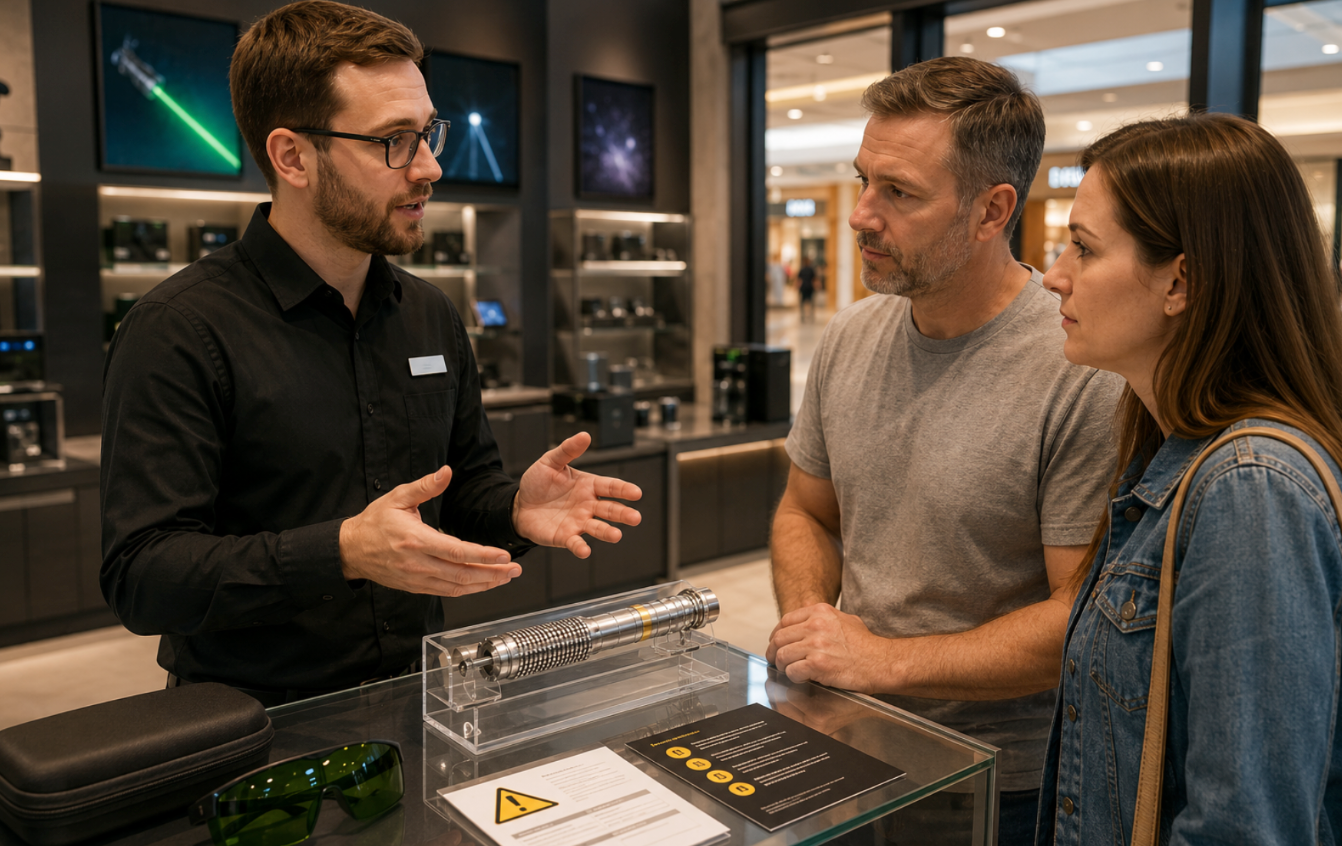
High-power laser pointers grab attention with their bright beams. Before you buy a high-power laser pointer, ask yourself: Is it legal? Is it safe? Are you getting real output? Many products claim fake features and ignore the 5mW U.S. limit. Watch out for claims like "peak power," "burns anything," "100km range," and "no goggles needed." High-power lasers need to be handled with care. This guide cuts through the hype and helps you buy responsibly.
Key Takeaways
-
- Check the applicable laws and product restrictions before buying a high-power laser pointer. In the U.S., visible products promoted for pointing or demonstration purposes are limited to Class IIIa / IEC Class 3R, up to 5mW.
-
- Check the laser class, warning labels, key-lock switches, operating instructions, and other safety features appropriate to the product. These features can reduce accidental or unauthorized activation, but they do not make direct beam exposure safe.
-
Be cautious of unclear or contradictory power claims. Look for clearly stated optical output and credible measurement documentation rather than relying on “peak power,” brightness, range, or burning claims.
-
Compare wavelength, battery type, duty cycle, beam characteristics, and thermal design together. Maximum wattage alone does not tell you which product is better.
Safety and Legality First

Before buying a high power laser product, start with its legal classification rather than the marketing name.
In the United States, FDA regulations limit visible laser products promoted for pointing or demonstration purposes to Class IIIa / IEC Class 3R, up to 5mW. Products from 5mW to 500mW fall into Class IIIb / IEC Class 3B and cannot legally be promoted as ordinary laser pointers or demonstration products.
Buyers should check the product label for the stated laser class, wavelength, output power, warning information, manufacturer or distributor identification, and applicable compliance statement. Availability online does not automatically mean that a product is appropriate or compliant for ordinary pointing use.
Understanding Power Limits and Legal Risks
Laser class describes hazard potential; it is not a quality score and it does not tell you whether a product is “better.”
|
Laser Class |
General Meaning |
What Buyers Should Know |
|
Class 2 |
Lower-output visible laser |
Avoid deliberate or prolonged direct viewing |
|
Class 3R / FDA Class IIIa |
Higher visible exposure potential; up to 5mW in the U.S. pointer/demonstration context |
Direct viewing can be hazardous; not risk-free |
|
Class 3B / FDA Class IIIb |
5mW to 500mW under the FDA system |
Serious direct-eye hazard; cannot legally be promoted as an ordinary laser pointer in the U.S. |
|
Class 4 |
Above the Class 3B accessible-emission limits |
Direct and reflected exposure can cause serious eye or skin injury; fire hazards may also exist |
In the United States, FDA regulations limit visible products promoted for pointing or demonstration purposes to Class IIIa / IEC Class 3R, up to 5mW.
Higher-output products should be evaluated according to their actual laser class, product type, labeling, intended use, and applicable regulations. Do not assume that a higher laser class means better performance or better value.
Real-World Safety Hazards to Avoid
Higher-output lasers require more attention to access control, thermal design, battery safety, and product labeling.
Depending on the product class and design, useful safety features may include a key switch or other lockout, emission indicators, warning labels, aperture information, operating instructions, and interlock features where required. These controls can reduce accidental or unauthorized activation, but they do not make exposure to the beam safe.
Housing and thermal design also matter. A metal body can help spread heat away from the diode and driver, while regulated circuitry such as APC may help reduce output fluctuations within the circuit's operating range. Neither aluminum construction nor APC changes the fundamental hazard class of the laser.
Before buying, check whether the safety features, labels, battery system, duty cycle, and operating instructions are appropriate for the stated laser class and output.
Smart Buying Tips for High Power Lasers

Decoding Power, Wavelength, and Build Quality
Marketing terms such as “peak power,” “maximum power,” or “extreme power” can be misleading when the measurement conditions are not explained.
When comparing products, look for clearly stated optical output in milliwatts or watts and check whether the specification refers to continuous-wave output, pulsed output, or another defined measurement condition.
Accurate verification requires calibrated equipment suitable for the laser's wavelength and output range. Ordinary buyers should not estimate wattage from beam brightness, burning ability, battery drain, or informal home tests. Use the product label, technical documentation, and credible measurement data as the starting point.
Wavelength affects perceived brightness, but it does not determine optical power by itself.
Human daytime vision is highly sensitive to green wavelengths such as 520nm and 532nm, so a green laser may appear much brighter than a red or blue laser with the same measured optical output. This is why brightness should never be used as a substitute for reading the mW/W specification and laser class.
Blue wavelengths such as 445nm and 450nm may appear less bright to the eye even when their optical output is high. Buyers should compare color, wavelength, measured output, laser class, beam characteristics, and intended use separately rather than increasing power simply to match perceived brightness.
Build quality matters, but buyers should evaluate specific construction and operating specifications rather than relying on one material alone.
Metal housings can help spread heat and protect internal components, while regulated drivers such as APC may help stabilize output within the driver's normal operating range. These features do not remove thermal limits or change the laser's hazard class.
Technology also matters. 520nm green lasers commonly use direct-diode designs, while traditional 532nm green lasers usually use DPSS frequency conversion and may be more sensitive to temperature changes. Actual operating temperature and duty cycle are model-specific, so check the manufacturer's specifications for the exact product.
Evaluating Cost, Value, and Real-World Use
Low price alone does not prove that a laser is unsafe, and a high price does not guarantee compliance. What matters is whether the product provides clear, consistent, and verifiable safety information.
NIST testing of commercial laser pointers has found significant mislabeling and excessive emissions in sampled products, including both visible and infrared output from some green pointers. FDA has also warned that laser products sold online may be overpowered, mislabeled, or missing required safety information.
Before buying, check the product's wavelength, stated optical output, laser class, certification and identification labels, warning labels, manufacturer information, and operating instructions.
Think about long-term value rather than purchase price alone. Check whether the product has a durable housing, secure battery compartment, reliable focus mechanism, clear duty-cycle guidance, replaceable or rechargeable battery support, warranty information, and accessible customer documentation.
Construction quality can affect durability and thermal performance, but no single feature guarantees long service life. Compare the complete product design and warranty rather than assuming that a heavier or more expensive laser will automatically last longer.
The right specification depends on the legitimate intended use, but higher power should never be treated as the default solution.
For a buying decision, start by asking whether you actually need a higher-output product. Then compare wavelength, optical output, laser class, battery requirements, beam divergence, focus design, duty cycle, temperature range, safety features, warning labels, and documentation.
Professional laboratory, industrial, and other specialized applications may require dedicated laser equipment, controlled environments, training, and additional safety measures. A handheld laser should not automatically be treated as a substitute for professional laser equipment.
Before buying a high power laser product, check the applicable laws, stated optical output, laser class, wavelength, warning labels, battery system, duty cycle, safety features, and product documentation.
Do not choose by maximum wattage, advertised range, beam brightness, or dramatic performance claims alone. Higher laser classes mean greater hazard potential and require greater attention to safe handling and appropriate controls.
When comparing Hgyuskl models or any other brand, apply the same checklist to every product. Clear specifications and responsible product information should come before maximum power.
FAQ
Is a high power laser pointer over 5mW legal in the U.S.?
FDA regulations limit visible laser products promoted for pointing or demonstration purposes to Class IIIa / IEC Class 3R, up to 5mW. Products above that range fall into higher hazard classifications and should not be marketed or treated as ordinary laser pointers. Additional requirements can depend on the product type, intended use, state, and local jurisdiction, so buyers should check the current rules that apply to the specific product and activity.
Is a higher-power laser always better?
No. Higher optical output increases hazard and may place the product in a higher laser class. It does not automatically mean better beam quality, better visibility, longer battery life, or better suitability. Choose the lowest output appropriate for the legitimate intended use and compare wavelength, laser class, beam characteristics, battery system, duty cycle, and safety documentation together.
How can you tell whether a laser's power specification is credible?
Look for clearly stated optical output, wavelength, laser class, warning labels, manufacturer information, and technical documentation. If measurement data are provided, the measurement conditions and equipment should also be clear. Accurate optical-power verification requires calibrated equipment suitable for the wavelength and output range. Do not estimate output from brightness, burning ability, battery drain, or informal home tests.
Share:
Best High Power Laser Pointer: Green or Blue?