
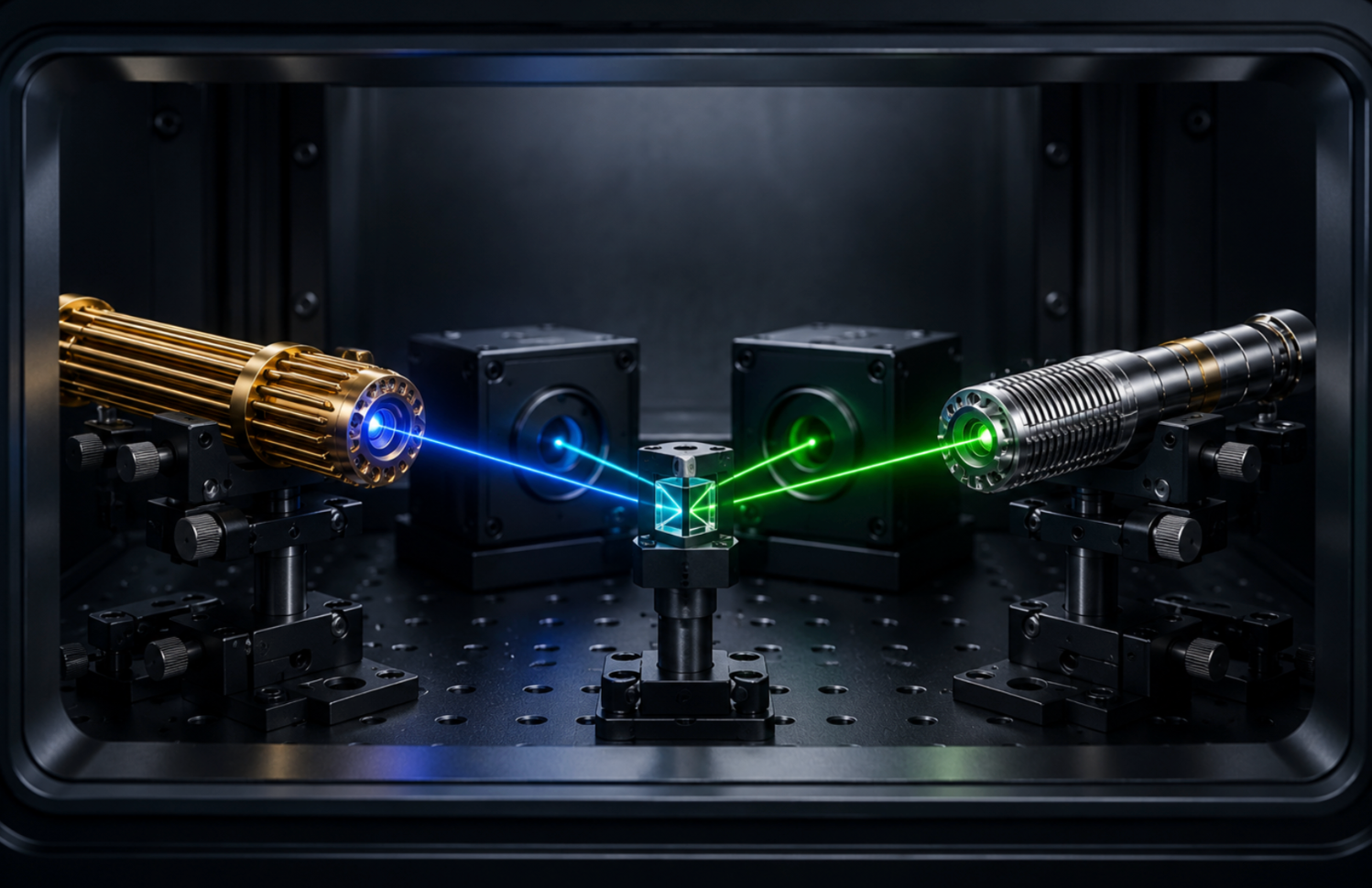
When you compare a green vs blue laser pointer, brightness depends on more than just raw power. Human eyes are most sensitive at 555 nm, so green laser pointers look naturally brighter at the same wattage. But high-power blue lasers often come with much higher mW ratings, so blue options can win in real-world visibility. For demanding tasks like stargazing, signaling, or professional work, high-power lasers deliver the performance you need—just make sure you choose the wavelength that matches your application.
Key Takeaways
-
At equal optical output, green wavelengths such as 520nm and 532nm generally appear brighter than 445nm or 450nm blue light because human vision is more sensitive to green.
-
A much higher-output blue laser can appear brighter than a lower-output green laser, so color alone cannot predict which individual product will look brighter.
-
Optical power and perceived brightness are different specifications. Read the mW or W rating together with wavelength and laser class.
-
Beam divergence, background lighting, atmospheric conditions, and viewing angle can also change how bright a beam or dot appears.
-
Do not use visual brightness as a safety test. A blue laser can appear less bright while still having very high optical output.
Green vs Blue Laser Pointer: The Brightness Science

Perceived Brightness vs. Raw Power
A laser's optical power and its perceived brightness are not the same thing.
Optical output, measured in milliwatts or watts, tells you how much radiant power the laser emits. Perceived brightness describes how bright that light appears to human vision, which depends strongly on wavelength.
This is why a 100mW green laser and a 100mW blue laser can have the same optical output but look very different to the eye. Green lies closer to the wavelength region where human vision is most sensitive, so it generally produces a stronger visual impression at the same measured power.
For buyers, the key rule is simple: use mW or W to compare optical output, and use wavelength to understand perceived visibility. Do not treat one as a substitute for the other.
The Eye's Sensitivity to Green and Blue Wavelengths
Human vision responds differently to different wavelengths. Under well-lit conditions, the standard photopic sensitivity curve peaks near 555nm.
Green laser wavelengths such as 520nm and 532nm are relatively close to this peak. Blue wavelengths such as 445nm and 450nm are farther away, so the same amount of blue optical power generally produces a weaker visual impression.
This is why green usually looks brighter than blue when the measured optical output is the same.
The exact difference should not be treated as one universal multiplier. A 532nm green laser and a 445nm blue laser will not have exactly the same visibility relationship as a 520nm green laser and a 450nm blue laser. Beam divergence, focus, ambient light, background, and viewing angle also affect what the user sees.
The practical takeaway is more useful than a fixed brightness ratio: green generally gives higher perceived visibility per milliwatt, while blue can have high optical output without looking proportionally bright.
|
Factor |
Green Laser |
Blue Laser |
What It Means |
|
Common wavelengths |
520nm, 532nm |
445nm, 450nm |
Exact wavelength matters |
|
Same optical output |
Usually appears brighter |
Usually appears dimmer |
Human vision is more sensitive to green |
|
Optical power |
Product-specific |
Product-specific |
Color does not determine mW or W |
|
Beam visibility |
Often easier to see |
Usually less visually efficient |
Lighting and scattering also matter |
|
Dot visibility |
Usually strong at equal power |
Can still be strong at higher output |
Target surface and background matter |
|
Beam divergence |
Product-specific |
Product-specific |
Do not judge by color alone |
|
Safety |
Depends on class and output |
Depends on class and output |
A dimmer-looking beam is not automatically safer |
Green vs Blue Laser Pointer: Real-World Comparison
Why Wattage Categories Do Not Tell You Which Color Is Brighter
Green and blue laser products are both available at different optical output levels, so there is no useful rule such as “green is low power and blue is high power.”
A 520nm green laser can be a direct-diode product, while a traditional 532nm green laser usually uses DPSS technology. Blue products around 445nm and 450nm commonly use direct laser diodes. Each technology is available in different output ranges.
When comparing brightness, first decide whether the products have the same optical output.
If they do, green will generally appear brighter.
If they do not, compare both the wavelength and the measured output instead of assuming that the color with the larger wattage is automatically the better choice.
When Can a Blue Laser Appear Brighter?
A blue laser can appear brighter than a green laser when the blue product has sufficiently higher optical output. This does not reverse the basic wavelength advantage of green; it simply means the two products are no longer being compared at the same power.
Battery life should also be evaluated separately from color. Traditional 532nm green lasers usually use DPSS technology, while 520nm green and 445/450nm blue products are commonly direct-diode designs. Runtime depends on output power, diode efficiency, driver design, battery capacity, temperature, and duty cycle.
Ambient light also matters. Green generally maintains a perceived-visibility advantage at equal output, but bright daylight can reduce the contrast of both colors significantly.
When comparing individual products, check the wavelength, optical output, battery system, laser class, beam divergence, and documentation. Do not use color alone to predict brightness, runtime, or overall performance.
A Brighter-Looking Laser Is Not Necessarily More Powerful or Safer
Perceived brightness should never be used as a safety measurement.
Green light can look brighter than blue light at the same optical output because human eyes are more sensitive to green wavelengths. This means a blue laser that looks relatively dim can still have substantial optical output.
The reverse is also important: if a blue laser appears as visually intense as a green laser, do not assume they have similar power. The blue product may have significantly higher optical output.
Always check the stated output in mW or W and the laser class rather than judging hazard by color or apparent brightness.
At the same optical output, green generally appears brighter than blue because human vision is more sensitive to green wavelengths.
When two products have different output ratings, the comparison becomes more complicated. A much higher-output blue laser may appear brighter than a lower-output green laser, but that does not make blue more visually efficient.
When choosing between green and blue, compare the exact wavelength, measured optical output, laser class, beam divergence, battery system, and intended use. Do not choose by color, advertised range, or maximum wattage alone.
FAQ
How Much Power Does a Blue Laser Need to Match a Green One?
There is no single reliable multiplier that applies to every green and blue wavelength or viewing condition. At equal optical output, green generally appears brighter. The exact visual difference depends on whether you are comparing 520nm or 532nm green with 445nm or 450nm blue, as well as beam divergence, ambient light, background, and viewing conditions. Do not increase laser power simply to match the perceived brightness of another wavelength.
Is Green Always Brighter Than Blue?
At the same optical output, green generally appears brighter than blue to human eyes. However, a higher-output blue laser can appear brighter than a lower-output green laser. That is why you should compare both wavelength and optical output rather than color alone.
Should I Trust the Power Rating on the Label?
The power rating should be checked together with the laser class, wavelength, warning labels, manufacturer information, and technical documentation. Do not judge output from beam brightness alone. Green and blue wavelengths can look very different even when their measured optical power is the same. If a product makes extreme power or range claims but does not clearly state its class, wavelength, or output conditions, treat that as a warning sign.
Share:
High Power Laser Pointer: What Should You Know Before Buying?
The Strongest Laser Pointer You Can Buy in 2026