
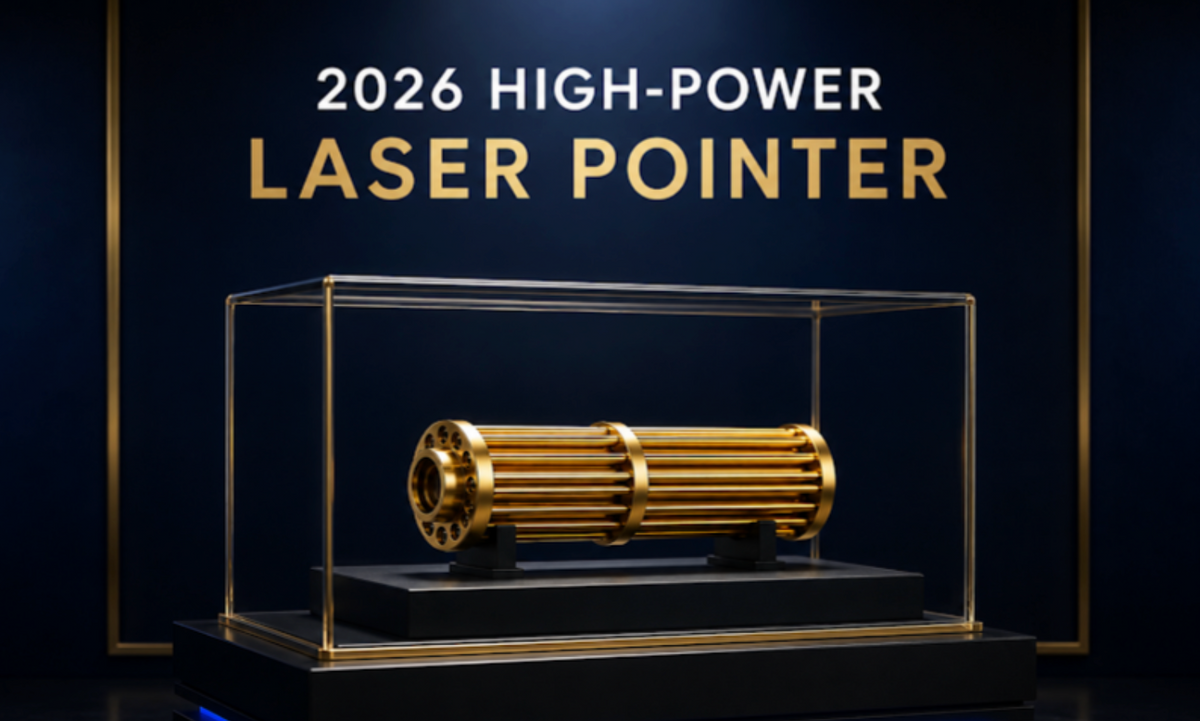
Searches for the “strongest laser pointer” often lead to handheld products advertising several watts of optical output. But the largest number in a product title does not automatically identify the most powerful or best-verified laser.
To compare high-power handheld lasers properly, buyers need to distinguish advertised wattage from documented optical output, understand laser class, and check wavelength, beam characteristics, duty cycle, battery requirements, thermal design, and safety information.
Some manufacturers currently advertise handheld blue lasers in the multi-watt range, including products around 7.5W and higher. This guide explains how to evaluate those claims, what Class 4 output means, and what buyers should know before comparing high-power handheld lasers in 2026.
Key Takeaways
- Do not identify the “strongest” handheld laser from advertised wattage alone. Compare documented optical output and measurement conditions.
- Multi-watt handheld lasers generally fall far above ordinary pointer output and may be Class 4 products with serious eye, skin, reflection, and fire hazards.
- In the United States, visible products promoted for pointing or demonstration purposes are limited to Class IIIa / IEC Class 3R, up to 5mW.
- Compare wavelength, optical output, laser class, duty cycle, battery system, thermal design, safety features, labels, and documentation before comparing maximum wattage.
- When protective eyewear is required, it must match the specific wavelength and hazard level; generic “laser goggles” are not enough.
Top Contenders for the Strongest Laser Pointer

The word “strongest” can describe several different things, and product listings do not always use the same definition.
A handheld laser should not be compared directly with an engraving module, laboratory laser, multi-diode system, or laser projector simply because they all advertise output in watts.
For a meaningful comparison, check whether the wattage refers to:
- measured optical output or an advertising claim;
- continuous-wave output or a short-term peak;
- a single diode or multiple emitters;
- output before or after the final optics;
- a handheld product, module, projector, or another laser system.
Only products measured under comparable conditions should be ranked by wattage. Without that information, a “10W” or “15W” label does not automatically prove that one handheld laser is stronger than another.
A Current Example: Sanwu Striker
Sanwu currently advertises versions of its Striker series at approximately 7.5W of blue optical output and markets the product as one of the highest-output handheld blue lasers available.
That makes the Striker a useful example of the multi-watt handheld category, but a manufacturer claim should not be treated as an independent market-wide ranking.
Before comparing the Striker with another product, check whether both wattage figures use the same measurement method, wavelength, operating condition, optical configuration, and definition of output.
At several watts of visible output, the more important buyer question is no longer simply “which one is strongest?” Laser class, thermal limits, battery requirements, beam characteristics, labeling, and safe-use controls become increasingly important.
How to Compare Hgyuskl Models With Other High-Output Lasers
When comparing Hgyuskl models with Sanwu or other high-output handheld lasers, use the same measurement standard for every product.
Check the exact wavelength, stated optical output, laser class, battery type, focus design, duty cycle, driver information, safety lock, warning labels, and product documentation.
A larger advertised wattage should only be used in a direct comparison when the measurement basis is clear. For example, optical output measured after the final optics should not be compared directly with an unspecified “maximum,” “peak,” or module-level wattage claim.
Hgyuskl offers green and blue products across several wavelength and output categories, but buyers should evaluate each model from its own documented specifications rather than assuming that a color, housing material, or maximum wattage automatically proves better performance.
For green models, also distinguish 520nm direct-diode designs from traditional 532nm DPSS designs. Their optical architecture, temperature behavior, efficiency, and IR-filter considerations are different.
Power, Safety, and U.S. Legal Context
Before buying a higher-output handheld laser, it is important to separate product classification from possession, sale, import, marketing, and use.
There is no single U.S. rule that can be summarized as “you may legally own any wattage.” FDA regulations restrict how laser products are classified, labeled, marketed, imported, and sold, while state and local requirements may add additional restrictions.
Visible products promoted for pointing or demonstration purposes are limited by FDA regulation to Class IIIa / IEC Class 3R, up to 5mW. Higher-output Class 3B and Class 4 products belong to different hazard categories and should not be treated as ordinary consumer laser pointers.
Understanding Laser Classes and Real-World Power
|
Laser Class |
General Output Context |
Buyer Meaning |
|
Class 3R / FDA IIIa |
Up to 5mW in the U.S. visible pointer/demonstration context |
Direct viewing can be hazardous; not risk-free |
|
Class 3B / FDA IIIb |
5mW to 500mW under the FDA system |
Serious direct-eye hazard; direct beam may also present skin hazards |
|
Class 4 |
Above Class 3B limits |
Direct and reflected exposure can present serious eye and skin hazards; fire hazards may also exist |
Laser class describes hazard potential, not product quality.
A multi-watt handheld laser is far beyond ordinary pointer output. Once a product reaches Class 4, buyers should focus less on whether another product is a few watts stronger and more on whether the product has appropriate labeling, controls, documentation, thermal design, and a legitimate intended use.
Actual hazard distances and reflection risks depend on output, wavelength, beam diameter, divergence, exposure duration, optics, and the surrounding environment. They should not be reduced to one universal distance or rule.
Independent testing has shown that laser labels and actual emissions do not always match regulatory requirements.
In a NIST study of 122 commercial laser pointers, 89.7% of the tested green pointers and 44.4% of the tested red pointers were found to exceed applicable federal accessible-emission limits at one or more wavelengths.
That does not mean every low-cost laser is mislabeled, and price alone is not a reliable test of compliance.
Buyers should instead look for consistent wavelength, optical-output, laser-class, warning-label, manufacturer, and compliance information. If a product claims unusually high wattage without explaining how the output was measured, treat the claim cautiously.
Legal Restrictions and Essential Safety Gear
The FDA regulates laser products under 21 CFR 1040.10 and 1040.11. Visible products promoted for pointing or demonstration purposes are limited to Class IIIa / IEC Class 3R, up to 5mW.
Products above this range are not simply “stronger pointers.” They fall into different hazard categories and may be subject to different product, labeling, reporting, marketing, import, sale, and use requirements.
Do not treat the use of a different product description as a loophole around the pointer limit. The intended use and actual product classification both matter.
U.S. laser law should not be reduced to one universal “maximum legal wattage” for possession. Product type, intended use, laser class, federal product requirements, and state or local rules can all affect what is lawful and appropriate.
Before purchasing a laser product, check whether the labeling clearly identifies:
- the manufacturer or distributor;
- the date of manufacture where applicable;
- the laser wavelength;
- the optical output;
- the laser hazard class;
- radiation and exposure warnings;
- applicable certification or compliance information.
Missing or contradictory label information is a more useful warning sign than price alone.
State and local laws can add restrictions beyond federal product requirements, including rules covering possession, registration, sale, or use.
Outdoor use also creates aviation and public-safety concerns. In the United States, intentionally aiming a laser at an aircraft is a federal crime.
Check current federal, state, and local rules before purchasing or using a higher-output laser.
Class 3B and Class 4 products belong to high-hazard categories and should not be presented as beginner and expert upgrade levels. The appropriate laser class depends on a legitimate need, applicable regulations, the operating environment, and the user's training and safety controls.
For most buyers, the better question is not “what is the maximum wattage I can get?” It is “what output and laser class are actually appropriate for the intended use?”
Compare documented specifications and choose the lowest output appropriate for the legitimate task.
FAQ
What makes a “strongest laser pointer” claim credible?
A credible comparison should state the wavelength, measured optical output, operating mode, measurement method, and whether the value is continuous, peak, module-level, or measured after the final optics. The laser class, duty cycle, battery configuration, and thermal conditions should also be clear. A large wattage number without comparable measurement conditions is not enough to establish that one handheld laser is stronger than another.
Do I need a license to own or use a high-power laser in the U.S.?
There is no single nationwide answer that can be reduced to wattage alone. Requirements can depend on the product type, intended use, laser class, state or local law, and whether the laser is being used in a professional, entertainment, medical, industrial, or other regulated setting. FDA also distinguishes ordinary pointing products from higher-class professional laser products. Check the requirements that apply to the exact product and use before purchasing.
Is the highest-wattage laser the best value?
No. Wattage is only one specification. A better comparison includes documented optical output, wavelength, laser class, beam quality, battery system, thermal design, duty cycle, safety features, warranty, and technical documentation. A lower-output product with clear specifications and appropriate safety controls may provide better value than a higher-wattage product with unclear measurement claims.
Share:
Green vs Blue Laser Pointer: Which Is Brighter?