
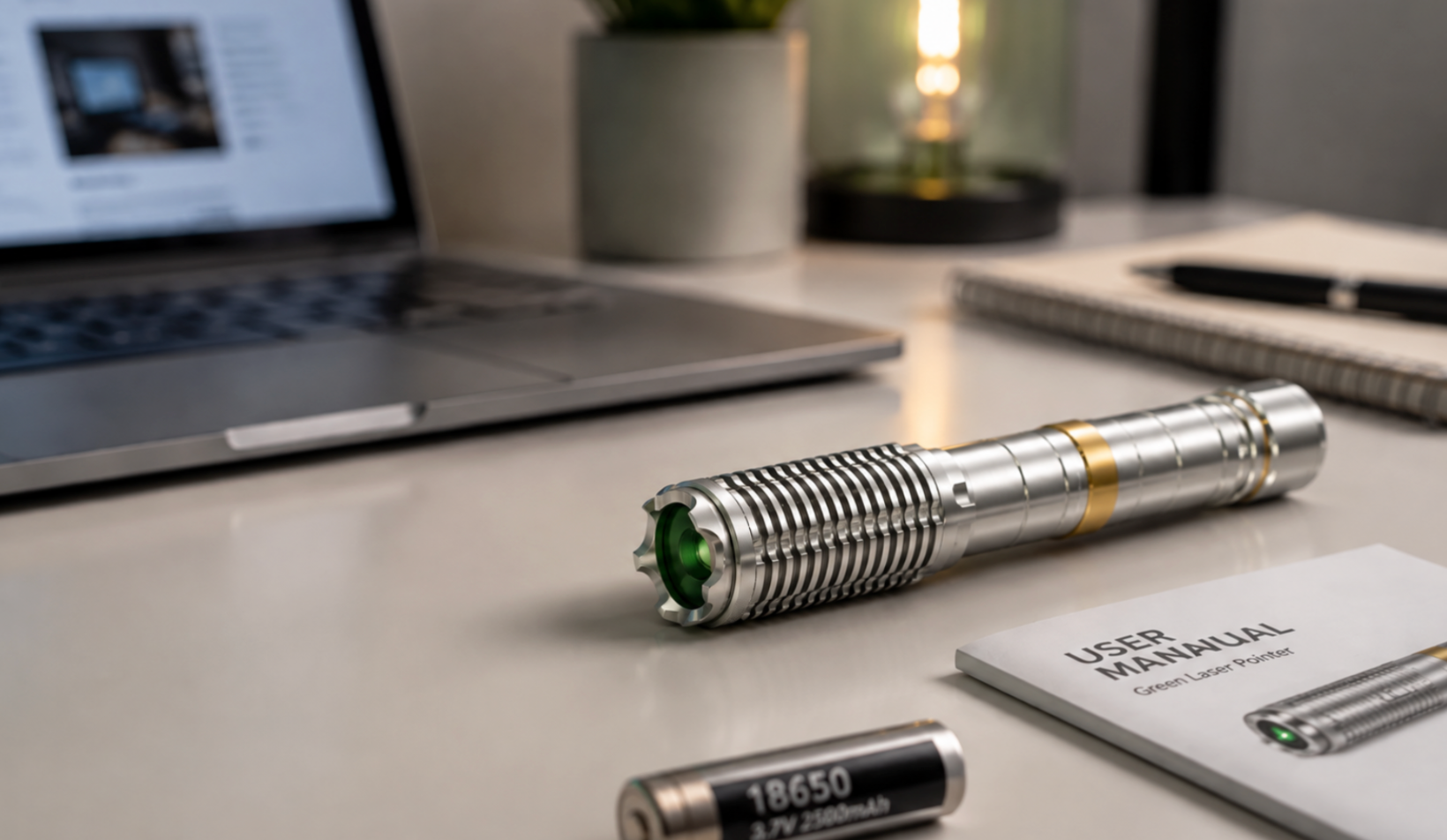
Choosing the best green laser pointer is not simply a matter of selecting the highest advertised power. A useful comparison should consider wavelength, verified output, laser classification, beam divergence, operating temperature, duty cycle, safety controls, battery design, and build quality.
This guide explains how 520nm and 532nm green lasers differ, which specifications deserve the most attention, and how to identify unsupported performance claims. Because laser regulations vary by country and product class, always confirm the applicable rules before purchasing or operating a laser.
Key Takeaways
-
Compare 520nm and 532nm by visibility, temperature stability, and laser architecture—not wavelength alone.
-
In the United States, products promoted as laser pointers are limited to 5mW of visible output; local rules may differ.
-
A 532nm DPSS laser should include appropriate infrared filtering, while a 520nm direct-diode laser does not use the same infrared conversion process.
-
Check the product’s laser class, measured output, beam divergence, duty cycle, warning label, and access-control features.
-
Do not treat aluminum construction, CE marking, or an advertised power number as proof of safety or performance.
Power and Wavelength: Key to the Best Green Laser Pointer
When you look for the best green laser pointer, you will see two important specs: wavelength and power output. These numbers tell you about beam visibility, safety needs, and overall performance. Knowing them helps you stay safe and avoid disappointment.
Why 532 nm Remains the Standard for Green Laser Pointers
A 532nm green laser commonly uses a diode-pumped solid-state (DPSS) system. In a typical design, infrared pump light is converted through a nonlinear optical process to produce 532nm green light. Because human vision is highly sensitive in this part of the spectrum, a 532nm beam often appears slightly brighter than a 520nm beam at the same measured output power.
A 520nm laser usually uses a direct green diode and therefore avoids the 808nm and 1064nm conversion stages associated with 532nm DPSS systems. Direct-diode designs may also offer better performance across changing temperatures. However, 520nm is not automatically brighter, safer, or higher quality; the result still depends on measured output, beam quality, thermal management, and the overall product design.
Understanding mW for Safe and Effective Use
Power output, in milliwatts (mW), tells you what you can safely do with your laser. Listings often claim outputs from 100mW to 1000mW. These numbers sound good, but many cheap makers lie about specs. A real 100mW laser costs much more than a fake one.
In the United States, a laser product promoted for pointing, alignment, demonstration, or entertainment purposes is limited to Class IIIa, equivalent to no more than 5mW of visible output between 400nm and 710nm. Products between 5mW and 500mW generally fall within Class IIIb and cannot legally be promoted in the United States as laser pointers or amusement products.
A CE mark or an IEC 60825-1 classification does not override U.S. FDA requirements. Higher-class portable laser systems require an appropriate professional application, accurate hazard labeling, required engineering controls, operator training, and compliance with the laws of the destination market.
Do not select a higher output simply to obtain a more visible beam. First determine the legal laser class and the minimum output required for the intended professional application.
Always check the real output specs before buying. Good makers give true mW ratings and full safety papers. Your eyes rely on this honesty.
Beam Visibility and Color Quality

What Makes a Green Laser Beam So Bright?
A laser beam’s apparent brightness depends on more than output power. Wavelength affects how strongly the eye responds to the light, while beam divergence, ambient lighting, humidity, dust, haze, and viewing angle all affect how clearly the beam can be seen.
Human photopic vision peaks near 555nm, so 532nm green generally appears brighter than red or blue light at the same measured power. Under dark-adapted conditions, visual sensitivity shifts toward shorter wavelengths, but this does not make one wavelength universally “best” in every environment.
For a useful comparison, evaluate 520nm and 532nm products at the same measured output, distance, beam divergence, and ambient conditions.
Real life adds some trouble. Haze, dust, and smoke can change how light scatters a lot. But the science is clear: green makes the brightest beam for any handheld laser.
Direct Diode vs. DPSS: What Actually Changes?
A well-designed 532nm DPSS laser produces a defined 532nm green output; the conversion process does not inherently make the color yellow, dull, or impure. Its practical limitations are more likely to involve temperature sensitivity, alignment complexity, conversion efficiency, and possible infrared leakage when adequate filtering is absent.
A 520nm direct-diode laser produces a slightly bluer shade of green and generally performs more consistently across a wider temperature range. It also avoids the infrared pump stages used by a 532nm DPSS system.
Neither design is automatically superior in every category. Choose between them based on verified output, temperature range, beam profile, duty cycle, infrared filtering where applicable, and the intended operating environment.
Build Quality and Personal Safety Precautions

The casing of a laser decides how long it lasts outdoors. You need a pointer that can handle drops, wet weather, and rough use. The parts inside must give steady power without sudden changes. Good parts stop the laser from getting too hot or breaking early. With good safety features, a well-made laser keeps both the tool and your eyes safe.Hgyuskl product pages identify aluminum construction and model-specific output specifications. Before making a purchase decision, check the individual product page for its measured output, body material, driver design, duty cycle, operating temperature, and safety controls, because these details may vary by model. These parts keep the laser working well in tough conditions. For the best green laser pointer, you need a sealed body and reliable electronics.
Durable Materials: Aviation Aluminum and Water Resistance
Top makers use aviation-grade aluminum for the body. This metal resists rust and gets rid of heat well. It also feels solid in your hand. A strong build stops damage from accidental drops. Water resistance adds extra safety for outdoor use. Rain, dew, or splashes will not hurt the parts. The APC current drive keeps power steady even as the battery drains. This drive stops power surges that could harm the diode. Look for a sealed body with O-ring gaskets. These gaskets keep water and dirt away from the lens. A textured grip gives a secure hold in wet conditions. These features set high-quality green lasers apart from cheap ones.
Essential Safety Features: Key Switch and IR Filter
Safety steps start with the hardware. A key switch stops people from using the laser without permission. You take out the key to turn off the laser completely. Pet and child safety is very important. The switch makes sure only a responsible adult can use the device. An IR filter is also very important for DPSS green lasers. Without this filter, the laser gives off invisible infrared light. This light can hurt your eye even if you wear green-blocking goggles. Your eye is the most at-risk part during use. Always check that the device has a built-in IR filter.
Never aim the laser at eyes, people, or animals. The law limits pointing lasers to Class IIIa for a reason. Strong lasers can be very dangerous.
Always follow laser safety rules. Use certified safety goggles made for the exact wavelength. Store the laser in a locked case when not in use. These steps stop accidents and protect your eyesight. Always watch children and pets near any laser device. Being a responsible owner means knowing these rules.
Battery Life and Power Source for Your Green Laser Pointer
Your green laser pointer's battery system determines how reliably it performs when you need it most. A laser that dies mid-stargazing session or during a wildlife control task becomes useless equipment. You must understand the trade-offs between battery types and what runtime you can realistically expect from different power levels.
Rechargeable vs. Disposable: Which Is Better?
Rechargeable batteries offer clear advantages for regular users. You can recharge a lithium-ion cell hundreds of times before replacement. This approach saves money over the long term and reduces waste. Many premium green laser pointers now include built-in rechargeable batteries with USB charging ports. You simply plug the device into a power bank or wall adapter when the battery runs low.
Disposable batteries, such as CR123A or AA cells, provide convenience in remote situations. You can carry spare cells in your pack without worrying about finding an outlet. This option suits outdoor survival scenarios where power access remains uncertain. However, disposable batteries cost more over time and create ongoing waste.
Consider your primary use case before choosing. Astronomy enthusiasts who use their laser nightly benefit most from rechargeable systems. Outdoor survivalists who venture far from civilization might prefer disposables for their reliability. Some premium models accept both battery types, giving you maximum flexibility. Check the battery compartment design before purchasing to confirm your preferred option works.
Runtime Expectations for Different Power Levels
Battery runtime cannot be estimated reliably from optical output alone. It also depends on battery capacity, driver efficiency, input power, temperature, operating mode, and the manufacturer’s permitted duty cycle.
When comparing products, look for a measured runtime accompanied by the battery specification and test conditions. Also distinguish between total intermittent runtime and continuous operating time. A device may have sufficient battery capacity for several hours of intermittent use while still requiring short duty cycles to prevent overheating.
Premium models incorporate advanced driver circuits that regulate power draw. These APC constant current drives maintain steady output while maximizing battery efficiency. A well-designed driver prevents wasteful energy consumption that shortens runtime. When comparing green laser pointers, examine the claimed runtime specifications carefully. Honest manufacturers provide realistic numbers based on actual testing conditions. Look for devices that balance power output with sensible battery demands for your intended application.
Price vs. Value: What to Expect from a Green Laser Pointer
Budget Models: When to Save and When to Avoid
Price alone does not determine whether a green laser is accurately rated or appropriately designed. Low-cost products may omit useful specifications, but a higher price is not proof of measured output, compliant labeling, effective thermal management, or adequate safety controls.
Premium Features: Justifying the Cost
Compare value using documented criteria: laser class, measured output tolerance, wavelength, beam divergence, duty cycle, battery specification, temperature range, locking controls, warranty, and after-sales support. If a seller cannot provide these basics, treat the advertised power with caution regardless of price.
Intended Use: Choosing the Right Green Laser Pointer for You
Astronomy and Controlled Outdoor Use
Where permitted, a visible laser rated at no more than 5mW may be sufficient for identifying objects in the night sky. However, 5mW should not be described as risk-free: never direct the beam toward a person, vehicle, aircraft, reflective surface, telescope, binoculars, or other optical equipment.
Do not select a higher-powered laser for open-air signaling without first evaluating airspace, bystander exposure, reflections, local law, and the product’s hazard class. A laser should never be used as a substitute for an approved emergency signaling device.
Wildlife Deterrence Requires a Purpose-Built System
Do not aim a handheld laser directly at an animal. Eye exposure can cause injury, and the legality of laser-based wildlife deterrence varies by location, species, site, and product class.
Professional wildlife-control programs may use purpose-built optical deterrent systems under controlled procedures, but that does not make an ordinary handheld laser suitable for the same task. Property owners should consult local wildlife authorities and use a documented, non-injurious method appropriate for the target species and environment.
Workplace laser safety cannot be reduced to a single blink-response time or a universal optical-density value. The required controls depend on the laser class, wavelength, output, exposure duration, beam geometry, and the calculated maximum permissible exposure.
Class 3B and Class 4 systems may require a controlled area, engineering controls, warning signs, operating procedures, training, wavelength-specific protective eyewear, and oversight by a Laser Safety Officer. Employers should perform a formal hazard assessment under the applicable ANSI, OSHA, and local requirements.
Lab work needs continuous duty cycles and steady output. The APC constant current drive keeps power stable during long sessions. Your choices should fit the specific job at hand. Match your laser to your main use. These tips help you pick the right tool for each situation.
Choosing the best green laser pointer demands attention to wavelength, power, and safety. Prioritize 532nm or 520nm output.Select a product by starting with the legal laser class and the minimum output required for a legitimate application. Wavelength, measured output, beam divergence, duty cycle, labeling, access controls, and operator requirements should all be evaluated together. Higher output is not automatically a better purchase and always introduces greater control requirements and potential risk. Never compromise on safety features. A key switch and IR filter protect your eye from invisible radiation. Invest in aviation aluminum construction for durability. Real output specifications remain non-negotiable; dishonest sellers inflate numbers constantly.
Follow these recommendations when comparing products. Apply these tips during your evaluation. Every laser purchase carries responsibility. Verify documented output, confirm safety certifications, and inspect build quality before spending money. Your safety and satisfaction depend on this checklist. Choose a product that delivers exactly what its label promises.
FAQ
Before you pick the best green laser pointer, you need answers to common questions. These answers cover safety, performance, and everyday use. Read each one carefully so you can make a smart choice.
What Power Level Should I Choose for Astronomy?
For stargazing, pick a 5mW green laser. This power shows a clear beam in dark skies. More power adds risk without making the beam easier to see. The 5mW rating follows FDA Class IIIa rules for pointing devices. A 5mW rating does not make direct eye exposure safe. Never aim the beam at people, vehicles, aircraft, reflective surfaces, or optical instruments, and confirm that outdoor use is permitted in your location.
How Can I Verify a Laser's Real Output?
Look for written specs from the maker. Check the product label for the manufacturer, wavelength, maximum output, laser class, warning statement, and applicable compliance statement. For output verification, look for a measurement made with a calibrated laser power meter under stated test conditions. Do not describe an FDA accession number, product report, or manufacturer certification as “FDA approval” unless the agency has explicitly approved that specific use. Check independent reviews that measure real output. Stay away from sellers who will not share safety documents. True specs matter more than ads. These safety checks protect your money and your eyesight.
What Safety Features Should I Prioritize?
Find a key switch that stops people from using the laser without permission. Make sure an IR filter is present, especially for DPSS models. This filter blocks invisible infrared light that can harm your eye without warning. Prioritize accurate hazard labeling, a secure activation system, a key switch or other access control where required, a protected aperture, clear operating instructions, and suitable infrared filtering for DPSS designs. Housing material affects durability, but it does not determine whether a laser is safe or compliant.
Can I Use a Green Laser for Wildlife Control?
Do not aim a handheld laser directly at wildlife. Professional optical deterrent systems may be used in some controlled settings, but their legality and suitability depend on the species, location, product class, operating procedure, and local wildlife regulations. Pick a model with a momentary switch for quick bursts. More power lets you reach farther across ponds and fields. Always aim below the animal's head so you do not startle it. This use needs careful handling at all times.
How Long Will My Laser Battery Last?
Battery life depends on power output and battery size. Runtime varies by battery capacity, driver efficiency, temperature, operating mode, and duty cycle. Compare manufacturer-provided runtime tests only when the battery specification and test conditions are stated. Premium drivers control power use well. These tips help you match battery life to what you need.
Share:
The Strongest Laser Pointer You Can Buy in 2026
450nm Blue Laser Pointer: How Bright Is It?