
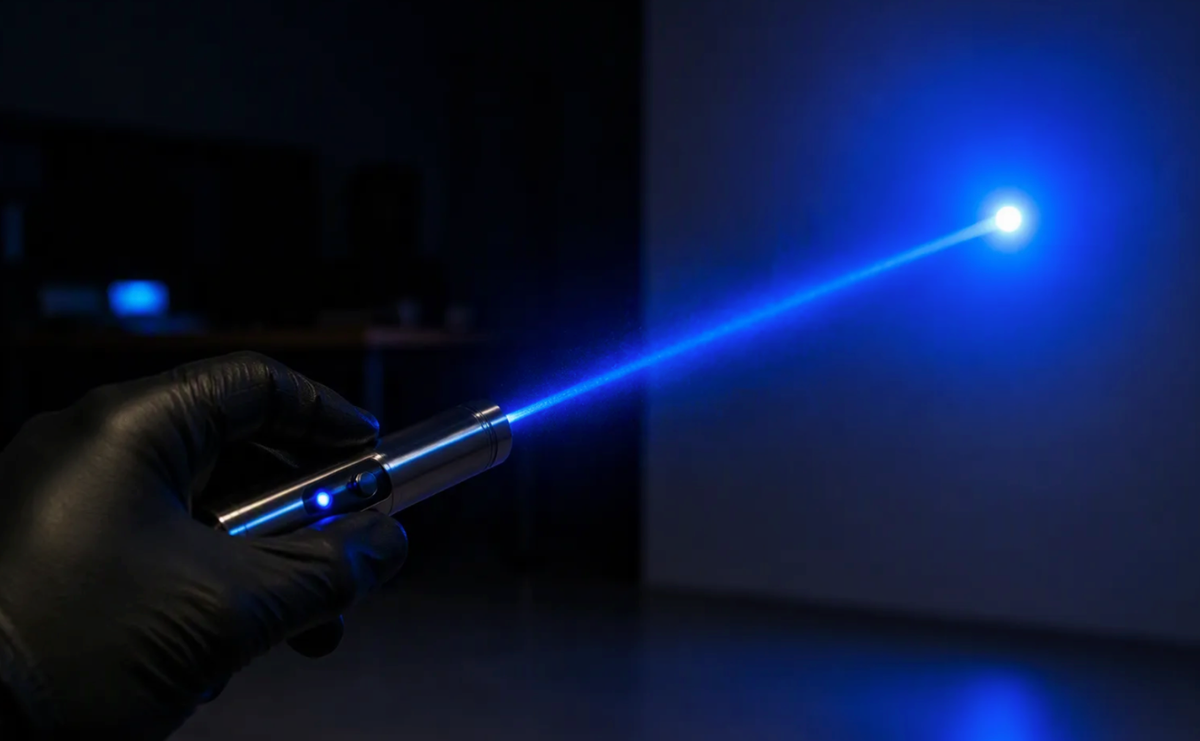
A 450nm blue laser can produce a vivid blue beam, especially in low-light conditions, but it does not usually appear brighter than a 532nm green laser at the same measured optical power. Human vision is far more sensitive to green light than to deep blue light.
The apparent brightness of a 450nm laser depends on output power, beam divergence, ambient lighting, air conditions, viewing angle, and the surface receiving the beam. Beam visibility and dot brightness should also be evaluated separately, because a clearly visible beam does not necessarily produce the brightest-looking spot.
Why does such a small blue light grab so much attention? The reason is how this wavelength works with your eye and the air around it. Blue laser pointers have shorter wavelengths that scatter more easily, which gives them that bright, electric look. High-power blue lasers make this effect much stronger. This article looks at the science behind this amazing visibility, compares different colors in real life, and covers key safety rules you need to know before using one.
Key Takeaways
-
A 450nm beam can appear vivid in low light, but 532nm green generally appears brighter at the same measured optical power.
-
Output power alone does not determine visibility; beam divergence, ambient light, air conditions, viewing angle, and surface properties also matter.
-
Shorter wavelengths undergo stronger Rayleigh scattering, but greater scattering does not automatically make blue brighter than green to the human eye.
-
Protective eyewear must be selected for the actual wavelength, output, beam characteristics, and exposure conditions—not by a universal OD rating.
-
Products above 5mW require substantially greater controls and cannot be promoted as ordinary laser pointers in the United States.
-
Verify the product’s laser class, measured output, warning label, duty cycle, safety controls, and operating instructions before purchase.
Defining Laser Brightness
Wavelength and Power Basics
Brightness comes from two main things: wavelength and power. Optical power describes the amount of radiant energy emitted per unit of time, while wavelength determines the laser’s color and influences how the eye and different materials respond to it. Beam spread is described separately by beam divergence and is not determined by wavelength alone. Laser power is measured in milliwatts (mW) and controls total light output. Wavelength is measured in nanometers (nm) and decides color plus how light acts with air and surfaces.
A 450nm blue laser sits at the shorter end of visible light. This wavelength makes a bright blue color that spreads easily in the air. More power makes this effect much stronger. As output increases, a 450nm beam may become more visible from the side under low-light conditions. However, there is no universal power threshold at which the beam becomes clearly visible. Visibility varies with beam divergence, air particles, humidity, ambient light, viewing angle, and the observer’s visual adaptation.
A 50mW laser is already above the U.S. power limit for products promoted as laser pointers, while a 500mW system presents a much more serious eye, reflection, skin, and potential fire hazard.
Power ratings matter a lot here. Many brands advertise inflated numbers that don't match real performance. When comparing Hgyuskl products or other blue laser systems, look for a stated measurement method, acceptable output tolerance, test conditions, laser class, and model-specific specification sheet. A numerical power claim is more credible when it can be supported by a calibrated laser power-meter result and traceable product documentation.
Eye Sensitivity to Blue Light
Your eye doesn't treat all wavelengths the same. Human vision is best at about 555nm, which looks green. Sensitivity drops a lot at shorter wavelengths. Blue at 450nm appears much dimmer than green at equal power. This biological fact means a 5mW green laser looks brighter than a 5mW blue one.
Higher output can make a 450nm beam appear very intense, but it does not reverse the eye’s relative sensitivity to different wavelengths. At equal measured optical power and under comparable viewing conditions, 532nm green generally remains much more visually efficient than 450nm blue.
A high-power blue laser may still look extremely bright in absolute terms, but that comparison should not be confused with brightness per milliwatt. This explains why blue lasers feel extra brilliant. The beam grabs your attention because your eye struggles to handle such strong blue light.
This mix of wavelength and power sets how bright a laser seems. Knowing both helps you pick the right tool for your job. Lower output does not automatically make a laser suitable for indoor use, and higher output should not be selected merely to create a more dramatic visible beam. Choose the minimum output appropriate for a legitimate application, then confirm the product class, local law, beam-control requirements, and exposure risks. Always match your laser's specs to what you actually plan to do.
Perceived Brightness of a 450nm Blue Laser Pointer

Beam Visibility and Scattering
When you turn on a blue laser in a dark room, the beam looks like a bright, straight line of electric-blue light. Light particles hit tiny bits in the air. Dust, smoke, and water drops all make this scattering happen. Shorter wavelengths scatter more than longer ones. Light at 450nm scatters a lot more than longer wavelengths. This scattering lets your eye see the beam.
Rayleigh scattering increases as wavelength becomes shorter, so 450nm light undergoes more molecular scattering than 532nm light under the same atmospheric conditions. However, side-view beam visibility is not determined by Rayleigh scattering alone.
Human spectral sensitivity, output power, beam divergence, aerosols, humidity, ambient light, and viewing angle all affect the result. Although blue light scatters more strongly, the eye’s substantially greater sensitivity to green means that a 532nm beam generally appears brighter at equal optical power.
Greater atmospheric scattering should not be treated as a reason to use a high-powered blue laser for open-air signaling or casual sky pointing.
Dot Intensity in Various Lights
A concentrated 450nm spot may appear intense on a nearby surface, but direct viewing of the beam or a specular reflection can create an eye hazard. A 50mW laser is not a conventional presentation pointer and should not be recommended for pointing out details in occupied rooms.
For presentations, use a compliant, low-power device designed and labeled for that purpose.
The FDA sets a consumer laser limit at 5mW. That's the max power for regular products. But high-power models for special uses can reach extreme levels. These devices need serious care and proper safety gear.
The table below shows how your eye reacts to different wavelengths at equal power:
|
Wavelength |
Approximate photopic response |
Practical meaning |
|
445nm |
Very low |
Deep blue; low visual efficiency |
|
450nm |
Very low |
Slightly more visually efficient than 445nm |
|
520nm |
High |
Bright green with high visual efficiency |
|
532nm |
Very high |
Usually appears much brighter than 450nm at equal power |
|
555nm |
Peak |
Reference peak of photopic human vision |
These values describe the CIE standard photopic observer under light-adapted conditions. They do not directly predict nighttime beam visibility, which is also affected by atmospheric scattering, viewing conditions, and visual adaptation.
In a bright room, the blue dot still looks strong. The high power beats the surrounding light. You can see the dot clearly on a white wall or a dark surface. The dot looks sharp and focused. This makes these lasers useful for pointing out details in presentations.
But you must remember the danger. The same brightness that makes the dot useful also makes it risky. Even a quick look at the dot can hurt your eyes. Always wear proper eye protection. Never aim the laser at people, animals, or shiny surfaces. A blue laser needs caution and respect every time you use it.
Safety with High-Power Blue Lasers
Eye Hazards and Risk Levels
A 450nm blue laser needs serious care. It is not a toy. Even a quick look can cause lasting eye damage. Visible laser light from approximately 400nm to 700nm can be focused by the eye onto the retina. The severity of an exposure depends on wavelength, power, beam characteristics, exposure duration, viewing geometry, and whether the exposure is direct or reflected.
A high-output 450nm beam can cause serious retinal injury, but it should not be described as more dangerous than red light simply because it “goes deeper” into the eye.
The FDA says consumer laser pointers can only go up to 5mW. High-power models for work use go well past this limit. Some special units give out hundreds or thousands of milliwatts. At these strengths, the beam can make you lose your sight at once. You may not feel pain when it happens. The damage happens quietly. By the time you see a blind spot, the harm is forever.
Reflected light is another risk. A blue beam hitting a shiny surface can bounce at odd angles. You might get a dangerous dose without looking straight at the laser. Specular reflections from mirrors, polished metal, glass, and similarly reflective surfaces can remain highly hazardous. For sufficiently powerful Class 4 systems, even diffuse reflections may exceed safe exposure limits within part of the hazard zone. The actual risk must be determined from the product class and a formal hazard assessment.
Essential Handling Precautions
Laser protective eyewear must cover the actual emission wavelength and provide an optical density calculated for the laser’s output, beam characteristics, exposure conditions, and applicable maximum permissible exposure.
An OD4 marking indicates a nominal attenuation factor of 10,000 within the specified wavelength range, but it does not prove that the eyewear is suitable for every 450nm laser. Check the covered wavelength range, optical-density certification, damage threshold, fit, and relevant safety standard. Ordinary sunglasses do not provide laser protection.
Normal sunglasses give no protection at all. Buy eyewear from trusted sellers who have tested optical density numbers. Do not skip on this gear.
Never aim a strong laser at people, pets, or cars. Do not point it at shiny surfaces like windows, mirrors, or metal. These can bounce the beam to places you don't want. Always check your area before turning it on. Make sure the path from the laser has no surprise objects.
Keep your pointer locked up away from kids. Treat it like a gun—locked, without batteries, and out of reach. Take out the batteries when storing so it cannot turn on by mistake. Make a steady routine for how you handle and move it. Put a clear label on your storage case.
Safety controls vary by product. Check the individual model for its key switch, remote interlock, emission indicator, aperture protection, activation method, warning label, and storage requirements. Do not assume that every model includes the same controls. These features stop the laser from turning on by accident. We also give you full safety guides with every purchase. Being a responsible owner means having the right gear and using good habits. Your eyesight depends on both.
Comparing Blue to Red and Green Lasers

Blue Light Laser Pointers vs. Red and Green
Under the CIE photopic model, 532nm green has much greater luminous efficiency than either 650nm red or 450nm blue. At equal optical power, 650nm red is also generally more visually efficient than 450nm blue under photopic conditions.
Nighttime perception is more complicated because the eye transitions toward mesopic or scotopic vision. For that reason, a simple green-blue-red ranking should always state the lighting conditions and comparison method.
The CIE photopic luminous-efficiency function shows that 532nm light is far more visually efficient than 450nm light. This helps explain why a lower-powered green laser may appear brighter than a higher-powered blue laser.
However, luminous flux alone does not fully describe the perceived brightness of a narrow laser beam. Spot size, divergence, viewing angle, background luminance, surface reflectance, scattering, and visual adaptation also affect what an observer sees.
Yet the blue light laser still holds its own in real world use. The beam scatters more strongly through air particles. Dust and moisture catch the shorter wavelength and bounce it back toward your eye. In a dark room, a blue beam looks like a solid rod of electric color. The green beam appears brighter overall, but the blue beam often looks more dramatic against a night sky.
The dot tells a different story. Blue light triggers fluorescence in many materials. White paper, certain plastics, and some fabrics absorb the short wavelength and re-emit it as visible glow. This effect makes the blue dot seem to "pop" off the surface. A red dot just sits there. A green dot looks clean and bright. A blue dot seems to glow from inside the material itself.
Why a High-Power 450nm Beam Can Still Look Intense
Although 450nm light has relatively low photopic visual efficiency, a sufficiently high-output beam can still appear extremely intense in absolute terms. This does not mean that blue becomes more visually efficient than green; it means that the much greater optical output compensates for part of the eye-sensitivity difference.
Comparisons should therefore distinguish between equal-power brightness and the appearance of products with substantially different outputs.
Blue light also reacts with materials differently. Many substances absorb shorter wavelengths more easily than longer ones. Dark plastics, wood, and even some metals take in 450nm energy well. This absorption turns light into heat at the surface. Purpose-built industrial blue-laser systems can be used for material processing when they are integrated into controlled equipment with suitable optics, shielding, interlocks, ventilation, and process monitoring. This should not be confused with using a handheld laser to burn, cut, mark, or ignite materials.
Think about the visual character of each color. A red dot looks like a dull ember—visible but flat. A green dot looks like a bright leaf in sunlight—clean and luminous. A blue dot acts like an electric spark—sharp, crackling with energy, almost alive. This felt intensity comes from the wavelength's behavior, not just its power rating.
The scattering effect boosts this impression. When you sweep a blue beam through a dusty room, the whole path lights up. Tiny particles reflect the short wavelength back at you from every angle. The beam looks thicker and more solid than a red beam of equal power. This visibility makes blue light laser pointers great for outdoor signaling and astronomy work.
For your practical needs, think about what matters most. If you want maximum perceived brightness per milliwatt, choose green. If you want dramatic beam visibility and material interaction, choose blue. Hgyuskl offers true high-power blue units with measured output you can verify. Every laser ships with real specs, not inflated marketing numbers. When you need a tool that performs exactly as rated, our professional-grade designs deliver steady results you can trust.
Practical Uses for Bright Blue Lasers
Astronomy and Open-Air Use
A 450nm beam can be visible in a dark sky, but this does not make a 100mW blue laser appropriate for casual stargazing. In the United States, products promoted as laser pointers are limited to 5mW of visible output, and local astronomy sites may impose additional restrictions.
Never direct a laser toward an aircraft, vehicle, person, public area, telescope, binoculars, or unknown area of the sky. Do not use a handheld laser as a substitute for an approved emergency signaling device.
How 450nm Lasers Are Used in Professional Systems
Blue wavelengths are used in some industrial and scientific systems, including selected material-processing, fluorescence-excitation, inspection, and alignment applications. These systems are normally designed around a specific wavelength, optical configuration, operating mode, and safety enclosure.
A handheld 450nm laser pointer should not be presented as interchangeable with an industrial welding laser, laboratory excitation source, or machine-vision module. Buyers should use purpose-built equipment that meets the technical and safety requirements of the application.
A 450nm blue laser pointer delivers extraordinary brightness. High power amplifies its visibility and impact. This tool demands respect. A blue laser pointer requires careful handling every time you use it. Always wear protective eyewear certified for this laser. Follow all legal guidelines in your area. Never look directly at the beam. The blue light can cause permanent retinal damage. The same brightness that makes it useful also makes it dangerous. When choosing laser pointers, select Hgyuskl's real-output models for legitimate uses. Our units ship with true measured power and safety features like key-lock switches. We reject fake specs common in the industry. Always prioritize safety and responsibility.
A 450nm blue laser can produce a vivid beam, particularly in low-light conditions, but it is less visually efficient than 532nm green at equal measured power. Its apparent brightness depends on output, beam divergence, ambient light, air conditions, viewing angle, and surface response.
Before purchasing, verify the laser class, wavelength, measured output, duty cycle, labeling, access controls, and operating instructions. Higher power is not automatically better and introduces substantially greater eye, reflection, skin, fire, and legal risks.
FAQ
How does a 450nm blue laser compare to a green one at equal power?
Under the CIE photopic model, 532nm green is substantially more visually efficient than 450nm blue at equal optical power. The exact perceived difference in practice also depends on ambient light, visual adaptation, divergence, air conditions, and viewing geometry.
What eye protection do I need for high-power operation?
Eye protection must cover the actual wavelength and provide an optical density appropriate for the laser’s output and calculated exposure conditions. Do not rely on a generic OD4+ label alone. For Class 3B or Class 4 equipment, eyewear and other controls should be selected through a formal laser-hazard assessment.
Can I use this pointer for stargazing?
Do not assume that a 100mW blue laser is suitable for stargazing. In the United States, products promoted as laser pointers are limited to 5mW of visible output. Always confirm local rules and never direct any laser toward aircraft, vehicles, people, optical instruments, or an uncertain area of the sky.
Why does the dot appear to glow on certain surfaces?
Some materials absorb 450nm light and re-emit part of the energy at longer wavelengths, making the illuminated spot appear to glow. The response depends on the material, coating, pigments, optical brighteners, and surface condition. It is not accurate to say that red or green light can never produce fluorescence.
What power level should I choose for my needs?
Do not choose output by location alone. Start with the product’s legal classification and the minimum output required for a legitimate application. In the United States, ordinary visible laser pointers are limited to 5mW. Products above that level require different controls and must not be promoted as normal presentation or astronomy pointers.
Share:
Best Green Laser Pointer: 9 Specs to Check Before Buying