
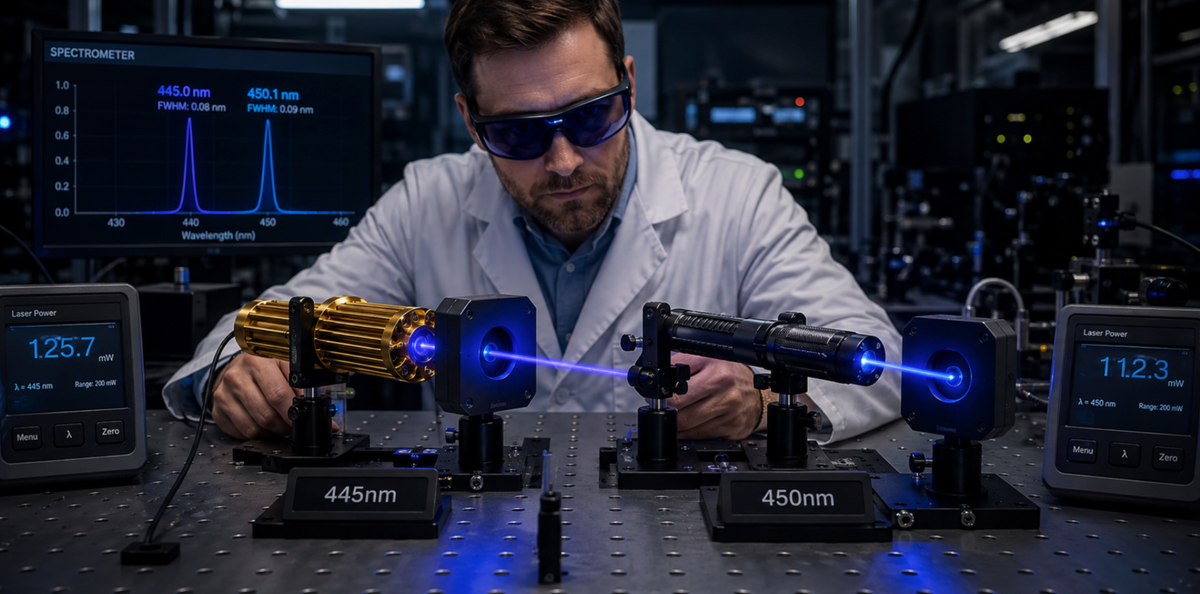
When you compare a 445nm vs 450nm laser, you will notice clear differences in how they work. Strong high-power laser pointers that use a 450nm wavelength offer much better brightness and visual clarity. Using 450nm tactical blue lasers in these blue laser pointers also helps improve overall heat management. Even so, each blue laser beam output still keeps the exact same burning strength. In the end, both option types cast a deep blue beam that has equal visibility.
Key Takeaways
-
445nm and 450nm are both blue wavelengths, so their color difference is usually subtle to most users.
-
450nm may appear slightly brighter than 445nm at the same optical output, but real-world visibility also depends on output power, divergence, optics, air conditions, and ambient light.
-
The 5nm wavelength difference does not automatically decide performance. Diode quality, driver stability, heat sinking, duty cycle, and battery design often matter more.
-
Do not choose a blue laser by “burning” claims. Higher output increases eye, skin, reflection, and fire risks.
-
Buyers should check wavelength, output power, laser class, safety labels, duty cycle, and eyewear requirements before choosing a 445nm or 450nm blue laser pointer.
445nm vs 450nm Laser Spectrum Overview

Color Perception of Spectrally Adjacent Blue Light
You see a bright ray when you turn on a high-power blue laser pointer. The light coming from a 445nm vs 450nm laser looks almost the same to human eyes. Both options project a deep blue beam across the dark night sky. On the visible light spectrum, these two numbers sit right next to each other. 445nm and 450nm sit very close together in the blue part of the visible spectrum. Many users will see both as a deep blue beam, with only a subtle shift in shade.
Because the color difference is small, buyers should not treat 445nm vs 450nm as the only deciding factor. Output power, beam shape, focus, and product safety information usually matter more.
Wavelength Characteristics of Blue Diodes
The setup of the diode inside controls the main light wavelength of your device. Small changes in heat during production alter the actual light output during long use. Hgyuskl builds every blue laser pointer using strict professional quality rules. When comparing Hgyuskl models or any other blue laser product, check the listed wavelength, output power, driver type, duty cycle, battery type, safety lock, warning label, and safe-use documentation instead of relying only on brightness claims.
Some online laser products may be mislabeled, overpowered, or missing clear safety information. Buyers should look for accurate wavelength, output power, laser class, warning labels, and manufacturer information.
Beam Visibility and Eye Sensitivity

Photopic Response to Blue Wavelengths
Human vision changes a lot depending on the color of light. Our daylight vision works best near 555 nm on the main eye sensitivity scale. A 450nm laser pointer is slightly closer to this main peak than an older 445nm diode model. Because of this, light sent out at a wavelength of 450 nm gives a small boost in brightness when you look at the main light dot. Still, human eye sensitivity drops quickly when you move from green light into the deep blue light area.
|
Wavelength |
Color Area |
Visual Meaning |
|
445nm |
Deep blue |
Lower photopic sensitivity |
|
450nm |
Blue |
Slightly higher perceived brightness than 445nm |
|
520/532nm |
Green |
Much higher perceived brightness than blue |
|
555nm |
Yellow-green |
Peak photopic sensitivity |
Normal human eyes react much less to blue light than they do to green light. A standard blue laser pointer sending out light at 445nm gets to about 3.5% of top human eye response. On the other hand, a green diode laser works at about 88% of top human eye response. Compared with green wavelengths such as 520nm or 532nm, both 445nm and 450nm blue lasers sit much lower on the human photopic sensitivity curve. This is why a green laser often appears much brighter than a blue laser at the same optical output power.
However, actual visibility also depends on beam divergence, output power, surface color, ambient light, and viewing angle.
Visual Brightness of a Blue Laser Pointer
You need to check beam visibility details when picking strong optical tools for special jobs. A high power laser device creates a bold, visible beam path across the dark night sky. Tiny dust bits in the air spread the tight light ray outward. At night, a blue beam may become visible from the side when there is enough dust, humidity, or scattering in the air. The result depends on output power, divergence, air conditions, background light, and viewing angle. This solid side visibility lets people trace the whole beam line over long outdoor spaces, which boosts overall visibility for nighttime tasks.
Even so, direct light contact creates serious optical danger for the human eye. Direct light goes into your eye fast and hits your delicate retina. These focused light rays can rapidly cause lasting retinal damage if you do not wear tested protective laser eyewear. Because of this risk, High-output blue lasers can create serious eye hazards from direct exposure and specular reflections. Safety eyewear must be rated for the blue wavelength range and provide an optical density appropriate for the product’s output.
Eyewear is not a permission to use the laser casually. Users should also control the beam path, avoid reflective surfaces, follow duty-cycle limits, and never direct the beam toward people, animals, vehicles, aircraft, or public areas.
Trained users count on precise optical tools for specific tasks. Some users compare blue lasers for visibility or optical demonstrations, but high-output blue lasers should not be promoted for rescue signaling, animal scaring, or casual sky use. Those scenarios create separate safety and legal concerns.
Thermal Output and Diode Efficiency
Operating Temperature and Heat Generation
Thermal performance depends on the specific diode, output power, driver, housing, heat sinking, and duty cycle. The 5nm difference between 445nm and 450nm does not automatically prove that one product will run cooler than another.
For buyers, the practical questions are: Does the product list a duty cycle? Does the body provide adequate heat dissipation? Is the output stable during normal use? Does the manual explain rest intervals?
Power Stability in Heavy-Duty Lasers
Extra heat changes internal laser power needs when you use it for a long time. Laser diode strength drops as internal temperatures rise. Unchecked heat lowers total brightness and ruins laser beam quality. Tough jobs need steady power output during field work and factory projects. You can trust steady beam strength during crucial science tests and outdoor trips.
Hgyuskl adds Automatic Power Control drives inside heavy-duty units. An Automatic Power Control system uses a light sensor built right into the diode. This sensor creates a steady signal to track light output levels. The control system changes the drive current automatically to hold power steady. This active system fights temperature swings to keep your laser beam bright.
Automatic Power Control systems protect your blue laser diode from power spikes and heat damage. Factory labs need steady light output during long testing sessions. Normal laser setups lose power output as heat builds up inside. An APC driver can help stabilize optical output by adjusting drive conditions based on feedback. However, APC does not remove the need for heat management, duty-cycle limits, battery compatibility, and safe handling.
Selecting a 445nm vs 450nm laser changes beam visibility, output power, and performance. The difference between 445nm and 450nm is usually subtle. A 450nm beam may appear slightly brighter, but product performance depends more on output power, diode quality, optics, heat management, duty cycle, driver stability, and laser class.
When comparing Hgyuskl models or any other blue laser pointer, do not choose by wavelength or power alone. Check the label, safety class, output, duty cycle, battery type, focus design, eyewear requirements, and safe-use documentation.
FAQ
Which blue laser pointer model appears brighter in a 445nm vs 450nm laser test?
A 450nm beam may appear slightly brighter than 445nm at the same optical output because it is a little closer to the human eye’s photopic sensitivity peak. In practice, the difference is usually subtle.
How do safety guidelines protect your vision from a high power laser?
Use laser safety eyewear rated for the blue wavelength range and with an optical density appropriate for the laser’s output. Also avoid direct beams, reflective surfaces, people, animals, vehicles, aircraft, and public areas.
What should you check before buying a blue laser pointer?
Check wavelength, output power, laser class, warning label, duty cycle, battery type, driver design, focus mechanism, safety lock, and whether the manual specifies suitable eye protection.
Share:
Laser Pointer Safety Lock Guide: Key Switches, Tail Caps, and Safe Storage
Laser Pointer for Presentations: Red vs Green, Indoor Visibility, and Safety