
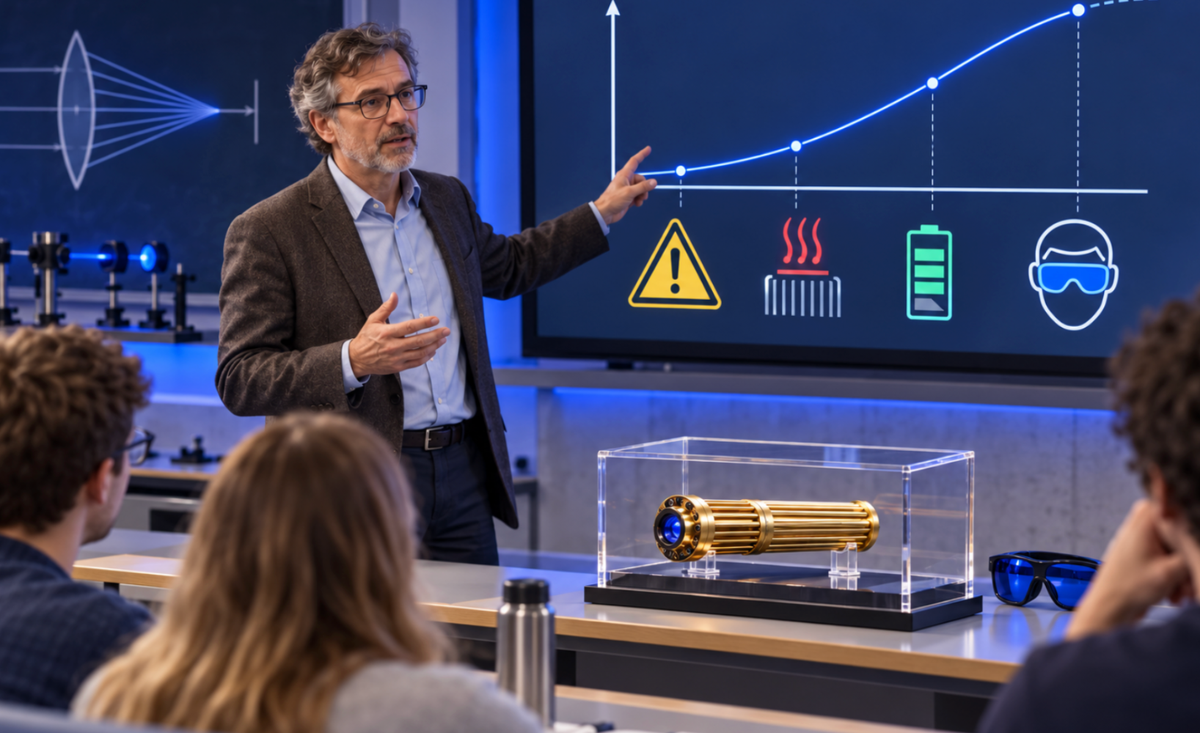
A multi-watt blue laser may look attractive to a buyer who equates wattage with performance, but higher output also changes the product’s hazard class, control requirements, heat load, battery demand, and legal status.
For ordinary pointing or astronomy, extreme output is unnecessary and may be unsuitable. The better approach is to identify the minimum output required for a legitimate application, then compare beam quality, duty cycle, safety controls, and documentation.
You don’t always need extreme output for an effective pointing device. In many cases, a more modest, lower-wattage model will serve your needs far better. Before you invest hundreds of dollars in a tool that could jeopardize your vision or put you at odds with the law, take a moment to ask yourself: what do you truly require from your laser?
Key Takeaways
-
Higher output increases the potential for eye, skin, reflection, and fire hazards, but exact injury time cannot be predicted from wattage alone.
-
In the United States, visible lasers promoted as pointers are limited to 5mW; products above that level fall under different regulatory and safety requirements.
-
Perceived brightness depends on wavelength as well as output, so a higher-powered blue laser may not appear proportionally brighter.
-
Battery life, heat management, beam divergence, duty cycle, safety controls, and documentation often matter more than maximum wattage.
-
Output claims should be supported by a stated measurement method and product-specific test conditions.
-
Choose the lowest output appropriate for a legitimate, controlled application.
Safety Risks of High Power Blue Laser Pointer

Eye and Skin Hazards
Visible laser radiation in the approximately 400–700nm range can pass through the ocular media and be focused by the eye onto the retina. A high-output 445–450nm beam can therefore create a severe retinal hazard.
The severity of an exposure depends on output, wavelength, beam diameter, divergence, exposure duration, viewing geometry, and whether the exposure is direct or reflected. It should not be described as automatically causing an “instant burn” in every exposure scenario.
Published clinical reports have documented serious macular injuries after exposure to high-output handheld blue lasers, including retinal disruption, hemorrhage, and macular holes. These reports demonstrate that high-power blue lasers can cause permanent injury, but they should not be used to claim that every exposure produces the same injury pattern.
|
Evidence type |
Wavelength/output |
Reported concern |
|
Clinical case series |
High-output 450nm handheld lasers |
Retinal disruption, hemorrhage and macular injury were reported |
|
Laser classification |
More than 500mW continuous visible output |
Generally falls within Class 4 |
|
Safety assessment |
Product-specific |
Injury risk depends on output, beam geometry, distance and exposure duration |
Clinical cases demonstrate potential severity, but they do not provide a universal “safe distance” or injury time for every blue laser.
Direct eye exposure to a Class 4 beam is a medical emergency. Anyone who experiences a new blind spot, distortion, reduced vision, or other visual symptoms after laser exposure should seek urgent ophthalmic evaluation.
Real Output vs. Labeled Specs
Here's the uncomfortable truth about cheap imports: the number on the box rarely matches what comes out of the aperture. Some products may be mislabeled, underreported, overreported, or tested only under short-duration peak conditions. A stated output should therefore be checked against the laser class, measurement method, operating mode, duty cycle, and product-specific documentation.
Most 445–450nm handheld blue lasers use direct blue diodes, not the infrared-pumped frequency-conversion architecture associated with traditional 532nm DPSS green lasers. Independent testing reveals widespread non-compliance:
-
Lack of regulatory labeling: FDA-compliant devices must display Class, Output, and Compliance Statement (21 CFR 1040.10). Absence suggests non-compliance.
-
Misrepresentation of power ratings: Output may change as a device warms, but the amount varies by diode, driver, heat sinking, battery voltage, ambient temperature, and duty cycle. Do not publish a specific 60-second output range unless it comes from a documented test of the exact model.
-
No legitimate blue laser pointer above 5mW is FDA-approved for consumer presentation use. Higher-powered devices cannot legally be marketed as "pointers."
-
Absence of safety features: Many units lack key switches, aperture shutters, or compliance documentation entirely.
For each Hgyuskl model, provide the rated output, acceptable tolerance, measurement method, duty cycle, driver type, safety controls, and test conditions. Claims such as “real output” or “APC-controlled” should be made only when supported by model-specific documentation. When you buy from a reputable manufacturer, you know exactly what you're holding—and exactly what protective gear you need.
That protective gear matters enormously. Class IV lasers require specialized goggles with the correct optical density (OD) for the specific wavelength. Standard glasses designed for low-power laser pointers offer zero protection against a 1W+ beam. You need OD-rated eyewear matched to 445–450nm, not generic "laser safety" glasses from an unverified seller.
A 1W laser is no joke. Permanent damage is definitely likely.
Before you dismiss these risks, consider this: your eye has no pain receptors on the retina. You won't feel the burn happening. By the time you notice the dark spot in your vision, the damage is already done. That's why understanding real output, not labeled specs, could save your sight.
Legal Limits for Blue Laser Pointers
The FDA has strict rules for selling lasers. These rules depend on how strong the laser is. Knowing them helps you stay out of legal trouble.
FDA Classifications and Power Thresholds
The FDA puts visible lasers into four classes. Each class has a power limit. Here's the breakdown:
|
FDA/CDRH class |
Visible continuous-wave context |
General hazard context |
|
Class II |
Up to 1mW |
Direct prolonged viewing may be hazardous |
|
Class IIIa |
Up to 5mW |
Maximum class permitted for products promoted as visible laser pointers |
|
Class IIIb |
Above 5mW to 500mW |
Direct eye exposure is hazardous; cannot be promoted as a pointer in the U.S. |
|
Class IV |
Above 500mW |
May present eye, skin, reflection and fire hazards |
Classification depends on accessible emission and applicable test conditions. Do not describe the blink response as a guarantee of eye safety.
That table matters when you buy a laser. By law, a high power blue laser pointer of 1 W or more is Class IV. That's the same class as industrial cutting tools. The FDA is clear:
Class IIIb and Class IV products cannot legally be promoted in the United States as laser pointers or amusement products. Battery-operated portable laser systems may be sold for legitimate professional applications only when they comply with applicable federal requirements, are properly certified and reported, and are not promoted for prohibited pointing or amusement uses.
A variance applies to certain regulated uses, such as demonstration laser products, but it should not be described as a universal authorization for every Class 3B or Class 4 portable laser.
So any high power blue laser sold as a "laser pointer" breaks federal law. A laser pointer over 5 mW cannot be marketed for pointing. Every owner should know this rule.
When High Power Becomes a Restricted Device
Laws vary by country, state, local jurisdiction, product classification, import status, intended use, and where the laser is operated. Do not assume that purchase or possession is lawful solely because the product is not being called a pointer. The problem comes when a seller calls it a "laser pointer." A laser above 5 mW becomes a restricted device for pointing.
The penalties for misuse are serious. If you aim a blue laser pointer at an aircraft, you can get up to five years in prison under 18 U.S.C. section 39A. These devices are powerful and dangerous. The numbers show why authorities enforce this rule:
The FAA reported 10,993 laser strikes in 2025. Pointing a laser at an aircraft is a federal crime in the United States and may result in civil and criminal penalties.
Hgyuskl does things differently. This helps you stay legal while still getting the power you need for astronomy or industrial work. A responsible choice keeps you safe and follows the law. Choose your laser wisely, and check the label before you buy.
Practical Applications: Where High Power Helps or Hurts

You might think more power is always better. That idea can lead you wrong quickly. The truth depends on what you really need from a laser pointer.
When High Power Is Justified
A 1W visible laser is a Class 4 device and is not appropriate for casual astronomy pointing or public star parties. Where laser pointing is permitted, use a compliant, purpose-designed device within the applicable output limit and follow the venue’s safety rules.
But here is the catch. Your eye sees blue and green differently. Using standard CIE data, a green laser at 532nm looks about 29.7 times brighter than a blue laser at 445nm with the same power. Under bright light, green is 100% bright, but blue is only about 4% bright. A 5mW green laser makes a clear beam in the night sky. You would need a 30 to 50mW blue laser pointer to match that visibility. That puts the blue laser pointer in a higher safety class.
Do not recommend 100–200mW green lasers for personal stargazing. In the United States, visible lasers promoted as pointers are limited to 5mW. Higher output introduces a substantially greater retinal, distraction, reflection, and legal risk.
Outdoor and Wildlife Applications Require Separate Controls
A handheld high-power laser should not be recommended as a general emergency signaling device. Approved signaling equipment is more appropriate, and an uncontrolled beam may endanger aircraft, vehicle operators, bystanders, or animals.
Do not aim a handheld laser directly at wildlife. Professional optical-deterrent systems may be used in some controlled settings, but their legality and suitability depend on the species, location, product class, operating procedure, and local wildlife regulations.
When It's Overkill
For ordinary presentation use in the United States, visible laser pointers are limited to no more than 5mW. A 50mW product is already above the permitted pointer limit and should not be described as an acceptable indoor pointing device. Institutional safety rules limit approved indoor presentation laser pointers to Class IIIa with a max output of 5mW. The aversion or blink response may reduce the duration of some accidental visible-light exposures, but it is not a guarantee against injury and should never be treated as a protective control.
In dark rooms, even 1mW may be enough. At 3 to 5mW, you get enough visibility in bright rooms. But go past 5mW, and you enter dangerous territory. That laser pointer poses a direct risk of eye damage to both you and your audience.
A blue laser pointer for indoor use should never get near the power levels needed for outdoor survival. You just don't need that much energy bouncing off walls in a conference room. Your audience does not need that risk either. Professional laser pointers should always put safety before raw power. A well-chosen laser pointer works better than an overpowered one every time.
Pick the lowest power that meets your real needs. Do not just choose the highest power available. That choice keeps you safe, legal, and practical.
Cost and Battery Life Trade-Offs
Upfront Price vs. Hidden Expenses
A high power blue laser pointer may cost $50 for a cheap import or $500+ for a top brand like Hgyuskl. That price tag only shows part of the picture. The true cost includes safety gear you cannot skip.
The purchase price is only one part of the total cost of operating a higher-class laser system. Depending on the application, additional costs may include wavelength-appropriate protective eyewear, controlled-area equipment, beam stops, warning signs, secure storage, operator training, ventilation, and compliance documentation.
These requirements are product- and workplace-specific, so universal accessory prices or penalty amounts should not be used without current, authoritative sources.
Power Drain and Thermal Management
Runtime cannot be predicted from optical output and battery format alone. It depends on battery capacity, voltage, driver efficiency, diode efficiency, current draw, temperature, and duty cycle. Compare product-specific measured runtime rather than assuming that every 1.6W system performs the same way. You will carry spare cells for any long session. Heat becomes your next issue. Without proper thermal management, the diode overheats and fails early. Aviation aluminum casings help spread that heat well.
Check the manufacturer’s model-specific duty-cycle specification and the conditions under which it was established. Do not apply one product’s on/off cycle to every high-output blue laser.
That duty cycle means you run your laser pointer for one minute, then let it cool for two. Some premium models claim longer runs, but physics sets the limit. A 10-minute continuous duty cycle at this power level is truly impressive engineering.
Premium brands use APC (Automatic Power Control) circuits to keep output steady and extend battery life. These circuits control current to the diode, stopping power spikes that harm the emitter. Cheap models lack this protection. Their output fades as the battery drains, giving you uneven performance and unpredictable beam quality.
You might think you save money with a budget laser pointer. Add in the shorter lifespan, the uneven output, and the risk of diode failure. The premium option often costs less per hour of reliable use. Pick your power level based on your real needs, then invest in quality that lasts.
Smarter Alternatives to Raw Power
When comparing blue lasers, it is easy to focus on the maximum wattage while overlooking beam quality, duty cycle, thermal design, safety controls, and product classification. Raw output isn't the most important factor for real-world use. A laser:1 with tight beam quality will outperform a high power laser:1 with poor beam control every time. That's the truth about quality laser pointers:1.
Beam Quality and Focusability
Beam divergence determines how tight the beam stays over distance. A laser:2 with tighter divergence maintains its intensity much longer. Greater beam divergence causes the spot to expand more quickly with distance, reducing irradiance at the target. However, “effective range” also depends on initial beam diameter, output, target contrast, ambient light, and the visibility or safety threshold being used.
Many high-quality lasers:3 use a 1 milliradian divergence as a standard reference value. High-output multimode diodes often have less favorable beam quality than lower-output single-mode diodes, but output power alone does not determine divergence. Optics, diode geometry, beam correction, focus, and assembly quality also matter.
The reason comes down to diode design. Single-mode blue diodes have one transverse mode and lower étendue. This gives a tighter, more focusable beam. Multimode diodes support multiple modes, which limits focusability. You get more output but a larger spot. For pointing, beam quality matters more than wattage and total power:2.
|
Property |
Single-Mode Diode (e.g., 80 mW) |
Multimode Diode (e.g., 6 W) |
|
Focusability |
Tight, small spot |
Larger minimum spot |
|
Beam quality |
Lower M², better for pointing |
Higher M², less focusable |
|
Typical use |
Precision pointing |
High-output applications |
An adjustable focus helps too. Adjustable focus changes spot size and irradiance, which can significantly change both performance and hazard. A smaller focused spot may increase eye, skin, surface-heating, and fire risks. Focus adjustment should therefore be treated as a controlled optical function, not simply as a way to increase performance. A focused lower-power laser:5 can outperform an unfocused higher-power laser:6 at the exact waist distance. That capability makes a quality laser pointer:2 far more useful than a high-output laser pointer:3 with a fixed focus.
Features That Matter More Than Wattage
Beyond beam quality, several features matter more than raw output. Duty cycle tells you how long to run before cooling. Key-lock switches prevent unauthorized use. These features determine if your laser:7 works when you need it.
Depending on the product and applicable requirements, a Class 4 system may require engineering controls such as a key-controlled master switch, emission indicator, activation delay, protective housing, aperture control, interlock provisions, warning labels, and a controlled beam path.
Exact requirements should be verified against the applicable FDA/CDRH, IEC, ANSI, workplace, and local rules rather than an online forum checklist.
Hgyuskl's 520nm direct green diodes offer better visibility:1 per watt compared to blue. You get a brighter beam with less output, reducing risk while maintaining performance. That visibility:2 advantage makes them a smarter choice for many tasks. In astronomy, this visibility:3 difference really matters for seeing the beam.
For most users, the best laser:9 is the lowest output that meets your needs. Don't default to the highest wattage. A well-chosen laser:10 always outperforms an overpowered one. Choose a quality laser pointer:5 that fits your real use case.
More power isn't the answer. It's a trade-off between capability, safety, legality, and cost. Before you buy, ask yourself three questions. What is the legitimate application, and what is the minimum output required? What laser class and engineering controls apply? Can the beam path be fully controlled? Does the product provide reliable output, duty-cycle, labeling, and safety documentation? Are you ready to invest in proper safety gear and follow legal restrictions? Does your budget cover accessories and potential liabilities, not just the device?
The best laser pointer performs reliably, safely, and legally for your specific needs. Don't chase the highest wattage on the box. Choose quality, real specs, and appropriate power. You'll get more value from your investment—and keep your eyes safe. When you're ready, explore Hgyuskl's lineup of true high-power lasers built for serious work. Price and branding alone do not prove output accuracy, reliability, or compliance. Compare model-specific specifications, testing, controls, warranty, and documentation before purchasing.
FAQ
What class of laser works best for stargazing?
Do not recommend a 100–200mW laser for personal stargazing. In the United States, visible products promoted as laser pointers are limited to 5mW. Local rules and astronomy-site policies may be stricter.
Can I legally buy a high power blue laser pointer online?
Legality depends on the country, product class, certification and reporting status, intended use, marketing claims, import rules, and local restrictions. In the United States, Class 3B and Class 4 products cannot legally be promoted as ordinary laser pointers or amusement products.
Why do cheap laser prices not match real output?
Output claims may differ from measured accessible emission because of inaccurate labeling, peak-versus-continuous ratings, measurement conditions, thermal behavior, or poor quality control. Verify output with a calibrated meter and stated test conditions.
What safety goggles do I need for a high power laser?
Eyewear must cover the actual wavelength and provide optical density appropriate for the laser output and calculated exposure conditions. Do not choose protection solely from a generic “445–450nm” or “OD4+” product title. For Class 3B or Class 4 systems, use a formal hazard assessment.
Share:
Blue vs. Green Laser Pointers Outdoors: Visibility, Weather, and Safety
Why is a green laser pointer beam so visible at night?