
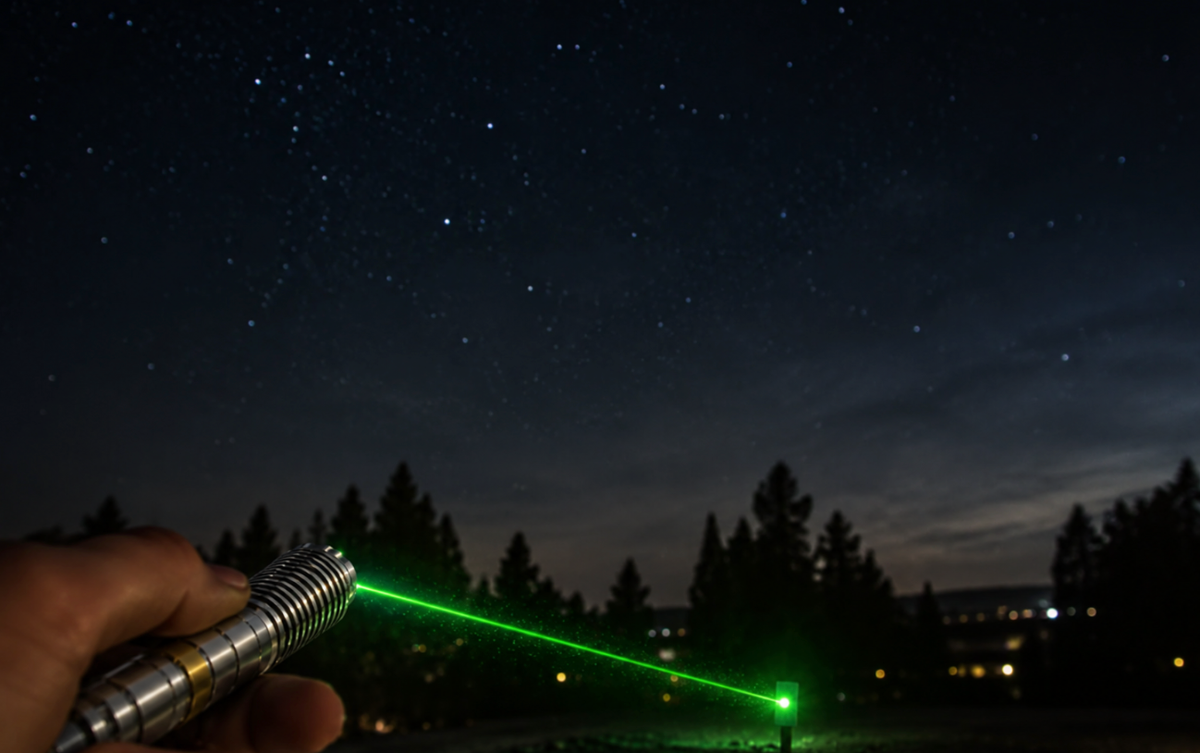
You stand under a star-filled night sky and raise a green laser pointer at night. Its beam cuts upward—sharp, bright, easy to see. Your friend's red laser barely shows against the dark. Why the difference?
The answer comes from three scientific ideas: higher typical power output, efficient scattering in the air from a shorter wavelength, and your eye's peak sensitivity to green light. These factors multiply, not just add. Green laser pointers lead in astronomy for these reasons.
Professional-grade tools like those from Hgyuskl boost this visibility with true, high-power output. A real 5mW green laser shows a clear beam under dark skies. High-visibility green lasers and outdoor tactical lasers use these same ideas—engineered for demanding environments where performance and reliability are non-negotiable.
Key Takeaways
-
Human vision is much more sensitive to green wavelengths than to common red wavelengths.
-
Darkness increases contrast, making scattered green light easier to notice from the side.
-
Molecular Rayleigh scattering is stronger at 532nm than at 650nm, but real beam visibility also depends on aerosols, humidity, fog, dust, divergence, and viewing angle.
-
A beam that looks bright is not necessarily more powerful, safer, or capable of traveling farther.
-
520nm and 532nm are both highly visible green wavelengths, but their optical architecture and visual response differ.
-
Never estimate laser class or eye risk from apparent brightness.
Why Green Laser Beams Look Bright Without Being More Powerful

When you shine a green laser pointer at night, you see more than just the bright spot at the end. You see the whole beam of light across the sky. The air itself does not become visible. Instead, a small portion of the laser light is redirected toward your eyes by molecules and suspended particles along the beam path. Nitrogen and oxygen molecules contribute primarily to Rayleigh scattering. Larger airborne particles such as dust, haze droplets, and smoke are more often described by Mie scattering or more complex scattering behavior.
Understanding Rayleigh Scattering and the λ⁻⁴ Rule
Rayleigh scattering follows a strict math rule. The amount of scattered light depends on the wavelength raised to the fourth power. This is the λ⁻⁴ rule. It means shorter wavelengths scatter much more than longer ones. For a small round particle, the scattered light strength uses the wavelength to the fourth power in the bottom of the equation. If you double the wavelength, scattering drops by sixteen times.
For particles much smaller than the wavelength of light, Rayleigh scattering varies approximately with the inverse fourth power of wavelength, I∝1/λ4I \propto 1/\lambda^4. This is why 532nm light undergoes more molecular scattering than 650nm light under otherwise comparable conditions.
This rule comes from classical electrodynamics. When a light wave hits a molecule, it polarizes that molecule. This creates a moving electric dipole. The dipole sends out energy in every direction. The scattering cross-section grows with the fourth power of frequency. Since frequency goes down as wavelength goes up, scattering follows the inverse fourth power rule. Shorter wavelengths scatter more because their higher frequency makes stronger dipole motion.
How Green Laser Pointers Outperform Red in the Atmosphere
Now apply this rule to real laser colors. Green light at 532 nanometers and red light at 650 nanometers differ a lot in wavelength. The ratio of 650 divided by 532 equals about 1.22. Raising that to the fourth power gives roughly 2.2. Using the idealized Rayleigh relationship, 532nm light produces approximately 2.2 times the molecular scattering of 650nm light under otherwise identical conditions. This theoretical ratio does not directly mean that the complete beam will look exactly 2.2 times brighter in a real atmosphere.
The λ⁻⁴ rule acts as a main loss method during travel through air. Rayleigh scattering removes photons from the laser beam. This cuts its power along the path.Atmospheric scattering has two competing effects: it redirects some light toward a side observer, making the beam easier to see, while also removing energy from the forward beam. The balance depends on wavelength, path length, aerosols, humidity, fog, and other atmospheric conditions.
Real-world tests confirm this theory. Think about what you see with different power levels:
There is no universal output threshold at which a beam becomes clearly visible. Side visibility depends on wavelength, divergence, ambient light, humidity, aerosols, viewing angle, and the observer’s visual adaptation.
This visibility limit explains why green laser pointers lead in astronomy and outdoor guiding. The scattered green photons along the whole beam reach your eyes. This creates the look of a solid, continuous line. Red lasers scatter fewer photons, so the beam looks faint or invisible except at the end point.
In real-world environments with large particles (fog, smoke, dust), Mie scattering becomes less dependent on wavelength. Consequently, laser power matters more than color for beam visibility in these conditions.
For stargazing laser pointers, this scattering edge proves vital. You need a beam that stays visible in air across hundreds of meters. It must cut through darkness to guide observers toward specific stars. The green wavelength does this naturally. Higher output is not required to explain why green appears visible at night. A more useful comparison considers the minimum appropriate output, wavelength, divergence, environmental conditions, and laser class.
The Human Eye: Why We Are Wired to See Green Best

Your eye is not a neutral detector. It favors certain wavelengths over others. This biological bias explains why a green laser pointer at night appears so dramatically bright. The effect begins with how your retina processes light through two distinct systems: cones for bright conditions and rods for darkness.
Photopic Vision and the Photopic Luminosity Function
During daylight or under bright artificial light, your cone cells handle vision. Scientists call this photopic vision. The CIE (1931) Photopic Luminosity Function, denoted V(λ), maps exactly how your cones respond across the visible spectrum. This standard curve peaks at 555 nanometers, which sits in the green-yellow region. Your eye extracts maximum brightness from light at this wavelength.
Under light-adapted conditions, the CIE photopic luminous-efficiency function peaks near 555nm. Both 520nm and 532nm lie relatively close to this peak, which helps explain why green light appears bright per unit of optical power.
This standard response curve provides a more reliable explanation than comparing the approximate population of different cone types, which varies across the retina and between individuals.
|
Vision Condition |
Peak Sensitivity Wavelength |
|
Photopic (cones, daylight) |
555 nm |
|
Scotopic (rods, nighttime) |
~507 nm |
Scotopic Vision and Nighttime Sensitivity Shift
Under fully dark-adapted conditions, the standard scotopic sensitivity curve peaks near 507nm. A 520nm green wavelength lies closer to this peak than 532nm, while both are much closer than common 650nm red light.
However, a bright laser beam may locally move the eye away from fully scotopic vision, so real observation often involves mesopic or photopic response rather than rods alone.
The shift matters enormously for laser visibility. Red light at 650 nanometers falls far from the rod peak, so it appears extremely dim. Green light at 532 nanometers sits remarkably close to 507 nanometers. Your rods respond strongly to it. At night, green generally retains a substantial visibility advantage over common 650nm red light at equal output. The exact perceived difference depends on the specific wavelengths, visual-adaptation state, ambient light, divergence, and observation conditions.
Consider what this means in practice. A lower-output green laser may appear brighter than a higher-output red laser, but there is no universal power-conversion ratio that applies to every product and nighttime environment.
This visual sensitivity helps explain why green is commonly chosen for controlled nighttime pointing applications. It does not make a high-powered green laser appropriate for navigation, emergency signaling, wildlife deterrence, or uncontrolled outdoor use.
Because green already offers high perceived visibility per milliwatt, extreme output should not be treated as necessary for nighttime visibility. Select the minimum output and product class suitable for a legitimate application. You receive a tool that works with your vision, not against it. The result is a beam that performs exactly as your eye expects it to—bright, clear, and reliable under the darkest skies.
A green laser beam appears highly visible at night because green wavelengths align well with human visual sensitivity, darkness creates strong background contrast, and molecules and particles scatter some of the light toward the observer.
That visibility does not prove that the laser is high powered, safe, or capable of a specific range. Always check the measured output, laser class, divergence, labeling, and local rules rather than judging a product by appearance alone.
FAQ
Can I use a green laser pointer for stargazing in a city with light pollution?
Light pollution reduces beam-to-background contrast, so a green beam may be harder to see in a city than under dark skies. Do not compensate automatically by choosing a higher-powered laser. Use only a compliant product and confirm that outdoor use is permitted.
Why does my green laser beam look brighter on some nights than others?
Beam visibility changes with humidity, haze, dust, fog, aerosols, ambient light, and viewing angle. More suspended particles may make the beam easier to see from the side, while also increasing forward attenuation and beam spread. A clear, dry night does not always produce the most visible beam.
How do I know if my green laser has true power output?
Look for a model-specific output specification, laser class, stated tolerance, measurement method, test conditions, duty cycle, and safety documentation. Apparent beam brightness cannot verify output power.
Is it safe to use a green laser for wildlife pest control?
Do not aim a handheld laser directly at wildlife. Professional optical-deterrent systems may be used in some controlled settings, but legality and suitability depend on the species, location, product class, and operating procedure.
How does a green laser compare to a blue laser for night visibility?
At equal measured output, green generally appears brighter than 445nm or 450nm blue because human vision is more sensitive to green wavelengths. Color alone does not determine safety; output, laser class, divergence, exposure, and reflections must also be considered.
Share:
High-Power Blue Lasers: Why More Power Is Not Always Better
Best Blue Laser Pointer: 8 Specifications to Check Before Buying