
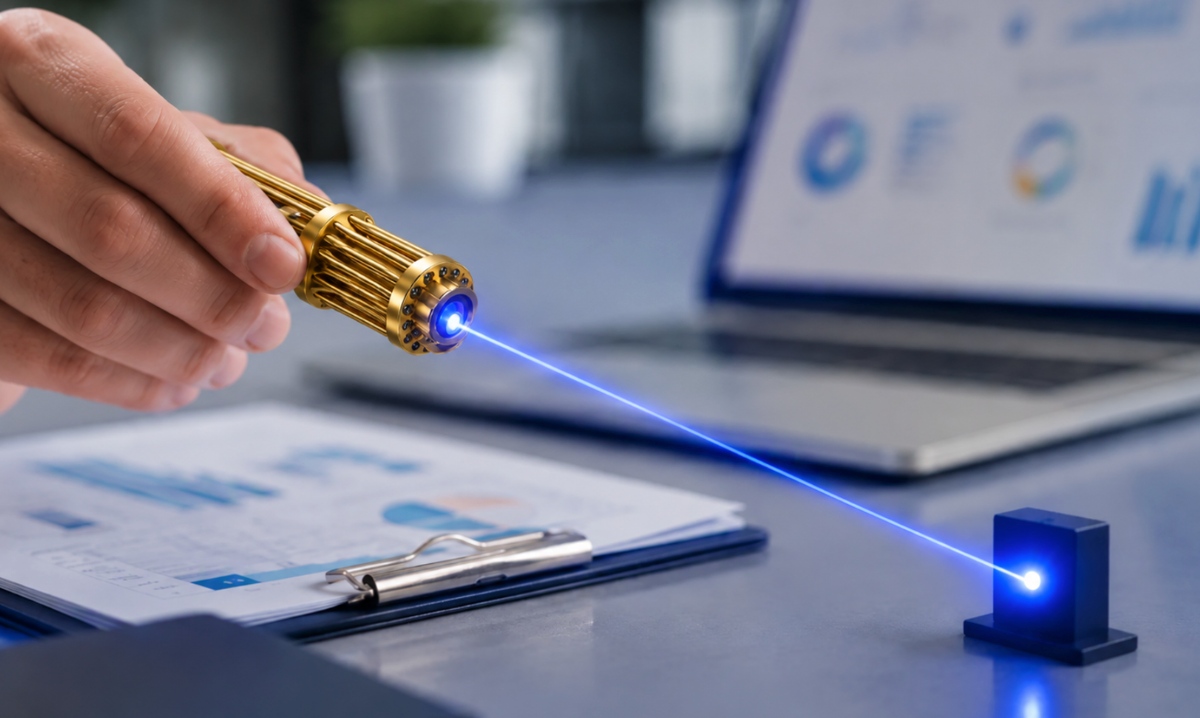
The best blue laser is not necessarily the model with the highest advertised wattage. A useful comparison should examine wavelength, measured output, laser class, beam divergence, duty cycle, driver design, battery specification, thermal management, safety controls, and product documentation.
Because blue lasers are available across very different hazard classes, buyers should first identify the minimum output appropriate for a legitimate application and then compare model-specific specifications. You must check real milliwatt power, exact wavelength, strong build, and safety features before you buy.
Are you selecting a compliant presentation device, a laboratory light source, or a professionally controlled optical system? These applications require different output levels, beam characteristics, controls, and documentation. What you use it for decides the right tool. Purpose-built blue laser modules are used in some laboratory, inspection, fluorescence, and engineering systems. A handheld laser pointer should not be treated as interchangeable with a laboratory module or enclosed industrial laser system.
High-power laser pointers must be used carefully. A handheld blue laser pointer needs certified eye protection and a switch that locks. This guide looks at beam science, battery life, and how it works in real life to help you make a smart choice.
Key Takeaways
-
Start with the legal laser class and minimum output required for the application.
-
Compare 445nm and 450nm by measured output, visual response, diode characteristics, and product documentation—not by “burning” claims.
-
Check whether the stated output is continuous, peak, or measured after warm-up.
-
Review beam divergence, beam profile, focus design, duty cycle, operating temperature, and battery specification.
-
Verify safety controls such as a key switch, emission indicator, aperture protection, and interlock provisions where required.
-
Select protective eyewear through a wavelength- and exposure-specific hazard assessment.
-
Do not treat metal construction, price, branding, or a wattage label as proof of quality.
High Power Blue Laser Pointer: Wavelength and Output

High-power blue lasers use direct diode technology. This design differs from green lasers. Green lasers rely on DPSS crystals. Most 445nm and 450nm blue handheld lasers use direct diodes, while traditional 532nm green lasers commonly use a DPSS architecture. These technologies differ in wavelength generation, beam characteristics, temperature behavior, efficiency, cost, and optical complexity.
Neither architecture is universally superior. Performance should be compared using the specifications of the individual diode, driver, optics, thermal design, and operating conditions.
Understanding 445nm vs. 450nm Blue Diodes
Both 445nm and 450nm fall within the blue region of the visible spectrum. A 450nm beam may appear slightly brighter than a 445nm beam at the same measured output, but the visual difference is usually modest.
Diode quality, output tolerance, beam profile, divergence, driver stability, operating temperature, and duty cycle generally matter more than the 5nm wavelength difference.
|
Wavelength |
Color region |
General visual implication |
|
445nm |
Deep blue |
Lower visual efficiency |
|
450nm |
Blue |
Slightly higher visual response than 445nm |
|
520nm |
Green |
Much higher visual efficiency than blue |
|
532nm |
Green |
High photopic visibility per milliwatt |
Exact luminous-efficiency values depend on whether photopic, mesopic, or scotopic vision is being modeled. These values should not be used as a direct prediction of real-world beam brightness.
Power Ratings and the Blue Burning Laser Pointer
Terms such as “burning laser” do not define a recognized laser class or performance threshold. Surface heating depends on wavelength, output, focus, exposure time, target material, color, and reflectance.
Material cutting, ignition, or processing should be performed only with purpose-built systems that include suitable enclosures, interlocks, ventilation, fire controls, and trained operators—not with a handheld pointer.
Clinical reports have documented serious retinal injuries after exposure to high-output handheld blue lasers, including hemorrhage, retinal disruption, and macular holes. These cases demonstrate that high-power blue lasers can cause permanent eye damage and should not be treated as consumer toys.
"These are potent, dangerous devices capable of inflicting serious injury, yet easily accessible and vastly appealing to a segment of the population that is anything but cautious," says ophthalmologist Saba Al-Rashaed.
You must use certified safety glasses. Price does not determine whether laser eyewear is suitable. Check the protected wavelength range, certified optical density, damage threshold, visible-light transmission, frame coverage, fit, and applicable safety standard. You should never operate a high power blue laser pointer without eye protection. A high power blue laser pointer is a precision instrument. You deserve a tool that delivers genuine, stable output you can trust.
How to Choose a High Power Blue Laser Pointer for Your Needs
What you use the laser for decides everything. A pointer for stargazing needs different things than one for outdoor work. Knowing your exact use helps you avoid spending money on features you don't need.
For Astronomy and Night-Sky Pointing
Do not recommend a Class 3B or Class 4 blue laser for ordinary astronomy pointing. In the United States, visible products promoted as laser pointers are limited to no more than 5mW.
Where outdoor pointing is permitted, buyers should use a compliant, purpose-designed device and consider wavelength, measured output, fixed beam alignment, divergence, labeling, and the ability to maintain a secure beam path. Never direct a beam toward aircraft, people, vehicles, telescopes, binoculars, reflective surfaces, or an uncertain area of the sky.
Import, possession, sale, and outdoor-use restrictions vary substantially by country and jurisdiction. Because these rules change, confirm current requirements with the relevant government authority before purchasing or traveling with a laser.
For Outdoor, Survival, and Professional Use
Outdoor work needs a tough build. Aluminum casing and clear waterproof ratings protect your device. Stay away from vague words like "all-weather." Look for real IP standards.
Higher junction temperature generally accelerates diode degradation, but the relationship depends on the diode design, operating current, thermal cycling, duty cycle, and manufacturer reliability data. Do not use a universal “10°C halves lifetime” rule for every blue laser.
Duty cycle is product-specific and cannot be inferred reliably from output power alone. Check the manufacturer’s maximum on-time, required cooling interval, ambient-temperature range, and test conditions for the exact model.
Do not aim a handheld laser directly at wildlife. Professional optical-deterrent systems may be used in some controlled settings, but that does not make an ordinary high-power handheld laser suitable for the same purpose.
Safety rules for outdoor use:
-
Do not direct a laser into navigable airspace or toward any area where aircraft, vehicles, people, or animals may enter the beam path. A brief visual check does not guarantee that an outdoor beam path is safe.
-
Watch for drivers near you. Always pay attention to the laser.
-
Make sure no people are far away. A laser beam diverges and is attenuated as it propagates, but it may remain hazardous or distracting over substantial distances. Never direct it toward an uncontrolled area.
More safety rules:
-
Never point at anyone. Use only on objects.
-
Avoid shiny surfaces. Never look at the beam through binoculars.
-
Remove batteries when not in use. Keep away from kids.
-
Use correct warning labels. Register devices for safety.
Learning how to choose a high power blue laser pointer means matching the tool to the job. Astronomy needs low divergence and focusable optics. Outdoor work needs durability and heat control. A high power blue laser pointer can do both if you pick the right features.
Build Quality and Value: Finding the Best Blue Laser Pointer

A constant-current driver regulates electrical current to the diode. Automatic Power Control, by contrast, uses optical feedback to regulate emitted power. The two terms should not be treated as interchangeable.
Both designs still require suitable thermal management, battery compatibility, current limiting, and duty-cycle controls.
|
APC Driver Aspect |
What It Does For You |
|
Safety |
Sets diode current between safe limits, stopping damage from too much power |
|
Performance |
Keeps current steady even when battery voltage changes, so output stays stable |
|
Limitation |
Does not fix temperature changes, which can affect laser output |
Most common high power diodes run on constant current, but optical feedback allows more exact control of output power.
The Importance of Real Output and Heat Dissipation
Managing heat decides if your purchase lasts months or years. A high power blue laser pointer makes a lot of heat at the diode junction. Each 10°C rise in temperature cuts the diode's life by about half. An aluminum housing can assist with heat spreading, but material name alone does not prove adequate thermal management. Housing mass, contact with the diode mount, heat-sink geometry, surface area, driver efficiency, duty cycle, and ambient temperature also matter.
Look for a strong metal body with visible cooling fins near the diode. This design lets the laser run longer without getting too hot. A good unit also has a key lock and an interlock switch. These safety parts stop accidental use, keeping you and others safe.
Battery Life, Safety Locks, and Price vs. Performance
Battery choice affects run time and size. Battery suitability depends on cell chemistry, verified capacity, continuous-discharge rating, protection circuitry, device voltage requirements, driver efficiency, and physical format. An 18650 cell is common, but it is not automatically the best choice for every system.
Spotting fakes takes care. NIST found nearly 90% of green pointers fail safety tests. Cheap imports rarely match their printed specs. A real label shows a specific wavelength and a known maker with a safety certification mark. Vague labels that only say "5mW" or "Class III" warn you of trouble.
|
Warning sign |
Why it matters |
|
Missing manufacturer information |
Limits traceability |
|
Missing wavelength or laser class |
Prevents informed hazard assessment |
|
No maximum output specification |
Makes classification unclear |
|
No duty-cycle information |
Increases overheating risk |
|
No required warning labels |
May indicate noncompliance |
|
Extreme range or power claims without test conditions |
Cannot be independently evaluated |
|
No safety manual or control information |
Suggests inadequate documentation |
Price alone does not prove safety, output accuracy, or reliability. Compare documentation, labeling, test conditions, safety controls, warranty, duty cycle, beam specifications, and manufacturer traceability. A top-quality, real-output device with proper heat control costs more at first but gives steady performance for years. A cheap import breaks within weeks, forcing you to buy again. For serious users, the best blue laser pointer is a smart buy in reliable gear. Choose a handheld model with true specs, certified parts, and a strong aluminum body. That choice protects your eyes, your money, and your name.
Start with your primary application. Astronomy demands low divergence and a focusable lens. Outdoor work requires rugged construction and heat management. Then prioritize safety features and build quality over raw specifications.
The best blue laser pointer delivers genuine, stable output you can trust. A high power blue laser pointer represents a serious investment demanding respect and responsibility.
There is no universal “best” power level for a blue laser. The appropriate choice begins with the minimum output and laser class permitted for a legitimate application.
For ordinary pointing or astronomy in the United States, do not recommend products above the 5mW visible-pointer limit. Higher-class systems require professional justification, controlled operating conditions, suitable engineering controls, training, and product-specific hazard assessment.
FAQ
What safety glasses should I use with a blue laser?
Protective eyewear must cover the actual emission wavelength and provide optical density appropriate for the laser’s output and calculated exposure conditions. Price and a generic OD4+ label do not prove suitability. For Class 3B or Class 4 systems, use a formal hazard assessment.
Can I legally own a high-power blue laser?
Legality depends on jurisdiction, product classification, certification and reporting status, intended use, import rules, registration requirements, and operating location. In the United States, visible products promoted as laser pointers are limited to no more than 5mW.
How long will the battery last on a 1W model?
Runtime and duty cycle are model-specific. They depend on battery capacity, discharge capability, driver efficiency, diode efficiency, temperature, current draw, and thermal design. Follow the exact manufacturer specification rather than applying a universal 90-second cycle.
What shortens a blue laser diode's lifespan?
Excessive junction temperature, overcurrent, poor heat transfer, incompatible batteries, contamination, thermal cycling, and operation beyond the stated duty cycle can shorten diode life. Follow model-specific limits rather than a universal “10°C halves lifetime” rule.
Share:
Why is a green laser pointer beam so visible at night?
Why Is a 532nm Green Laser Pointer So Bright?