
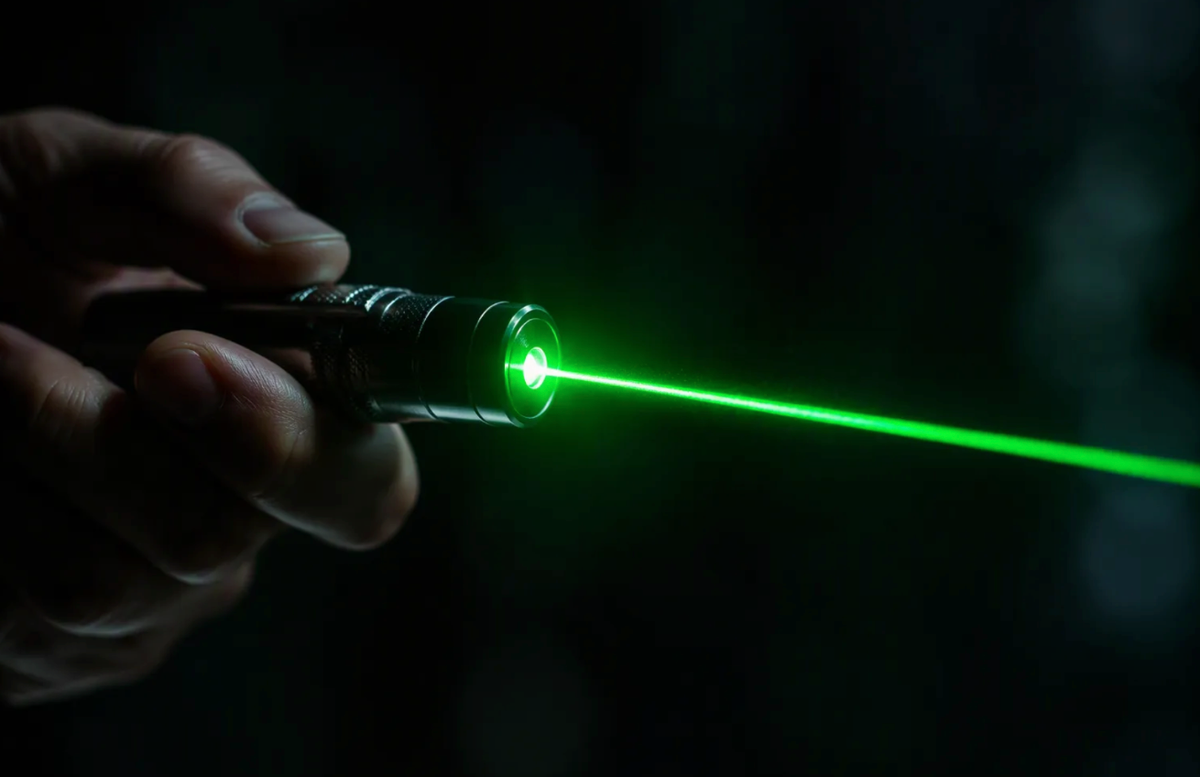
A 532nm green laser often appears much brighter than a red or blue laser with the same measured optical output. The main reason is human visual sensitivity: 532nm lies close to the peak of the CIE photopic luminous-efficiency curve, which describes the average eye’s response under well-lit conditions.
Wavelength, however, is only part of the explanation. Beam divergence, ambient light, atmospheric particles, viewing angle, target surface, and the eye’s adaptation level all affect apparent brightness. A brighter-looking beam also does not necessarily mean higher optical power, greater range, or safer operation.
Key Takeaways
-
A 532nm beam appears bright because its wavelength lies close to the peak of human photopic sensitivity.
-
Most traditional 532nm handheld lasers use DPSS technology to convert infrared energy into visible green light.
-
DPSS output can be temperature-sensitive, although the amount of variation depends on the individual design.
-
Apparent brightness does not prove that a laser has an accurate power rating or that it is safe to use.
-
Buyers should check the stated laser class, measured output, beam divergence, operating-temperature range, and the presence of adequate infrared filtering.
The Science of Sight: Why Green Stands Out

Photopic Vision and the Sensitivity Curve
Your vision works differently depending on light levels. In bright settings, your eye uses cone cells for what scientists call photopic vision. These cones are most sensitive at about 555 nanometers, a wavelength that falls in the green part of the spectrum. This value comes from the CIE 1931 photopic luminosity function, a standard set by the Commission Internationale de l'Eclairage. The curve shows how your eye responds across visible light, with its highest point at that 555nm mark.
Why does this matter for a 532nm green laser pointer? The answer is how close its output is to your eye's best detection point. At 532nm, your cones respond with nearly maximum efficiency. For photopic vision, 1 watt of radiant power at 555nm produces a luminous flux of 683 lumens. This reference point anchors all photometric measurements. Under photopic conditions, the standard human luminous-efficiency curve reaches its maximum at approximately 555nm. At 532nm, the eye retains a large proportion of this peak sensitivity. This is why a given amount of 532nm optical power generally produces a stronger brightness impression than the same optical power at 650nm or 450nm.
The CIE curve represents the average response of the human visual system rather than the behavior of a single type of cone cell. Individual perception can also vary with age, adaptation, background illumination, and viewing conditions.
The CIE 1931 standard curve shows that your sensitivity drops quickly as wavelengths move away from that peak. Red light at 650nm falls far down the slope. Blue light at 450nm also sits well below maximum. This explains why green laser pointers appear so much brighter than other colors at equal output. Your visual system simply pays more attention to that part of the spectrum.
Why the Sensitivity Curve Matters
The eye’s response to wavelength is determined by the combined spectral properties of its photoreceptors, neural processing, and optical media. For practical laser comparisons, the measured CIE luminous-efficiency curve is more useful than speculative explanations about why human vision evolved in a particular way.
It is also important to distinguish photopic vision from low-light vision. The photopic curve peaks near 555nm, while the scotopic curve associated with rod-dominated vision peaks closer to 507nm. Real nighttime viewing often falls between these two states.
The Technology Behind a 532nm Green Laser Pointer
Making that bright green beam takes clever engineering. Red and blue lasers send out their color directly. But a 532nm green laser pointer uses a step-by-step optical process called Diode-Pumped Solid-State (DPSS) technology. This method turns invisible infrared light into the vivid green you see.
How a 532nm DPSS Laser Produces Green Light
Most traditional 532nm handheld lasers use a diode-pumped solid-state, or DPSS, optical system. An infrared diode commonly emits light near 808nm and pumps a neodymium-doped gain crystal, such as Nd:YVO₄ or Nd:YAG. The gain medium produces infrared laser light at 1064nm.
A nonlinear crystal, commonly KTP, then converts part of the 1064nm light into 532nm green light through second-harmonic generation. Optical coatings and filters are used to separate the visible output from residual infrared wavelengths.
Adequate infrared filtering is an important safety and quality consideration. A bright green beam does not reveal whether invisible 808nm or 1064nm radiation is also leaving the device, so this cannot be evaluated reliably by eye alone.
Power Efficiency and Perceived Brightness
DPSS lasers can be more sensitive to temperature than direct-diode designs. Temperature changes may affect the pump wavelength, crystal efficiency, alignment, output stability, or beam mode. Some models produce reduced or unstable output after a cold start, while others are less noticeably affected.
The size of the effect is product-specific. Buyers who expect to use a laser outdoors should check the manufacturer’s documented operating-temperature range, duty cycle, and measured output specifications rather than assuming that every 532nm laser behaves the same way.
This temperature dependence explains why professional users think about operating conditions carefully. A laser that works great indoors may do poorly during winter stargazing sessions. The green output shifts with air temperature, affecting beam visibility when you need it most.
For this reason, Hgyuskl offers another choice: green laser pointers with 520nm direct green diodes. These diodes send out green light directly without frequency conversion. They skip the temperature-sensitive KTP stage entirely. Direct-diode 520nm lasers stay steady across a wider temperature range because they do not rely on that conversion process. This makes them especially useful for outdoor survival, wildlife control, and astronomy applications where conditions change.
That said, even direct-diode lasers can have output drift if you use them outside their designed conditions. Driver heating, diode heating, or weak battery performance in extreme cold can still affect output. You should always check the maker-specified operating temperature and duty cycle for your exact model.
The efficiency story matters because perceived brightness depends on real optical power. A top-quality laser gives its rated output steadily. Product quality cannot be determined from wavelength or housing appearance alone. Useful indicators include a clearly stated laser class, measured output range, beam-divergence specification, infrared-filter information, operating-temperature limits, duty-cycle instructions, and model-specific test documentation.
Comparing Green to Red and Blue Lasers

The Red Laser's Visibility Challenge
A red pointer at 650nm sits far from the photopic peak near 555nm. The photopic sensitivity at 550nm reaches 0.994950. At 650nm, the standard photopic response is much lower than it is at 532nm. Therefore, when optical power and beam geometry are comparable, the 650nm spot will generally appear dimmer. This does not mean intensity is irrelevant: optical power, divergence, target reflectivity, viewing distance, and ambient light still have major effects on visibility.
Beam divergence helps red devices maintain some visibility at distance. Low divergence keeps the beam tight, so the spot remains small even at long range, preserving intensity far better than a flashlight's spread. Even with excellent collimation, the color itself limits perceived brightness. For applications like astronomy or outdoor signaling, red sacrifices visibility compared to alternatives.
The Blue Laser's Position on the Curve
A blue laser at 450nm faces an even steeper challenge. It sits further from the 555nm peak than red does. A 445–450nm blue laser also lies in a region where photopic sensitivity is substantially lower than at 532nm. At equal measured optical output and similar beam geometry, 532nm will normally appear brighter. A single universal brightness multiplier should be avoided because perceived brightness depends on the observer and viewing conditions. This ratio means that a green device of a given power appears brighter than a blue device of much higher power. For outdoor use, this efficiency translates directly into better beam visibility without requiring unsafe output levels. Your cones simply do not respond as strongly to blue light.
When you compare red and blue options side by side, the green wins for perceived brightness. For outdoor work, astronomy, or wildlife control, that efficiency matters. A high-quality laser delivers consistent output. Professionals choose green laser pointers for superior visibility. This color remains the standard for pointing applications. Whether you need a clear beam for astronomy or a reliable signal in the field, that color gives you the most visible light per milliwatt.
Seeing the Beam: Practical Visibility in the Field
Beam Visibility in Daylight and Darkness
In full daylight, the beam of a 532nm green laser pointer stays almost invisible. Sunlight overpowers the scattered light. You only see the dot where the beam hits a surface. Everything changes as light fades. At dusk and in darkness, the beam shows up as a clear column reaching across the sky.
The science involves scattering. Tiny particles in the air, like dust, smoke, and fog, catch the beam along its path. These particles bounce some light toward your eyes through Mie scattering. The beam does not stop at the particle layer. It keeps going until light gets absorbed or scattered too much to see. Fewer particles above that layer make the beam seem to end at that height. This explains why you see a green beam better in hazy or humid weather.
A laser beam becomes visible from the side when a small portion of its light is scattered toward the observer by molecules, aerosols, dust, or moisture in the air. The apparent beam is usually easier to see against a dark background, while strong daylight greatly reduces contrast.
Visibility varies with atmospheric conditions and viewing geometry. A visible beam should never be treated as proof of a particular output power or usable range. Users should not deliberately introduce smoke, mist, or reflective materials around a high-output laser, because doing so can create uncontrolled exposure paths.
Atmospheric Scattering and the Night Sky
Astronomy fans use green laser pointers to show constellations. How well the beam shows under the stars depends fully on particles in the air. At high altitudes or in very clean air, the beam looks faint. Dust and moisture naturally boost visibility at night. You can add particles with a fog machine or humidifier mist to make the beam more visible for shows.
This process works best at 532 nm. The wavelength matches your eye's peak sensitivity closely, making each scattered photon easier to notice. The visual efficiency of 532nm can make relatively low optical output appear bright, but wavelength alone does not make a laser safe. Safety depends on the actual output, laser class, exposure duration, beam path, and compliance with local regulations.
In the United States, visible products promoted as laser pointers are limited to 5mW and Class IIIa/3R requirements. A laser must never be directed at an aircraft, vehicle, person, animal, or reflective surface. Outdoor users should check the surrounding airspace before activation and stop immediately if an aircraft is present.
For wildlife control, beam clarity matters most. You need to aim a visible deterrent across a pond or field without bothering neighbors. A green beam gives a clear aiming line. The beam stays visible at distances where red or blue lasers disappear into the dark. Hgyuskl builds its devices with real output specs, so you get the brightness you expect.
Your eye's natural sensitivity to green light works with the efficient DPSS technology inside a 532nm green laser pointer. This mix of visibility and power is why green is the dominant choice for astronomy. At night, your vision is more sensitive to green light than to red. A lower-power green beam still looks brighter than a higher-power red beam. This efficiency makes green laser pointers the better tool for stargazing and outdoor signaling. For reliable performance, you need a laser that gives its rated output all the time. Pick a quality laser with true and tested numbers. The good mix of biology and engineering makes a tool that works great under the night sky. Your sky deserves the clearest beam possible.
FAQ
Why does a 532nm laser appear so bright?
A 532nm beam lies close to the peak of the eye’s photopic sensitivity curve. At equal measured optical power and similar beam geometry, it will generally appear brighter than common 650nm red and 450nm blue wavelengths.
Is every 532nm laser a DPSS laser?
Most conventional 532nm handheld lasers use DPSS technology, commonly converting 808nm pump light to 1064nm and then to 532nm. The exact optical design can vary by manufacturer and model.
Can a 532nm laser emit invisible infrared light?
A DPSS system can produce residual 808nm and 1064nm infrared radiation. A properly designed product uses optical filtering to reduce this unwanted output. Infrared leakage cannot be judged from the apparent brightness of the green beam.
Does cold weather affect 532nm output?
It can. Temperature may affect the pump diode and frequency-conversion efficiency, but the amount of change depends on the design. Check the documented operating-temperature range for the individual model.
How can actual output power be verified?
Reliable verification requires a calibrated laser power meter or a model-specific measurement report stating the test conditions. Housing material, beam brightness, battery type, or the presence of a constant-current driver does not independently prove output power.
Share:
Best Blue Laser Pointer: 8 Specifications to Check Before Buying
What makes 520nm green laser pointers different from other laser pointers?