
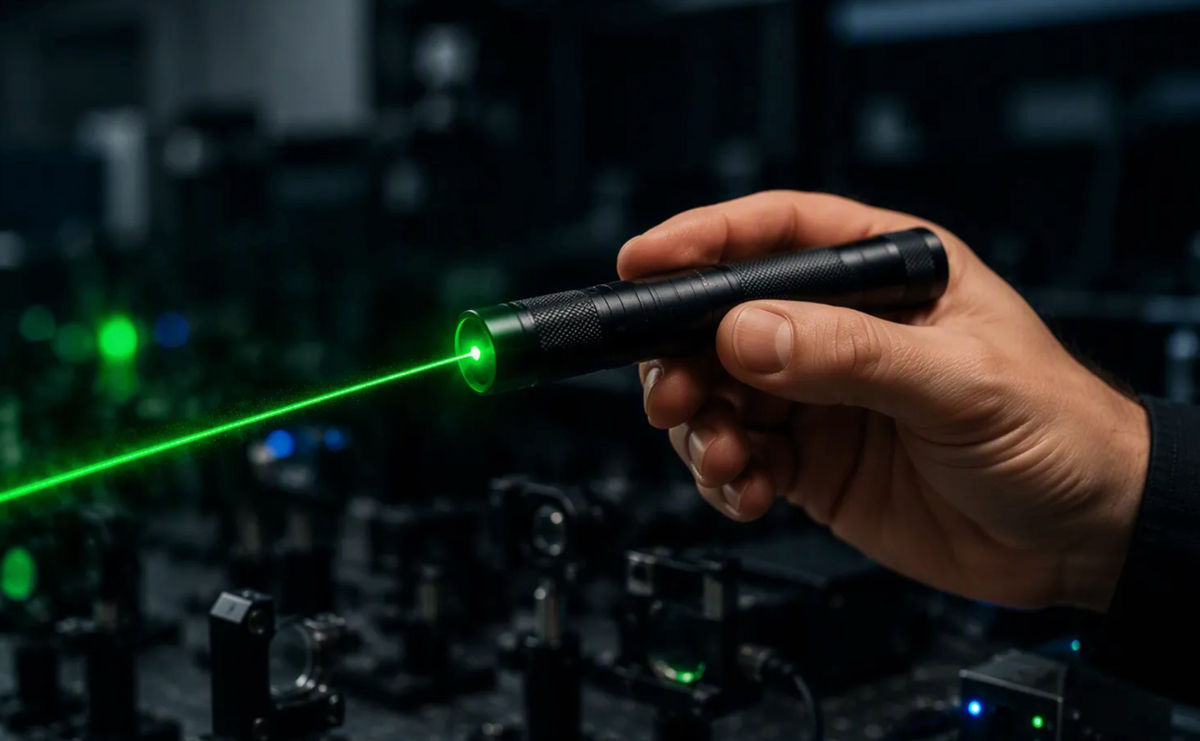
A 520nm green laser differs from a traditional 532nm green laser primarily in how the light is generated. Most 520nm models use a semiconductor diode that emits green light directly, while conventional 532nm models commonly rely on a DPSS system that converts infrared light into visible green light.
This difference can affect startup behavior, temperature response, beam shape, and system complexity. However, 520nm is not automatically the brightest wavelength per milliwatt. Under photopic conditions, 532nm lies closer to the human eye’s peak sensitivity near 555nm and generally receives a higher luminous-efficiency weighting at equal optical power.
Actual visibility also depends on output power, beam divergence, ambient light, target surface, atmospheric conditions, and the observer’s visual adaptation.
Key Takeaways
-
A 520nm laser commonly generates green light directly from a semiconductor diode rather than through DPSS frequency conversion.
-
Direct-diode construction removes the infrared pump and frequency-doubling stages used in traditional 532nm lasers.
-
A 520nm diode may provide more predictable startup and temperature behavior, but performance still depends on the complete module design.
-
Compared with 532nm DPSS output, a 520nm diode often produces a more elliptical beam and may have different divergence characteristics.
-
Wavelength does not determine safety, range, or legal status. Buyers must check the actual output, laser class, specifications, and local regulations.
The 520nm Wavelength and Human Visibility

How Photopic Vision Enhances Green Laser Perception
Your eyes have three types of cone cells. Each type reacts to a certain range of wavelengths. S cones peak at about 445 nanometers, picking up blue-violet light. M cones peak near 540 nanometers, sensing green wavelengths. L cones peak at roughly 565 nanometers, responding to greenish-yellow light. Together, these three cone types form the photopic luminosity curve that peaks at 555 nanometers.
A 520nm beam stimulates the visual system efficiently because it lies within the green region where photopic sensitivity is high. However, perceived brightness is not determined by a single cone type. The CIE photopic curve represents the combined average response of the human visual system under well-lit conditions.
At equal measured optical power, 520nm generally appears brighter than common 650nm red and 450nm blue wavelengths. A 532nm beam, however, normally receives a higher photopic weighting because it lies closer to the 555nm peak.
Green light near 520nm gains from this biological precision. The photopic luminosity function gives a value of 0.107 to 650nm red light. Green light at 520nm reaches about 0.71. This gap explains why green laser pointers beat red models by a lot.
Comparing 520nm to 532nm Green Laser Brightness
The difference between 520nm and 532nm is usually easier to notice when the two beams are compared side by side. A 520nm beam may appear slightly deeper or less yellow-green, while 532nm often appears somewhat brighter at equal optical output. Color perception varies between observers, cameras, target surfaces, and ambient-light conditions.
One experienced user said the two wavelengths look almost the same unless you use a camera sensor to tell them apart. Another user explained that you can see the difference more easily by looking at scattered light on a surface rather than staring at the beam. The 520nm version gives a slightly different saturation profile. Some users see this shade as cleaner and more distinct in daylight. This small difference matters for professionals who need steady optical performance.
This quality itself becomes the main difference between laser types. While both colors look green, the 520nm offers a shade that stays visible in tough outdoor conditions. For astronomers pointing out constellations, the beam cuts through ambient light well.
The science of human vision shows why these pointers work so well. Your eyes evolved to see green light most efficiently.
Direct Diode Technology: The 520nm Advantage
The 520nm green laser pointer uses direct diode technology, not DPSS methods. Regular green lasers use crystal conversion. DPSS means diode-pumped solid-state. This process sends infrared light into a Nd:YAG crystal. Then the light goes through a KTP crystal that doubles the frequency. The 532nm green laser that comes out needs exact alignment and steady temperatures. The 520nm version skips this complicated chain. It uses a direct diode that makes green light at the chosen frequency. This simpler design gives you several benefits.
Efficiency and Stability of 520nm Green Laser Pointers
A direct 520nm diode generates green light without the 808nm pump, 1064nm gain medium, and frequency-doubling stages commonly used in a 532nm DPSS system. This reduces the number of optical conversion stages and removes the need to align multiple crystals.
The simpler optical path can improve startup consistency and reduce certain temperature-related conversion effects. It does not guarantee longer battery life or lower heat generation, because electrical efficiency still depends on the diode, driver, operating current, output level, and thermal design.
Temperature can affect both direct-diode and DPSS lasers, but it affects them in different ways. In a DPSS system, temperature may influence the pump wavelength, gain medium, frequency-conversion efficiency, cavity alignment, and output mode. A direct diode avoids several of these conversion-related variables, although its wavelength, efficiency, and output can still change with temperature.
Direct-diode designs may therefore provide more predictable cold-start behavior, but the result is model-specific. Meaningful comparisons require measurements of the finished product over its documented operating-temperature range.
Beam Quality and Spot Characteristics
Direct green diodes often produce a more elliptical raw beam than a well-designed DPSS source. Additional optics may be used to collimate or reshape it, so the finished beam depends on the complete optical design rather than wavelength alone.
Beam divergence directly affects how quickly the spot expands with distance. A low-divergence beam generally maintains a smaller spot, while a higher-divergence beam spreads its power over a larger area. Buyers should therefore look for a measured divergence specification instead of assuming that every 520nm laser has the same beam profile.
Some laser modules use automatic power control, or APC, to adjust the drive based on feedback from a monitoring photodiode. Other designs use regulated current drivers without directly measuring optical output.
APC can improve output stability, but its presence does not independently verify the stated power, laser class, or performance over temperature. Those claims require model-specific measurement data.
Why 520nm Green Laser Pointers Outperform Red and Blue
Appropriate Uses and Important Limitations
A 520nm laser may be used for controlled pointing, alignment, demonstration, or astronomy where the product class and local regulations permit it. Its high apparent visibility can allow a lower-output beam to remain noticeable under suitable conditions.
Outdoor operation requires special care because the beam can travel beyond the intended target. Never direct a laser toward aircraft, vehicles, people, animals, occupied buildings, or reflective surfaces. Do not use a laser as a general-purpose wildlife deterrent or emergency signaling device unless it is specifically designed, approved, and operated for that purpose.
Versatile Applications: Astronomy, Survival, and Wildlife Control
The 520nm green laser pointer works for many professional jobs. Astronomers use these tools for stargazing. The green light stands out in the night sky. You can trace constellations and lead groups with accuracy. The beam stays visible even with some light pollution.
For outdoor survival, you need tough gear. Hgyuskl makes pointers with aviation aluminum. This material resists damage and rust. The waterproof design works in rain or snow. The laser pointer works for emergency signals. The bright green beam catches attention over long distances. Rescue teams can spot your location quickly.
Wildlife control also uses green laser technology. Farmers and property managers use these pointers for safe animal control. The bright beam scares off geese, coyotes, and other animals without hurting them. The long-range visibility reaches far targets. You can protect crops and ponds effectively.
Hgyuskl gives real-output specs for these tough jobs. You get a tool you can rely on. The mix of green color, high visibility, durability, and accuracy makes the green laser your top choice for pointing. This green tool handles all your outdoor needs.
Selecting a Reliable 520nm Green Laser Pointer
Picking the right 520nm green laser pointer takes more than grabbing the brightest one on the shelf. You need to learn about power classes, spot real specs, and tell apart a pro tool from a risky fake. This know-how keeps your money safe and your eyes protected.
Laser Classification Is Not the Same as Legal Permission
Laser classification describes the potential hazard of accessible radiation, but it does not by itself determine whether a product may be sold, imported, possessed, or used in a particular location. These rules vary by country and may also vary by state, province, city, or proximity to an airport.
In the United States, visible products promoted as laser pointers are limited to 5mW and Class IIIa/3R requirements. Other jurisdictions may impose stricter restrictions on sales, possession, importation, or public use. Buyers should consult the relevant government authority rather than relying on a universal country-by-country power table.
Why Real Output Matters for Professional Use
The laser pointer business has a big problem: fake specs. Many "high-power" lasers sold online do not work as advertised. Makers list power levels their products never reach. This trickery wastes your cash and hurts your work.
A true 520nm green laser pointer from a trusted brand uses quality parts. Hgyuskl engineers check real output before sending each unit. They skip the common habit of inflated claims. You get a tool that works exactly as stated.
Automatic Power Control (APC) circuits separate good pointers from cheap copies. The Roithner datasheet for 520nm green laser pointers lists APC as a key feature. Models like RLP-520-01E and RLP-520-01 come with APC driving electronics. These circuits keep output power steady within laser class limits.
The Quarton page explains how APC works step by step. The circuit watches laser output through a built-in photodiode. This feedback loop keeps power constant even when temperature changes. The spec table shows operating current under 80mA or 100mA. Laser power outputs range from less than 0.39mW up to 4mW. With APC, these numbers confirm real and steady output power.
When you check a green laser pointer, look for certain features. An APC drive circuit keeps brightness steady. An aviation aluminum body lasts through outdoor work. A clear spec sheet shows honest power ratings without hype.
Professional users need steady performance. Astronomers need a reliable beam for night sky tours. Wildlife managers need predictable output for safe animal control. Outdoor survivalists trust gear that works in harsh conditions. A true 520nm green laser pointer gives this reliability through honest design.
The green light from a quality pointer stays steady from the first press of the button. You do not wait for warm-up. You do not worry about temperature shifts. The APC circuit handles these changes on its own.
Your eyes need protection. Your work needs precision. Your money should bring real value. Choose a 520nm green laser pointer that meets these standards. Check the specs. Confirm the APC drive. Pick a brand known for honesty. This path ensures you get the performance you need without risking safety.
A 520nm green laser is different mainly because it commonly uses a direct semiconductor diode instead of the infrared conversion process found in traditional 532nm DPSS lasers. This can simplify the optical system and improve startup consistency, but it does not automatically guarantee greater brightness, longer range, better beam quality, or longer battery life.
When comparing products, check the measured optical output, laser class, beam divergence, output tolerance, operating-temperature range, duty cycle, and test documentation. These specifications provide more useful information than wavelength or advertised visibility alone.
FAQ
How far can a 520nm green laser pointer shine?
Laser light can propagate over a long distance, but there is no single useful visibility range for every 520nm pointer. Spot visibility depends on output power, divergence, atmospheric conditions, target reflectivity, viewing position, and ambient light. Manufacturers should provide measured divergence and test conditions rather than an unsupported distance claim.
Does a 520nm green laser pointer require warm-up time?
A direct-diode 520nm laser generally does not require the same frequency-conversion warm-up behavior associated with some DPSS designs. However, output can still change as the diode, driver, battery, and housing change temperature. “Instant full power” should only be claimed when supported by model-specific measurements.
Can a 520nm green laser pointer cause eye damage?
Yes. A 520nm laser can cause retinal injury when the direct beam or a strong reflection enters the eye. Risk depends on output, exposure duration, beam diameter, distance, and laser class. Never aim at people, animals, vehicles, aircraft, or reflective surfaces.
What battery life can you expect from a 520nm green laser pointer?
Battery life is model-specific and depends on output power, driver efficiency, battery chemistry, capacity, temperature, and duty cycle. Use the manufacturer’s tested runtime under stated conditions. Do not operate a handheld laser continuously unless the product documentation specifically permits it.
How does a 520nm green laser pointer perform in cold weather?
A 520nm direct diode may provide more predictable cold-start behavior than a 532nm DPSS system because it does not rely on frequency-doubling crystals. It can still experience changes in wavelength, efficiency, battery performance, and output. Check the operating-temperature specification for the exact model.
Share:
Why Is a 532nm Green Laser Pointer So Bright?