
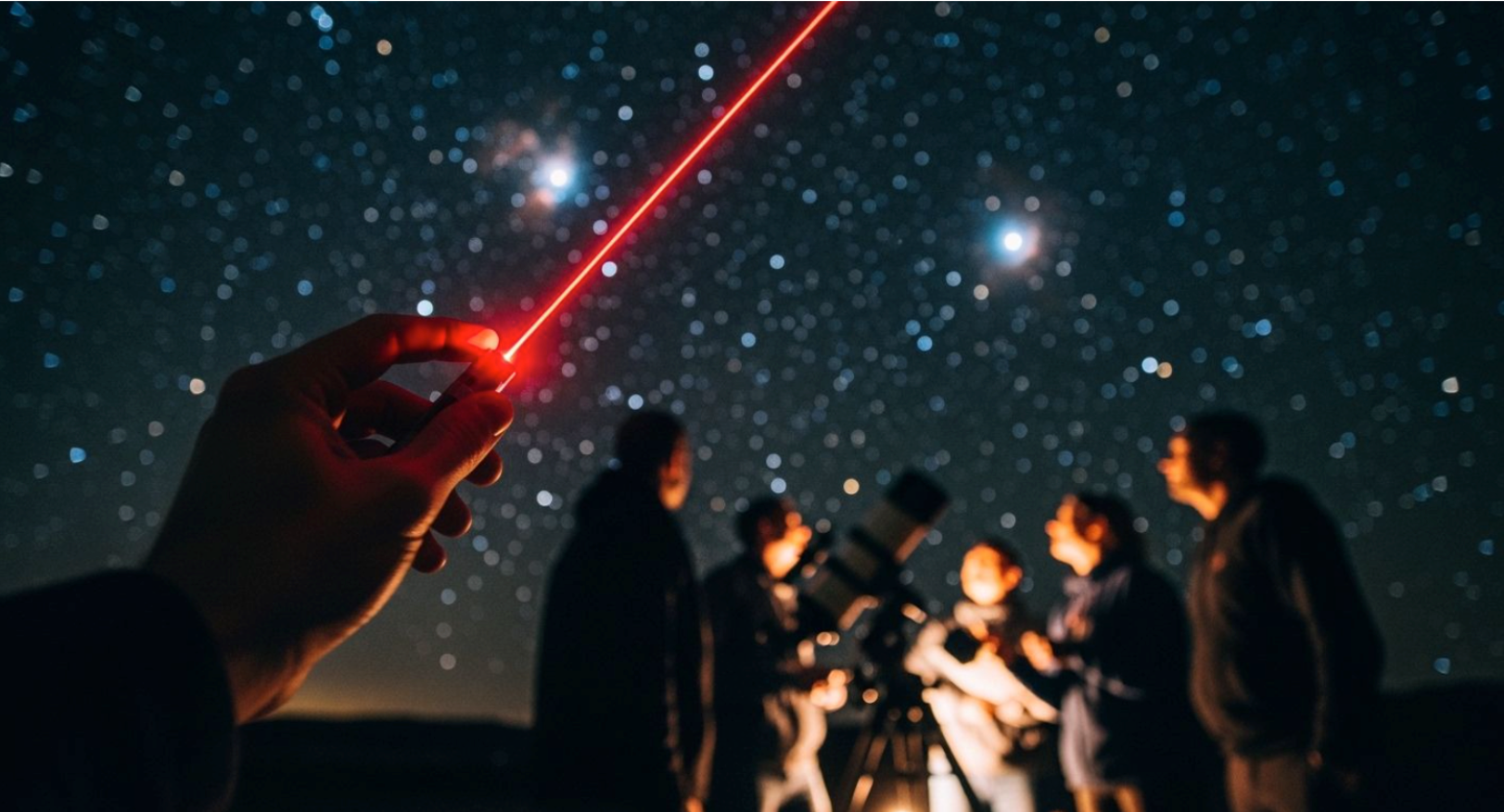
You want to show a star without hurting your eyes or safety. Red laser stargazing is a smart choice for astronomy tours and planetariums. Professional Red laser pointers from Hgyuskl give exact beams. Astronomy lasers keep your eyes safe. Stargazing laser pointers help you lead groups safely.
-
Pick red laser stargazing for safer, easier pointing.
-
Red laser pointers help you stop problems and accidents.
Key Takeaways
-
A low-power red laser can make sense for small-group stargazing, indoor astronomy demonstrations, and night-vision-sensitive environments.
-
Red beams are less visible than green beams, which can be a benefit when you want lower distraction, but a limitation for large outdoor groups.
-
Do not judge safety by color alone: check output power, laser class, product labeling, and local regulations.
-
Never aim a laser at aircraft, vehicles, people, animals, optical equipment, or reflective surfaces.
-
For public astronomy events, use the lowest power that is suitable for the task and follow club or venue rules.
Red Laser Stargazing Benefits

Visibility and Pointing Accuracy
If you want to show stars to a group, a red laser helps. The beam is clear and easy to see. You can point out stars and constellations without confusion. Hgyuskl's red laser pointers are made for this job. For indoor astronomy classes or planetarium-style demonstrations, follow the venue’s rules and use only approved low-power devices.
For outdoor sky pointing, follow local laws, scan for aircraft, use short controlled bursts, and avoid public or crowded environments unless the event has clear safety controls. The beam stays steady and sharp. This makes it easy to show where things are in the sky.
The color of a laser changes how well you see it in the dark. Look at the table below to compare:
|
Laser Color |
Typical Wavelength |
Visibility in Dark Conditions |
Best Fit |
|
Green |
520–532 nm |
Very high |
Large outdoor groups, long-distance pointing, when high visibility is needed |
|
Red |
635–650 nm |
Lower than green |
Small groups, indoor demonstrations, low-distraction pointing, night-vision-sensitive use |
|
Blue |
445–450 nm |
Variable |
Specialized visual or technical demonstrations, not a default astronomy choice |
Red is not the brightest beam for the night sky. It makes sense when you want enough pointing ability without the distraction and visibility of a green beam.
Tip: Use red lasers inside planetariums or with small groups. You will not distract others. Your group can focus on your talk.
Night Vision Protection
It is important to keep your night vision safe. Red lasers help your eyes stay used to the dark. The red beam does not make things too bright. You can point out stars and still see faint things in the sky.
Red lasers are not as bright as green ones in low light. Our eyes see green lasers as much brighter. A 5 mW green laser can be seen from 60 feet away in a bright room. A red laser with the same power fades after 20 feet. Red lasers are good for close pointing. They do not hurt your night vision.
Hgyuskl's red laser pointers use strong parts and real diodes. You get a tool that keeps your eyes safe and your group happy. You can use these lasers for tours, classes, or planetarium shows.
Lower Risk to Eyes and Equipment
You want everyone to be safe when using red lasers. Low-power red lasers are safer for eyes and equipment. You can use them with groups and not worry.
-
Low-power red lasers are less likely to hurt eyes than stronger lasers.
-
The danger depends on power and how wide the beam is.
-
A 5 mW red laser is dangerous up to 0.9 NM. A 5 mW green laser is dangerous up to 1.8 NM. Green lasers are easier to see and more risky.
-
If the laser is stronger, the danger goes up, but not in a straight line.
A red beam may be less disruptive around observers, telescopes, and cameras than a brighter green beam, but you should still avoid aiming any laser at optical equipment or camera sensors. See the table below for differences:
|
Feature |
Red Lasers (620-750 nm) |
Green Lasers (495-570 nm) |
|
Visibility |
Less visible |
More visible |
|
Retinal Damage Risk |
Lower |
Higher |
|
Wavelength |
Longer |
Shorter |
|
Applications |
Similar |
Similar |
Both red and green lasers can be dangerous if used wrong. Green lasers can hurt your eyes more. Red lasers are safer for people and equipment.
Hgyuskl's red laser pointers are made with strong aluminum and safe drives. You get a tool that is tough and safe for stargazing. You can use them for group tours, class demos, or in places with sensitive tools.
Note: Always use lasers safely. Do not point them at eyes or equipment. Pick low-power red lasers for safer stargazing.
Laser Pointer for Stargazing Safety
Eye Safety and Legal Limits
You should know the rules before using a laser pointer for stargazing. Each country has its own safety limits for laser pointers. These rules keep your eyes safe and help you stay out of trouble. Always check the power rating before using a laser pointer for stargazing. Most countries set a power limit to protect everyone.
|
Region |
Safer wording |
|
United States |
Laser pointers sold as pointers are generally expected to meet FDA labeling and power requirements; never aim at aircraft |
|
United Kingdom |
Check current import, sale, and public-use restrictions before purchase |
|
Australia / Victoria |
Some handheld lasers above 1mW may be regulated as prohibited weapons |
|
Any region |
Outdoor use near aircraft, vehicles, crowds, or public events requires special caution |
You have to follow these rules. If you use a laser pointer for stargazing that is too strong, you could get a fine or lose your pointer. The FDA and CE say safe laser pointers should be Class IIIa and not go over 5 mW. Using a pointer with more power can hurt your eyes. High-power lasers can cause permanent eye damage if used wrong.
For public or educational stargazing, avoid recommending higher-power handheld lasers. Use the lowest power suitable for the setting and stay within local law and event rules. This power is bright enough to show stars but still safe for eyes. If you use a laser pointer for stargazing inside, you only need less than 5 mW. For outside, you might need more power, but you must stay under the legal limit.
Tip: Always look at the label on your laser pointer for stargazing. Hgyuskl’s products show the real power. You can trust what you see and know it is safe.
Avoiding Aircraft and Observer Interference
You must use your laser pointer for stargazing in a safe way. Laser safety is not just about your own eyes. You need to keep others safe and stop accidents. Never point a laser at an airplane. It is illegal and very dangerous. Pilots can get distracted or even blinded, which is risky for everyone.
Agencies like the FAA take laser pointer safety very seriously. The FAA checks laser incidents and gives fines. Never aim a laser at or near aircraft. In the United States, the FAA works with law enforcement to pursue civil and criminal penalties for people who intentionally aim lasers at aircraft. Laser strikes remain a major aviation safety issue. Congress told the FAA to report laser incidents every few months. The FAA also wants more people to learn about laser safety.
You should also think about other people watching the sky. If you use a laser pointer for stargazing with a group, never point it at someone or at equipment. Always aim the beam away from eyes and cameras. This keeps night vision safe and makes stargazing better for everyone.
Here are some easy rules for safe use:
-
If you use a laser for astronomy pointing, scan the sky first, use short controlled bursts, and stop immediately if you see or hear aircraft. Never use a laser near airports, flight paths, roads, crowds, animals, or reflective surfaces.
-
Do not aim at planes, cars, or animals.
-
Use low-power lasers when there are lots of people.
-
Check around you before turning on your laser pointer for stargazing.
-
Use Hgyuskl’s professional pointers for safe and steady use.
Note: You can stay safe by following these rules. You protect yourself, your group, and everyone else. Laser pointer safety starts with you.
If you want more tips for safe stargazing, check our Stargazing Safety Guide for more help.
Practical Stargazing Tips
Choosing the Right Power Level
You want to pick a laser pointer that is best for stargazing. The right power level helps you point out stars without risk. Most astronomy clubs say you should use a laser pointer with a maximum output of 5mW. This power is enough for your group to see the red laser light, but it will not harm eyes if used with care. You should always check the label before buying. Look for these details:
-
The label should show the power in milliwatts (mW).
-
It should say the laser pointer meets safety rules like Chapter 21 CFR.
-
The label should show the class (Class IIIa is best for stargazing).
-
The name of the maker and the date of manufacture should be clear.
Hgyuskl offers professional-grade red laser light tools that meet these standards. You can trust the real output and safe design. If you plan to use your laser pointer inside a planetarium or with a small group, a lower power is best. For outdoor use, stay under the legal limit and think about the distance you need to reach.
Handling and Etiquette
You must use your laser pointer with care, especially in groups. Astronomy clubs have clear rules for safe use. See the table below for common guidelines:
|
Guideline |
Description |
|
Careful Usage |
Always use with caution. |
|
Children |
Never let children handle a laser pointer. |
|
Power Limit |
Do not exceed 5mW output. |
|
Targeting Aircraft |
You should never point a laser pointer at people or animals. Only use it to show stars or planets. Always keep the beam below the horizon. If you use a laser pointer for stargazing, check your surroundings first. Make sure you do not shine the beam into someone’s eyes or into equipment. You should not buy laser pointers for children. Always store your device safely after use.
Tip: Using a laser pointer the right way keeps everyone safe and makes your event the best for stargazing.
If you want more tips on safe group stargazing, visit our Stargazing Safety Guide.
Laser Beam Comparison
Red vs. Green Laser Beam
You want to choose the right laser beam for stargazing. The color of the laser beam changes how well you and your group see the stars. Green laser beams are much brighter than red laser beams. Your eyes see green light better at night. This makes green laser beams stand out in the sky. Red laser beams have lower visibility, but they protect your night vision and reduce distractions.
Here is a table to help you compare:
Green wavelengths around 520–532nm usually appear much brighter to the human eye than 650nm red at the same output power. That makes green easier to see, but also more distracting and more safety-sensitive.
You can use green laser beams for large outdoor groups. The bright beam helps everyone see where you point. Red laser beams work best in planetariums, classrooms, or small outdoor groups. The softer beam keeps the focus on your talk and does not disturb others. Hgyuskl offers both green and red laser beams for astronomy, so you can pick the right tool for your needs.
-
Green laser beams are easy to see and great for big groups.
-
Red laser beams are better for indoor use and sensitive environments.
-
Battery life depends on output power, diode efficiency, driver design, battery capacity, temperature, and usage time. Check the specific product specifications instead of assuming one color always lasts longer.
Note: If you want to protect night vision or avoid distractions, choose a red laser beam for stargazing. You can find more tips in our Stargazing Safety Guide.
High-Power vs. Low-Power Laser Pointer
You need to think about the power of your laser beam. High-power laser beams can be dangerous. They can cause eye damage or even burns. Many high-power laser beams are illegal for stargazing. You should always use a low-power laser beam for astronomy.
-
High-power laser beams (like 5W) are Class 4 and can cause instant eye injury.
-
Low-power laser beams (like 5 mW) are safer and good for teaching.
-
High-power laser beams are not allowed for casual stargazing in most places.
-
Many high-power laser beams sold online break the law.
You should use a low-power red laser beam for indoor shows, planetariums, or sensitive equipment. The beam is safe, clear, and easy to control. Hgyuskl’s real-output laser beams meet safety rules and give you peace of mind. You can use them for group tours, classes, or astronomy clubs.
Tip: Always check the label before you use a laser beam. Pick a low-power red laser beam for safe and effective stargazing.
Picking a red laser for stargazing is a good idea. Research says red lasers under 5 mW almost never hurt eyes. You keep your group and tools safe. Use Hgyuskl’s professional pointers for safe and steady astronomy. Get better gear and have clear, fun stargazing every night.
FAQ
Can I use a red laser pointer for stargazing outside?
Only if it is legal in your location, low-power, properly labeled, and used responsibly. Scan the sky first, use short controlled bursts, and never aim at aircraft, vehicles, people, animals, telescopes, cameras, or reflective surfaces.
Why do astronomy clubs prefer low-power lasers?
Low-power lasers reduce distraction and risk compared with brighter, higher-power devices. They are still not harmless, so correct handling, labeling, and event rules remain essential.
How do I choose the best red laser pointer for stargazing?
Look for a low-power, properly labeled red pointer with clear output power, laser class, wavelength, manufacturer details, and safety warnings. Choose the lowest power that works for your setting and follow local regulations.
Share:
Laser Pointer Wavelength Guide: 405nm, 450nm, 520nm, 532nm, and 650nm
650nm red laser pointer uses in presentations and night vision