
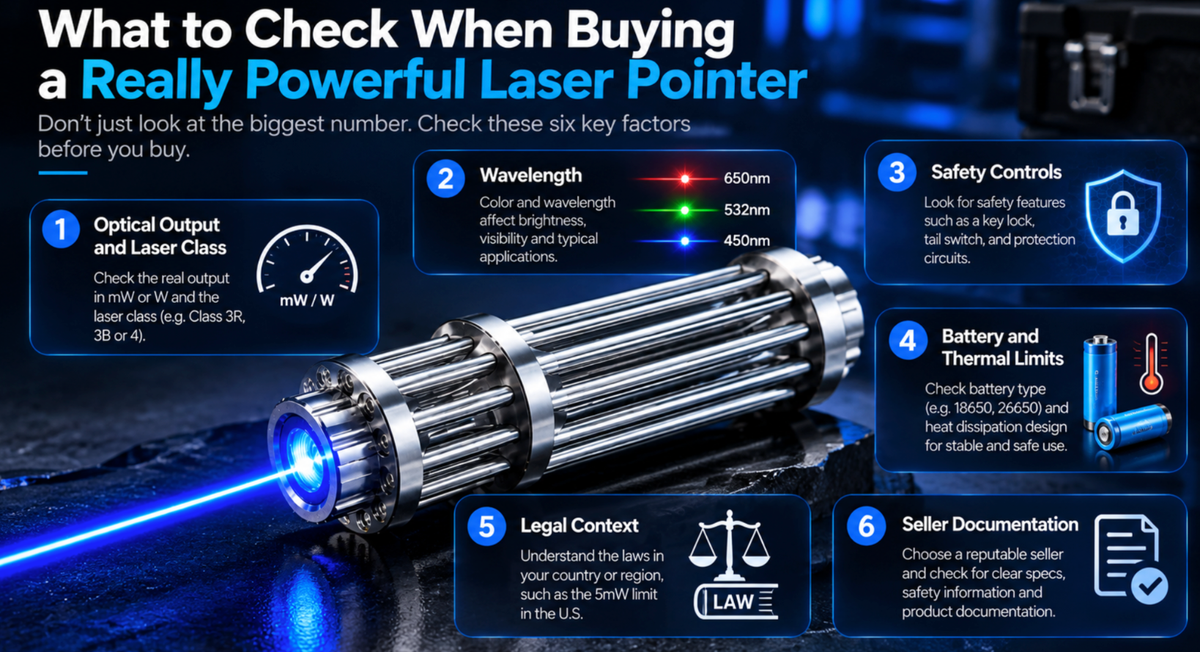
If you are looking for a really powerful laser pointer, do not start with the largest wattage number in the product title.
Before buying, check six things: documented optical output and laser class, wavelength, safety controls, battery and thermal limits, legal context, and seller documentation.
This matters because laser products sold online can be mislabeled, overpowered, or described using measurement conditions that are difficult to compare. Independent NIST testing has also found significant compliance problems in sampled commercial laser pointers.
A good buying decision therefore starts with specifications, not words such as “extreme,” “super powerful,” or “maximum power.” This guide gives you a practical checklist for evaluating those claims before you buy.
Key Takeaways
-
Check the documented optical output and laser class before comparing maximum wattage.
-
In the U.S., 5mW is an important regulatory limit for visible products promoted for pointing or demonstration purposes; it is not a universal “safe power” threshold.
-
Check the exact wavelength because color affects perceived brightness but does not determine optical power.
-
Review safety controls, warning labels, duty-cycle guidance, battery requirements, and operating instructions.
-
Be cautious when a seller promotes extreme wattage but does not explain how the output was measured.
-
Compare warranty, returns, manufacturer information, and technical documentation before buying.
Power Output on a Really Powerful Laser Pointer

Laser Class and the U.S. 5mW Limit
Laser class describes hazard potential. It is more meaningful than marketing phrases such as “really powerful” or “high power.”
In the United States, visible laser products promoted for pointing or demonstration purposes are limited by FDA regulation to Class IIIa / IEC Class 3R, up to 5mW.
Products above this range fall into higher hazard categories and should not be marketed or treated as ordinary laser pointers.
Class 3B products can present serious direct-eye hazards, while Class 4 products can present serious eye and skin hazards from direct or reflected exposure and may also create fire hazards.
The important buying lesson is simple: do not judge legality or safety from the words “powerful” or “high power.” Check the actual optical output, laser class, intended product category, and applicable regulations.
Verifying Real Output With Test Reports
Marketing wattage should be treated as a specification to verify, not as proof by itself.
When comparing products, check whether the seller explains what the wattage represents. For example, is it measured optical output, peak output, module-level output, or output after the final optics?
Two products cannot be compared fairly when their wattage figures were measured on different bases.
For most buyers, useful documentation is simpler than a full engineering report.
Check whether the product clearly states:
-
optical output in mW or W;
-
wavelength;
-
laser class;
-
warning information;
-
manufacturer or distributor;
-
battery requirements;
-
duty cycle or operating limits;
-
measurement conditions when output test data are provided.
-
A circuit schematic is not necessary for an ordinary buying decision, and it does not prove optical output by itself.
If measurement data are provided, look for a clear description of the equipment, measurement conditions, and whether the result represents continuous, peak, or another type of output.
Wavelength and Green Laser Pointers for Astronomy

Check the Wavelength, Not Just the Wattage
Wavelength tells you the color of the laser and influences how bright a given optical output appears to human eyes.
Common visible handheld wavelengths include:
-
445nm and 450nm blue;
-
520nm green;
-
532nm green;
-
635nm and 650nm red.
Human vision is generally more sensitive to green wavelengths than to blue or deep red at the same measured optical output. This means a lower-output green laser can sometimes appear brighter than a higher-output blue or red product.
That does not mean green is more powerful. Wavelength affects perceived brightness; mW or W measures optical output.
Buyers should therefore read wavelength and optical output together instead of choosing a product simply because one color looks brighter.
Why Green Beams Are More Visible
The human eye does not treat all wavelengths the same. The eye's brightness curve peaks in the green range, between about 500 nm and 610 nm. The first CIE 1924 standard set the peak at 555 nm. Newer Stockman and Sharpe curves place the peak at 545 nm.
|
Wavelength |
Color |
Buyer Takeaway |
|
445nm / 450nm |
Blue |
Can have high optical output while appearing less bright than green |
|
520nm |
Green |
High perceived visibility; commonly direct diode |
|
532nm |
Green |
High perceived visibility; commonly DPSS |
|
635nm / 650nm |
Red |
Usually appears less bright than green at equal output |
The exact perceived difference should not be reduced to one universal brightness multiplier. Viewing conditions, background light, beam characteristics, and the exact wavelengths being compared all affect what the user sees.
Safety Features to Check
Higher-class laser products require greater attention to safety controls.
Depending on the product class and design, useful controls can include key-actuated access control, emission indicators, interlock provisions, warning labels, and beam-control features.
These controls can reduce accidental or unauthorized activation, but they do not make direct or reflected beam exposure safe.
Key Locks, Shutters, and Indicators
|
Safety Item |
What Buyers Should Check |
|
Key control |
Helps restrict unauthorized activation where applicable |
|
Emission indicator |
Provides a visible or audible warning that emission is occurring or about to occur |
|
Interlock provision |
May be required or useful for integration into controlled systems |
|
Warning labels |
Should identify radiation hazard, class, output and wavelength where applicable |
|
Operating instructions |
Should explain model-specific controls and limitations |
|
Beam control |
Important for higher-class systems and controlled environments |
The required controls depend on the product class and applicable standard. Do not assume that one safety feature makes a high-output product suitable for ordinary consumer use.
Eye Protection and Safe Handling
Protective eyewear may be required for higher-class laser systems, but it must be selected for the specific wavelength, output, and exposure conditions.
Ordinary sunglasses are not laser protective eyewear.
Do not choose eyewear from color alone. Check the protected wavelength range, appropriate optical density or protection rating, visible-light transmission, and manufacturer documentation.
Protective eyewear is only one layer of control. It does not make intentional direct or reflected beam exposure safe.
Follow these personal safety steps each time you use the device. Never point any laser at people, animals, or reflective surfaces. Always turn off the laser when you are not using it. Store the device with the key removed to stop access. Read the safety guidelines that come with your laser pointers. Do not think you know how to use lasers safely just because you have used low-power ones before. The risk to eyesight goes up with every milliwatt of power. Safety matters more than power. A high-power laser can cause damage in a fraction of a second. Your reflexes cannot react fast enough.
Use the device in a controlled area. Set up the beam path so it cannot reach anyone else. Keep the beam away from aircraft and vehicles. Safety comes before everything else. These habits reduce accidents. A moment of carelessness can cause lifelong harm. Treat each device as a serious tool.
Build Quality and Durability
Build Quality, Thermal Design, and Duty Cycle
Higher optical output places greater demands on the diode, driver, battery, and thermal design.
Metal housings and heat sinks can help move heat away from internal components, but material name alone does not prove good thermal performance.
The more useful specification is the model's documented duty cycle or operating limit. Check whether the manufacturer states:
-
maximum recommended on-time;
-
required cooling interval, if any;
-
operating-temperature range;
-
thermal-protection features;
-
whether the product is designed for continuous or intermittent operation.
Do not confuse “continuous-wave” laser emission with unlimited continuous operating time. They describe different things.
Battery Compatibility
Check the exact cell format, nominal voltage, polarity, capacity, discharge requirements, and charger compatibility specified for the product.
Do not assume that a larger lithium-ion cell automatically improves performance or that physically similar cells are interchangeable.
Battery runtime also depends on optical output, driver efficiency, diode efficiency, temperature, and duty cycle.
Driver and optical design also matter, but buyers do not need to diagnose the circuit themselves.
A regulated driver can help stabilize operation within its designed current and voltage range. Some laser systems also use optical feedback or automatic power control, but the implementation is product-specific.
Optics affect transmission, focus, beam shape, and divergence. Anti-reflection coatings can reduce optical losses, while beam quality and divergence depend on the complete emitter and optical design.
These features should be evaluated separately from the maximum wattage claim.
Legal Rules for a Laser Pointer
U.S. Legal Context
In the United States, visible laser products promoted for pointing or demonstration purposes are limited by FDA regulation to Class IIIa / IEC Class 3R, up to 5mW.
Products above that range belong to higher hazard categories and should not simply be marketed or treated as ordinary laser pointers.
Buyers should check the stated product category, laser class, wavelength, output, warning labels, manufacturer or distributor information, and applicable compliance documentation.
The phrase “really powerful laser pointer” is a search term, not a legal product classification.
These rules exist for a clear reason. Your eyes cannot react fast enough to avoid harm from a high-power beam. The blink reflex takes about 250 milliseconds. A high-power beam can cause lasting damage in much less time. The legal limit keeps consumer devices at a level where harm is less likely. No one should treat these legal limits as optional. They exist to prevent harm.
Import, Shipping, and Local Limits
Import, sale, possession, and use requirements can differ from one another and may also vary by state or local jurisdiction.
A product being available from an overseas seller does not automatically mean it can be lawfully imported, marketed, or used in every location.
Check current federal, state, and local requirements for the exact product and intended use before ordering.
Check the laws in your own area for legal and safety reasons before buying. A device that is legal in one state may be illegal in another. Take time to research local limits. Not knowing the law does not protect you from penalties. Buy only from sellers who label their products clearly and follow FDA rules.
Spotting Overpowered Lasers and Trusting Sellers
How to Spot a Trustworthy Seller
Overpowered lasers often come with tricky ads. Sellers put big numbers on the box but do not show proof. You need to check the real output before you pay. Start by looking at the label. Make sure it has the maker's name, the wavelength, and the right class marks. A missing label is a red flag.
Do not estimate laser output from burning ability, battery drain, case temperature, beam brightness, or informal home tests.
Accurate optical-power verification requires calibrated equipment suitable for the wavelength and output range.
For ordinary buyers, the safer approach is to review the product label, technical documentation, measurement information, manufacturer identity, and warranty rather than attempting open-beam performance tests at home.
A trustworthy seller should provide clear product information rather than relying only on dramatic performance slogans.
Look for:
-
identifiable manufacturer or distributor information;
-
wavelength and optical-output specifications;
-
laser class and warning labels;
-
battery and duty-cycle information;
-
operating and safety instructions;
-
clear warranty and return terms;
-
measurement documentation when specific output claims are supported by test data.
No single housing material or driver type proves product quality on its own.
Warranty, Returns, and Support
Read the return policy before checkout. A useful policy clearly states the return window, product-condition requirements, exclusions, and who is responsible for return shipping.
Also check the warranty terms. A good warranty explains the coverage period, which components are covered, and how repair or replacement claims are handled.
For higher-output products, accessible technical support is also valuable. Buyers should be able to obtain clear answers about battery compatibility, duty cycle, labels, operating instructions, and warranty service.
Before buying a really powerful laser pointer, check six things: documented optical output and laser class, wavelength, safety controls, battery and thermal limits, legal context, and seller documentation.
Do not choose by maximum wattage, beam brightness, advertised range, or dramatic words alone.
A credible product should make it easy to identify what the output specification means, what class the laser belongs to, how it should be operated, and who stands behind the product after the sale.
For higher-class systems, any required protective eyewear and safety controls must be matched to the actual wavelength, output, and operating environment.
Specifications should make the buying decision clearer—not the marketing adjective.
FAQ
Can a 1000mW Laser Be Sold as an Ordinary Laser Pointer in the U.S.?
No. Visible laser products promoted for pointing or demonstration purposes in the United States are limited to Class IIIa / IEC Class 3R, up to 5mW. A 1000mW product belongs to a much higher hazard category and should not be marketed or treated as an ordinary laser pointer. Other legal requirements can depend on the product category, intended use, state, and local jurisdiction.
How Can You Tell Whether a Laser Power Claim Is Credible?
Look for a clearly stated wavelength, optical output, laser class, manufacturer information, and measurement conditions. If test data are provided, the seller should explain what equipment was used and whether the stated figure represents continuous, peak, or another type of output. A driver schematic is not required to verify optical power.
What Duty Cycle Should a Powerful Laser Have?
There is no universal duty cycle for high-output lasers. Some products are designed for intermittent operation, while others may support longer or continuous operation through adequate thermal design. Check the exact model's maximum on-time, cooling guidance, operating-temperature range, and thermal-protection information. “Continuous-wave” describes the laser emission mode; it does not automatically mean unlimited operating time.
Does a Bigger Wattage Number Mean a Better Laser?
No. Higher optical output can increase hazard and may increase brightness under comparable conditions, but it does not automatically improve beam quality, divergence, battery life, duty cycle, reliability, or value. Compare the complete specification rather than choosing the largest wattage number.
Share:
Strong Laser Pointer vs High Power Laser Pointer: Is There a Difference?
What Is Considered a Powerful Laser Pointer? A Simple Guide to mW, W, and Class