
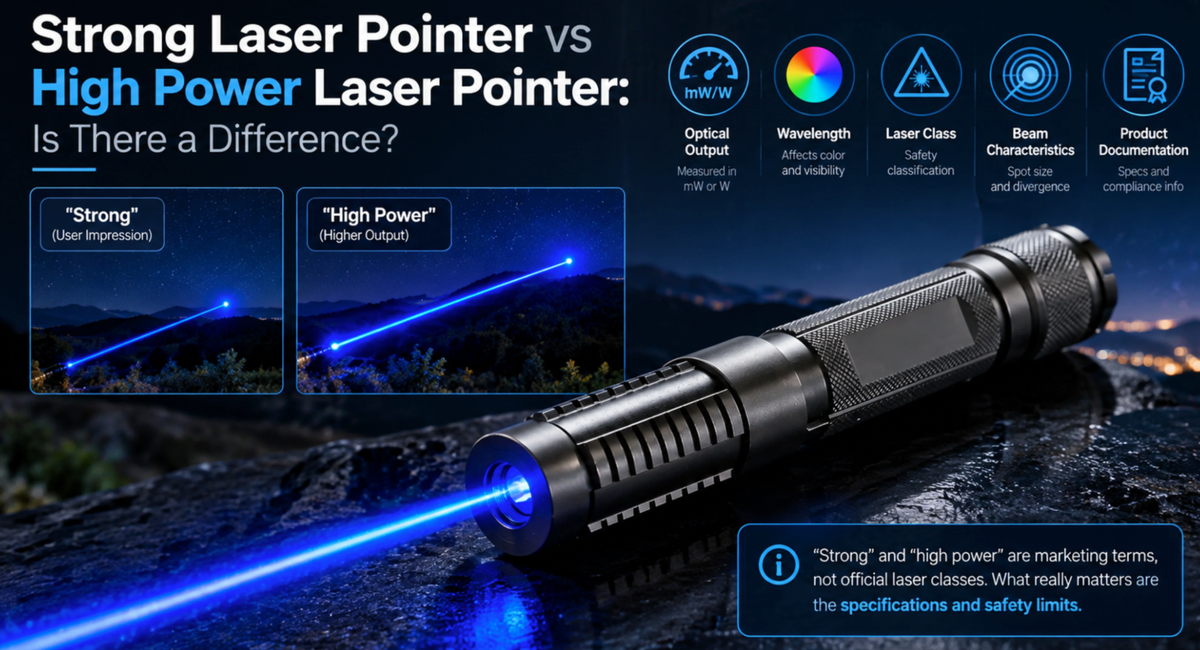
“Strong laser pointer” and “high power laser pointer” are common search and marketing terms, but neither is an official laser safety class.
“Strong” usually describes the user's impression of brightness, visibility, or performance. “High power” usually suggests higher optical output, but it does not have one universal technical threshold.
The specifications that actually matter are optical output in mW or W, wavelength, laser class, beam characteristics, and product documentation.
This guide explains the difference between these marketing terms, why the U.S. 5mW limit is often misunderstood, and what buyers should check instead of relying on words such as “strong” or “high power.”
Key Takeaways
-
“Strong” and “high power” are informal terms, not official laser classifications.
-
Optical output in mW or W tells you more than marketing words, but wavelength and laser class also matter.
-
The U.S. 5mW limit applies to visible laser products promoted for pointing or demonstration purposes; it is not the formal definition of “high power.”
-
A laser that looks brighter is not necessarily more powerful, because human eyes respond differently to different wavelengths.
-
For higher-class products, safety controls and protective eyewear must be selected according to the actual wavelength, output, laser class, and operating environment.
Strong Laser Pointer vs High Power Laser Pointer: Terminology

When you shop for a laser online, “strong” and “high power” may sound like technical specifications, but they are not formal laser classes.
“Strong” is usually a descriptive word. It may refer to a bright-looking beam, a noticeable dot, higher output, or simply the overall impression of performance.
“High power” more often refers to optical output, but there is no universal rule stating that the term begins at exactly 5mW, 100mW, 500mW, or any other single number.
Formal laser classification uses classes such as 2, 3R, 3B, and 4. Buyers should therefore compare the measured optical output and laser class rather than trying to determine safety or performance from the words “strong” and “high power.”
How Marketing Terms Differ From Technical Specifications
Marketing language is flexible. A seller may describe a laser as “strong,” “powerful,” “high power,” “super bright,” or “extreme” without those words identifying a formal laser class.
Technical specifications are different. Optical output is stated in mW or W, wavelength is stated in nanometers, and laser class describes hazard potential.
In the United States, the important 5mW threshold comes from FDA rules for visible laser products promoted for pointing or demonstration purposes. Products above the Class IIIa / IEC Class 3R limit should not simply be marketed or treated as ordinary pointers.
This regulatory threshold should not be confused with a universal definition of the phrase “high power.”
|
Term |
Is It an Official Laser Class? |
What It Usually Means |
|
Strong laser pointer |
No |
A laser that appears bright, visible, concentrated, or powerful |
|
Powerful laser pointer |
No |
General marketing/search language suggesting higher performance |
|
High power laser pointer |
No |
Usually suggests higher optical output, but has no universal threshold |
|
Class 3R |
Yes |
Formal hazard classification with defined accessible-emission limits |
|
Class 3B |
Yes |
Higher-hazard class requiring substantially greater controls |
|
Class 4 |
Yes |
Highest general hazard category; may include eye, skin, reflection, and fire hazards |
The key distinction is simple: “strong” and “high power” describe how products are marketed or searched for, while laser class and measured optical output provide the technical information buyers actually need.
Independent testing has found commercial laser pointers whose actual emissions did not comply with applicable limits or labeling. This does not mean every product label is unreliable, but it does show why wavelength, optical output, laser class, manufacturer information, warning labels, and technical documentation should be checked together.
A credible product listing should provide more than words such as “strong” or “high power.”
The Specifications That Matter More Than Marketing Words
Optical output is normally stated in milliwatts (mW) or watts (W). This tells you how much optical power the laser emits.
However, mW alone does not tell you everything about how a laser looks or how hazardous it is. Wavelength affects perceived brightness, beam characteristics affect spot size and divergence, and laser class describes hazard potential.
For U.S. visible pointing and demonstration products, FDA regulations limit output to Class IIIa / IEC Class 3R, up to 5mW.
A product above that range should not be treated as an ordinary pointer simply because a listing calls it “strong” or “high power.”
A larger wattage number does not automatically mean a better product.
Two lasers with similar optical output can differ in beam divergence, focus, thermal design, battery requirements, duty cycle, safety controls, and documentation.
For this reason, “strong” should not be interpreted as “highest advertised wattage,” and “high power” should not be interpreted as a quality rating.
Laser Pointer Power Levels: What They Mean
Optical output affects visibility, but it does not control everything you see.
Human eyes respond differently to different wavelengths. At equal optical output, green wavelengths such as 520nm and 532nm generally appear brighter than blue wavelengths such as 445nm or 450nm.
This means a higher-output blue laser can sometimes look less bright than a lower-output green laser.
Power and perceived brightness are related, but they are not the same specification.
How Power Affects Visibility
When wavelength, beam characteristics, and viewing conditions are the same, higher optical output can make the dot or beam easier to detect.
However, useful visibility at distance also depends on beam divergence, target reflectivity, background light, atmospheric conditions, and viewing angle.
Color also matters. Human daytime vision is particularly sensitive to green wavelengths, so comparing mW values across different colors without considering wavelength can be misleading.
This is another reason why neither “strong” nor “high power” should be used as a substitute for the actual specifications.
|
What the Listing Says |
What It Actually Tells You |
What You Should Check |
|
“Strong laser” |
Almost nothing technical by itself |
Optical output, wavelength, class |
|
“Powerful laser” |
Suggests performance but has no formal threshold |
mW/W and measurement conditions |
|
“High power laser” |
Usually suggests higher output |
Actual output and laser class |
|
“Ultra powerful” |
Marketing language |
Ignore the adjective; read specifications |
|
“5W” |
A power claim |
Is it optical output, peak, module output, or another figure? |
|
“Long range” |
Marketing description |
Beam divergence, output, atmosphere, target conditions |
|
“Super bright” |
Perceived-visibility claim |
Wavelength, optical output, ambient light |
Why 5mW Matters in the United States
For visible laser products promoted for pointing or demonstration purposes in the United States, FDA regulations limit the product to Class IIIa / IEC Class 3R, up to 5mW.
Products above this range fall into higher hazard categories and should not be treated as ordinary pointers.
As optical output and laser class increase, the requirements for access control, beam control, warning information, operating procedures, and protective measures become more demanding.
The important point is that 5mW is a regulatory threshold for certain U.S. laser products—not the universal definition of the phrase “high power.”
High-Power Lasers: Safety and Legal Classifications

You cannot treat a high-power laser like a toy. The rules change the moment output climbs above the consumer limit. Understanding those rules keeps you legal and keeps everyone around you safe.
Risks of Using High-Power Devices
A high-power laser pointer above 5 mW can hurt you before your blink reflex fires. That reflex takes about 0.25 seconds. A more than 5mW beam can damage the retina faster than that. This is why safety rules exist for every high-power laser. You cannot rely on your body to protect you.
Never direct a laser toward aircraft. In the United States, intentionally aiming a laser at an aircraft is a federal crime and may result in substantial civil and criminal penalties.
State and local rules may also apply to other forms of misuse.
|
Category |
Details |
|
Reporting (aircrew) |
Report to the FAA via the official laser incident reporting link and the local safety office |
|
Reporting (ground) |
Call 911 |
|
Fines |
Civil penalties from $50 to $27,338.29; criminal imprisonment of 3 to 51 months |
Class 4 products represent a much higher hazard category than ordinary pointing products. Direct and reflected exposure can create serious eye and skin hazards, and fire hazards may also exist.
Protective measures for Class 3B and Class 4 systems should be based on the actual wavelength, output, beam characteristics, and operating environment.
What Should You Check Instead of “Strong” or “High Power”?
|
Specification |
What It Tells You |
|
Optical output |
Actual emitted power in mW or W |
|
Wavelength |
Color and how strongly human vision responds to the light |
|
Laser class |
Hazard category |
|
Beam divergence |
How quickly the beam spreads |
|
Focus design |
Whether and how the spot size can be adjusted |
|
Duty cycle |
How long the product can operate before cooling is required |
|
Battery specification |
Required cell type, voltage, and compatibility |
|
Safety controls |
Features appropriate to the laser class |
|
Warning labels |
Radiation, output, wavelength, and class information |
|
Documentation |
Manufacturer, operating instructions, compliance information |
These specifications are much more useful than the words “strong,” “powerful,” or “high power.”
If two products use different marketing language but list the same measured output, wavelength, laser class, and beam characteristics, the adjective in the title should not decide which product you choose.
So, is there a real difference between a strong laser pointer and a high power laser pointer?
Not in the way a formal laser class creates a technical distinction.
“Strong” usually describes how powerful, bright, or noticeable a laser seems. “High power” usually suggests greater optical output. Neither term has one universal technical threshold.
The reliable way to compare two products is to ignore the adjective and check the measured optical output, wavelength, laser class, beam characteristics, and product documentation.
In short: marketing words describe the product; specifications define it.
FAQ
Is “High Power Laser Pointer” an Official Laser Class?
No. “High power laser pointer” is a common search and marketing phrase, not an official laser safety class. Formal laser classifications include Class 1, 2, 3R, 3B, and 4. Buyers should use the stated optical output and laser class to understand the product.
Does “High Power” Mean the Laser Is More Dangerous?
Higher optical output can increase hazard, but the term “high power” itself does not define the risk. Check the actual laser class, output, wavelength, and beam characteristics. Class 3B and Class 4 products require substantially greater safety controls than ordinary pointing products. Protective eyewear, when required, must match the specific wavelength and hazard assessment.
How Can You Spot a Questionable Laser Listing?
Check whether the listing clearly states the wavelength, optical output, laser class, warning information, manufacturer or distributor, battery requirements, and basic operating instructions. Be cautious when a product relies heavily on words such as “strong,” “extreme,” or “super powerful” but does not explain the actual output or class.
Is a Strong Laser Pointer the Same as a Powerful Laser Pointer?
In everyday language, the terms often overlap. “Strong” usually describes the user's impression of the beam, while “powerful” more often suggests higher optical output. Neither word has a universal technical definition. Use mW/W, wavelength, laser class, and beam specifications for an actual comparison
Share:
What Makes a Strong Laser Pointer: Power, Color, and Visibility Explained
What to check when buying a really powerful laser pointer