
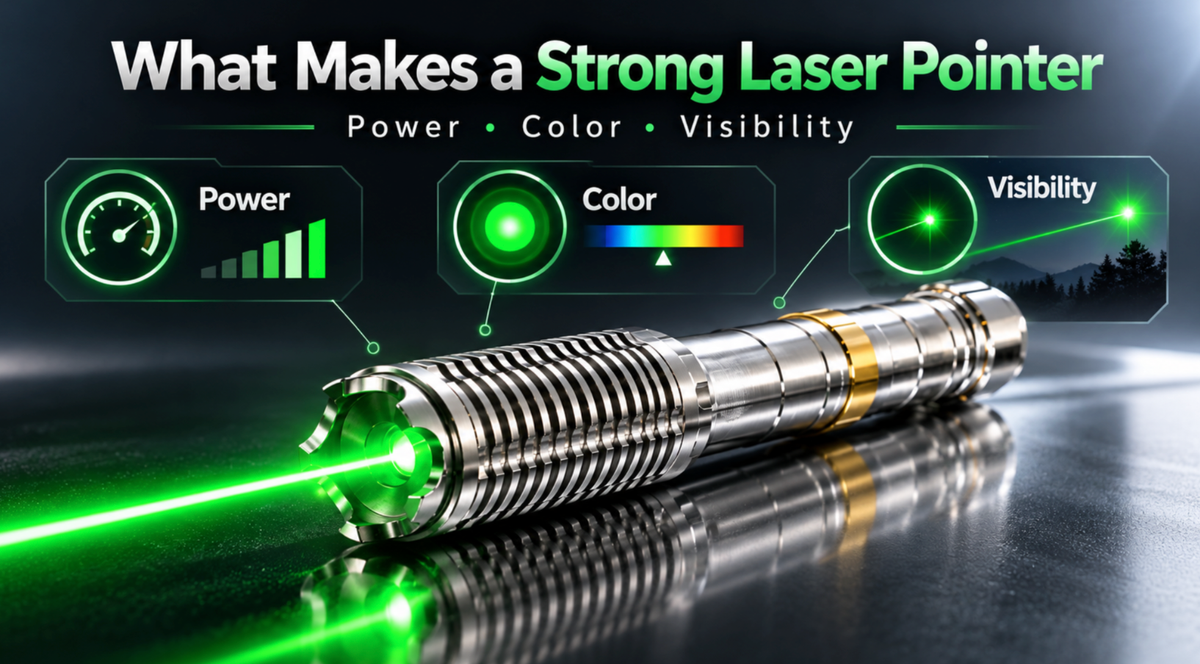
What makes a strong laser pointer? “Strong” is not an official laser class or technical specification. In everyday searches, people usually mean a laser that has noticeable output, strong visual visibility, or a concentrated beam.
Those qualities are not determined by milliwatts alone. Optical output tells you how much laser power is emitted, wavelength affects how bright that light appears to human eyes, and beam divergence affects how concentrated the spot remains with distance.
That is why a lower-power green laser can sometimes look brighter than a higher-power red or blue laser. This guide explains power, color, and visibility in simple terms so you can understand what actually makes a laser pointer seem strong—and why the largest wattage number is not automatically the best choice.
Key Takeaways
-
“Strong” is not an official laser specification. Compare optical output, wavelength, laser class, and beam characteristics separately.
-
More mW means more optical output, but it does not automatically mean a brighter-looking beam, better divergence, or better overall performance.
-
Green wavelengths such as 520nm and 532nm generally appear brighter than blue or red wavelengths at the same measured optical output because of human visual sensitivity.
-
Beam divergence, ambient light, atmospheric scattering, background contrast, and viewing angle all affect real-world visibility.
-
Check clearly stated optical output, wavelength, laser class, warning labels, and product documentation instead of relying on words such as “strong,” “extreme,” or “super powerful.”
Power: The Core of a Powerful Laser Pointer

Understanding Milliwatts and Laser Classes
Power is one of the first specifications people look at when searching for a strong laser pointer. Optical output is normally stated in milliwatts (mW) or watts (W), with 1,000mW equal to 1W.
However, terms such as “strong laser,” “powerful laser,” and “high power laser pointer” are not formal laser safety classes. A product should be evaluated by its actual optical output and laser class rather than by marketing language.
In the United States, 5mW has a specific regulatory significance: visible laser products promoted for pointing or demonstration purposes are limited to FDA Class IIIa / IEC Class 3R, up to 5mW.
Products above that range fall into higher hazard categories and should not simply be treated as stronger versions of an ordinary pointer.
Here is the full class system you should know:
|
Laser Class |
General Meaning |
What Buyers Should Understand |
|
Class 1 |
Considered non-hazardous under normal operating conditions |
Hazard can change if optical aids or internal accessible radiation are involved |
|
Class 2 |
Lower-output visible laser |
Prolonged direct viewing should be avoided |
|
Class 3R / FDA IIIa |
Higher visible exposure potential; up to 5mW in the U.S. pointer/demonstration context |
Direct viewing can be hazardous; not risk-free |
|
Class 3B / FDA IIIb |
5mW to 500mW under the FDA visible-laser context |
Serious direct-eye hazard; requires substantially greater controls |
|
Class 4 |
Above Class 3B accessible-emission limits |
Direct and reflected exposure may create serious eye and skin hazards; fire hazards may also exist |
Laser class describes hazard potential. It is not a rating of product quality, brightness, or value.
A Class 4 laser is not automatically a “better” or “stronger-quality” product than a Class 3R laser. It simply belongs to a much higher hazard category.
A powerful-looking laser does not have to be Class 3B or Class 4. Perceived strength depends on several variables working together.
For example, two lasers with different wavelengths can have the same measured optical output but look very different to the eye. A green beam may appear much more noticeable than a red or blue beam at equal power because of human spectral sensitivity.
This is why optical output should always be read together with wavelength, laser class, beam divergence, and viewing conditions.
Real Output: How to Read Power Claims
Product labels and actual laser emissions do not always match perfectly. Independent testing has found examples of laser pointers that exceeded applicable emission limits or had labeling and output problems.
That does not mean every large wattage claim is false. Instead, buyers should ask how the number was measured.
A useful power specification should clearly identify:
-
the optical output in mW or W;
-
the wavelength;
-
the laser class;
-
whether the value is continuous, peak, or measured under another condition;
-
where the measurement was taken;
-
the operating conditions used for the measurement.
Driver design should also be evaluated separately. Regulated constant-current or automatic-power-control designs can help improve output stability, but they do not remove battery, thermal, or safety limits.
When comparing Hgyuskl with another brand, use the same standard for both products: documented output, wavelength, class, duty cycle, beam specification, warning labels, and technical documentation.
Color: How Wavelength Affects Laser Pointer Brightness

When you choose a handheld device, the color matters just as much as the power. The wavelength determines how bright the dot and ray look. Two devices at the same power can look completely different. Your eyes react very differently to each wavelength of light.
Green vs. Blue vs. Red: Which Looks Strongest?
|
Color |
Common Wavelengths |
Perceived Visibility at Equal Output |
Important Buyer Note |
|
Green |
520nm, 532nm |
Usually highest |
520nm often direct diode; 532nm commonly DPSS |
|
Blue |
445nm, 450nm |
Lower than green |
Often available at high optical outputs; brightness does not indicate hazard |
|
Red |
635nm, 650nm |
Lower than green |
Common in lower-output presentation products |
|
Violet |
405nm |
Relatively low visual efficiency |
May create fluorescence on some surfaces |
Color changes perceived brightness because human eyes do not respond equally to every wavelength.
Under normal light-adapted conditions, the standard photopic visual response peaks near 555nm. This gives green wavelengths such as 520nm and 532nm a strong perceived-visibility advantage.
Blue wavelengths such as 445nm and 450nm lie farther from this peak, so they generally appear less bright than green at the same measured optical output. Red wavelengths such as 635nm and 650nm also appear less visually efficient than green.
This does not mean green has more optical power. A higher-output blue or red laser can still appear brighter than a much lower-output green laser.
Violet light around 405nm is even less visually efficient under normal photopic conditions, although it can cause fluorescence on some surfaces and therefore create unusual-looking spots.
Battery life should be evaluated separately from color. Runtime depends on optical output, diode technology, driver efficiency, battery capacity, temperature, and duty cycle.
Beam Characteristics Are Not Determined by Color Alone
Wavelength can influence how light interacts with the atmosphere, but color does not automatically determine beam diameter, divergence, or beam quality.
In clean air, shorter visible wavelengths undergo stronger Rayleigh scattering than longer wavelengths. This can affect how much light is seen from the side of the beam.
However, stronger scattering does not mean that the laser is more powerful or travels farther.
Beam divergence depends mainly on the emitter, collimating optics, focus setting, and overall optical design. A green laser is not automatically narrower than a blue laser, and a blue laser is not automatically more powerful because of its color.
When comparing products, treat wavelength, optical output, and divergence as separate specifications.
Visibility: What Makes a Laser Pointer Beam Stand Out

Environment Changes How Strong a Beam Looks
Real-world visibility depends heavily on the environment.
A laser beam becomes visible from the side because some of its light is scattered toward the observer. Clean air produces molecular scattering, while haze, fog, smoke, dust, rain, and other particles can change the amount and direction of scattered light.
More scattering can make part of the beam easier to see from the side, but it can also reduce forward transmission. It does not mean the laser has gained optical power.
|
Factor |
Effect on Visibility |
|
Bright daylight |
Reduces contrast and makes beams or dots harder to see |
|
Darkness |
Increases contrast and makes visible light easier to notice |
|
Haze / aerosols |
Can increase side-scattered beam visibility but reduce forward transmission |
|
Fog |
Can strongly scatter and attenuate the beam |
|
Rain / snow |
Can scatter, reflect, and block part of the light |
|
Beam divergence |
Changes how quickly the spot expands with distance |
|
Background color |
Changes target contrast |
|
Viewing angle |
Changes how much scattered light reaches the observer |
|
Temperature |
Can affect batteries and some laser architectures |
Focus can change spot size and irradiance at a target, but it does not increase the laser's total optical output.
Likewise, a beam that looks more visible in fog or darkness is not necessarily more powerful.
|
If You Mean “Strong” As… |
Check This Specification |
Do Not Assume |
|
Higher actual power |
Optical output in mW/W |
A brighter-looking color has more power |
|
Brighter-looking beam |
Wavelength + optical output |
More mW always looks proportionally brighter |
|
Smaller spot at distance |
Beam divergence |
Green is always tighter |
|
More visible airborne beam |
Output + wavelength + atmosphere + viewing angle |
More scattering means more power |
|
Better runtime |
Battery + driver + output + duty cycle |
One color always lasts longer |
|
Better quality |
Documentation + optics + driver + build + warranty |
Higher laser class means better product |
|
Safer product |
Laser class + controls + labels |
A dim-looking beam is safer |
So, what makes a strong laser pointer?
It is not simply the largest mW or W number. Optical output tells you how much power the laser emits, wavelength influences how bright that power appears to human eyes, and beam divergence and environmental conditions affect how concentrated and visible the beam looks.
A well-informed comparison therefore checks optical output, wavelength, laser class, beam divergence, duty cycle, safety information, and product documentation together.
The key point is simple: strong, bright, and powerful are related ideas, but they are not the same specification.
FAQ
What Does “Strong Laser Pointer” Actually Mean?
“Strong” is an informal search term rather than an official laser specification. It can refer to higher optical output, a brighter-looking beam, a concentrated spot, or strong visibility. These qualities should be evaluated separately using mW/W, wavelength, laser class, and beam divergence.
Does a Higher Price Mean a Stronger Laser Pointer?
No. Price does not directly measure optical power. A more expensive product may use different optics, batteries, safety controls, housing materials, warranty support, or a more costly wavelength, but none of those automatically prove higher output. Compare the documented mW/W specification, wavelength, laser class, beam characteristics, and technical documentation rather than using price as a power rating.
Why Does a Green Laser Look Stronger Than a Red Laser?
Human vision is much more sensitive to green wavelengths such as 520nm and 532nm than to deep red wavelengths such as 650nm. At equal measured optical output, green therefore usually appears substantially brighter. This is a difference in perceived visibility, not proof that the green laser has more optical power.
Does More mW Always Make a Laser Pointer Look Stronger?
No. When wavelength and beam conditions are the same, higher optical output can increase apparent brightness. But different colors can look very different at the same measured power because human visual sensitivity changes with wavelength. More mW also does not automatically improve beam divergence, battery life, or product quality.
How Can I Tell Whether a Laser Power Claim Is Credible?
Look for clearly stated optical output, wavelength, laser class, warning labels, manufacturer information, and measurement conditions. A large wattage number is not automatically false, but terms such as “peak,” “maximum,” or “extreme power” are difficult to compare when the measurement method is not explained. If test data are provided, check whether the seller explains the equipment, measurement point, operating condition, and whether the figure represents continuous or peak output.
Share:
Blue vs Green Laser Pointer for Outdoor Use
Strong Laser Pointer vs High Power Laser Pointer: Is There a Difference?