
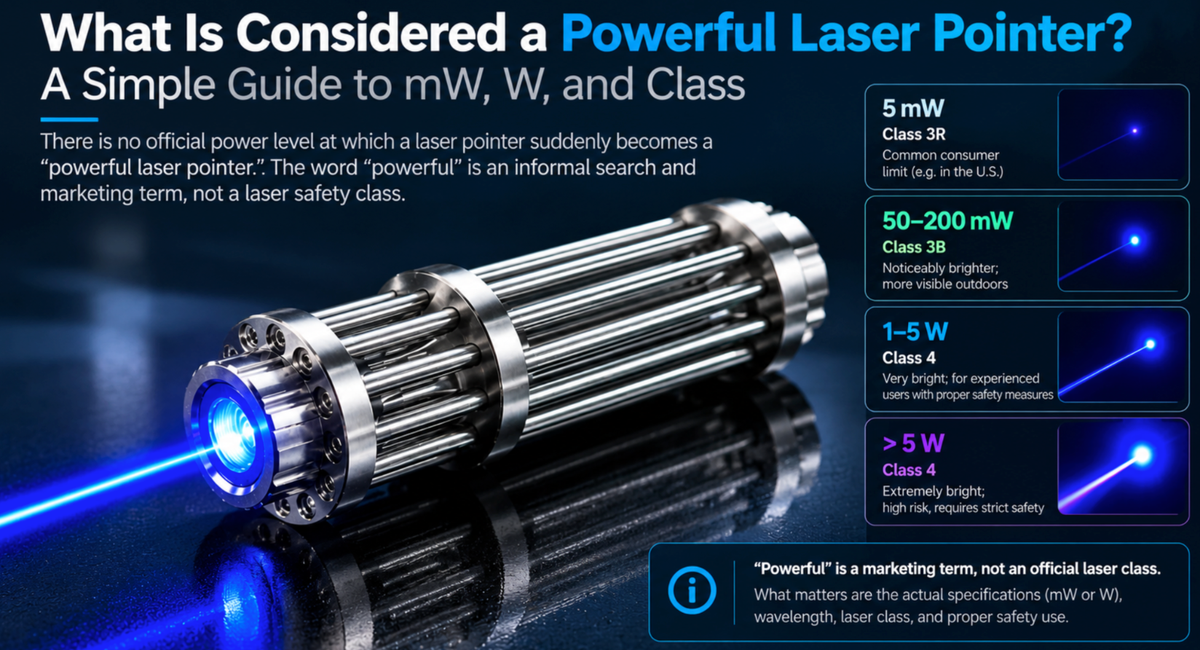
There is no official power level at which a laser pointer suddenly becomes a “powerful laser pointer.” The word “powerful” is an informal search and marketing term, not a laser safety class.
The useful technical specifications are optical output, measured in milliwatts (mW) or watts (W), and laser class, which describes hazard potential.
In the United States, 5mW is an important regulatory threshold because visible products promoted for pointing or demonstration purposes are limited to FDA Class IIIa / IEC Class 3R, up to 5mW. That does not make 5mW the universal definition of a powerful laser.
This guide explains mW, W, Class 3R, Class 3B, and Class 4 in simple terms so you can understand what laser power ratings actually mean.
Key Takeaways
-
“Powerful laser pointer” is not an official laser class and has no universal mW threshold.
-
Optical output is measured in mW or W; 1W equals 1,000mW.
-
Laser class describes hazard potential and should be checked separately from marketing terms such as “powerful” or “high power.”
-
In the U.S., 5mW is the maximum visible output for products promoted for pointing or demonstration purposes under FDA Class IIIa / IEC Class 3R limits.
-
Higher optical output does not automatically mean better beam quality, visibility, range, battery life, or value.
-
Apparent brightness cannot be used as a reliable measurement of laser power.
Laser Power Units: mW and W

What mW and W Mean
Optical output tells you how much laser power is emitted, but the same mW value can belong to different practical situations depending on wavelength, pulse duration, beam geometry, and classification standard.
For visible continuous-wave lasers, Class 2 generally covers lower-output products up to about 1mW, while Class 3R can extend to about 5mW.
Higher optical output can increase irradiance and may increase apparent brightness under comparable conditions, but it does not create a simple “more watts = more distance” rule.
Useful visibility also depends on wavelength, beam divergence, ambient light, atmospheric conditions, target reflectivity, and viewing angle.
Power and Wavelength Are Different Specifications
Wavelength identifies the laser's color, while mW or W describes optical output.
These two specifications should not be confused.
For example, human eyes are generally more sensitive to green wavelengths such as 520nm and 532nm than to blue wavelengths around 445nm or 450nm or deep red wavelengths around 650nm.
As a result, two lasers with the same measured optical output can appear very different in brightness.
This is why apparent brightness should not be used to estimate how many milliwatts a laser emits.
The system starts from class 2 for the lowest output devices. Devices under 1 mW are in this category. The next range, 1 to 5 mW, falls in class 3A. Five milliwatts to half a watt is class 3B. Over half a watt is class 4.
Laser Classes Explained
Class 1 and Class 2
Class 1 laser products are considered non-hazardous under normal operating conditions. The risk can change if higher internal laser radiation becomes accessible or if optical aids are involved.
Class 2 applies to lower-output visible lasers. Brief accidental exposure generally presents lower risk than higher classes, but deliberate or prolonged direct viewing should still be avoided.
Laser class describes hazard potential. It should not be interpreted as a guarantee that any type of exposure is safe.
|
Laser Class |
General Visible-CW Context |
Simple Buyer Meaning |
|
Class 1 |
Low-risk or enclosed laser product |
Generally non-hazardous when used as designed |
|
Class 2 |
Up to about 1mW visible output |
Lower-risk visible class; avoid deliberate staring |
|
Class 3R / FDA IIIa |
Up to about 5mW in the U.S. visible pointer/demonstration context |
Direct viewing can be hazardous; not risk-free |
|
Class 3B / FDA IIIb |
About 5mW to 500mW under the FDA visible-laser system |
Serious direct-eye hazard; not an ordinary pointer class |
|
Class 4 |
Above Class 3B accessible-emission limits |
Serious eye and skin hazards; reflected exposure and fire hazards may also exist |
These values are a simplified guide for visible continuous-wave lasers. Exact classification limits depend on wavelength, exposure duration, pulse characteristics, and applicable standards.
Class 3R, 3B, and Class 4
Class 3R lasers can reach higher accessible output than Class 2 and require greater caution.
In the U.S. visible pointer and demonstration context, Class IIIa / IEC Class 3R products are limited to 5mW.
Direct viewing can be hazardous, especially when optical aids are involved. Class 3R should therefore not be described simply as “safe” because its output remains below 5mW.
Class 3B is a higher hazard category, not an official threshold for the marketing word “powerful.”
Direct exposure to the beam can present an immediate eye hazard, and direct beam exposure may also present a skin hazard.
In the United States, Class IIIb products cannot be promoted as ordinary pointing or demonstration products.
Higher-class products require substantially greater attention to access control, beam control, warnings, operating procedures, and protective measures.
Class 4 is the highest general laser hazard category.
Class 4 products can present serious eye and skin hazards from direct or reflected exposure and may also present fire hazards.
The appropriate controls depend on the wavelength, output, beam characteristics, product design, and operating environment.
A Class 4 label describes hazard potential. It does not mean the product is higher quality or more suitable for a buyer.
Class 3B and class 4 groups are the ones you should think of as truly dangerous. Their power makes them unfit for casual use. You need professional experience to use them safely. Standards from ANSI and IEC can differ in exact limits. The basic safety rules stay the same in both systems.
What Makes a Laser Pointer Powerful?
Why Does 5mW Matter?
The 5mW figure matters because of regulation and laser classification—not because it creates an official definition of “powerful.”
In the United States, visible laser products promoted for pointing or demonstration purposes are limited to FDA Class IIIa / IEC Class 3R, up to 5mW.
Above that range, visible continuous-wave products generally enter higher hazard categories such as Class 3B.
So 5mW is an important regulatory and classification threshold, but “powerful laser pointer” remains an informal phrase.
High Power Laser Pointer Safety

Eye Safety Basics
Power level matters because higher mW output means greater risk. A high power laser pointer sends more energy into a smaller spot. That energy can damage your retina in an instant. Reflections from shiny surfaces pose the same danger. A beam bouncing off glass or metal can hit your eye just as hard as a direct hit.
Your body has one natural defense. The aversion response makes you blink or turn your head away from bright light.
The human aversion time for bright-light stimuli is stated as 0.25 second, identified as the blink reflex, and described as the basis of the Class II concept and the first line of defense against unexpected laser exposure.
That reflex protects you from a class 2 laser pointer. It does not protect you from a high power laser. The beam delivers its energy faster than you can blink. For a 0.25-second exposure to visible light, the Maximum Permissible Exposure is 2.5 milliwatts per square centimeter. A high-power laser pointer can exceed that limit many times over. The ANSI Z136.1 standard also notes that injury thresholds depend on beam diameter and wavelength. Smaller spots and certain wavelengths lower the damage threshold. You cannot rely on your reflexes with a high power laser.
Rules and Regulations
Approved laser pointers must be Class IIIa or lower with a maximum of 5 mW. The FDA enforces this limit under 21 CFR 1040.11(b) and 1040.11(c). The rule covers the visible wavelength range of 400 to 710 nanometers. Pointers may not exceed the accessible emission limits of CDRH Class IIIa or IEC Class 3R.
-
Lasers sold to the public as pointers must be less than 5 milliwatts.
-
The FDA requires manufacturers to limit laser light power to 5 mW or less.
-
Pointers may not exceed CDRH Class IIIa or IEC Class 3R limits.
Class 3B and Class 4 devices face legal restrictions in many places. You cannot sell or promote them as laser pointers in many regions. High-output Class 4 devices require proper training and protective gear. Always check the class label and the mW rating before you buy. That habit protects your safety, legality, and reliability as a user.
A powerful laser pointer has more than 5 mW of power or is in Class 3R or higher. The mW rating and the class label are connected. A higher mW number often means a higher class. Before you buy or use any laser pointer, check both the power rating and the class label. This habit keeps you safe with lasers. Always handle every laser pointer carefully. Never aim any laser pointer at people, animals, or vehicles. Store your device safely when you are not using it. These simple steps make your powerful laser pointer both useful and safe.
FAQ
Is a 5mW Laser Pointer Considered Powerful?
There is no official rule defining 5mW as the start of a “powerful laser pointer.” In the U.S., 5mW is important because it is the maximum visible output allowed for products promoted for pointing or demonstration purposes under FDA Class IIIa / IEC Class 3R limits. “Powerful” remains an informal description, while mW and laser class provide the technical information.
How Can I Check a Laser's Power Specification?
Start with the stated optical output, wavelength, laser class, warning labels, and manufacturer information. These specifications should be internally consistent, but a printed label alone does not independently verify optical output. Accurate output measurement requires calibrated equipment suitable for the laser's wavelength and power range. Ordinary buyers should use credible product documentation and measurement data rather than estimating power from beam brightness or informal tests.
Can Higher-Class Lasers Damage the Eyes?
Yes. Class 3B and Class 4 lasers can present serious eye hazards. Risk depends on optical output, wavelength, beam characteristics, exposure conditions, and laser class—not simply on spot size. For higher-class systems, wavelength-appropriate protective eyewear may be required as one part of the safety controls. Eyewear does not make intentional direct or reflected beam exposure safe.
Is More Laser Power Always Better?
No. Higher optical output increases hazard potential and places greater demands on the battery, driver, thermal design, and safety controls. It does not automatically improve beam quality, divergence, visibility, runtime, accuracy, or value. Choose by the legitimate requirement and complete specification rather than maximum wattage alone.
Are Higher-Power Laser Products Legal?
The answer depends on the product type, jurisdiction, intended use, and laser class. In the United States, visible products promoted for pointing or demonstration purposes are limited to FDA Class IIIa / IEC Class 3R, up to 5mW. Higher-class products are subject to different product, labeling, marketing, and safety requirements. State and local laws may also apply. Do not assume that availability online means a product can legally be marketed or used as an ordinary laser pointer.
Share:
What to check when buying a really powerful laser pointer
What to Check First When Looking for a Really Powerful Laser Pointer