
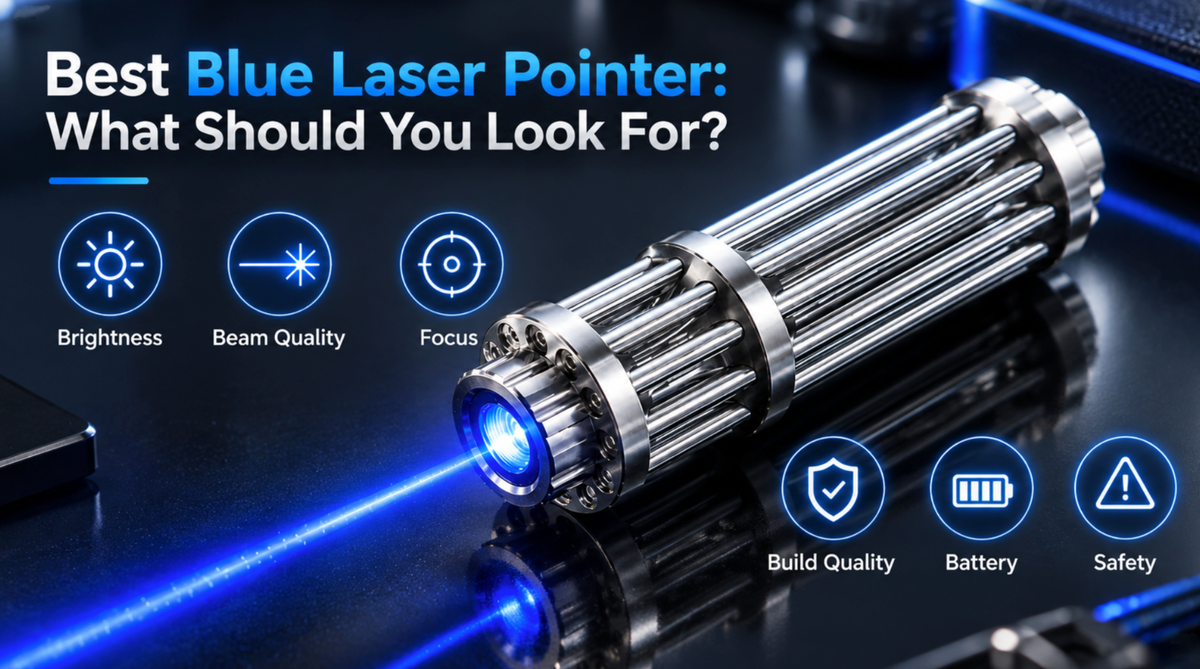
Choosing the best blue laser pointer is not simply about finding the highest advertised wattage. A useful comparison starts with the exact wavelength, documented optical output, laser class, beam characteristics, duty cycle, battery requirements, safety controls, and product documentation.
Most blue handheld lasers use wavelengths around 445nm or 450nm, but products with similar-looking housings can have very different output levels and hazard classifications. Before buying, check what the power specification actually means, whether the product is properly labeled, and whether its design matches the legitimate intended use.
This buying guide explains the specifications that matter most when comparing blue laser products and the warning signs buyers should not ignore.
Key Takeaways
-
Compare the exact wavelength and documented optical output rather than relying on terms such as “extreme power” or “ultra bright.”
-
Check the laser class and warning labels before comparing wattage. A higher output is not automatically a better buying choice.
-
Review beam divergence, focus design, duty cycle, and thermal guidance because these affect real-world performance.
-
Match the battery type, voltage, and charging method to the exact model instead of assuming every blue laser uses the same cell.
-
Safety features such as key controls and interlocks can reduce accidental or unauthorized activation, but they do not make direct beam exposure safe.
-
For higher-class lasers, protective eyewear must match the wavelength and hazard assessment; a generic OD number is not enough.
-
Never direct a laser toward aircraft, people, vehicles, animals, or uncontrolled public areas.
Power And Brightness: The Core Of Any High Power Blue Laser Pointer

Understanding Milliwatt Ratings And Wavelengths
Optical output is normally stated in milliwatts or watts, but the number is useful only when the measurement basis is clear. Buyers should check whether the specification refers to continuous optical output, peak output, or another defined condition.
Wavelength identifies the color region of the laser. Most high-output blue handheld products use direct diodes around 445nm or 450nm. Traditional 532nm green lasers, by contrast, commonly use DPSS frequency-conversion technology, while 520nm green lasers are commonly direct-diode designs.
Human vision is much more sensitive to green wavelengths than to 445nm or 450nm blue light. This means a blue laser can have substantial optical output while appearing less bright than a lower-output green product.
For buying decisions, compare wavelength, measured optical output, laser class, and beam characteristics separately rather than treating apparent brightness as a power measurement.
|
Wavelength |
Color Region |
General Visual Effect |
Buyer Note |
|
445nm |
Deep blue |
Lower visual efficiency |
Common in high-output blue diodes |
|
450nm |
Blue |
Slightly stronger visual response than 445nm |
Common blue handheld wavelength |
|
455nm |
Blue |
Similar blue appearance |
Compare actual diode and product specs |
|
520nm |
Green |
Much higher perceived visibility than blue |
Direct-diode green; comparison only |
|
532nm |
Green |
High perceived visibility |
Usually DPSS; not a blue-laser option |
Hgyuskl turns down the industry habit of fake specifications. Many sellers print "5W+" on a handheld pointer. That claim is not true. A real high power blue laser pointer gives honest milliwatt output. Hgyuskl tests every unit and shares real numbers. This real-output way of thinking saves you from wasted money and false hopes.
Start With the Minimum Appropriate Output and Laser Class
Do not begin the buying process by asking for the highest available wattage. Start by identifying the legitimate application and the minimum laser class and optical output appropriate for that application.
In the United States, visible products promoted for pointing or demonstration purposes are limited by FDA regulation to Class IIIa / IEC Class 3R, up to 5mW. Products from 5mW to 500mW fall into Class IIIb / IEC Class 3B and cannot legally be promoted as ordinary laser pointers or demonstration products.
Higher-class systems may be appropriate in controlled professional applications, but they should not be treated as simple upgrades from an ordinary pointer. Laboratory, industrial, entertainment, and research systems may require purpose-built equipment, controlled beam paths, training, and additional safety measures.
For buyers, the correct sequence is: identify the legitimate application first, determine the appropriate class and output, and only then compare wavelength, beam quality, battery, duty cycle, and construction.
Safety Features: What To Look For In A High Power Blue Laser

How to Evaluate Laser Safety Eyewear
|
What to Check |
Why It Matters |
|
Protected wavelength range |
Must include the actual blue wavelength, such as 445nm or 450nm |
|
Optical density |
Must be appropriate for the specific output and exposure conditions |
|
Applicable safety standard |
Helps verify that the eyewear has been tested and documented |
|
Visible-light transmission |
Eyewear must still allow safe visibility of the work area |
|
Frame and side coverage |
Protection depends on the complete eyewear design, not only the lens |
|
Damage threshold |
Relevant for higher-power systems |
|
Manufacturer documentation |
Generic “laser goggles” without spectral data are not enough |
Protective eyewear should be selected through a wavelength- and exposure-specific hazard assessment. A generic OD3, OD4, or OD6 label does not prove that eyewear is suitable for every blue laser.
Eyewear is only one layer of protection and does not make intentional direct or reflected beam exposure safe.

Outdoor and Public-Space Safety
Do not test a higher-output blue laser by directing it into an uncontrolled outdoor area. A visual check of the surroundings cannot guarantee that aircraft, vehicles, people, animals, or reflective objects will not enter the beam path.
In the United States, intentionally aiming a laser at an aircraft is a federal crime. State and local rules may add restrictions on possession, registration, sale, or use of higher-class laser products.
If a professional application requires outdoor laser operation, it should be evaluated under the applicable laws, site rules, beam-control procedures, and hazard assessment for that activity.
A high-output handheld laser should not be treated as a general outdoor visibility or signaling device.
Build Quality And Durability Of A High Power Blue Laser
Build quality matters because higher-output laser diodes, drivers, batteries, and optics all place demands on the housing.
A useful buyer comparison should examine how the diode is mounted, how heat is transferred through the housing, whether the focus mechanism is secure, whether the battery compartment is properly specified, and whether the manufacturer provides clear duty-cycle and operating-temperature guidance.
Housing material is only one part of the design. A heavy metal body does not automatically prove good thermal management or long service life.
Materials, Thermal Design, and Duty Cycle
Metal housings can assist with heat spreading, but material name alone does not prove that a laser has adequate thermal management.
Important factors include the thermal contact between the diode and mount, housing mass, heat-sink geometry, driver efficiency, output level, ambient temperature, and duty cycle.
Most 445nm and 450nm blue handheld lasers use direct laser diodes. These diodes and their drivers generate heat during operation, especially at higher output levels.
Do not assume that an aluminum housing permits continuous operation. Check the exact model's maximum on-time, recommended cooling interval, operating-temperature range, and test conditions.
Water and Impact Claims: Look for Actual Ratings
Do not assume that a metal housing, threaded cap, or O-ring makes a laser waterproof or drop-proof.
If water resistance matters, look for a documented IP rating or another clearly defined test standard. If impact resistance is advertised, check whether the manufacturer states the test height, surface, and test method.
Terms such as “all-weather,” “waterproof,” “shockproof,” or “tactical” have limited value when no test conditions are provided.
For an evergreen buying guide, documented ratings are more useful than general ruggedness claims.
Battery Life And Power Source
Battery Type and Compatibility
Battery requirements are model-specific. Do not assume that every blue laser uses an 18650 cell or that physically similar lithium-ion batteries are interchangeable.
Check the exact battery format, required voltage, polarity, protected or unprotected-cell requirements, charger compatibility, and manufacturer instructions for the specific model.
Runtime depends on more than battery capacity. Optical output, diode efficiency, driver efficiency, current draw, temperature, and duty cycle all affect how long the product can operate between charges.
Use only battery types and chargers specified for the device. A larger capacity number or a physically similar cell does not automatically make a battery compatible.
Runtime and Duty Cycle
Battery runtime and laser duty cycle are different specifications.
Runtime describes how long the battery can supply the device under defined conditions. Duty cycle describes how long the laser may operate before it requires a cooling interval or shutdown.
Do not assume that a large battery means the laser can operate continuously. Higher-output diodes may reach their thermal limit long before the battery is empty.
When comparing products, look for model-specific information about battery capacity, current draw, maximum on-time, required cooling interval, ambient-temperature limits, and any thermal-protection features.
Price And Value: Finding The Best Laser Pointer
Price Does Not Prove Power or Quality
Price alone does not tell you whether a blue laser is accurately specified, compliant, or durable.
A useful product listing should clearly state the wavelength, optical output, laser class, battery requirements, duty cycle, warning labels, manufacturer information, operating instructions, and warranty.
Large power claims are not automatically false, and high prices are not automatically proof of quality. Compare the documentation and measurement basis behind the specifications rather than using price as a shortcut.
What Makes a Blue Laser Good Value?
|
Value Factor |
What to Check |
|
Wavelength |
Exact nm value, such as 445nm or 450nm |
|
Optical output |
Clearly stated mW/W and measurement basis |
|
Laser class |
Consistent with the stated output |
|
Beam specification |
Divergence, focus design, and beam profile where available |
|
Duty cycle |
Maximum on-time and cooling guidance |
|
Battery |
Exact cell type, voltage, and charging requirements |
|
Thermal design |
Model-specific limits, not only “aluminum housing” |
|
Safety controls |
Appropriate lockout, labels, and interlock provisions |
|
Documentation |
Manufacturer information and operating instructions |
|
Warranty |
Clear support and warranty terms |
|
Compliance information |
Certification and identification information where applicable |
The best value is not necessarily the cheapest product or the one with the largest wattage number. A well-documented model with appropriate safety controls and clearly defined operating limits may offer better value than a product with more dramatic performance claims but limited technical information.
Use the same checklist when comparing Hgyuskl models with competing products.
How To Choose A High Power Blue Laser Pointer Within Legal Limits
FDA and FAA Rules Buyers Should Know
In the United States, FDA regulations limit visible laser products promoted for pointing or demonstration purposes to Class IIIa / IEC Class 3R, up to 5mW.
Products from 5mW to 500mW fall into Class IIIb / IEC Class 3B and cannot legally be promoted as ordinary laser pointers or demonstration products. Higher-class products are subject to additional hazard controls, labeling, and safe-use requirements.
Before buying, check that the label and documentation identify the wavelength, optical output, laser class, manufacturer or distributor, radiation warning, and applicable compliance information.
The FAA addresses a separate but critical issue: intentionally aiming a laser at an aircraft is a federal crime in the United States. This applies regardless of the color of the laser.
State And Local Restrictions
States and cities add their own rules on top of federal law. Some places ban certain power levels in public spaces. Others require a permit for outdoor use. A few restrict sales to minors outright. These rules change from one town to the next.
One technical point often confuses buyers. Frequency doubling applies to green 532nm lasers, not blue. A 532nm unit uses an infrared pump diode and a crystal to double the frequency. Blue diodes at 445nm produce their color directly. This difference matters for safety gear and for how you read a spec sheet.
Research your local laws before you buy. Call your city office or check the state code online. This guide cannot replace legal advice for your area. A responsible buyer confirms the rules first, then chooses a pointer that fits them.
The best blue laser pointer is not automatically the product with the highest output, largest battery, or heaviest housing.
Start with the exact wavelength, optical output, and laser class. Then compare beam divergence, focus design, duty cycle, thermal limits, battery requirements, safety controls, labels, documentation, warranty, and legal context.
For ordinary pointing applications, do not treat Class 3B or Class 4 output as a normal upgrade from a lower-power pointer. Higher-class systems require a legitimate need and more demanding safety controls.
When comparing Hgyuskl models or other brands, apply the same specification checklist to every product and choose by documented requirements rather than maximum wattage or marketing language.
FAQ
Is a Higher-Power Blue Laser Always Better?
No. Higher optical output increases hazard potential and may place the product in a higher laser class. It does not automatically mean better beam quality, better visibility, longer battery life, or better value. Choose the minimum output and laser class appropriate for the legitimate application, then compare the remaining specifications.
What is the difference between 445nm and 532nm lasers?
Both wavelengths fall within the blue region of the visible spectrum. A 450nm beam may appear slightly brighter than a 445nm beam at the same measured output, but the difference is usually modest. Diode quality, output tolerance, beam profile, divergence, driver design, thermal management, and duty cycle often matter more than the 5nm wavelength difference.
How Long Does a High-Power Blue Laser Battery Last?
Runtime is model-specific. It depends on battery capacity, cell chemistry, optical output, diode efficiency, driver efficiency, current draw, operating temperature, and use pattern. Battery runtime should not be confused with duty cycle. A battery may still have plenty of charge when the laser reaches its thermal operating limit. Check the exact battery and runtime specifications for the individual model.
What safety goggles do I need for a blue laser?
Wear certified goggles that block 445nm blue light. Look for an optical density of OD 3.0 or higher. Never look directly at the beam. Use the key lock to prevent unauthorized use.
Share:
450nm Blue Laser Pointer Brightness: What Affects Visibility?
High Power Blue Laser Pointer: Is More Power Always Better?