
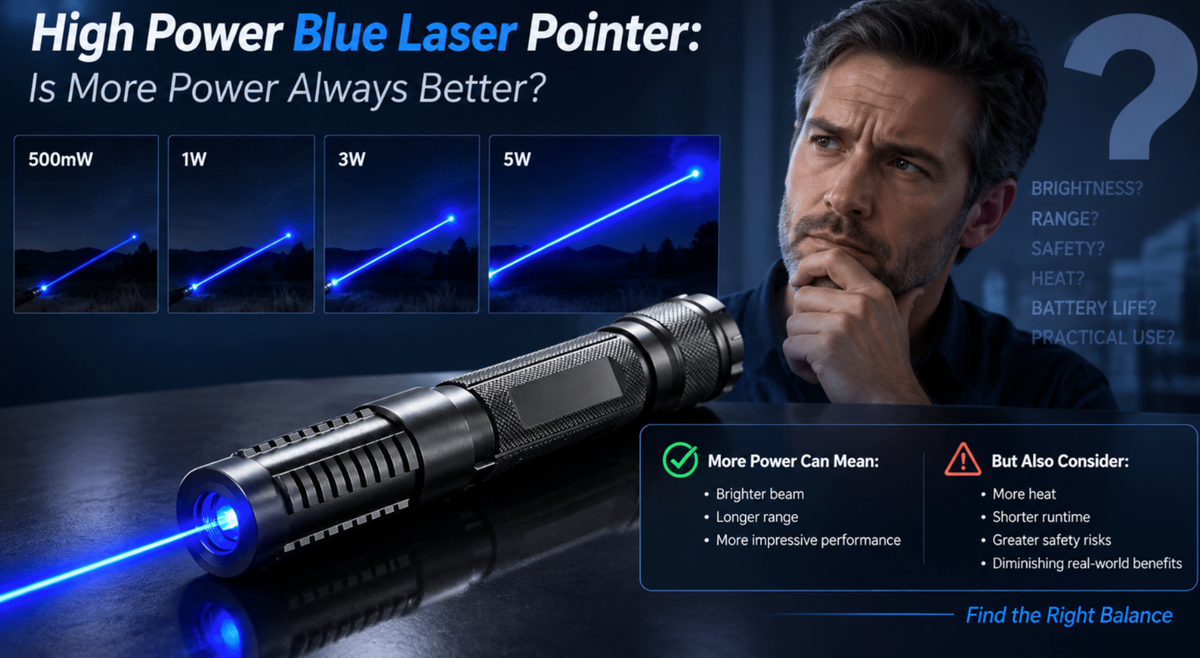
No, more power is not always better for a high power blue laser pointer. Higher optical output can increase irradiance and apparent brightness under comparable conditions, but it also increases hazard potential, heat generation, battery demand, and the importance of proper safety controls.
More power does not automatically give you better beam quality, lower divergence, longer runtime, better efficiency, greater reliability, or better value.
The right choice starts with the legitimate intended use and the minimum appropriate output and laser class. This guide explains what additional power actually changes, what it does not improve, and which specifications matter more than maximum wattage.
Key Takeaways
-
More optical power can increase irradiance and apparent brightness, but it does not automatically improve beam quality, divergence, accuracy, runtime, or reliability.
-
Higher output increases hazard potential and usually places greater demands on the battery, driver, and thermal design.
-
Choose the minimum output and laser class appropriate for the legitimate intended use instead of buying by maximum wattage.
-
Compare wavelength, documented optical output, laser class, divergence, duty cycle, battery requirements, thermal limits, and safety documentation together.
-
Apparent brightness is not a reliable measure of laser power or safety, especially when comparing blue and green wavelengths.
What Is a High Power Blue Laser Pointer?

“High power blue laser pointer” is a common search and marketing phrase, not a formal laser safety classification.
Blue handheld lasers are available across many output levels, and products above 5mW may fall into higher hazard classes depending on their accessible emission. The exact class—not the phrase “high power”—is what tells you more about the product's hazard potential.
For buyers, the useful specifications are the exact wavelength, documented optical output in mW or W, laser class, beam divergence, duty cycle, battery requirements, and safety information.
Typical Power Ranges and Classes
The International Electrotechnical Commission makes laser safety rules under IEC 60825-1. The table below shows where blue pointers fit in that system.
|
Laser Class |
General Output Context |
What It Means for Buyers |
|
Class 3R / FDA IIIa |
Up to 5mW in the U.S. visible pointer/demonstration context |
Direct viewing can be hazardous; not risk-free |
|
Class 3B / FDA IIIb |
5mW to 500mW under the FDA system |
Serious direct-eye hazard; cannot be promoted as an ordinary laser pointer in the U.S. |
|
Class 4 |
Above Class 3B accessible-emission limits |
Direct and reflected exposure can present serious eye and skin hazards; fire hazards may also exist |
Laser class describes hazard potential, not product quality or suitability for a particular hobby.
Moving from Class 3R to Class 3B or Class 4 should not be treated as a normal product upgrade. The appropriate class depends on a legitimate need, the operating environment, applicable regulations, and the safety controls available.
What 450nm Actually Changes
Most high-output blue handheld lasers use wavelengths around 445nm or 450nm. These wavelengths produce a distinctive blue appearance, but they are less visually efficient to human eyes than green wavelengths at the same measured optical output.
Shorter blue wavelengths can undergo stronger molecular scattering than longer visible wavelengths in clean air. However, apparent beam visibility also depends on optical output, beam divergence, atmospheric particles, ambient light, viewing angle, and human spectral sensitivity.
This is why wavelength and power must be evaluated separately. A higher-power blue laser can have substantial optical output without looking proportionally brighter to the eye.
What Does More Laser Power Actually Change?
Higher optical output increases the amount of laser energy emitted per unit time. Under otherwise comparable conditions, that can increase irradiance and may increase the apparent brightness of the dot or beam.
However, higher power does not automatically improve every aspect of performance. Beam divergence, beam profile, focusing quality, driver stability, battery efficiency, and mechanical alignment are separate specifications.
More output also places greater demands on the diode, driver, battery, thermal design, and safety controls.
More Power Does Not Automatically Mean More Useful Range
Increasing optical output can make a laser easier to detect under some conditions, but power alone does not determine how far a beam remains useful or visible.
Beam divergence determines how quickly the spot expands. Atmospheric conditions affect transmission and scattering. Background illumination affects contrast. The target surface and viewing geometry affect how easily the spot can be seen.
For this reason, “range” should not be treated as a direct conversion from milliwatts to distance. Compare divergence and the intended operating conditions together with optical output.
More Power Increases Irradiance and Thermal Load
When beam diameter and focusing conditions are similar, increasing optical output can increase irradiance at the illuminated surface.
That does not mean a handheld laser should be selected as a substitute for purpose-built engraving, marking, laboratory, or industrial equipment. Professional processing systems are designed around controlled optics, enclosures, interlocks, cooling, motion control, and application-specific safety requirements.
For handheld products, higher output should instead be evaluated as an increase in hazard potential and thermal load. Check the exact duty cycle, temperature limits, driver design, and safety requirements before treating higher wattage as a performance advantage.
Risks of Higher Power

Eye Hazard Increases With Higher Output
Apparent brightness should never be used to judge eye safety. A high-output blue laser can appear less bright than an equally powerful green laser while still presenting a serious ocular hazard.
Class 3B products are normally hazardous for direct intrabeam eye exposure, while Class 4 products present still greater eye and skin hazards and may also create hazards from reflected exposure.
Protective eyewear, when required, must be selected for the exact wavelength and hazard assessment. It is only one layer of protection and does not make intentional beam exposure acceptable.
The most effective buying decision is to avoid unnecessary output and choose the minimum class appropriate for the legitimate task.
Fire and Reflection Hazards Also Increase
At Class 4 output levels, the risk is no longer limited to direct eye exposure. Depending on wavelength, beam characteristics, material, and exposure conditions, fire and skin hazards may also exist.
Reflective surfaces can redirect concentrated laser energy into unintended directions. This makes uncontrolled operation around vehicles, windows, mirrors, machinery, or public areas especially inappropriate.
Higher output therefore adds safety-management requirements even when it does not improve the specification the user actually needs.
Legal Restrictions You Cannot Ignore

Laser pointers have strict rules in many countries. Governments decide who can buy them and how strong they can be. Before you order a high power blue laser pointer, you need to know these laws. If you ignore them, you could get fines, have your device taken away, or face charges. These rules are there to keep everyone safe. They apply to both sellers and buyers.
United States: FDA and FAA Context
In the United States, FDA regulations limit visible laser products promoted for pointing or demonstration purposes to Class IIIa / IEC Class 3R, up to 5mW.
Products above this range are not simply “stronger pointers.” Class 3B and Class 4 products fall into higher hazard categories and are subject to additional product, labeling, and safety-control requirements.
Buyers should check the wavelength, optical output, laser class, warning labels, manufacturer or distributor information, and applicable certification and identification labels. Avoid vague claims such as “FDA approved” when the product documentation does not explain the actual compliance basis.
Outdoor use creates an additional aviation concern. In the United States, intentionally aiming a laser at an aircraft is a federal crime.
Europe and Other Markets
Laser-product rules vary significantly by country and should not be reduced to one universal European or international power limit.
IEC laser classifications are widely used, but product-safety, sale, import, possession, and use restrictions can differ between jurisdictions.
For example, UK government safety guidance states that Class 3B and Class 4 lasers are not suitable for general consumer use. Other countries may apply different restrictions to handheld portable lasers.
Before ordering a higher-class laser internationally, check the current rules for the destination country and the specific intended use rather than assuming that a product legal in one market is automatically legal in another.
What More Power Changes and What It Does Not
|
Factor |
Does More Power Help? |
Important Limitation |
|
Optical output |
Yes |
This is what mW/W measures |
|
Irradiance at the same beam size |
Usually |
Focus and beam geometry also matter |
|
Apparent brightness |
Often |
Wavelength and viewing conditions strongly affect perception |
|
Beam divergence |
No |
Determined mainly by emitter and optics |
|
Beam quality |
No |
Higher wattage does not guarantee a cleaner beam |
|
Accuracy |
No |
Depends on alignment, optics, and mechanical stability |
|
Battery life |
Usually worsens |
Higher current draw can reduce runtime |
|
Thermal load |
Increases |
More heat may shorten allowable duty cycle |
|
Safety margin |
Worsens |
Higher output generally increases hazard potential |
|
Legal simplicity |
Usually worsens |
Higher-class products face more restrictions |
|
Product value |
Not necessarily |
A larger wattage number may add no useful benefit |
Picking a high power blue laser pointer means matching the device to the task. A 5W unit has a different job than a 5 mW pointer. The real question is not about more power being better. It is about what work the laser must do. High power gives real benefits for professional jobs. Lower power keeps daily tasks safe and easy. Knowing this helps buyers make smart choices. A powerful laser used for the wrong task becomes a danger, not a tool.
When Higher Output May Be Justified
Higher output may be justified in specialized professional systems where the application has a documented optical-power requirement and the environment provides appropriate engineering and administrative controls.
In those cases, the correct tool may be a purpose-built laboratory, industrial, scientific, or entertainment laser system rather than a handheld pointer.
The important distinction is that higher output should follow a defined technical requirement. It should not be selected first and then matched to a use afterward.
When Lower Output Is the Better Choice
For ordinary pointing and demonstration tasks, higher output often adds hazard without improving the task itself.
In the United States, visible laser products promoted for pointing or demonstration purposes are limited to Class IIIa / IEC Class 3R, up to 5mW. Many ordinary presentation tasks can be performed with lower-class products.
The goal should therefore be the minimum appropriate output, not the highest permitted output.
If a task can be completed with a lower laser class, moving to Class 3B or Class 4 usually adds safety, thermal, battery, and regulatory burdens without creating a corresponding benefit.
Power should fit the job, not the biggest number on a spec sheet. A high power blue laser pointer gives brighter beams and can burn things. These good points come with serious trade-offs. Safety risks get bigger. Legal punishments go up. Everyday costs increase. The smart choice means checking local laws first. Buyers should pick trusted sellers like Hgyuskl who give honest specifications. Eye safety must come before anything else. Safety glasses made for the exact wavelength are a must.
The best tool for any job uses the lowest power that gets the work done.
More power adds danger without adding value. Smart owners match the tool to the task. They respect the risks. Safety stays the top priority.
FAQ
Is a More Powerful Blue Laser Always Brighter?
When wavelength, divergence, beam diameter, and viewing conditions are the same, higher optical output can increase apparent brightness. However, perceived brightness does not increase in a simple one-to-one relationship with wattage, and more power does not improve beam quality or divergence. Do not increase laser class simply to obtain a brighter-looking beam.
Are High-Power Blue Lasers Dangerous to the Eyes?
Yes. Class 3B and Class 4 blue lasers can present serious eye hazards. A blue beam may also look less bright than a green beam with similar optical output, so visual brightness should never be used to judge safety. For higher-class systems, protective eyewear may be required as one part of a broader safety program. It must match the wavelength and hazard assessment, and it does not make direct beam exposure safe.
Can a 5W Blue Laser Be Sold as an Ordinary Laser Pointer in the U.S.?
No. In the United States, visible products promoted for pointing or demonstration purposes are limited to Class IIIa / IEC Class 3R, up to 5mW. A multi-watt blue laser is a much higher-class laser product and should not be marketed or treated as an ordinary pointer. Other legal requirements can depend on the product type, intended use, state or local law, and operating environment.
What Should Buyers Check Before Comparing High-Power Blue Lasers?
Check the exact wavelength, documented optical output, laser class, beam divergence, focus design, duty cycle, battery requirements, thermal limits, safety controls, warning labels, manufacturer information, operating instructions, and warranty. If a product emphasizes maximum wattage but does not clearly explain its class, duty cycle, measurement basis, or safety requirements, treat that as a warning sign.
Share:
Best Blue Laser Pointer: What Should You Look For?
Blue vs Green Laser Pointer for Outdoor Use