
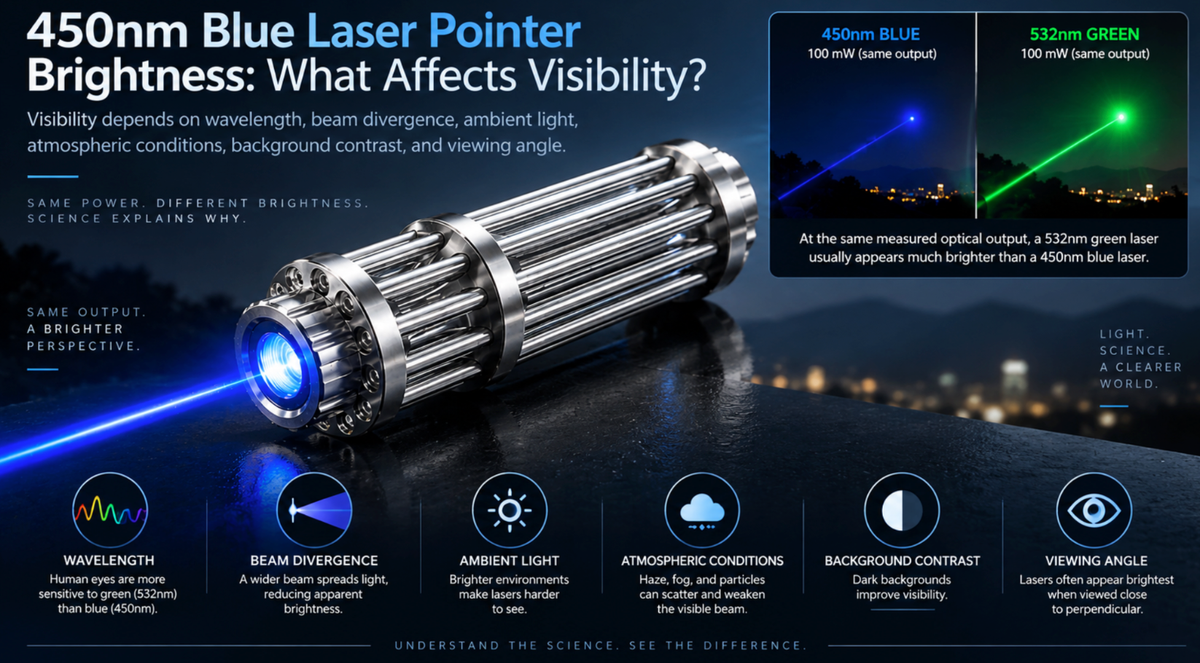
At the same measured optical output, a 532nm green laser generally appears much brighter than a 450nm blue laser. However, the visibility of a 450nm beam also depends on beam divergence, ambient light, atmospheric conditions, background contrast, and viewing angle.
This guide explains how 450nm blue laser pointer brightness works, why optical power and perceived brightness are different, and which specifications matter when comparing blue laser products.
Key Takeaways
-
A 450nm blue laser's apparent brightness depends on optical output, wavelength sensitivity, beam divergence, ambient light, and viewing conditions.
-
At the same optical output, a 532nm green laser generally appears much brighter than a 450nm blue laser because human vision is more sensitive to green light.
-
A higher mW or W rating does not translate directly into the same increase in perceived brightness.
-
Atmospheric particles can make a beam path more visible from the side, but fog, dust, and haze can also scatter and attenuate the beam.
-
Apparent brightness is not a safety measurement. Always check optical output and laser class rather than judging hazard by how bright the beam looks.
Brightness metrics: power vs. perception

Optical power vs. perceived laser brightness
Optical power is measured in milliwatts or watts and describes the rate at which the laser emits optical energy. A 100mW laser has twice the optical power of a 50mW laser, assuming the values are measured on the same basis.
Perceived brightness is different. Human vision does not respond equally to every wavelength. Under well-lit conditions, standard photopic sensitivity peaks near 555nm, while 450nm blue light lies much farther from that peak.
As a result, a 450nm laser can have substantial optical output without appearing proportionally bright to the eye. When comparing laser brightness, always consider both wavelength and measured optical output.
Optical power is measured in milliwatts or watts and describes the rate at which the laser emits optical energy. A 100mW laser has twice the optical power of a 50mW laser, assuming the values are measured on the same basis.
Perceived brightness is different. Human vision does not respond equally to every wavelength. Under well-lit conditions, standard photopic sensitivity peaks near 555nm, while 450nm blue light lies much farther from that peak.
As a result, a 450nm laser can have substantial optical output without appearing proportionally bright to the eye. When comparing laser brightness, always consider both wavelength and measured optical output.
Why 450nm blue light appears dimmer
A 450nm blue laser generally appears less bright than a 532nm green laser when both have the same optical output. The reason is human spectral sensitivity: green wavelengths lie much closer to the peak of photopic vision, while 450nm blue lies in a region where visual sensitivity is substantially lower.
This also explains why milliwatts alone cannot predict apparent brightness. A higher-output blue laser can still look brighter than a much lower-output green laser, but that is no longer an equal-power comparison.
Shorter blue wavelengths undergo stronger molecular scattering in clean air than longer visible wavelengths. However, that does not automatically give blue a real-world visibility advantage. Human eye sensitivity, beam divergence, atmospheric particles, background contrast, and viewing angle all contribute to what the observer actually sees.
Factors affecting 450nm blue laser pointer brightness
Beam quality and brightness visibility
Beam divergence affects how quickly the laser spot expands with distance. A lower-divergence beam generally produces slower spot growth, while higher divergence spreads the same optical power over a larger area.
This can affect how bright the spot appears on a surface, but divergence does not determine airborne beam visibility by itself. Beam-path visibility also depends on optical output, atmospheric scattering, ambient light, background contrast, and viewing angle.
When comparing 450nm products, use model-specific divergence and focus information rather than assuming that every high-output blue laser has the same beam quality.
Atmospheric conditions can change how a 450nm beam looks. Aerosols, haze, fog, smoke, and dust can scatter light toward an observer, sometimes making part of the beam path appear more visible.
At the same time, stronger scattering also removes light from the original beam direction and can reduce transmission. A beam that appears brighter from the side is therefore not necessarily traveling more effectively through the atmosphere.
For brightness comparisons, treat atmospheric conditions as a variable rather than an automatic advantage for blue light.
Atmospheric Scattering and Beam Visibility
In clean air, shorter wavelengths such as 450nm are more strongly affected by Rayleigh scattering than longer visible wavelengths. This can contribute to side visibility of a blue beam.
Real outdoor air is more complicated. Dust, haze, smoke, fog, and other aerosols contain particles large enough that Mie scattering can become important. These particles can increase visible side-scatter while also reducing how much light continues along the original beam path.
For this reason, atmospheric scattering should not be described as a simple “blue advantage.” The apparent beam brightness depends on the type and amount of particles in the air, optical output, divergence, viewing angle, background brightness, and the observer's spectral sensitivity.
A beam that looks more visible because of scattering is not necessarily more powerful or capable of traveling farther.
Blue laser brightness vs. green and red
450nm Blue vs. 532nm Green Brightness
At equal optical output, a 532nm green laser generally appears substantially brighter than a 450nm blue laser because 532nm lies much closer to the peak sensitivity of human photopic vision.
There is no need to describe this difference with one fixed brightness multiplier. The exact perceived difference varies with the wavelengths being compared, viewing conditions, background light, beam divergence, and individual visual response.
A higher-output 450nm laser can still appear brighter than a lower-output 532nm laser. In that case, however, both wavelength and optical power are changing at the same time.
The practical rule is simple: compare mW or W for optical output, and use wavelength to understand perceived visibility.
450nm Blue vs. 650nm Red Brightness
450nm blue and 650nm red both lie away from the peak of daytime visual sensitivity, and their apparent brightness differs from green even when optical output is the same.
Under standard photopic viewing conditions, red and blue should be compared by both wavelength and optical output rather than by color alone. Atmospheric scattering can also make the airborne beam paths look different.
For this article, the key point is that neither red nor blue brightness can be predicted from mW alone. Wavelength, optical output, divergence, ambient light, and viewing conditions all matter.
Safety and brightness of blue lasers
Brightness Is Not a Safety Measurement
A 450nm blue laser can look less bright than a green laser while still having substantial optical output. Apparent brightness should therefore never be used to judge whether a laser is safe.
Laser hazard depends on optical output, wavelength, beam characteristics, exposure conditions, and laser class. Higher-class products can present serious eye hazards even when the beam does not look exceptionally bright.
Reflections also need to be considered according to laser class and surface type. Mirror-like reflections can redirect a concentrated beam, while Class 4 products may present hazards from reflected exposure under a wider range of conditions.
Always use the product's stated optical output and laser class—not visual brightness—to evaluate hazard.
Safe Comparison and Product Selection
Do not choose a 450nm laser by assuming that more power automatically means better visibility.
For ordinary pointing or demonstration purposes in the United States, visible laser products are limited by FDA regulation to Class IIIa / IEC Class 3R, up to 5mW. Higher-output products fall into different hazard categories and should not be treated as ordinary pointers.
When comparing 450nm products, check the wavelength, documented optical output, laser class, beam divergence, battery system, duty cycle, warning labels, and operating instructions.
For higher-class products, protective eyewear may be required as part of an appropriate safety system. Eyewear must match the wavelength and hazard level; generic glasses do not make deliberate beam exposure safe.
Never direct a laser toward people, animals, vehicles, or aircraft. Pointing a laser at an aircraft is a federal crime in the United States.
The brightness of a 450nm blue laser pointer comes from two forces. Raw power sets the energy level. The 450nm wavelength scatters strongly in air. That scattering makes the beam path sharp and visible, even when your eye sees blue as dimmer than green. Brightness is never just one number. It combines milliwatts, wavelength, and the environment around you. For astronomy and outdoor signaling, choose a real-power blue laser. Hgyuskl recommends the Hgyuskl 450nm True High Power model for honest output and reliable performance. Always wear safety glasses rated for 450nm. Never point any laser at people or aircraft. Respect the tool, and it will serve you for years.
FAQ
Is a 450nm blue laser brighter than a green laser?
At the same optical output, a 532nm green laser generally appears much brighter than a 450nm blue laser because human vision is more sensitive to green wavelengths. A 450nm beam can experience stronger molecular scattering in clean air, but real beam visibility also depends on atmospheric particles, divergence, ambient light, background contrast, and viewing angle.
Is a 450nm blue laser visible in daylight?
Daylight greatly reduces contrast for a 450nm blue laser. The dot may still be visible under some conditions, but visibility depends on optical output, beam divergence, target surface, background brightness, viewing distance, and angle. The airborne beam path is especially difficult to see in bright daylight. Increasing laser power should not be treated as the default solution to poor daylight visibility.
Does a higher mW rating always make a 450nm laser look brighter?
A higher optical output can increase apparent brightness when the wavelength and other conditions are the same. However, mW alone does not determine what you see. Beam divergence, ambient light, atmospheric conditions, background contrast, and viewing angle also affect the apparent brightness of the beam and dot. Optical output should also be considered together with laser class and safety requirements.
Do I need safety glasses for a 450nm blue laser?
It depends on the laser class, optical output, and operating environment. For higher-class lasers, wavelength-appropriate protective eyewear may be required as part of the safety controls. The eyewear must provide protection appropriate for 450nm and the specific hazard level. Protective eyewear does not make direct beam exposure safe. Avoid eye exposure and mirror-like reflections regardless of whether eyewear is being used.
Share:
What makes 520nm green laser pointers different from other laser pointers?
Best Blue Laser Pointer: What Should You Look For?