
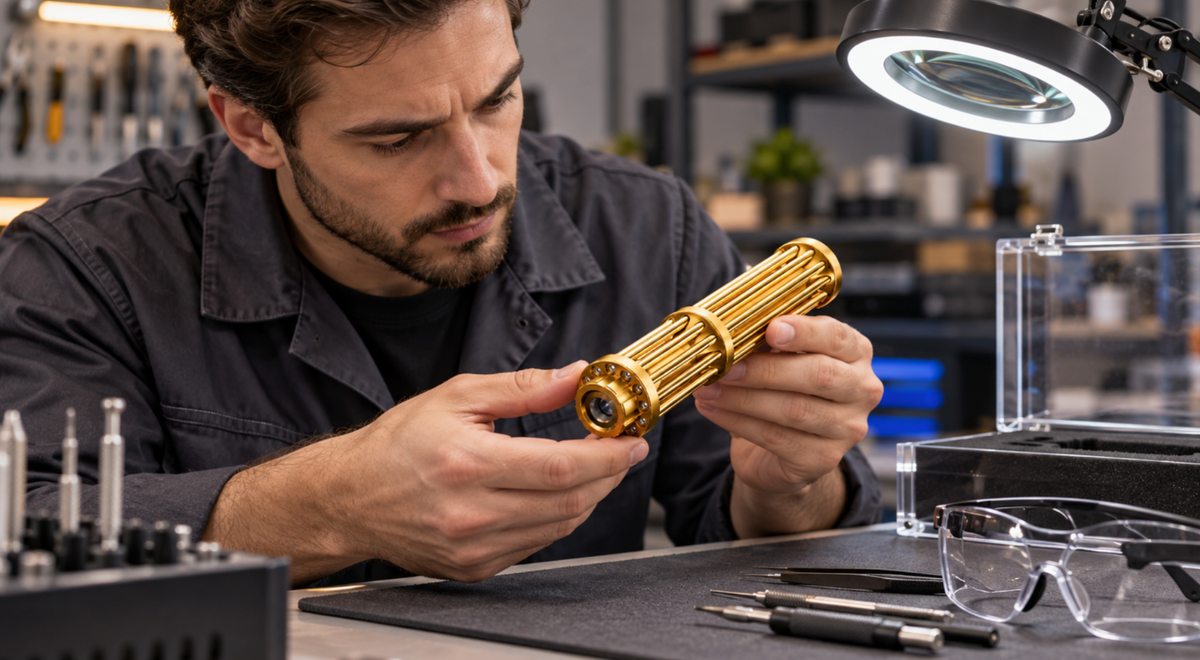
If you are looking for a really powerful laser pointer, the first thing to check is not the marketing adjective—it is the documented optical output and laser class.
“Really powerful” is not an official laser classification. Sellers may use terms such as “strong,” “high power,” “extreme,” or “super powerful,” but those words do not tell you the actual optical output or hazard category.
Start by checking the stated output in mW or W, the exact wavelength, and the laser class. Then review the safety information, duty cycle, battery requirements, legal context, and product documentation.
A larger wattage number is not automatically a better buying choice. Higher output generally increases hazard potential and places greater demands on the battery, driver, thermal design, and safety controls.
Key Takeaways
-
Check the documented optical output and laser class before looking at words such as “strong,” “extreme,” or “high power.”
-
Confirm the exact wavelength because color affects perceived brightness but does not define optical power.
-
Review warning labels, access controls, operating instructions, duty cycle, battery requirements, and thermal limits.
-
Check how the advertised wattage was measured before comparing two high-output products.
-
Verify the legal requirements for the exact product and jurisdiction rather than assuming one global power limit.
-
Higher output should only be chosen when there is a legitimate requirement for it; Class 3B and Class 4 should not be treated as ordinary upgrade levels.
First Check: Optical Output and Laser Class

Optical output is the first specification to check because it tells you how much laser power is being emitted.
Laser class should be checked alongside it because class describes hazard potential.
Neither specification, however, creates an official definition of the phrase “really powerful laser pointer.” That phrase is informal. The technical comparison should use documented mW or W, wavelength, laser class, and measurement conditions.
Milliwatts and Laser Classes Explained
In the United States, visible laser products promoted for pointing or demonstration purposes are limited by FDA regulation to Class IIIa / IEC Class 3R, up to 5mW.
Products above this range fall into higher hazard categories and should not be marketed or treated as ordinary laser pointers in that U.S. regulatory context.
Other countries use different product-safety, import, sale, possession, and use rules, so there is no single worldwide 5mW definition.
Laser classes group devices by their output and the risk they pose. Under IEC 60825-1, the limits for visible light are clear:
|
Laser Class |
Simplified Visible-CW Context |
Buyer Meaning |
|
Class 2 |
Up to about 1mW |
Lower-output visible class; avoid deliberate staring |
|
Class 3R / FDA IIIa |
Up to about 5mW in the U.S. pointer/demonstration context |
Direct viewing can be hazardous; not risk-free |
|
Class 3B / FDA IIIb |
About 5–500mW under the FDA visible-laser system |
Serious direct-eye hazard; not an ordinary pointer class |
|
Class 4 |
Above Class 3B accessible-emission limits |
Serious eye and skin hazards; reflected exposure and fire hazards may also exist |
These figures are a simplified guide for visible continuous-wave lasers. Exact classification limits depend on wavelength, pulse characteristics, exposure conditions, and the applicable classification standard.
Laser class describes hazard potential. It does not tell you whether one product is better built or more useful than another.
Class 3B and Class 4 are high-hazard categories and should not be treated as ordinary consumer upgrade levels.
For buyers, the practical point is to confirm that the stated optical output and laser class are consistent with each other and that the product documentation explains the required safety controls and operating limits.
Check How the Power Claim Was Measured
Independent testing has shown that some commercial laser pointers do not match applicable output or labeling requirements.
In NIST testing of 122 commercial laser pointers, 89.7% of the tested green pointers and 44.4% of the tested red pointers exceeded applicable federal accessible-emission limits at one or more wavelengths.
That does not mean every large wattage claim is false.
Instead, check whether the seller explains what the number represents:
-
measured optical output;
-
continuous or peak output;
-
output before or after the final optics;
-
the wavelength tested;
-
the operating condition used for the measurement.
A 5W, 7.5W, or higher claim should be compared with another product only when both figures use a comparable measurement basis.
Second Check: Wavelength
Wavelength identifies the laser's color and affects how bright a given optical output appears to human eyes.
Common visible handheld wavelengths include 445nm and 450nm blue, 520nm and 532nm green, and 635nm or 650nm red.
At equal measured optical output, green generally appears brighter than blue or deep red under typical viewing conditions because human vision is more sensitive to green wavelengths.
Wavelength does not, however, tell you how much optical power the laser emits, and color alone does not determine useful range, beam divergence, battery life, or safety class.
Read wavelength and optical output as separate specifications.
Choosing the Right Wavelength
A buyer should use wavelength to understand color and perceived visibility, not as a shortcut for overall performance.
After checking wavelength, compare the exact optical output, laser class, beam divergence, duty cycle, battery system, and documentation for the individual model.
Do not choose a higher-output product simply because one wavelength looks less bright to the eye.
Third Check: Safety Controls and Warning Information
Higher-class laser products may require additional safety controls.
Features such as key controls, interlock provisions, emission indicators, beam attenuators, and warning labels can reduce specific risks such as unauthorized or accidental activation.
They do not make exposure to a Class 3B or Class 4 beam safe, and they do not change the underlying laser class.
Key Safety Mechanisms to Look For
Class 3B and Class 4 lasers need special controls. The table below shows what each part does.
|
Safety Item |
What to Check |
|
Key/access control |
Whether unauthorized activation can be restricted where required |
|
Interlock provision |
Whether the product supports appropriate controlled-system integration |
|
Emission indicator |
Whether the user is warned when emission is active or about to begin |
|
Beam attenuator / shutter |
Whether the beam can be blocked without relying only on the main switch |
|
Warning labels |
Whether class, wavelength, output and radiation warnings are clearly identified |
|
Operating instructions |
Whether the manufacturer explains class-specific precautions and limits |
The required controls depend on the laser class, product design, and applicable standard. A single safety feature should never be treated as proof that a high-output product is safe for ordinary use.
These features can reduce specific failure or misuse risks, but their function is model-specific.
For example, a key control can restrict activation, an emission indicator can warn the operator, and thermal protection may limit operation when defined temperature conditions are exceeded.
Check the actual product manual rather than assuming every higher-class laser uses the same safety system.
Fourth Check: Duty Cycle, Thermal Design, and Battery Requirements
Construction matters, but a metal housing alone does not prove good thermal performance, impact resistance, or long service life.
For higher-output products, check the documented duty cycle, maximum recommended on-time, cooling guidance, operating-temperature range, and battery specification.
Driver design may help regulate electrical operation, but terms such as “APC,” “constant current,” or “aviation aluminum” should not be treated as proof of measured optical output or overall safety.
The exact battery type, voltage, polarity, charging method, and operating limits should be stated for the individual model.
Fifth Check: Legal and Regulatory Context
Laser rules vary by jurisdiction, and manufacture, import, sale, possession, marketing, and use are not the same legal question.
In the United States, visible products promoted for pointing or demonstration purposes are limited by FDA regulation to Class IIIa / IEC Class 3R, up to 5mW.
Class IIIb / 3B products cannot legally be promoted as ordinary laser pointers or demonstration products in the United States.
Other countries may use IEC classifications while applying different national rules to sale, import, possession, or use. Do not assume that the U.S. 5mW rule—or any single 1mW or 5mW number—applies worldwide.
Outdoor use also creates aviation concerns. In the United States, intentionally aiming a laser at an aircraft is a federal crime.
Check the current rules for the exact product, destination, and intended use before purchasing.
|
Country/Region |
Legal Max Power (Consumer) |
Key Restrictions |
|
United States |
5 mW (Class IIIa / 3R) |
FDA requires compliance labeling; no sale of >5 mW as 'pointer' |
|
European Union |
1 mW (Class 2) |
EN 60825-1 applies; Class 3R devices require explicit user instruction |
|
Canada |
5 mW (Class 3R) |
Health Canada mandates compliance certification |
|
Australia |
1 mW (Class 2) |
Import/sale of >1 mW pointers banned since 2022 |

Some regions go further. Sweden requires a permit for devices at 1mW and above. Spain bans the sale of anything above 5mW. In New York, Class 3B and Class 4 lasers used for non-medical purposes must be registered under 12 NYCRR Part 50 with a designated Laser Safety Officer. California and Texas have similar registration rules. Always verify your state or national requirements before you order.
How to Identify Reputable Retailers
A trustworthy seller publishes real documentation. Look for test reports, not vague "certified" claims. Ask for wavelength graphs and driver schematics. Treat missing reports as a lack of verification. A lab-grade module should include a full IEC 60825-1 report and a safety interlock.
You should also check for a manufacturer name, postal address, and contact number. These details show accountability. Avoid marketplace scams that hide behind stock photos and fake wattage numbers. A laser that is proven to be exactly 5 mW or a verified high-power unit will come with a warranty and a money-back guarantee on measured output. That transparency separates a real tool from a dangerous toy.
Real-World Uses for Laser Pointers for Astronomy and Beyond
Quick Buying Checklist: What Should You Check First?
|
Priority |
Check |
Why It Matters |
|
1 |
Optical output in mW/W |
Shows the stated optical power |
|
2 |
Laser class |
Shows hazard category |
|
3 |
Wavelength |
Affects color and perceived visibility |
|
4 |
Measurement basis |
Makes wattage claims comparable |
|
5 |
Safety controls and labels |
Helps identify class-appropriate safeguards |
|
6 |
Duty cycle and battery |
Defines real operating limits |
|
7 |
Legal context |
Rules depend on product and jurisdiction |
|
8 |
Seller documentation |
Helps evaluate accountability and support |
|
9 |
Warranty and returns |
Protects the purchase if specifications or performance are disputed |
The first question should not be “What is the largest wattage I can buy?”
It should be “Are the output, class, wavelength, operating limits, and documentation clear enough for me to understand what this product actually is?”
Wildlife Control and Lab Work
Farmers and estate owners use green laser pointers to stop pests. Geese, coyotes, cormorants, and starlings react to the moving beam. This method causes no harm to the animals. It offers a humane, long-range solution for protecting crops and ponds.
In labs, high-stability DPSS tools handle precise work. These devices can run nonstop for research and testing. A stable laser beam gives accurate results in professional presentations and lab experiments. Always check that your device includes IR filtering. This blocks invisible 1064 nm radiation from DPSS lasers.
Use the right tool for the task. Begin with a low-power laser pointer for stargazing. Move up only when you know the risks.
When looking for a really powerful laser pointer, check the specification before the adjective.
Start with documented optical output and laser class. Then check wavelength, measurement conditions, safety controls, duty cycle, battery requirements, legal context, seller identity, warranty, and technical documentation.
Do not use visual brightness, advertised range, burning claims, housing weight, or a large wattage number as a substitute for clear specifications.
Class 3B and Class 4 products should not be treated as normal upgrades from ordinary pointing products. Higher output is appropriate only when there is a legitimate requirement and suitable safety and regulatory controls.
FAQ
What Power Output Makes a Laser “Really Powerful”?
There is no official mW threshold for the phrase “really powerful laser.” It is informal language. Laser power should instead be described by the actual optical output in mW or W and the laser class. In the U.S., 5mW is an important limit for visible products promoted for pointing or demonstration purposes, but it does not define the word “powerful.”
Are green laser pointers brighter than blue or red ones?
Yes. Your eyes pick up green light best in the 520–570 nm range. A green laser pointer at the same power looks brighter than red or blue models. This makes green laser pointers great for seeing the night sky.
Does a Higher Wattage Number Mean a Better Laser?
No. Higher optical output can increase hazard potential and may increase apparent brightness under comparable conditions, but it does not automatically improve beam quality, divergence, battery life, duty cycle, reliability, or value. Compare the complete specification rather than choosing the largest advertised wattage.
What Safety Information Should I Check?
Check whether the product includes class-appropriate warning labels, access controls, emission indicators, interlock provisions where applicable, beam-control features, and clear operating instructions. The exact requirements depend on the laser class and product design. Safety controls can reduce certain risks, but they do not make direct or reflected exposure to a higher-class beam safe.
Can I Legally Buy a Higher-Power Laser Where I Live?
It depends on the jurisdiction, product type, laser class, intended use, and how the product is marketed. In the United States, visible products promoted for pointing or demonstration purposes are limited to FDA Class IIIa / IEC Class 3R, up to 5mW. Other countries apply different rules to sale, import, possession, and use. Check the current requirements for the exact product and location before ordering.
Share:
What Is Considered a Powerful Laser Pointer? A Simple Guide to mW, W, and Class
What makes a strong laser pointer more visible than a low-power one?