
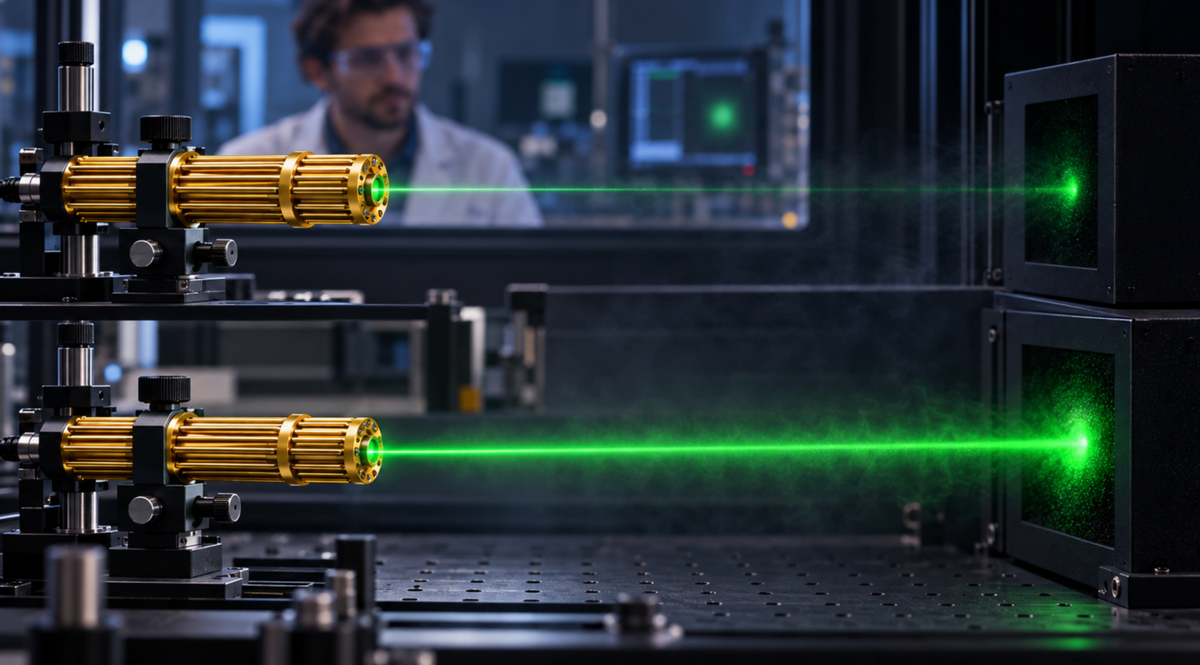
Why does one laser pointer look much more visible than another?
Optical output is part of the answer, but it is not the only factor. A laser's apparent visibility also depends on wavelength, beam divergence, ambient light, atmospheric scattering, target contrast, and viewing angle.
At the same wavelength and under similar conditions, higher optical output can make a laser easier to see. But two lasers with the same mW rating can still look very different because human eyes respond differently to different colors.
This guide explains the main factors that control laser pointer visibility and why “stronger,” “brighter,” and “higher power” are not always the same thing.
Key Takeaways
-
Higher optical output can increase visibility when wavelength, beam characteristics, and viewing conditions are comparable.
-
Green wavelengths generally appear brighter than blue or deep red at the same measured optical output because human vision is more sensitive to green.
-
Lower beam divergence can keep the spot smaller at distance, but divergence does not increase total optical output.
-
Ambient light, atmospheric particles, target contrast, and viewing angle can change how visible a beam or dot appears.
-
Apparent brightness is not a safety measurement. Check the actual optical output and laser class instead.
Power: Why a Strong Laser Pointer Shines Brighter

How Optical Output Affects Visibility
Optical output is measured in milliwatts (mW) or watts (W). When wavelength and beam characteristics are the same, increasing optical output generally makes the laser easier to detect. However, perceived brightness does not increase in a simple one-to-one relationship with mW. Human visual response changes with wavelength, and the same optical output can be concentrated into different spot sizes depending on beam divergence and focus.
For practical comparisons, use optical output as one visibility factor—not as a complete brightness measurement. When comparing Hgyuskl products with other lasers, use the same specification standard for every model. Check the stated wavelength, optical output, laser class, beam divergence, duty cycle, battery requirements, and measurement conditions.
A large wattage claim is not automatically false, and regulated driver circuitry does not by itself prove optical output. The most useful specification is one that clearly explains what was measured and under what operating conditions.
How Power Is Measured
Laser optical output is measured in milliwatts (mW) or watts (W), with 1W equal to 1,000mW.
Terms such as “strong” and “high power” are not official laser classes and do not begin at one universal mW value.
The formal laser class describes hazard potential. In the United States, 5mW is especially important because visible products promoted for pointing or demonstration purposes are limited to FDA Class IIIa / IEC Class 3R, up to 5mW.
|
Laser Class |
Simplified Visible-Laser Context |
What It Means |
|
Class 2 |
Lower-output visible laser |
Avoid deliberate or prolonged direct viewing |
|
Class 3R / FDA IIIa |
Up to about 5mW in the U.S. visible pointer context |
Direct viewing can be hazardous; not risk-free |
|
Class 3B / FDA IIIb |
About 5–500mW under the FDA system |
Serious direct-eye hazard; requires substantially greater controls |
|
Class 4 |
Above Class 3B accessible-emission limits |
Serious eye and skin hazards; reflected exposure and fire hazards may also exist |
Product labels and actual emissions do not always match perfectly. In NIST testing of 122 commercial laser pointers, 89.7% of the tested green pointers and 44.4% of the tested red pointers exceeded applicable federal accessible-emission limits at one or more wavelengths.
This does not mean every online laser is mislabeled. It does show why buyers should compare the stated output, wavelength, class, warning labels, manufacturer information, and measurement documentation together.
A key switch, metal housing, or large wattage number does not independently verify optical output.
Color: Why Green Laser Pointers Look Brightest
Why Wavelength Changes Perceived Brightness
Human eyes do not respond equally to every visible wavelength. Under light-adapted, or photopic, viewing conditions, standard visual sensitivity peaks near 555nm. Green wavelengths such as 520nm and 532nm lie much closer to this high-sensitivity region than 445nm or 450nm blue or 650nm red.
As a result, a green laser generally appears brighter than a blue or deep-red laser when measured optical output is the same.
The exact perceived difference is not one fixed multiplier. Ambient light, visual adaptation, beam characteristics, background contrast, and the exact wavelengths being compared all affect what the observer sees.

Green vs. Blue vs. Red Visibility
At equal optical output, green generally has the strongest perceived-visibility advantage under typical viewing conditions. Blue and red can appear less bright because human visual sensitivity is lower at those wavelengths.
However, color does not determine battery life, beam divergence, thermal performance, or physical range. A higher-output blue or red laser can still appear brighter than a much lower-output green laser. For a fair comparison, check both wavelength and measured optical output.
Hgyuskl builds its green laser devices with premium 520 nm direct green diodes. These direct diodes work without complex frequency-doubling optics. They produce consistent, high-visibility output without the spectral drift common in cheaper units. The APC constant current drive maintains stable performance. You get a true high-power device with honest specs. When you compare a red pointer and a green pointer side by side, the green unit looks far brighter. That distinction also matters for astronomy, outdoor signaling, and wildlife control.
Visibility: Scattering and Beam Divergence
Atmospheric Scattering Affects Beam Visibility
A laser beam becomes visible from the side when some of its light is scattered toward the observer. In clean air, shorter visible wavelengths generally undergo stronger molecular Rayleigh scattering than longer wavelengths. Real outdoor air is more complicated. Haze, fog, smoke, dust, rain, and other particles can increase scattering while also reducing forward transmission.
This means a beam can look more visible from the side without becoming more powerful or traveling farther. Atmospheric scattering and human eye sensitivity should therefore be treated as separate visibility factors.
Beam Divergence and Spot Visibility
Beam divergence describes how quickly a beam expands with distance, usually expressed in milliradians (mrad).
Lower divergence generally means slower spot growth. When the same optical power is spread over a smaller spot, the spot can appear more intense on a target.
However, divergence should not be used as a universal quality score. Different diode emitters, beam shapes, focusing systems, and applications can require different optical designs.
Compare the stated divergence of the exact models rather than assuming that one color or one arbitrary mrad threshold is always better.
|
Divergence Factor |
What It Affects |
|
Lower divergence |
Slower spot growth with distance |
|
Higher divergence |
Faster spot growth with distance |
|
Optical output |
Total emitted power; separate from divergence |
|
Focus |
Can change spot size but not total optical output |
|
Beam profile |
Affects shape and distribution of light |
|
Distance |
Magnifies the effect of divergence |
Safety and How to Choose a Laser Pointer
Visibility Is Not a Safety Measurement
A brighter-looking laser is not necessarily more dangerous, and a dimmer-looking laser is not necessarily safer. Laser hazard depends on optical output, wavelength, beam characteristics, exposure conditions, and laser class.
Class 3B and Class 4 products can present serious eye hazards, and Class 4 products can also create skin, reflected-beam, and fire hazards. Do not rely on visual brightness or the blink response to determine whether a laser is safe.
Some laser products have been found to exceed applicable emission limits or to contain labeling problems. For buyers, the useful checks are the stated wavelength, optical output, laser class, warning labels, manufacturer information, and technical documentation.
For higher-class systems, any required protective eyewear and safety controls should be selected according to the actual wavelength, output, and operating environment.
What Actually Makes One Laser More Visible Than Another?
A useful visibility comparison should consider five factors together:
-
Optical output — how much laser power is emitted.
-
Wavelength — how strongly human vision responds to that color.
-
Beam divergence — how quickly the beam expands with distance.
-
Ambient conditions — including background light and atmospheric scattering.
-
Viewing geometry — including target contrast and the observer's position.
No single factor determines visibility by itself. A higher-output laser can look dimmer than a lower-output laser of another wavelength, while a lower-divergence beam can produce a more noticeable spot at distance without having more total optical power.
Laser visibility is the result of several factors working together. Higher optical output can increase visibility under comparable conditions. Wavelength changes how strongly the eye responds to that output. Beam divergence changes how concentrated the spot remains with distance, while ambient light and atmospheric scattering change the contrast seen by the observer.
That is why a “strong” laser pointer cannot be judged from mW, color, or advertised range alone. Compare optical output, wavelength, laser class, divergence, and documented operating conditions separately.
FAQ
Why Does a Green Laser Look Brighter Than a Red Laser at the Same Power?
Human vision is much more sensitive to green wavelengths than to deep red under typical light-adapted viewing conditions. As a result, a green laser can appear substantially brighter than a red laser even when both have the same measured optical output. This is a difference in perceived visibility, not actual optical power.
Does a Higher mW Rating Always Mean Better Visibility?
No. Higher optical output can increase visibility when the wavelength and viewing conditions are similar, but beam divergence, wavelength, ambient light, background contrast, and atmospheric conditions also matter. A lower-divergence beam can keep the spot more concentrated at distance, but there is no single mrad value that defines a “good” laser for every application.
Is Lower Beam Divergence Always Better?
Lower divergence generally keeps the beam from expanding as quickly with distance, which can help maintain a smaller spot. However, the appropriate divergence depends on the laser emitter, beam profile, focus design, and intended application. Use model-specific divergence data for comparison rather than one universal “good” or “bad” threshold.
Can a Highly Visible Laser Still Be Dangerous?
Yes. Apparent visibility is not a reliable measure of hazard. A blue laser can look dimmer than a green laser while having substantially higher optical output. Check the actual output and laser class. Class 3B and Class 4 products can present serious eye hazards and require substantially greater safety controls.
What Affects Laser Pointer Visibility the Most?
The main factors are optical output, wavelength, beam divergence, ambient light, atmospheric conditions, target contrast, and viewing angle. No single specification determines how visible a laser will appear. For a useful comparison, keep as many conditions as possible the same and compare the remaining specification directly.
Share:
What to Check First When Looking for a Really Powerful Laser Pointer
High-Power Laser Pointer Guide—What to Know Before Buying